Keyless Entry System Installation: A Practical UK Guide
A smart lock is the easy part. The difficult question is whether the door can take it, whether people can still get out safely, and what happens when the power, network or app stops working. A reader that accepts a code or fob has proved only that it can recognise a credential. It hasn't proved that the latch releases, the door closes properly or the escape route remains safe.
That's the difference between fitting a device and doing keyless entry system installation properly. In South Wales and the South West, a sound job starts with the opening itself, then matches the access technology to the door, building and people who'll use it. The failure plan matters as much as the convenience.
Table of Contents
- Why the Lock Is the Easy Part of a Keyless Install
- Keypad, Fob, Smart Lock and Biometric Compared
- Pre-Installation Survey and Door Compatibility
- The Professional Installation Process Step by Step
- Typical UK Timelines and Realistic Costs
- Commissioning and Acceptance Tests That Prove an Install
- Choosing a Trusted Local UK Installer
Why the Lock Is the Easy Part of a Keyless Install
The popular advice is to choose a smart lock, check that it fits, then follow the fitting instructions. That's backwards. Start with the door and its escape function. A lock that's incompatible with the mechanism, or that interferes with the way people leave, isn't a bargain because it came with an app.
The warning isn't theoretical. UK vehicle-theft research recorded 2,916 vehicles, 33% of the cases reviewed, stolen from the owner's home or nearby while the owner reported still having the keys. A further 2,824, 32%, were stolen away from home with the owner also reporting they had the keys. Together, 64% of recorded thefts happened without the keys being used in the conventional way, a finding associated with vulnerabilities in remote or keyless systems (UK research on vehicle remote keyless entry). Vehicle access isn't the same as a front door, but the practical lesson carries across: convenience doesn't replace security design.
For a home, that means understanding the lock case, cylinder, door alignment and mechanical override before choosing a retrofit. For a business, add the escape route, fire strategy, access permissions and a record of who entered. If the opening is communal or part of a fire compartment, a consumer smart lock may be the wrong product altogether.
Installer's rule: A reader test proves the reader works. It doesn't prove the door is safe.
A proper installation therefore has to address credential management, emergency release, power loss and routine maintenance. If nobody can explain how the door behaves when the app fails or the fire alarm activates, the system isn't ready for handover.
Keypad, Fob, Smart Lock and Biometric Compared
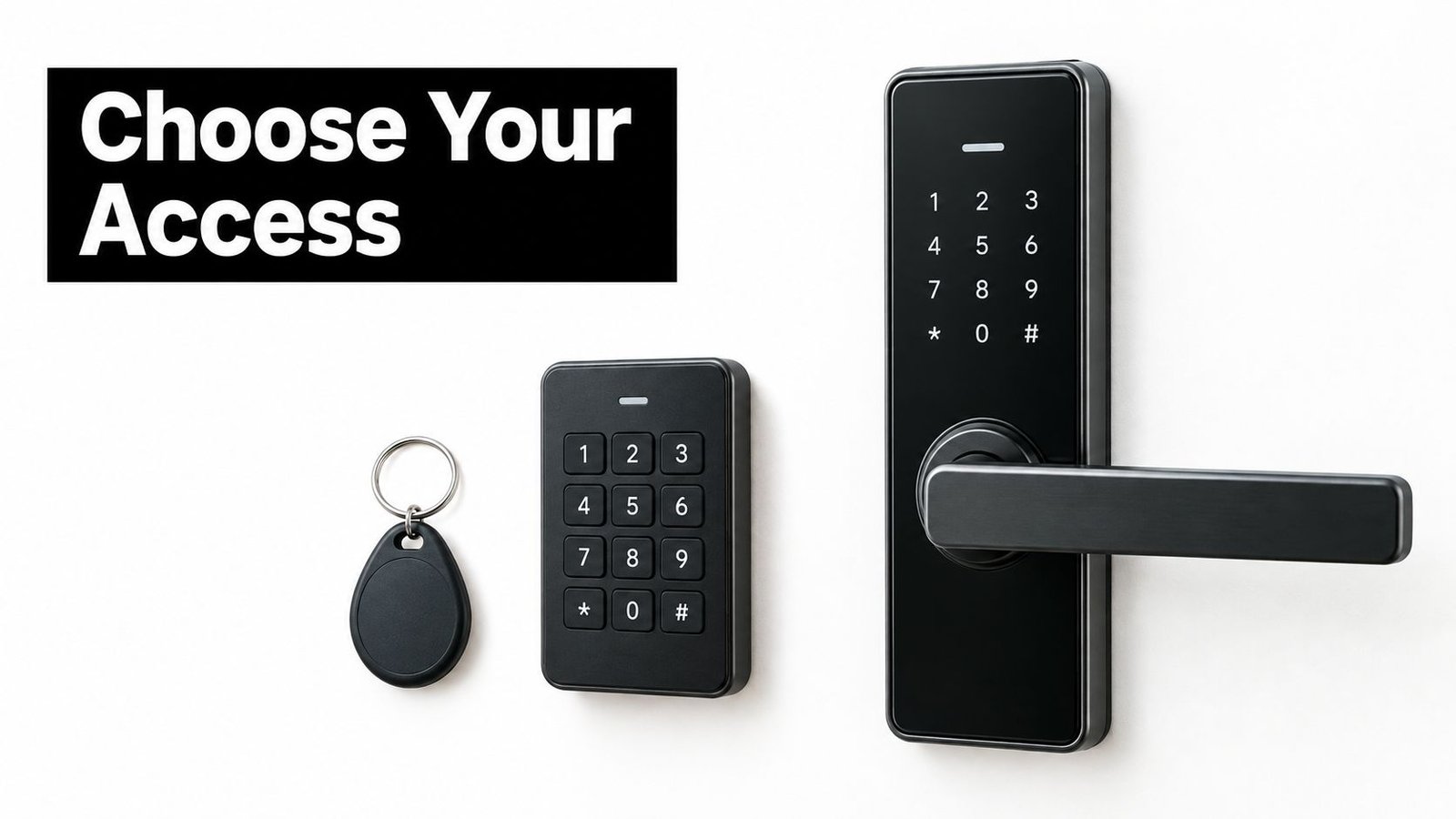
Choose the system around who needs access, how often permissions change and what the door must do during a fault. The four main options solve different problems.
| System | A good fit | Check before choosing |
|---|---|---|
| PIN keypad | A homeowner controlling a garage or side gate, or a small office that needs simple shared access. Codes can be changed when permissions change. | Shared codes are hard to audit. Use individual credentials if you need to know who entered. |
| Fob or card reader | Landlords, shops and small businesses managing staff, tenants or visitors. Networked systems can support individual credentials and entry records. | Plan for lost fobs, leavers and the process for issuing replacements. |
| App-driven smart lock | A homeowner who wants remote administration or temporary guest access. Some products can operate locally, while others depend on a network or cloud service. | Don't assume app access is a suitable replacement for compliant hardware on a communal or fire door. |
| Biometric reader | A controlled room or workplace where the access policy justifies using a personal characteristic as a credential. | Consider privacy, administration and a workable alternative for anyone who can't use the reader. |
These categories don't always mean four separate hardware types. A commercial reader may support cards and mobile credentials, while a domestic smart lock may combine an app, keypad and mechanical key. Decide first whether the property needs standalone control at one door or a managed system spanning multiple openings.
UK businesses increasingly use electronic access, often without replacing everything at once. The 2023 Wireless Access Control Report found 15% of surveyed businesses had no electronic system, down from 23% in 2021; 46% used traditional wired systems, 33% combined wired and wireless equipment, and 6% were fully wireless (2023 Wireless Access Control Report). That mix supports a practical approach: keep compatible infrastructure, then extend or replace it according to the site's needs.
For shared residential entrances, the decision also involves residents, managing agents and common-area rules. This guide to how keyless entry works for gated communities is useful for thinking through shared access policies. If a keypad is the likely fit, compare the management and door requirements with this overview of a keypad access-control system.
Pre-Installation Survey and Door Compatibility
A retrofit is only sensible if the door and lock mechanism can operate it reliably. A survey should settle that question before anyone orders hardware or promises a simple fit.
Check the opening, not just the cylinder
Record the door material, thickness, frame condition, handle clearance and lock type. Composite, uPVC, timber, aluminium and steel doors can each present different fixing and wiring challenges. A Euro-profile cylinder is common, but that alone doesn't prove compatibility: dimensions, cam alignment, cylinder position and space around the handle all matter.
Then check whether the door sits squarely in its frame and whether the latch moves freely. Friction makes motorised locks work harder, which can drain batteries and contribute to motor failure. A lock that works with the door open but binds when closed hasn't passed a meaningful fit test (UK smart-lock guidance on compatibility and egress).
Establish the door's safety role
Before selecting the reader or lock, classify the opening. Is it an escape route, a fire-compartment boundary, a security-controlled door, or more than one of these? The answer affects the permissible locking arrangement, release method and whether building or fire-safety requirements rule out a domestic retrofit.
On an escape route, occupants must be able to leave immediately without a key, code, fob or specialist knowledge. Communal doors and fire doors need particular care. Don't drill, alter or change shared or rented doors until the landlord, freeholder or managing agent has approved the proposal and the relevant responsible person has checked the fire strategy.
Take useful evidence to the survey
Before requesting a quote, take clear photographs of both sides of the door, the edge with the lock visible, the handles, the frame and the cylinder. Note the door material and thickness if known, any existing access or alarm equipment, and whether the door sticks or needs lifting to latch. For an apartment or business, include the shared entrance arrangement and who controls permission.
If the mechanism is multipoint, non-standard or worn, a full lock replacement may be the honest answer. Don't pay for a retrofit until the installer has confirmed that the cylinder, lock case and door alignment work together. Remedial carpentry or replacement hardware can change the job substantially, and a clear survey is how you find that out before installation day.
The Professional Installation Process Step by Step
On a good installation day, the engineer doesn't start by unpacking the reader. They check the survey against the actual door, confirm the escape arrangements and test the existing lock by hand. If the door binds, the team deals with the cause before installing electronics. Otherwise, the new equipment may appear to work while the underlying mechanical fault continues to drain batteries or prevent reliable latching.
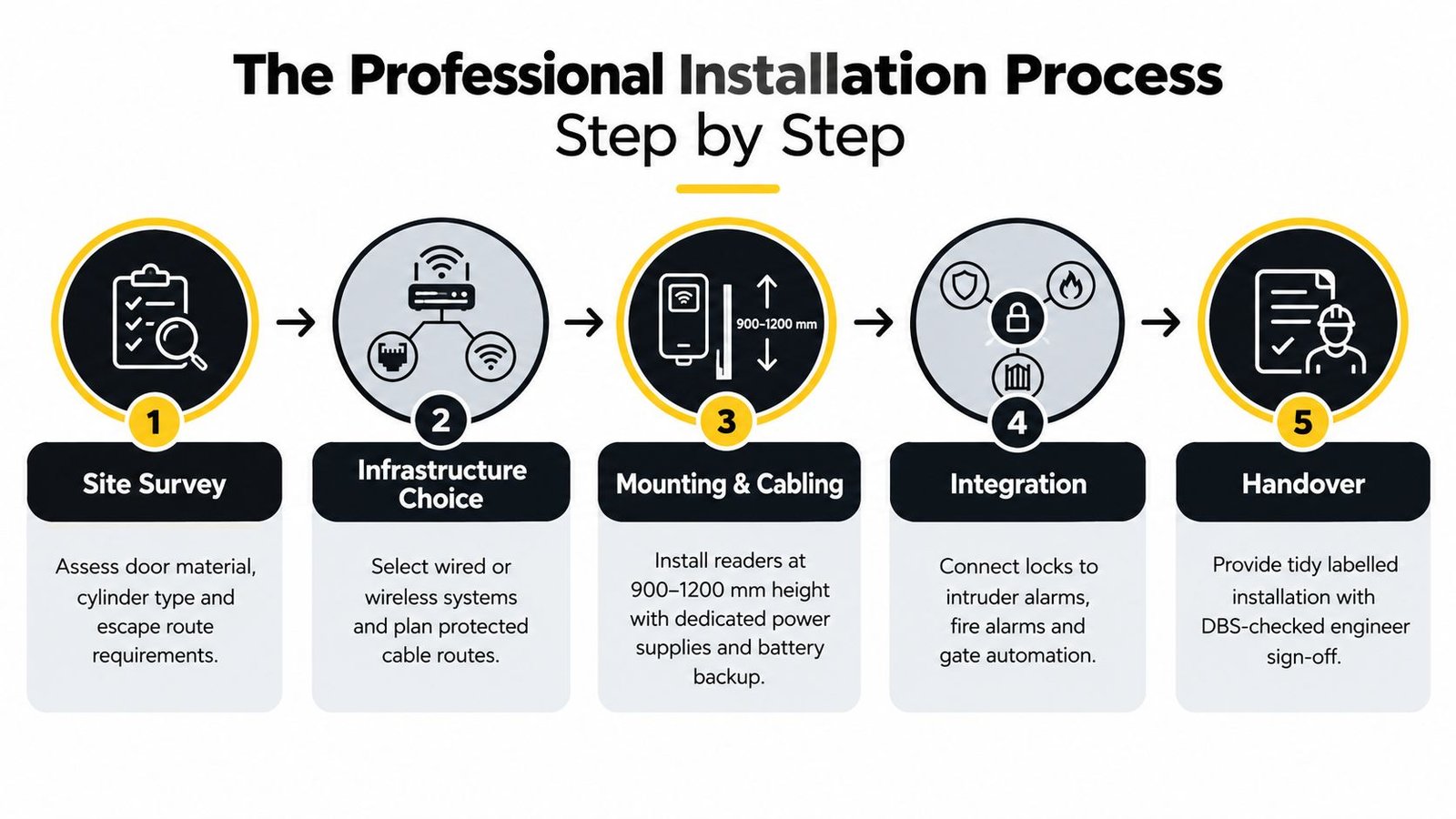
Next comes the infrastructure decision. A standalone wireless lock may suit a simple opening, but a multi-door site often needs planned power, protected cabling, network access and a central management system. Existing wired equipment can sometimes remain in service; a survey determines whether it's compatible rather than assuming that every reader and lock needs replacing.
Where accessibility and site conditions permit, UK institutional guidance places readers at approximately 900–1200 mm above finished floor level, with protected cabling and a dedicated power supply with battery backup. One institutional specification uses four hours of backup operation as its benchmark for access-control equipment and locks (UCL security-system specification). That's a useful design reference, not a substitute for deciding what your particular building needs during an outage.
Integration and handover
The installer should agree how access control interacts with the intruder alarm, fire alarm, intercom and gate automation. A release circuit that works only in normal conditions is incomplete. Cable routes need protection, connections need clear labelling, and the final arrangement should be documented so future maintenance doesn't depend on someone remembering what sits behind a ceiling tile.
A tidy handover includes the door and equipment identifiers, user-administration instructions, relevant configuration records and the results of commissioning tests. Ask who will administer credentials and who to call if the network, power supply or lock develops a fault. For work that includes replacing or altering a door, this overview of SuperiorPRO's door installation expertise can help explain why the door work itself deserves proper planning. A practical outline of what an access-control installation involves can also help you prepare questions for the contractor.
Typical UK Timelines and Realistic Costs
There isn't a reliable flat price for keyless entry system installation without knowing the door, wiring route, lock type and safety requirements. A straightforward residential door and a communal entrance with fire-alarm release are different projects, even if both end with a keypad on the wall. Any quote that treats them as interchangeable is leaving out important work.
A simple domestic fit may be completed in part of a day if the door is compatible, the hardware is in good order and the product needs little integration. A small shop or office may take longer where staff credentials, multiple openings, protected cabling or alarm connections need configuring. A multi-tenant entrance or a higher-security site may require staged work, coordination with building management and additional commissioning before it can be handed back.
Ask for a scoped quote, not a price for a box and a visit.
The proposal should separate the main cost areas so you can see what's included:
- Hardware: Reader, lock, control equipment, credentials and any compatible cylinder or door-hardware replacement.
- Installation labour: Survey, fitting, cable routing, door adjustment and setup.
- Integration: Fire-alarm release, intruder alarm, intercom, network or gate connections where required.
- Testing and records: Commissioning results, user guidance, configuration information and handover documentation.
- Ongoing support: Maintenance visits, fault response and administration help, if included.
The line items that catch buyers out are usually the ones no one surveyed properly: a fire-release interface, a dedicated power supply, a network connection, a cylinder upgrade or remedial door work. A job involving fire-alarm coordination can take substantially more planning and testing than a simple standalone lock. The right quote explains those dependencies rather than hiding them in an undefined allowance.
Compare like with like. Ask each installer to state what doors are included, what happens if the existing mechanism isn't compatible, which tests will be completed and whether fire or landlord approvals are the customer's responsibility. An unusually cheap price often means the survey, integration or handover has been stripped out, not that the same safe installation has somehow become cheaper.
Commissioning and Acceptance Tests That Prove an Install
Commissioning is where a working-looking system earns its handover. Don't accept “the fob opened it” as proof. The reader can authenticate correctly while a misaligned latch, faulty closer or incorrect lock wiring leaves the door insecure or unsafe.
The responsible installer should test and record the behaviour of the complete opening. That means checking normal entry, the internal single-action exit, mains failure and the intended fail-safe or fail-secure response. If the design includes a green emergency-release unit or fire-alarm interface, those must be operated and verified as part of the test, not assumed to work because the indicator light is on.
UK fire-safety guidance distinguishes between panic hardware for different settings. It specifies BS EN 1125 for public areas and BS EN 179 where users understand the building and escape operation. Electronic locking that forms part of an escape function should use equipment tested to BS EN 13637 and be interfaced with the fire-alarm strategy under BS 7273-4 (UK fire-safety guidance for shared residential buildings). A keypad or break-glass unit doesn't replace compliant escape hardware.
Test the door and its failure modes
A complete acceptance check should cover:
- Entry and exit: Test every credential type, then confirm the internal exit works as intended.
- Power failure: Isolate mains power and confirm the specified lock behaviour; check battery-failure indication.
- Emergency release: Operate the release unit and trigger the fire alarm, confirming the correct doors release.
- Mechanical operation: Observe closing, latch engagement and re-locking. Check that the latch doesn't bind.
- Monitoring: Test door-held-open, forced-door and request-to-exit monitoring.
- System rules: Verify configured time zones, anti-passback and network-loss behaviour.
Record results against the door identification, correct failures and repeat the failed tests. The right acceptance benchmark is 100% pass completion for every life-safety and power-loss test before handover. Partial success isn't a safe reason to sign off.
The video below is a visual reference, but it shouldn't replace a site-specific test plan or the checks required by the building's fire strategy.
Choosing a Trusted Local UK Installer
A glossy product brochure tells you nothing about an installer. The survey and the commissioning do. Pick someone who can explain how the lock, the door, the access policy and the fire strategy fit together, and who will still answer the phone when a credential needs changing or a door starts sticking.
Ask who designs the system, who carries out the work and what evidence you receive at handover. Check the company is insured, the engineers are vetted, and the accreditations and manufacturer relationships can be confirmed. SafeContractor accreditation, NSI approval where applicable, and installer-partner status for the equipment on the quote are all worth verifying. Wisenet Security Ltd serves South Wales and the South West with access-control installation and maintenance, covering keypad, card, fob and biometric options; judge them against the same checks as any other firm.
Questions that expose a weak proposal
Get the installer to show you the proposed equipment and answer these:
- Door suitability: What did the survey find about the lock case, cylinder, alignment and escape function?
- Release design: How does the door behave on fire alarm, mains failure and network loss?
- Credential control: Who can add and remove users, and how are leavers handled?
- Proof of completion: Which tests get recorded, and what documents and training come with handover?
- Maintenance: Who checks batteries, firmware, door alignment and release interfaces?
A quote produced without a site visit is a warning sign. So is a proposal that says nothing about fire release, offline access or what happens when a door fails to latch. For gated sites, weigh the access-control design against the communications method too; this guide on how to choose the best cellular gate opener is a useful reference when planning remote gate access. It also pays to review what to ask access-control installers before agreeing any work.
Keep the system safe after handover
Treat access control as a maintained building system. The work does not end at handover. Set a routine covering door alignment, battery condition, firmware, user permissions and the operation of any fire-alarm interface. Remove former staff or tenants promptly, expire guest codes when they are no longer needed and record who administers the system.
Connected-device security needs the same attention as the physical lock. A UK consumer study covering 2025–2026 found 32% were concerned about hacking or security risks, 32% were unsure how to install or operate smart products, and 35% felt overwhelmed by choice. Separate UK research found 20% invested in protection covering all connected home devices, while a further 32% expressed interest (UK consumer research on smart-home concerns). Set strong administrator access, enable two-factor authentication where available, install firmware updates and keep audit logs. A connected lock can be perfectly sound; its security depends on how it is configured and managed.
Write down the fallback plan. Keep a mechanical override where the hardware supports one, record who holds administrator credentials, and spell out what users should do if the app, broadband, Wi-Fi, cloud service or battery fails. For a business or rental property, maintain a current authorisation register and a clear process for issuing and removing credentials.
When a lock disengages intermittently or drains batteries, check alignment and friction before repeatedly swapping batteries. If access fails after a network outage, use the agreed local or mechanical fallback and have the installer investigate the system's offline behaviour. If the fire release fails, stop relying on the electronic access function and arrange prompt repair and re-testing. For a complete system design, installation, testing and maintenance plan, contact Wisenet Security Ltd for a consultation about your home, workplace or shared entrance.
Wisenet Security Ltd installs and maintains access-control systems for homes, businesses and shared buildings across South Wales and the South West, with options including keypad, fob, card and biometric entry. Visit Wisenet Security Ltd to arrange a consultation and have your door, escape requirements and failure plan assessed before you buy hardware.