Gate Automation System Guide for UK Homes and Business
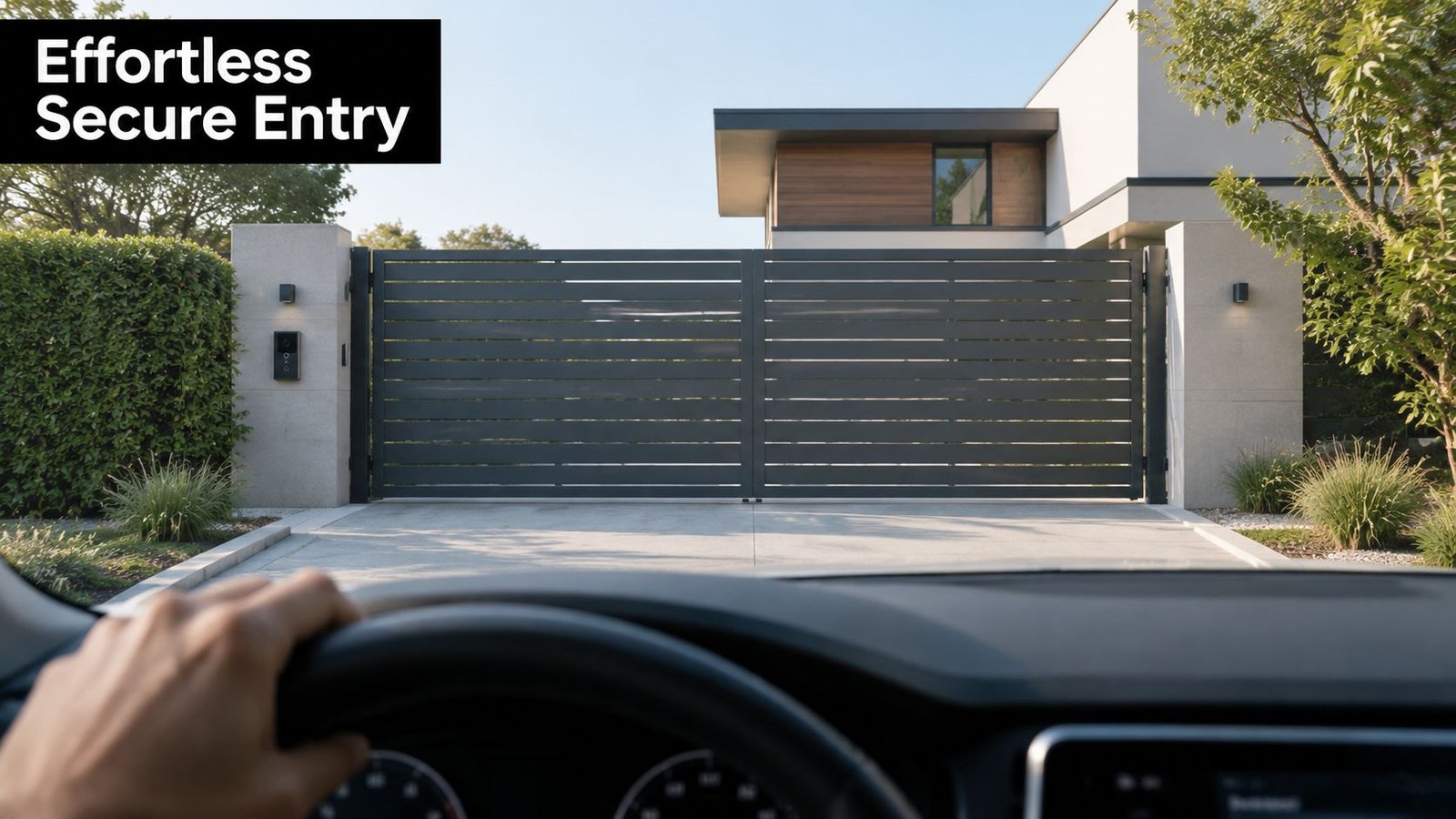
You arrive home after a wet evening, press a button from behind the steering wheel, and watch the driveway gate open without leaving the car. That small convenience becomes much more valuable when you're carrying shopping, managing children or pets, or arriving at a business site with a vehicle that needs controlled access.
A gate automation system turns a manually operated gate into managed machinery. The gate still provides the physical barrier, but motors, controls and safety devices decide when it moves and how it responds to people, vehicles and obstructions. For homes, warehouses, offices, retail premises and managed car parks across South Wales and the South West, that means access can become easier without treating safety as an afterthought.
This guide is for first-time buyers who want to understand what they're paying for. It covers how automation works, which gate style suits different sites, the components inside a dependable installation, and the UK duties that continue after the installer leaves. The central point is simple: an automated gate isn't just a motor-and-fob purchase. It's a safety-engineered product that needs appropriate design, documentation, testing and maintenance.
Table of Contents
- Introduction to Gate Automation for Modern Properties
- How a Gate Automation System Actually Works
- Choosing Between Swing Sliding Underground and Barrier Gates
- Key Components That Make Up a Reliable System
- Safety Standards Planning Permission and Legal Duties in the UK
- Costs Integration and Maintenance Planning With Real Examples
- Next Steps to Secure Your Property With Wisenet Security Ltd
Introduction to Gate Automation for Modern Properties
A gate is best understood as an outdoor doorway for vehicles and pedestrians. A door has hinges or tracks, a lock, a handle and safety considerations. An automated gate has the same broad responsibilities, but it also needs an operator, control electronics and protective devices because its movement is powered rather than supplied by your arm.
For a homeowner in Cardiff, a remote control may be enough for everyday driveway access. A small business in Bristol might need a keypad for staff, an intercom for visitors and a way to connect the entrance with CCTV. A Newport warehouse or a managed residential block may need user permissions, vehicle flow management and maintenance records. The right specification depends on who uses the entrance, how the gate is positioned and what could happen if movement continues when someone or something is in its path.
Automated access is now established across UK infrastructure. Government-linked border automation records show that ePassport gates were introduced at UK airports in 2008, had been used by over 260 million passengers by July 2020, and processed 51.9 million transactions in 2018. The report also records a 376% increase from the prior period cited. These airport systems aren't the same as residential or commercial perimeter gates, but they demonstrate how automated gate technology has become part of everyday UK operations. (UK gate automation market evidence)
What this guide helps you decide
Before requesting a quotation, you should be able to answer several practical questions:
- Gate type: Does your site suit swing leaves, a sliding panel, an underground operator or a rising barrier?
- Access method: Will users enter with remotes, keypads, cards, intercoms or an app?
- Safety design: How will the system detect a person, vehicle or object?
- Legal responsibility: Who will arrange inspections, repairs and record-keeping after installation?
- Future integration: Could the gate work with CCTV, alarms or wider access control later?
That last point is often missed. A gate that opens reliably on installation day can still become unsafe if hinges wear, tracks shift, sensors are damaged or testing records disappear. Treating the system as machinery from the outset makes the buying decision clearer and helps protect everyone who uses the property.
How a Gate Automation System Actually Works
The easiest way to understand automation is to follow one complete opening cycle. Think of an automatic supermarket door. A sensor detects a customer, a controller decides whether movement should begin, a motor drives the mechanism, and safety inputs can interrupt the movement if somebody enters the danger area.
A gate follows the same logic, although its movement may be a swing arc or a sliding travel path.
The five-part operating loop
Detection: A remote, keypad, card reader, intercom or other access device sends a request. The device identifies a user's intention to enter, but it doesn't physically move the gate.
Decision: The control board receives the signal and checks programmed conditions. It also checks safety inputs, such as whether a photocell beam is interrupted or whether a safety edge has been activated.
Drive: If the command is permitted and the safety circuit is clear, the control board sends power to the operator. The operator converts electrical energy into movement through gears, an arm, a ram or a drive wheel.
Movement: The gate opens or closes along its track or through its swing arc. Limit settings tell the controller where the travel should stop, while the mechanical structure keeps the movement aligned.
Safety feedback: Sensors continue monitoring during travel. If the system detects an obstruction, it should stop or reverse according to its design and risk assessment.
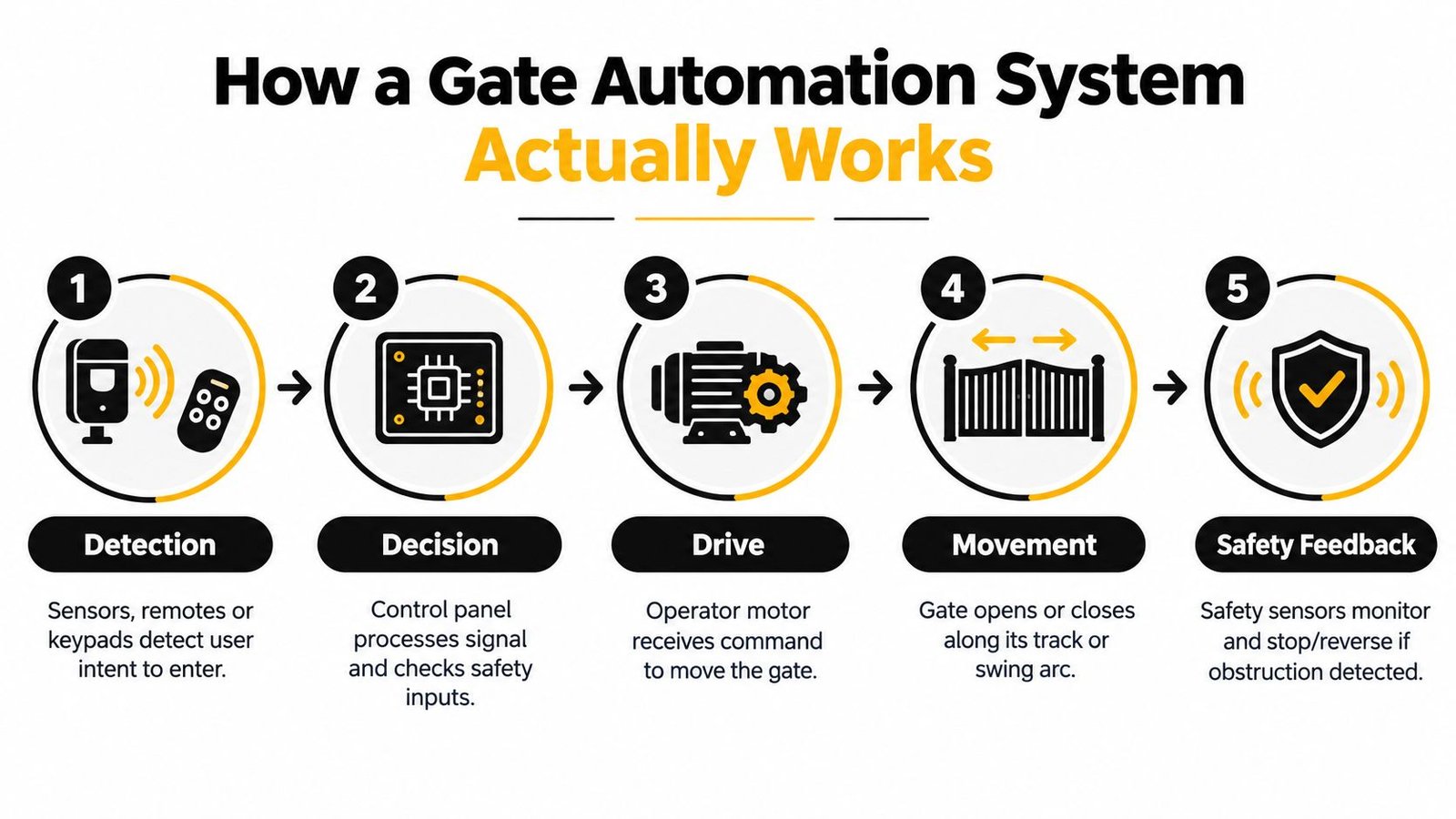
The motor isn't the system's brain. It's the muscle. The control panel coordinates the request, movement and protective inputs, while the gate itself must be mechanically suitable. A stiff hinge, damaged roller or poorly aligned track can force the operator to work harder, so a powerful motor can't compensate for a badly prepared gate.
Practical rule: The installer should assess the gate, posts, hinges, rollers, track, travel area and surrounding hazards before choosing the operator.
You'll find a useful overview of how motorised entry can sit alongside wider gate access control systems when a basic remote no longer meets the site's needs.
The following video provides a visual introduction to the operating principle. Watch it after considering the five stages above, because the terms will make more sense when you can connect them to detection, decision, drive, movement and feedback.
Choosing Between Swing Sliding Underground and Barrier Gates
The best gate mechanism is determined by the site, not by appearance alone. A swing gate needs room to move through its arc. A sliding gate needs a clear run beside the entrance. An underground operator can preserve a clean visual appearance, but installation may involve more work below the gate. A barrier controls vehicles efficiently, but it doesn't provide the same solid visual or physical closure as a full gate.
| Gate Type | Space Needed | Best For | Key Consideration |
|---|---|---|---|
| Swing | Clear space through the opening arc | Homes, rural entrances and wide driveways | Check inward or outward clearance, hinge condition and wind exposure |
| Sliding | A free run beside the entrance | Sloping drives, compact forecourts and commercial sites | Allow room for the gate to travel and keep the track clear |
| Underground | Space for concealed operator chambers below the gate | Heritage settings and properties where appearance matters | Drainage, foundation work and access for future maintenance need careful planning |
| Barrier | Vehicle lane space and a protected arm movement area | Retail car parks, offices, warehouses and controlled traffic routes | Select equipment for the site's traffic pattern and ensure pedestrian hazards are addressed |
Swing gates
Swing gates suit a driveway with sufficient depth and a stable pair of posts. They can be automated with articulated arms or linear operators, depending on the leaf design and hinge position. A narrow approach, a busy public footpath or a steep slope may make the opening arc unsuitable.
The installer should also consider wind loading and the gate's physical condition. A decorative metal gate may look light but still create considerable resistance if it has a large surface area.
Sliding gates
Sliding gates are often practical where there isn't enough depth for a swing arc. They can run along a boundary, which makes them useful for some sloping or compact approaches. Their success depends on a sound track, suitable rollers and enough side clearance for the full gate travel.
Leaves, stones, ice and vehicle debris can interfere with the track. The layout should therefore include access for cleaning and servicing rather than hiding the working parts where nobody can reach them.
Underground operators and barriers
Underground automation keeps the operator out of sight and can suit a carefully finished entrance, particularly where visible surface equipment would affect the design. The installer must plan drainage and future access because water management and maintenance become part of the mechanism's long-term reliability.
Barriers are more appropriate where the main task is controlling vehicle flow rather than enclosing a boundary. A retail car park may use one for managed entry, while a warehouse may need it to coordinate deliveries. In either case, the barrier should be treated as powered machinery, with suitable detection and a clear separation between vehicles and pedestrians.
Key Components That Make Up a Reliable System
A dependable installation has several parts working as one system. The operator moves the gate, but it can't make a safe decision by itself. The control panel, power supply, access device and protective sensors must communicate correctly, and the mechanical gate must be capable of moving smoothly.
The signal starts at the user
The access device creates the request. That might be a fob used by a household, a keypad used by staff, a card reader at a commercial entrance, or an intercom that lets an occupant speak to a visitor before releasing the gate.
Remote access can be convenient, but it should be specified around the site's actual users. A block of flats may need managed permissions and an audit trail. A private driveway may favour simple remotes. A business might combine a keypad with video verification so staff can identify visitors before opening.
The control panel coordinates everything
The control panel is the system's decision centre. It receives the access command, checks safety circuits, powers the operator and applies settings such as travel limits and automatic closing. Poor configuration can cause nuisance stops, incomplete opening or unsafe movement, even when the hardware itself is suitable.
The operator and motor provide the force. Swing gates may use rams or articulated arms, while sliding gates generally use a motor and drive wheel connected to a toothed rack. The installer needs to match the equipment to gate size, weight, structure and expected use rather than relying on a generic kit.
You can compare the practical role of automatic gate motors for sale with the wider system requirements before choosing equipment.
Safety and resilience complete the installation
Photocells detect a person or vehicle crossing a protected line. Safety edges respond to contact at vulnerable gate edges, while force limitation reduces the energy applied during movement. These devices don't replace one another. They protect different parts of the risk area.
The power supply needs weather-appropriate wiring and suitable protection. Battery backup may keep an entrance available during a mains failure, but it should be selected around the gate's design and the site's emergency requirements.
A reliable specification should identify:
- Operator and transmission: The motor, gearbox, rack, arm or underground drive that moves the gate.
- Safety inputs: Photocells, sensitive edges and other detection devices connected to the control logic.
- Access controls: Remotes, keypads, readers, intercoms or app-based commands.
- Documentation: Test results, conformity documents, user instructions and maintenance information.
- Integration points: Connections for CCTV, alarms or a broader access control platform where required.
Safety Standards Planning Permission and Legal Duties in the UK
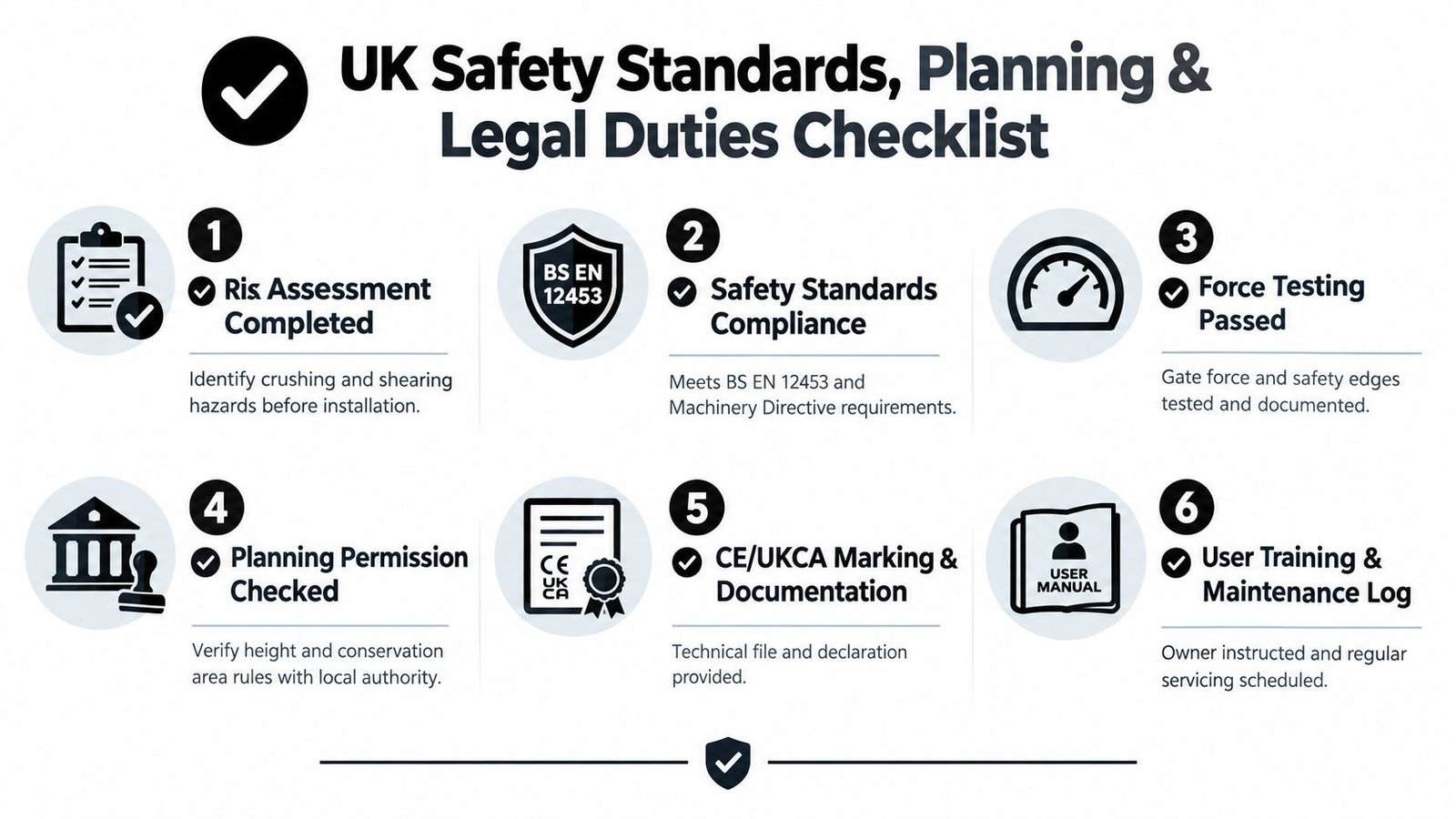
A powered gate may look like a driveway feature, but its motor, controls and moving panels make it regulated machinery. That changes the buying decision. The owner and installer must consider foreseeable trapping, crushing, shearing and impact risks, then keep the equipment safe throughout its working life.
Powered gates moved from a convenience-led installation category towards formal safety engineering after fatal incidents in the 2000s and early 2010s. EN 12453:2013 marked an important stage by tightening requirements for motorised gates and barriers. Earlier milestones included CE marking requirements under the Supply of Machinery (Safety) Regulations from 1 January 1995, while EN 13241-1 became available for CE marking from 1 May 2004. The UK gate safety history and legislation provides that background.
The practical reference today is BS EN 12453, although HSE explains that the standard does not set minimum safety integrity and reliability requirements for every situation. A compliant installation therefore needs more than a certificate or one sensor. The installer must combine force limitation, presence detection and controls suited to the site, as set out in HSE powered-gate safety guidance.
What the safety controls need to achieve
HSE identifies commonly applied force-limitation ceilings of about 400 N for crushing and shearing hazards and 1400 N for impact hazards. These values guide testing, rather than replacing it. A technician must test the completed gate in its actual environment and identify places where someone could be trapped or struck.
For automatic gates used by members of the public or untrained users, HSE recommends at least two safeguarding measures:
- Force limitation: Sensitive protective equipment, or another suitable method, limits the force applied by the moving gate.
- Presence detection: A device detects a person or obstacle on the floor at one side of the gate, allowing movement to stop or reverse before entrapment.
Force limitation alone may leave a person caught in a closing gap. The right combination depends on the gate design, the surrounding area and foreseeable user behaviour. Photocells, safety edges and control settings must work together, like several layers of protection rather than one answer.
Planning and documentation
Planning permission is not automatically required for every automated gate. The answer can depend on the physical gate, its height, its position, its relationship with a highway and any conservation-area restrictions. Ask the local planning authority before work begins, especially where the entrance is near a road or forms part of a listed or historically sensitive setting. This guide to deck building regulations explained offers a wider explanation of how property alterations can raise planning questions.
The installer should supply conformity documentation, operating instructions and records of completed safety tests. Current UK guidance from HSE and Gate Safe highlights CE or UKCA marking, declarations of conformity, photocells, safety edges and force limitation. The Gate Safe guidance for architects sets out relevant design considerations.
Who maintains the gate?
For gates at workplaces, car parks or managed premises, responsibility may involve landlords, managing agents, employers and site operators. HSE links powered-gate duties to the Supply of Machinery (Safety) Regulations 2008, the Health and Safety at Work etc Act 1974 and the Workplace (Health, Safety and Welfare) Regulations 1992. Its HSE powered-door and gate standards guidance explains the standards position.
The responsible person should arrange maintenance, keep safety information available and retain inspection and repair records. HSE guidance highlights six-month safety checks as a practical maintenance expectation. A modification, vehicle impact or change in use should prompt further assessment and testing, rather than waiting for the next scheduled visit.
Costs Integration and Maintenance Planning With Real Examples
The purchase price is only one part of a gate automation project. The final scope depends on the gate's condition, the operator type, electrical supply, groundworks, drainage, access devices, safety equipment and the amount of integration required.
A straightforward residential driveway may need a suitable motor, control panel, photocells, remotes and protected power. A commercial site may also require a reader, intercom, loop detection, CCTV linkage, user management and a documented maintenance arrangement. If the existing gate is heavy, misaligned or corroded, repairing or replacing the structure may be more sensible than attaching a new operator to it.
Three different site decisions
Cardiff residential driveway: The survey should confirm whether a swing or sliding arrangement fits the available space, whether the posts and hinges are sound, and where photocells can protect the approach. The owner may choose remote controls and an intercom for visitors, with a battery arrangement considered if reliable access during a power cut matters.
Bristol retail car park: Vehicle flow becomes the main design question. A barrier or sliding gate may need to work with access control, CCTV and a payment or visitor process, while pedestrian routes need to remain clear. The specification should also consider how staff will release the entrance safely if a sensor, reader or network connection fails.
Newport warehouse barrier: Delivery vehicles, shift changes and restricted areas create different access needs. A keypad, card reader or managed user list can control authorisation, while CCTV provides visual context around events. The maintenance file should identify the responsible manager, inspection dates, faults, repairs and any changes to the control settings.
Think in total ownership
Ask for a written survey and quotation that separates equipment, preparation, installation, testing, documentation and aftercare. A low equipment price can become poor value if it excludes drainage, cabling, foundations, safety testing or future servicing.
A useful maintenance record should include:
- Inspection date: Record when the gate and safety devices were checked.
- Test outcome: Note force testing, photocell operation, edge response and emergency release checks.
- Fault history: Describe failures, impact damage, unusual noise or intermittent access.
- Repair details: Record parts replaced and adjustments made.
- Change control: Document modifications to the gate, access users, software or surrounding layout.
Owners who need help identifying a fault can use this electric gate troubleshooting guide before calling for service, but recurring safety faults should be assessed by a competent technician rather than repeatedly reset.
Integration should be planned before installation. CCTV can help verify visitors and investigate incidents, intruder alarms can support perimeter protection, and video intercoms can give occupants a clear conversation before release. Wisenet Security Ltd designs, installs and maintains gate automation alongside CCTV, alarms, access control and intercoms for properties across South Wales and the South West, with DBS-checked engineers and SafeContractor accreditation. That provides one route for owners who want the gate and wider security equipment considered together.
Next Steps to Secure Your Property With Wisenet Security Ltd
Start with the entrance rather than the motor catalogue. Identify the gate's movement, available space, users, vehicle pattern, foreseeable hazards and desired access methods. Then ask the installer to explain the safety devices, force testing, conformity documentation and maintenance arrangements in plain English.
For a home in Swansea, the priority may be dependable remote access and safe operation around children and pets. A Cardiff business may need an intercom and CCTV connection. A Bristol landlord or Newport property manager should also establish who holds the maintenance records and who will arrange the required checks.
A professional survey should leave you with a clear decision on:
- Mechanism: Swing, sliding, underground or barrier.
- Controls: Remotes, keypad, reader, intercom or managed access.
- Protection: Force limitation, presence detection and site-specific safeguards.
- Aftercare: Maintenance visits, fault response, testing and record storage.
- Integration: CCTV, alarms and access control connections.
The system should be designed as regulated machinery, not installed as an isolated DIY accessory. A free consultation can help you assess the existing gate, understand the preparation required and plan compliant ongoing care before committing to equipment.
Wisenet Security Ltd provides site surveys, gate automation installation, safety testing, access control integration and planned maintenance for homes, businesses and managed properties across South Wales and the South West. Visit Wisenet Security Ltd to discuss your entrance, existing CCTV or access control, and arrange a practical consultation.