Analogue vs Digital Addressable Fire Alarm System Guide
Stop buying addressable panels because someone told you conventional is obsolete. It isn't. For a small, compartmented building where staff can walk to any detector in seconds, a conventional zone system is a competent answer. For a large, complex or sleeping risk building, it's too slow. The analogue vs digital addressable fire alarm system decision isn't about old versus new. It's about how quickly your people can find the source.
Table of Contents
- Analogue vs Digital Addressable Fire Alarm System at a Glance
- How Zone Circuits and Addressable Loops Report an Event
- Start with the BS 5839 Category Not the Panel Label
- False Alarms and the Costs That Outlast the Panel
- Maintenance Monitoring and Building Interfaces After Handover
- Premises Where Each Architecture Earns Its Place
- Commission the Right System in South Wales and the South West
Analogue vs Digital Addressable Fire Alarm System at a Glance
First, correct the label that causes most bad specifications. In UK practice, a conventional analogue system tells you which zone circuit is in alarm or fault. A digital addressable system tells you which individual device operated, where it is, and what condition it reported. Newer is not automatically required. The table shows where that distinction changes a purchase.
| Criterion | Conventional analogue | Digital addressable |
|---|---|---|
| What the panel shows | The zone circuit in alarm or fault | The individual device and its text label |
| Wiring | Radial zone circuits | Data-communication loops |
| Zone limits | Generally one storey above 300 m² and up to 2,000 m² | Same zoning principles, with scope for a longer search |
| Search after activation | Kept below 60 m inside the zone | Named device, so the search area shrinks |
| Diagnostics | Open circuit, short or contamination affects the whole zone | Alarm, fault, contamination or abnormal reading per device |
| Cause and effect | Outputs usually follow a zone | Selective device and interface control |
| Sleeping risk | Practical for small, simple sites with no assessed reliance on staff | Preferred where sleepers rely on staff to find and assist them |
| Typical premises | Small compartmented buildings | Warehouses, multi-tenant buildings, schools, care and complex offices |
What the Panel Actually Tells Responders
That's the row that matters operationally. According to London Fire Brigade guidance on fire alarms in managed property, conventional systems identify an alarm or fault only by zone, whereas addressable systems communicate individually with each detector, manual call point and other loop device. A conventional panel might say Zone 3, first floor east. An addressable panel can say the specific device and its programmed text, for example a named detector in a named room or aisle.
Don't treat that as a luxury. If Zone 3 covers several rooms, a corridor and a void, your staff still have a search to complete before they can confirm a fire, call it in accurately or decide it's a false activation. If the panel names the device, the search largely disappears. They go to a point.
Addressability does not itself choose life protection or property protection. It changes how an event is located and reported.
Wiring, Zoning and Search Distance
Conventional detectors sit on radial zone circuits. Addressable devices sit on data-communication loops that exchange information with individually identified devices. That sounds technical, but the buying implication is simple. On a large floor, one cable run per conventional zone multiplies quickly. A loop can carry many devices around the building and back to the panel.
Zoning discipline applies either way. A conventional zone can cover up to 2,000 m², with the search distance kept below 60 m, under the guidance cited above. Above 300 m², a detection zone is generally limited to one storey. A suitable addressable system can allow a longer search because responders aren't searching blind, they're walking to a named device.
Diagnostics follow the same split. A conventional fault usually implicates the whole zone. An addressable panel can report alarm, fault, contamination or an abnormal reading device by device, which is why engineers find problems faster on loop systems.
Cause and Effect and Sleeping Risk
Conventional outputs usually follow a zone, so a door release, sounder pattern or plant shutdown triggered from that zone affects everything grouped with it. Addressable cause and effect can be selective. One device, one group of devices or one interface can drive a specific response without evacuating or shutting down the wrong area.
Sleeping risk sharpens the choice. If residents, patients or guests need staff to find them and assist them, staff cannot afford to hunt through a zone first. They need the room, not the wing. That's where addressable reporting earns its cost.
Mark the two rows in the table that match your floor plate and your evacuation plan. If they're search after activation and sleeping risk, you're probably looking at addressable. If they're panel cost and simple compartments, conventional deserves a fair price comparison. Treat everything that follows as a test of that shortlist.
How Zone Circuits and Addressable Loops Report an Event
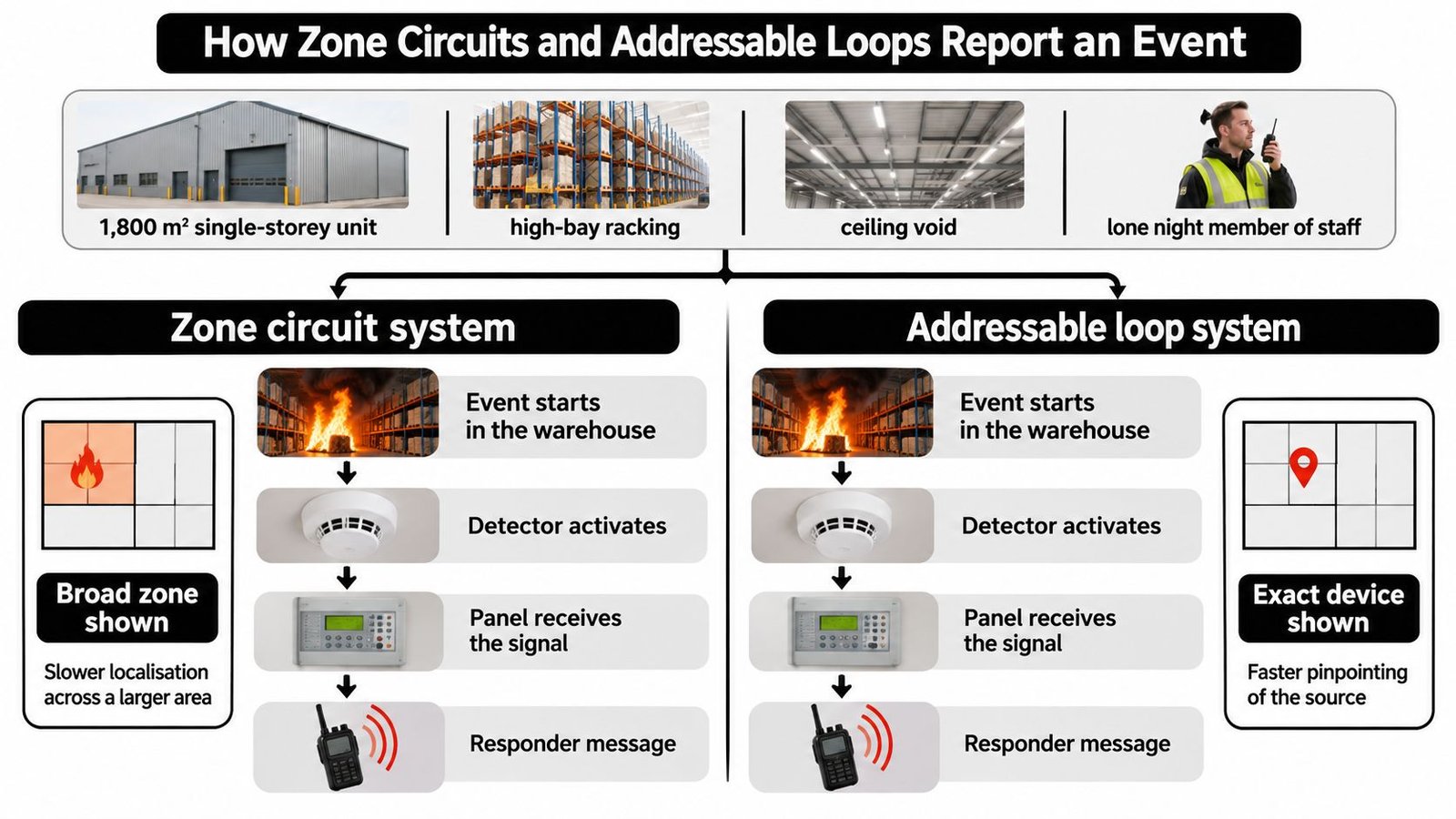
Take one building and run the same fire through both architectures. Say it's a 1,800 m² single-storey unit with high-bay racking, a ceiling void above the offices and one lone member of staff on nights. Smoke reaches a detector somewhere in the racking.
The two paths below show what that staff member learns at the panel, and what they still don't know.
The Conventional Walk
The panel shows the racking zone in alarm. That's all. The detector could be at the front of the unit, at the back, or in the void if the void shares the zone. Your night worker walks the aisles looking for smoke, a glowing detector LED or someone at a call point, working within that 60 m search principle.
Racking slows everything. Sight lines are blocked, aisles channel smoke away from its source, and a lone responder can't be at the panel and in the aisle at once. Time from panel indication to confirmed source stretches, and that's the time that decides whether you get an early, accurate call to the fire service or a vague one.
The Addressable Walk
The panel shows a named device, something like racking aisle 4 head 12. The worker walks straight to aisle 4. If there's no fire there, they can report that specific device as the suspect instead of condemning a whole zone, and firefighters arriving on site get a point location rather than a floor area.
That difference depends on paperwork as much as electronics. Device text is only useful if it matches the building as fitted, which is why accurate fire zone plans and device location records sit next to the panel and get updated when layouts change. A label that says aisle 4 after you've re-racked the unit is worse than no label.
The Fault Case Tells the Same Story
- Open or short circuit on a conventional zone: The panel reports a zone fault, and an engineer isolates and tests along the circuit to find it.
- Contaminated detector on an addressable loop: The panel names the device reporting contamination or an abnormal analogue reading, so the engineer brings the right replacement to the right ceiling tile.
- Detector removed or call point operated: Conventional narrows it to the circuit, addressable narrows it to the device.
Keep detector physics out of this argument. Smoke sensing isn't automatically better because the panel is digital. A detector still has to be the right type for the room it protects, and a badly chosen detector misbehaves on either architecture.
Before you accept a design, ask for evidence. For a conventional proposal, demand the zone map and walk the search distances yourself. For an addressable proposal, demand a printed device list and the cause-and-effect matrix. If a designer can't produce either, you're buying a panel, not a system.
Start with the BS 5839 Category Not the Panel Label
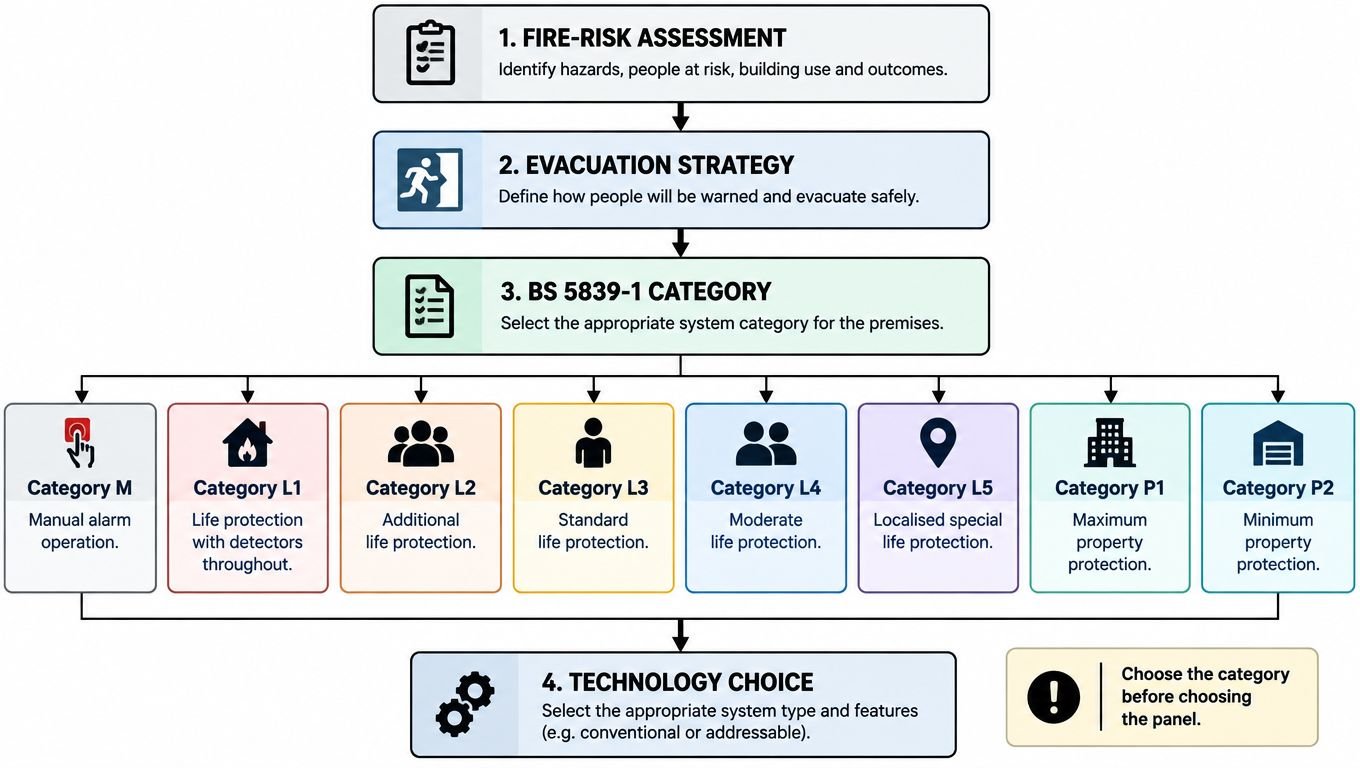
A panel label does not tell you whether a fire alarm system is right for the building. Specify the fire-risk assessment, evacuation strategy and BS 5839-1 category first, then choose the technology that can deliver the required coverage and functions.
The Eight Categories in Plain Language
Historic England guidance on fire alarm design and installation summarises the eight system categories: manual Category M, life-protection categories L1 to L5, and property-protection categories P1 to P2. Their purposes differ:
- Category M: Manual call points only, with no automatic detection.
- L1 to L5: Life protection, ranging from detection throughout the building to detection in areas covering a defined local risk.
- P1 and P2: Property protection, covering the whole building or specified areas.
The category defines the purpose and extent of detection. Analogue and addressable describe how devices communicate with the panel and how an event is reported. Either technology can deliver a given category in many buildings. Addressability does not change the category or compensate for missing detection where the design requires it.
Neither Technology Is Banned
BS 5839-1:2017 was withdrawn when BS 5839-1:2025 came into effect on 30 April 2025, according to the BSI preview of BS 5839-1:2025. The current edition covers zones with non-addressable detectors and zones with addressable automatic detectors. Both remain recognised options. A conventional system is not automatically unsuitable; the decision depends on the building's required category and how precisely staff need to locate an event.
The briefing below provides background before you discuss the category with a designer.
When the Category Pushes You to Addressable
Addressable equipment earns its cost when the building needs device-level reporting or selective control. Phased evacuation can require different areas to respond at different times, based on the event location. Interfaces with smoke control, automatic door releases, fuel shut-off valves and lift-related safety functions can also favour addressable systems, where the design depends on device-level logic. Multiple occupancies sharing a panel, or premises that are frequently extended or reconfigured, may benefit from addressable loops.
A small Category M site is the opposite case. Addressable equipment can add cost and programming complexity without changing the required coverage. When someone operates a manual call point, the alarm's category does not improve because the panel identifies the device precisely. Choose a cheaper zone panel if it meets the required category and staff can search the indicated zone effectively.
Before extending or replacing an existing system piecemeal, check it against the BS 5839-1 category the building requires. Do not assume that an extension is either straightforward or prohibited.
Ask the designer: Which category does the risk assessment require, and how does the proposed technology meet it? If the answer is only a panel brochure, ask for a design that addresses the building's coverage and operational needs.
False Alarms and the Costs That Outlast the Panel
Now for the sales claim you should reject outright. Digital addressable equipment does not solve nuisance alarms. If a salesperson promises that a panel swap ends your false alarm problem, end the meeting.
The scale of the problem has little to do with panel intelligence.
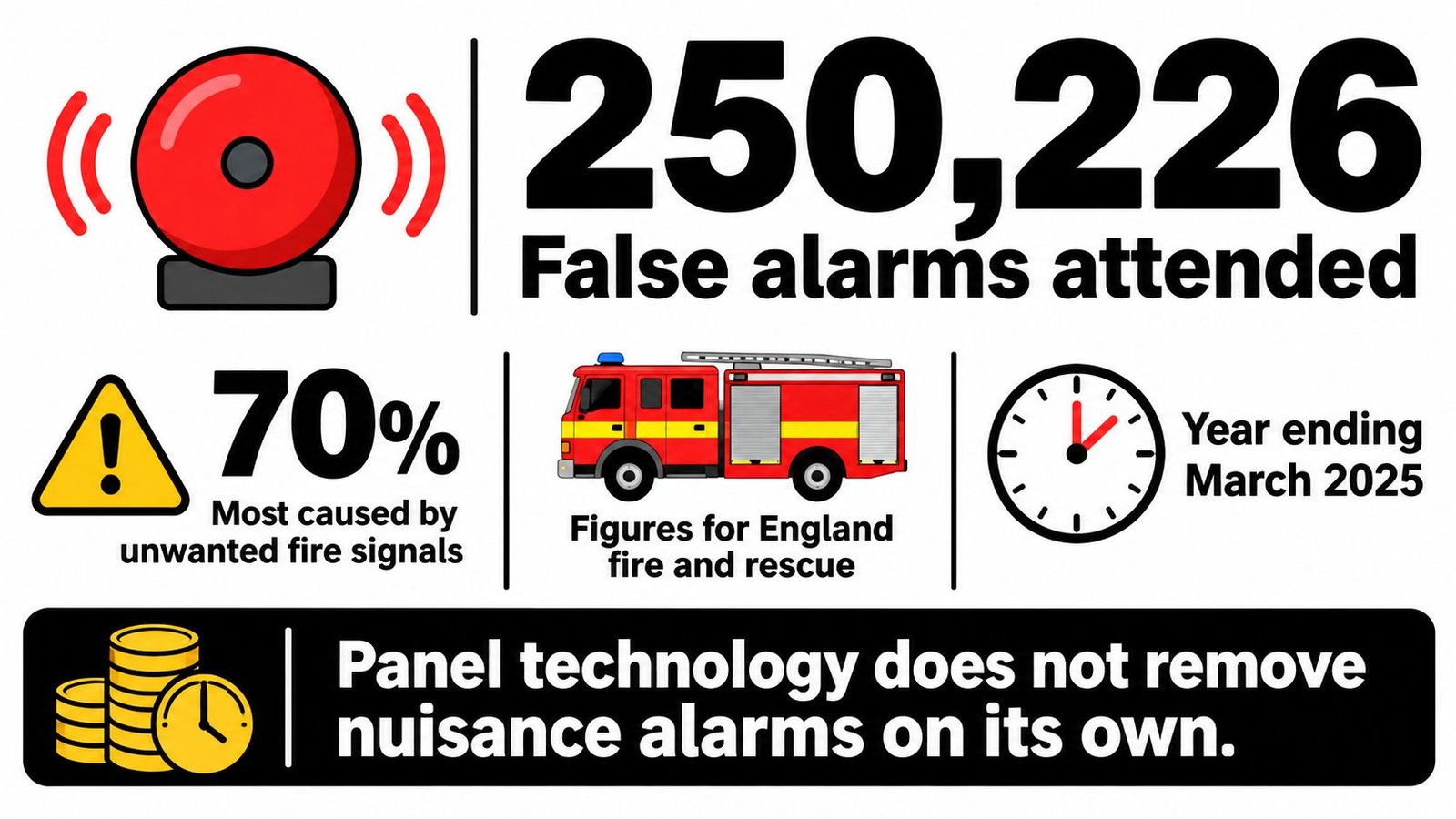
Fire and rescue services in England attended 250,226 false alarms in the year ending March 2025, and 70% were attributed to apparatus, according to the UK government fire and rescue incident statistics for the year ending March 2025. The same data also recorded false alarms caused by poor maintenance and faulty equipment. That's a maintenance and design failure pattern, not a panel generation problem.
Causes That Hit Either Architecture
- Dust in warehouses: It contaminates detectors regardless of what they report to.
- Cooking vapour and steam in retail and catering: The wrong detector type near the source activates faithfully and wrongly.
- Vehicle exhaust near loading doors: Siting defeats electronics every time.
- Layout changes: A detector left above a new process, kitchenette or storage cage inherits a risk it wasn't chosen for.
What addressable diagnostics do change is traceability. The panel names the repeat offender, so cleaning, relocation or a detector swap can be targeted at one device instead of a whole zone. That's valuable. It shortens investigations and builds an evidence trail. But it doesn't prevent contamination, steam or poor commissioning, and it won't fix a detector that should never have been a smoke detector in the first place. The discipline behind efforts to reduce false security alarms is the same one that works here. You investigate every activation, record the cause, and fix the source.
Cost rule: The cheapest panel is often the dearest system once search time, unwanted fire service attendance and later alterations are counted.
A well-zoned conventional system in a small building with a stable environment can run cleanly for years. Don't rip it out chasing a false alarm cure that lives in detector selection and cleaning regimes.
Price the Lifecycle, Not the Panel
| Cost driver | Conventional impact | Addressable impact |
|---|---|---|
| Panel and devices | Lower cost while zone count stays small | Higher device and module cost from day one |
| Cabling | A cable per zone can multiply on large floors | A loop often reduces long radial runs |
| Fault-finding labour | Engineers isolate a whole zone | The named device is known before the visit |
| Later extensions | New zones may need new circuits and panel capacity | Devices join the loop until loop capacity is reached |
| False-alarm callouts | Not prevented by the panel type | Faster to trace, still caused by environment and maintenance |
| Signal to an alarm receiving centre | Zone indication | Point identification where the communicator supports it |
Price both architectures against the same category and the same five-year maintenance plan. Panel price alone tells you almost nothing about what the system costs to own.
Maintenance Monitoring and Building Interfaces After Handover
Handover is where conventional and addressable systems share the same user routine, but differ in what the panel can report. Each week, test a different manual call point on a rota, check for panel faults, confirm sounders operate and record the results in the logbook. The UK fire alarm testing regulations and user duties explain this shared testing baseline.
Where the Engineer Visit Splits
The distinction becomes practical when a fault needs investigation. NHS Firecode guidance on fire alarm and detection systems describes conventional circuits as electrical zone circuits and addressable circuits as data-communication circuits. That affects how precisely the panel can direct an engineer.
- Conventional fault: The panel usually points to a whole zone, so the engineer tests or isolates that area to find the cause. Detector contamination may only become clear during inspection.
- Addressable fault: The panel identifies the device by address and description, helping the engineer target inspection and identify the likely part. Event logs can also show activity between visits.
Addressability improves fault location, not the underlying maintenance. It cannot clean or replace a detector, and it does not change the system's BS 5839 category. Reliability still depends on detector selection, the building environment, maintenance and cause-and-effect design.
In premises where sleepers rely on staff to locate and assist them, use the risk assessment and Firecode guidance to determine the detection arrangement. Addressable identification can help staff find the relevant room quickly, but the panel architecture does not set the sleeping-risk threshold.
Monitoring and Interfaces
With 24/7 monitoring, an alarm receiving centre can receive a zone signal from a conventional panel or, if the communicator supports it, a point description from an addressable panel. Set out keyholder contact procedures and a backup signalling path so a failure on one route does not prevent an alert. Wisenet's fire alarms are BS 5839-compliant with smoke, heat and CO detection, can integrate with security systems and are available with 24/7 monitoring.
Fire alarms can also integrate with emergency lighting. Door release, plant shutdown and lift functions need clearly defined cause-and-effect logic, followed by tests that confirm the sequence works. For buildings with fire-service lifts, consult elevator compliance guidance for facility managers when setting out the lift response. Do not assume the alarm signal and lift behaviour will work together without commissioning.
Your Commissioning Checklist
- As-fitted records: Provide a zone plan for a conventional system, or a device list and loop drawings for an addressable system.
- Cause-and-effect test sheet: Record each interface and witness it operating, rather than relying on programming alone.
- Logbook: Hand over the logbook, explain its use and confirm it has been started correctly.
- Maintenance contract: Name the battery tests, detector testing programme and compliance certification in writing.
Do not sign off with missing records or untested interfaces. The handover should leave you able to check the system's condition and confirm that its designed responses work.
Premises Where Each Architecture Earns Its Place
Building type settles most arguments faster than panel features do. The BS 5839 framework summary published via BP Index reflects the same split directly. Conventional systems remain practical for smaller, simpler buildings, whereas addressable systems are generally better suited to warehouses, offices, multi-tenant properties, schools, care premises and other buildings where precise device identification matters.
| Premises | Usually sufficient | Step up to addressable when |
|---|---|---|
| Home or small shop | Conventional zones | Mixed commercial use or interfaces with other safety systems |
| SME office or retail | Conventional if zones are short and staffed | Voids, mezzanines, frequent fit-out or phased evacuation |
| Warehouse or logistics hub | Rarely comfortable at 2,000 m² zones | High-bay racking, lone night staff or a long search |
| Multi-tenant or landlord building | Only a single simple occupancy | Separate occupiers, common parts and selective door release |
| Care or other sleeping risk | Only where sleepers are few and the risk assessment allows it | Where sleepers rely on staff to find and assist them |
| School or larger office | Conventional only if simple and stable | Many devices, extensions or plant and lift interfaces |
Small Premises and SME Buildings
A house converted to a small shop, with a few rooms and a short walk to any detector, can stay conventional if the risk assessment doesn't demand wider automatic coverage. The snag to watch is change of use. Add a commercial kitchen, a treatment room or staff sleeping on site, and the original answer may no longer hold.
An SME office or retail unit stays comfortable on conventional zoning when compartments are obvious and staff are present to investigate. Step up when a ceiling void, mezzanine or frequent shop-fit hides the source. Retail refits are the classic trap, because detectors end up above new layouts nobody checked against the zone plan.
A conventional system remains a recognised, competent choice for a small simple building, not a temporary compromise until you can afford better.
Warehouses, Landlords and Sleeping Risks
Warehouses punish zone-only reporting. Racking blocks sight lines, night staffing is thin, and a detector in alarm somewhere across a large floor gives a lone worker a long, uncertain walk. Addressable labels tied to aisles repay their cost in investigation time the first time something activates at 2 a.m.
Multi-tenant buildings create a different problem. The panel has to separate occupiers, identify common-area devices and drive door release without evacuating the wrong unit or locking the right one in. Zone-level logic gets clumsy fast, and disputes between tenants over false alarm responsibility need device-level evidence, not opinion.
Care settings and other sleeping risks follow the staff assistance test. Where sleepers rely on staff to find and assist them, specify addressable. The threshold is set by your risk assessment and evacuation model, so don't let anyone reduce it to a building size argument. Schools and larger offices land in the same place when device counts climb, cause and effect grows, and extensions are a matter of when, not if.
Find the row that matches your occupancy. That's your starting specification, not a default upgrade path.
Commission the Right System in South Wales and the South West
Give the designer enough information to price the system properly. Send floor plans and the fire-risk assessment, then ask five direct questions: What BS 5839-1 category is proposed? How many zones or devices are needed? What is the evacuation strategy? Which door-release, plant or lift interfaces apply? Is 24/7 monitoring required?
- Compare both options: Ask for conventional and addressable systems priced against the same category. Use the same assumptions for each through a fire alarm installation survey and design process.
- Check what the quote specifies: It should list zones or individual devices and state the proposed maintenance arrangements.
- Reject panel-only pricing: Ask for search distances and a device schedule. Without them, you cannot judge whether the proposed design will help staff locate an alarm quickly.
Wisenet Security Ltd offers conventional or addressable systems and is an authorised partner for Hikvision, Paxton, Pyronix and Fike fire alarm systems. The company provides a free, no-obligation survey and a detailed quote to suit your needs across South Wales and the South West, including Cardiff, Bristol, Newport and Swansea.
Keep conventional where the building is small, compartmented and straightforward to evacuate. Choose addressable where long search distances, multiple occupiers or complex cause-and-effect requirements make a zone indication too broad. The panel architecture changes how the system locates an event and reports it, not the BS 5839 category the building needs.
Send us your floor plans and fire-risk assessment. We'll price conventional and addressable options against your building's required category and provide a free, no-obligation survey with a detailed quote. Visit Wisenet Security Ltd to arrange yours in South Wales or the South West.