Fire Alarm System Training: Who Needs What in 2026
Most advice on this subject tells you to train everyone on everything. Don't. That wastes money and still leaves gaps.
Generic awareness teaches staff to leave when a bell rings, which matters, but it doesn't teach the person who owns the duty to judge whether the system suits the building, why a zone is disabled, or what records prove the weekly test happened. Role-specific, premises-specific competence beats generic awareness every time.
Good fire alarm system training matches a person, a task and a building. If your course can't name those three things, it isn't training. It's attendance.
Table of Contents
- Who Needs Fire Alarm System Training and Why
- Standards and Duties Behind Fire Alarm Training
- What the Responsible Person Must Know Beyond the Panel
- What a Fire Alarm Course Should Actually Cover
- Proving Competence Through Certificates and Records
- On-Site or Online Training and What It Costs
- Confirm Your Training Gap Before Booking
Who Needs Fire Alarm System Training and Why
A fire alarm course should match the job and the building. A shop assistant needs to recognise the alarm and evacuate. The person responsible for the premises needs to understand the system they have inherited, including its category, cause-and-effect logic, and routine checks.
Fire and rescue services in England attended 251,479 fire-false-alarm incidents in the year ending September 2025. These represented 39% of all incidents attended, compared with 28% for actual fires and 33% for non-fire incidents, according to the official fire and rescue incident statistics for the year ending September 2025.
The total was 1.1% lower than the previous year, but 11% higher than five years earlier and 19% higher than ten years earlier, when services attended 211,104 such incidents. These are England-wide figures, not local rates for South West England or rates for Wales. The volume matters to training because staff need clear procedures for responding to alarms and reporting faults, without treating every activation as a confirmed fire.
Find your row first
| Audience | Typical people | What they must learn | Evidence to keep |
|---|---|---|---|
| Ordinary staff and occupants | Shop assistants, warehouse operatives, tenants, office workers | Recognise the alarm, follow the evacuation plan, report faults, never silence without authority | Induction and drill attendance records |
| Nominated weekly testers | Site supervisors, caretakers, building managers | Weekly call-point test, panel indications, fault types, logbook entries, escalation | Signed logbook entries and test results |
| Responsible Persons | Owners, employers, landlords, facilities managers | System category, link to the fire risk assessment, competent-person arrangements, impairment and handover control | Current fire risk assessment, maintenance contract, logbook review dates |
| Engineers and installers | Fire alarm technicians and electricians | BS 5839-1 design, commissioning, cause-and-effect testing, fault diagnosis | Commissioning certificates and competence records |
| Homeowners | Owners and occupiers of single dwellings | Weekly test, battery checks, what to do when the alarm sounds | Usually no formal certificate; keep simple maintenance notes |
Check three responsibilities at the site: who is the Responsible Person, who carries out the weekly test, and who is authorised to isolate the system?
If you cannot identify each person by name, responsibility may be unclear. A short course can clarify tasks and escalation routes, but it cannot teach someone to design, certify or maintain a system without the required competence. Occupiers of a single dwelling face lighter expectations than those responsible for non-domestic premises. Landlords and managers of multi-tenant buildings still need to understand their duties, even if they do not operate the panel.
Standards and Duties Behind Fire Alarm Training
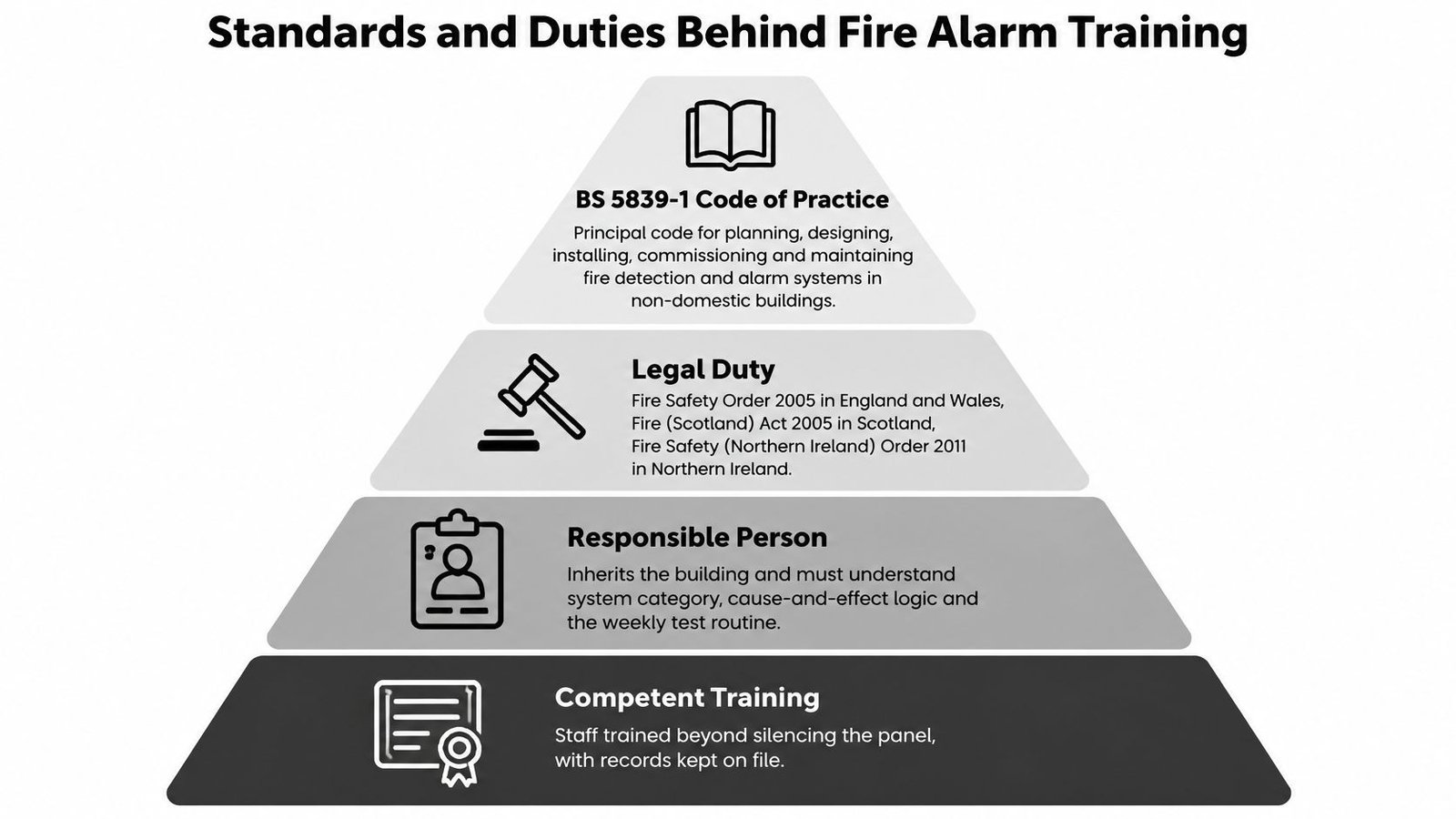
A fire alarm course is only useful if it matches the building and the learner's duties. BS 5839 sets out recommendations for planning, designing, installing, commissioning and maintaining fire detection and alarm systems. For non-domestic premises, the relevant part is BS 5839-1; domestic systems fall under BS 5839-6, while BS EN 54 covers fire detection and alarm system components. Historic England guidance on fire alarm design and installation
The BS 5839-1:2025 revision makes handover and maintenance understanding particularly relevant to training. Learners responsible for routine checks should know how to compare the site logbook and maintenance records with the system's documented arrangements, and what to do when information is missing or a fault remains unresolved. The Fire Industry Association update on BS 5839-1:2025 and routes to compliance explains routes to compliance. A short course can help staff recognise gaps and escalate them; it cannot qualify them to design, commission or certify a system.
Read the category before you book
| Category | Coverage | Typical premises | Training focus |
|---|---|---|---|
| M | Manual call points only, no automatic detection | Small premises with few occupants | Raising the alarm and evacuation |
| L1 | Automatic detection throughout the building | Offices, shops, care settings where life risk is highest | Full zone and cause-and-effect knowledge |
| L2 | Detection in rooms and escape routes presenting the highest risk | Hotels, flats with room-level risk | Room-level detection and impairment rules |
| L3 | Detection in escape routes only | Smaller premises with low room risk | Escape-route testing and fault response |
| L4 | Detection in circulation spaces only | Small flats and similar | Knowing the limits of coverage |
| L5 | Detection only in specific risk areas | Kitchens, plant rooms, specific warehouse zones | Risk-area focus and access for testing |
| P1 | Automatic detection throughout for property protection | Warehouses and stock areas where loss matters | Property-protection logic and insurer expectations |
| P2 | Detection in selected areas for property protection | Retail stock rooms | Selected-area testing and maintenance |
Use the commissioning certificate or design documents to identify the system category before booking. If neither is available, staff cannot reliably match course content to the installed system. Record the gap and ask a competent fire alarm professional to establish the system details. For help reviewing wider duties, see this fire safety compliance overview. Choose training that fits the confirmed category and the learner's actual responsibilities, rather than relying on a generic awareness course.
What the Responsible Person Must Know Beyond the Panel
The person who inherits a building can operate its panel and still lack the knowledge to manage its alarm. They need to know the system category, cause-and-effect logic, weekly test routine and fault escalation route. Generic awareness training cannot fill those gaps on its own.
The Responsible Person's duties extend beyond learning the controls. Under the 2025 UK care-sector fire safety code of practice, fire-detection equipment must be maintained by a competent person. The Responsible Person must also check that the alarm remains suitable for the premises and its fire risk assessment.
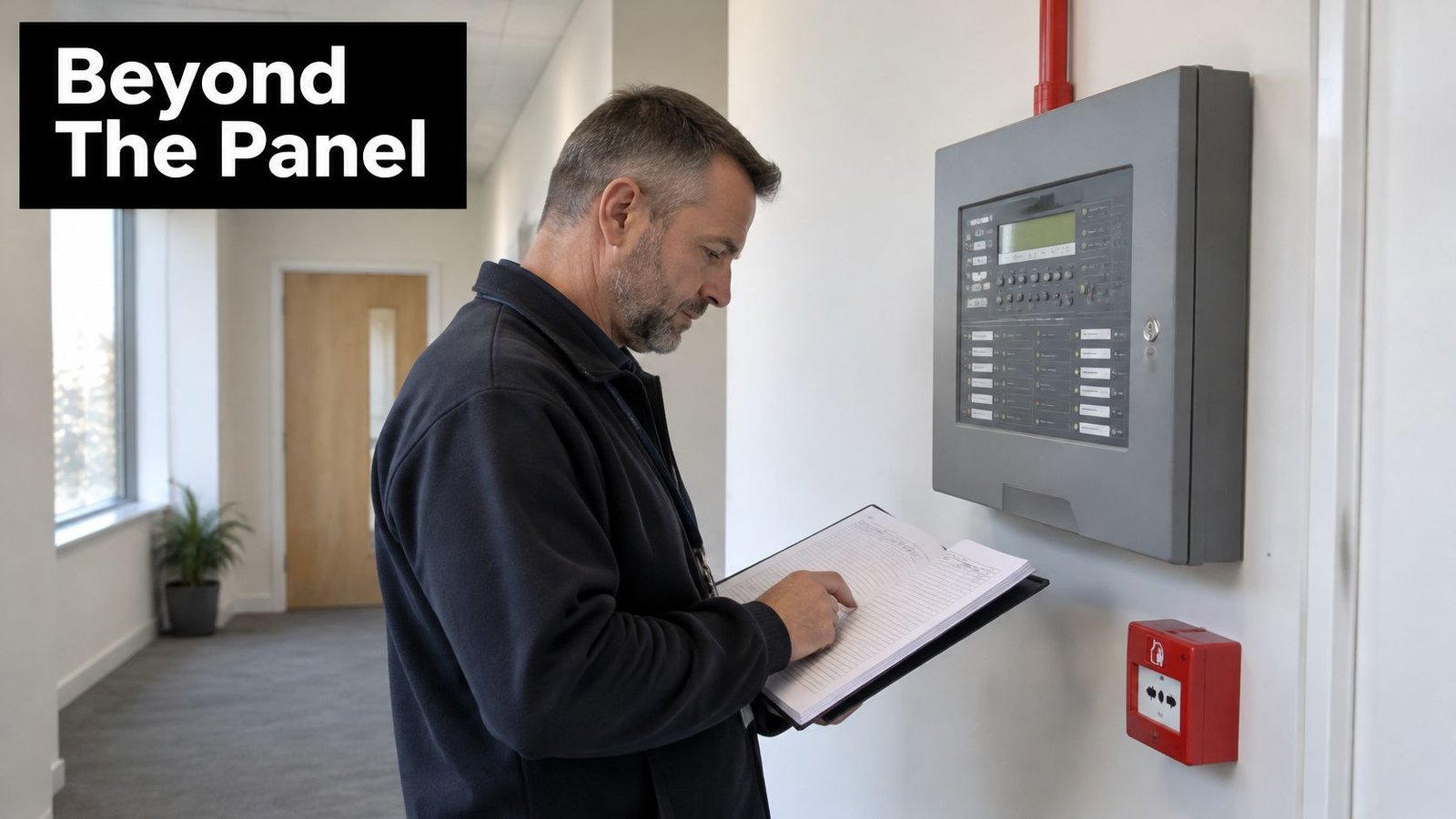
Under the Regulatory Reform (Fire Safety) Order 2005, the Responsible Person must keep the fire risk assessment current. Understanding what a fire alarm panel does helps with day-to-day operation, but it does not establish that the system suits the building or that faults and impairments are controlled.
Check four areas:
- System suitability: Does the category and detector placement still match the building's occupancy, layout and use?
- Records and testing: Do the logbook entries show tests, faults and actions completed?
- Competent-person arrangements: Who maintains the system, and what evidence supports their competence for that work?
- Impairment control: Who can authorise a disablement, for how long, and what temporary measures apply?
Illustrative scenarios
A landlord takes over a block with two disabled zones and no logbook. The immediate task is to establish when and why the zones were disabled, who authorised it, and what cover was in place. A system walk-through, a logbook and a written impairment rule address the practical gap more directly than another general awareness video.
In a separate illustrative warehouse scenario, new racking blocks a detector line, but the risk assessment and alarm arrangements remain unchanged. Compare the drawings, cause-and-effect information and current floor plan. If they do not match, staff may be working from records that describe a different layout.
Prepare a one-page duty map listing the system category, test owner, maintenance contractor and person authorised to isolate the alarm. Assign training or appoint a competent person wherever responsibility is unclear. A short course can clarify duties and routines, but it cannot substitute for a site-specific review of the installed system.
What a Fire Alarm Course Should Actually Cover
Judge a course by the decisions it rehearses, not its topic list. A provider can recite detector types all morning and still leave your tester frozen when the panel shows a fault at 6pm on a Friday.
Ask three questions. Does it cover every row of the audience table that applies to you? Does it use premises-specific scenarios? Are learners' decisions assessed, including the record they write afterwards?
The short video below is useful for panel familiarity, but it doesn't replace a rehearsal on your own zoning.
Scenarios worth paying for
| Scenario | Decision the learner must make | Correct response | Record kept |
|---|---|---|---|
| Repeated nuisance alarms from one detector | Whether the cause is dust, cooking or a fault | Report it, arrange engineer inspection, keep the system active unless an authorised plan exists | Fault log and engineer report |
| Zone disabled for building works | Whether the disablement is authorised and how long it lasts | Use an impairment permit, limit the duration, arrange temporary cover such as a fire watch | Impairment record with start and end times |
| Contractor handover of a refurbished site | Whether the certificate, logbook and cause-and-effect information exist | Request as-built drawings, cause-and-effect matrix and test records before accepting | Signed handover checklist |
| Plant room hard to reach for weekly testing | Who can reach the device and how often | Plan safe access, review the test arrangement, record the exception | Updated access arrangement and risk assessment |
| Alarm sounds at night in a warehouse | Whether to evacuate or investigate first | Evacuate under the evacuation plan; investigate only if the plan names a trained person and it can be done without delay | Incident log and post-event review |
The night warehouse case catches people out. The evacuation plan applies first. Investigation follows only if the plan names a trained person and it can be done without delay. Training that encourages keen staff to go looking for smoke before evacuating is dangerous.
Practical rule: Ask the provider to run one scenario on your real panel, or a training panel with the same zoning, and check the learner writes the correct logbook entry. If they won't, choose someone else.
Proving Competence Through Certificates and Records
A certificate on the wall doesn't prove competence. It proves someone sat in a room.
The Health and Safety Executive defines competence as the combined application of knowledge, skills and experience to perform responsibilities consistently to a recognised standard, and states training alone is insufficient without structured practice, task-specific assessment, validation, evaluation and documented records, in its guidance on competence and human factors.
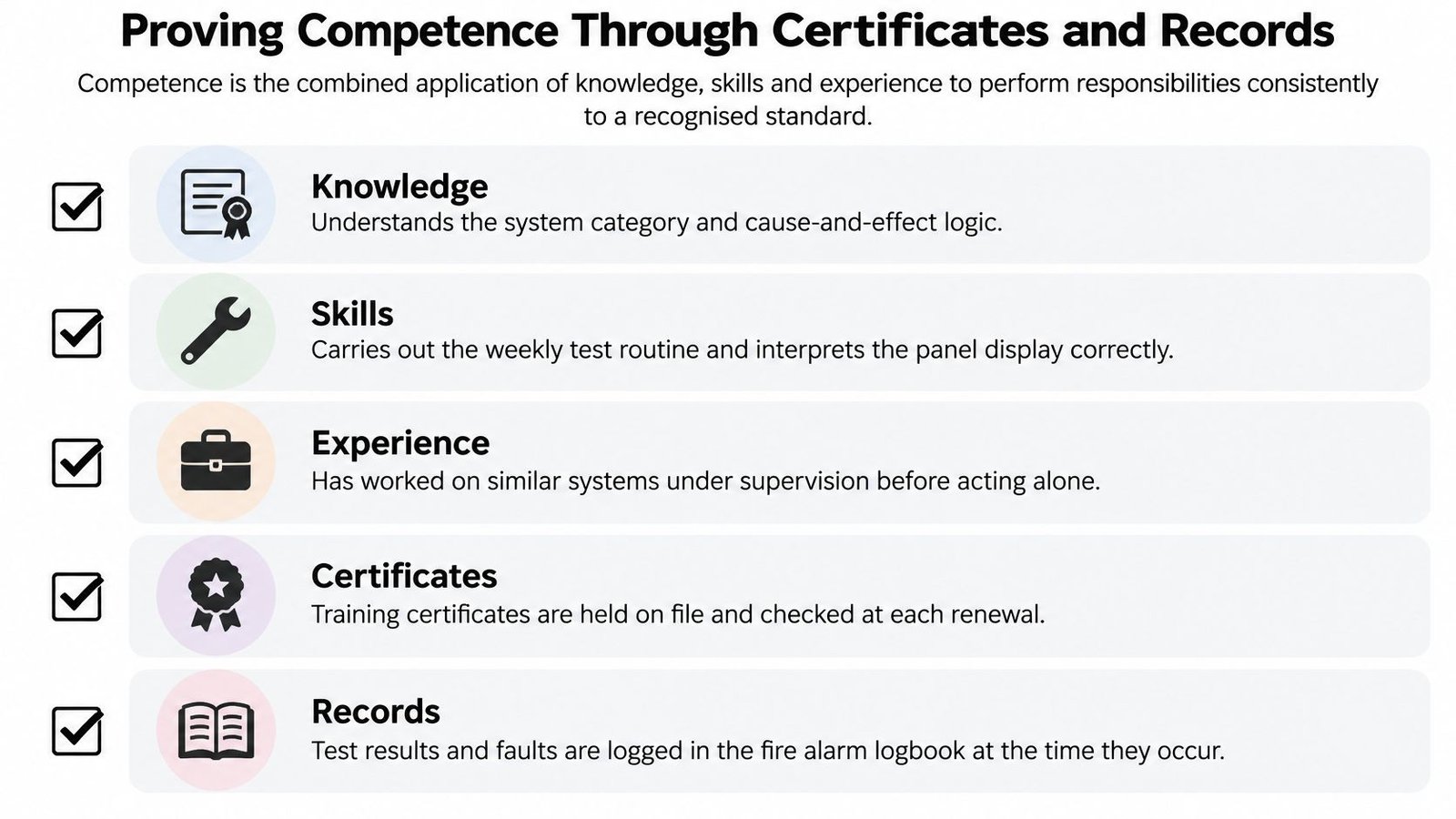
Separate two documents clearly. A completion certificate shows attendance. An assessment result shows the learner can do the task, such as interpreting panel indications, testing a call point, recognising a fault and escalating it correctly.
Ask providers who assesses, against which standard, and whether assessment includes supervised hands-on practice. For safety-critical or infrequent tasks, that detail matters more than course length. Details of testing duties are covered in the UK fire alarm testing regulations guide, but your own evidence still has to exist on site.
Minimum evidence set
- Logbook: Weekly test entries, signed, dated and kept in sequence.
- Fault and impairment records: Start and end times, authorisation and interim measures.
- Commissioning certificates: Supplied by the installer, with category and cause-and-effect information.
- Drill records: Dates, attendance and problems found.
- Training records: Who was trained, in what task, assessment outcome and refresher due date.
Refreshers depend on risk, not habit. Annual refreshers suit staff awareness. Engineers need updating when standards change or when they move into a new task. Weekly testers need reassessment after long absence, repeated false alarms or a system change.
Store it in one place, near the panel or in a controlled digital folder that an auditor can access quickly. Scattered PDFs across personal inboxes aren't a record system.
On-Site or Online Training and What It Costs
A Responsible Person who inherits a fire alarm system needs more than a general awareness course. They need to understand their premises' system category, its cause-and-effect logic and the routine their staff must follow. Choose delivery by task: online learning suits basic awareness, while work on a live panel needs supervised practice.
The Fire Industry Association delivered 490 training courses during 2024, a 26.3% increase on the previous year. Of those, 213 were online sessions and 277 were classroom sessions. The courses had 6,264 delegates, 26.9% more than the prior year, and 51% chose online training, according to the Fire Industry Association Annual Report 2024. Those figures show both formats are in use, not that online training suits every task.
Use e-learning for general staff awareness, especially where shift patterns make a group session difficult. It can provide completion records, but it cannot demonstrate that someone can operate a panel, follow cause-and-effect procedures or diagnose a fault. For those tasks, arrange practical instruction using a panel, with a trainer observing the learner.
Choose by task, then by price
| Format and course | Best for | Cost information | Time away |
|---|---|---|---|
| Online e-learning, staff awareness | All staff and occupants | Providers may price per learner; request a quote | Usually completed in short sessions at the learner's pace |
| Virtual or classroom, Responsible Person briefing | Managers, landlords, employers | Ask for a group quote | Typically half a day to a day |
| On-site group awareness session | Staff on one premises | Ask whether travel is included | Typically one to two hours |
| On-site weekly tester course with practical panel work | Nominated testers | Check whether practical assessment is included in the quote | Typically half a day to a day |
| Classroom engineer course on BS 5839-1 | Engineers and technicians | Request a quote by module and assessment | Check the course prospectus for duration |
Course prices are not published consistently enough to give a reliable range here. Cost depends on delivery format, group size, location and travel, course content, and whether assessment is included. Ask each provider to quote the same scope so you can compare like with like. A short attendance session and an assessed practical course are different services.
Before booking, check who will teach and what relevant system experience they have. Ask how practical skills are assessed, whether scenarios can use your premises' zoning and evacuation arrangements, what accreditation supports the certificate, and what refresher support is available. Get an itemised quote covering travel, assessment, materials, certificates and refresher terms. A stated day rate alone may not include all of those costs.
Confirm Your Training Gap Before Booking
A Responsible Person who inherits a system without knowing its category, cause-and-effect logic or test routine can book the wrong course. Check the site's records and duties first.
- Find the category: Check the commissioning certificate or design documents.
- List every user: Match each person's tasks to the relevant audience.
- Review the logbook: Check recent weekly tests, faults and impairments.
- Check the risk assessment: Confirm it reflects current occupancy and layout.
- Name each gap: Choose a format with the right assessment level. Testers and staff controlling impairments need assessed practical work, not e-learning alone. Compare prices only between providers covering the same tasks and assessment scope.
- Book role-specific training: Include site scenarios and agree refresher dates.
- File the evidence: Keep certificates and logbook copies together.
Homeowners can continue weekly tests and battery checks, and arrange a qualified inspection rather than a formal course. SMEs and retail sites should identify whether the Responsible Person, nominated tester or both need training. Warehouses, multi-tenant buildings and car parks should address scenario training and impairment control, where shift work and contractor access can expose gaps in generic awareness.
If your duty map has blank boxes or your logbook may not stand up to an audit, Wisenet Security Ltd can provide a second opinion on your fire alarm system and training gap across South Wales and the South West. Bring the commissioning certificate, current risk assessment and recent logbook entries to clarify who needs training, which format fits and what evidence to keep.