What Is Fire Alarm Panel
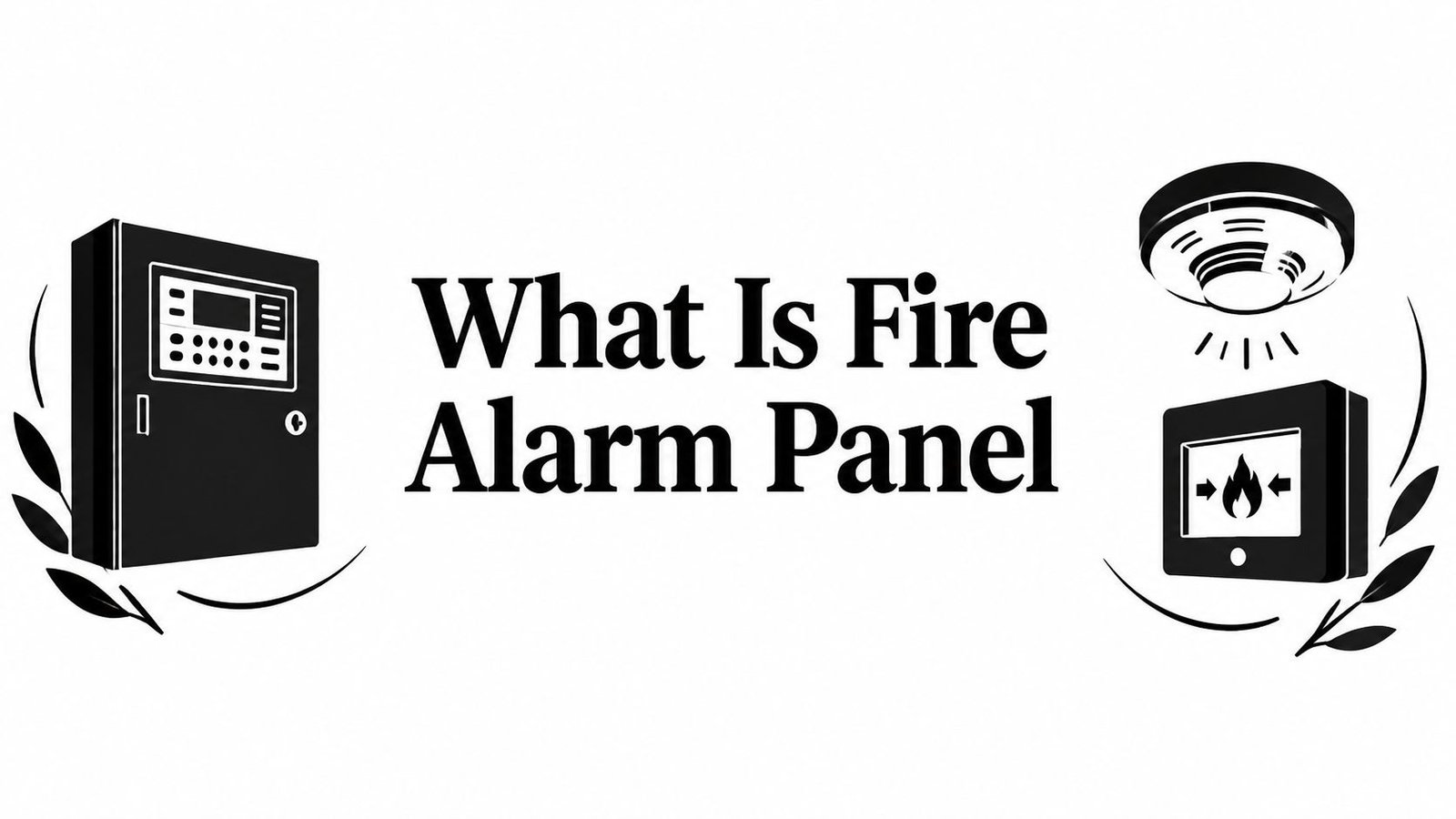
A fire alarm panel is the central control unit that receives signals from detectors and manual call points, identifies the affected zone or device, and activates sounders. It isn't the same as a domestic smoke alarm: the panel manages connected equipment rather than detecting smoke itself.
You may have noticed a flashing light beside your shop entrance, heard a beep from the office reception panel, or inherited a building without anyone explaining the controls. The important question isn't which button stops the noise. It's whether the system can detect a fire, warn people, and reveal problems that could prevent either from happening.
Table of Contents
- What a Fire Alarm Panel Actually Does
- Inside the Signal Chain
- Conventional vs Addressable Panels
- Reading the Indicators and Controls
- Testing, Servicing, and the Reality of UK Fire Data
- What to Do When the Panel Shows a Fault
- How the Panel Connects to the Wider Safety System
What a Fire Alarm Panel Actually Does
You access a shop and hear a beep from the wall-mounted panel. Nobody has reported smoke, and the building's evacuation sounders aren't operating. Before pressing anything, read the display: the panel may be reporting a problem with the protection, rather than a fire.
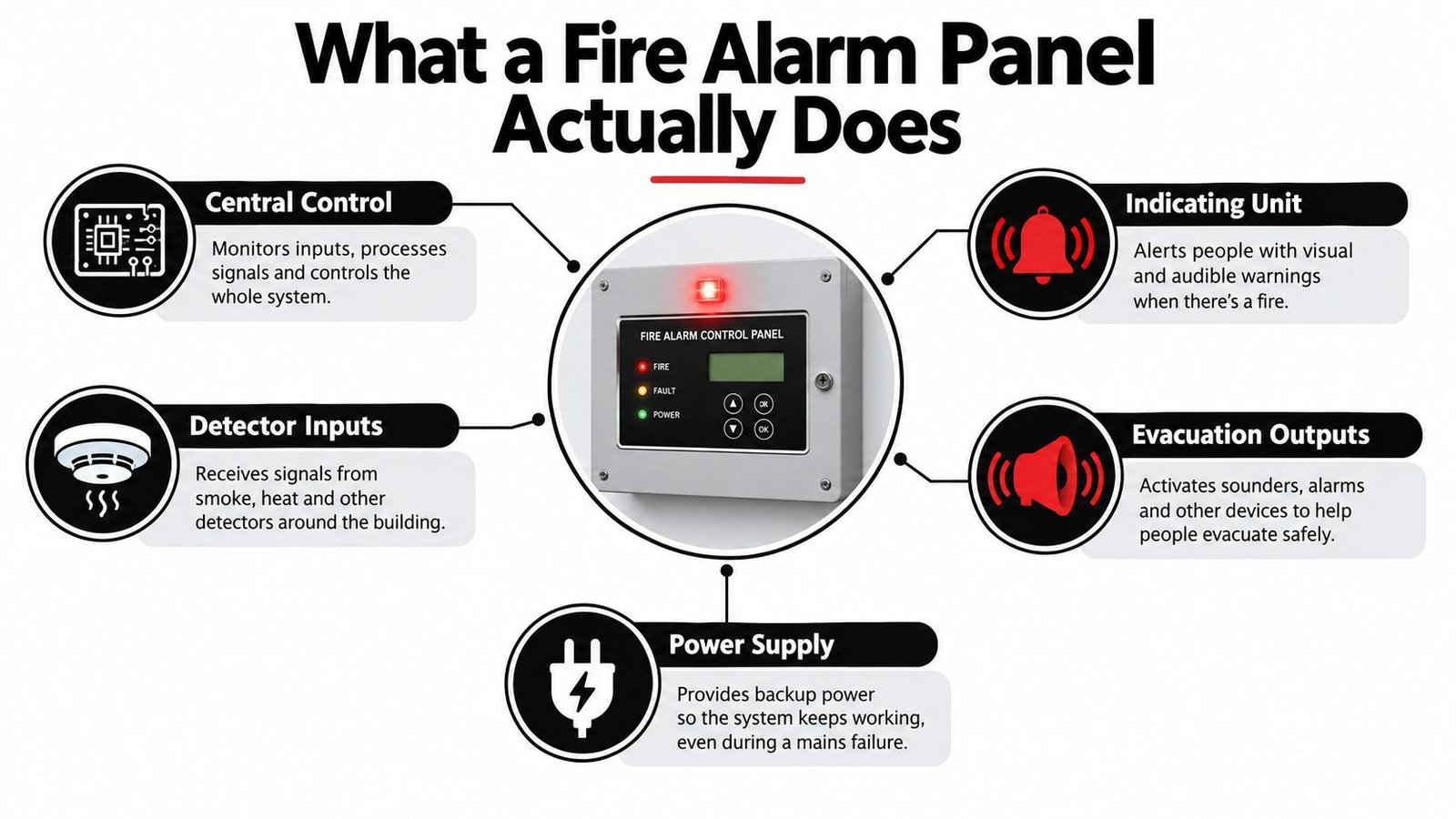
Think of it as a reception desk for fire-safety signals. Connected equipment sends information to that desk, and the panel displays the condition and operates the outputs programmed for it. Its formal name is control and indicating equipment, recognised under BS EN 54-2; BS 5839-1 covers fire detection and alarm systems in non-domestic premises within the UK fire-alarm standards framework.
The diagram separates the panel's main responsibilities.
Control doesn't mean complete protection
The panel can receive an alarm input, indicate its origin, operate warning equipment, and report monitored faults such as wiring breaks or power problems. Those functions depend on the surrounding installation: suitable detectors, compatible equipment, meaningful location information, dependable standby power, and regular inspection.
A useful distinction is between what the panel knows and what is happening throughout the building. A normal display isn't proof that every room has suitable detection or that every occupant can hear a warning. If a detector hasn't been installed where it's needed, the panel cannot compensate for that coverage gap.
A quiet panel is a status indication, not a complete assessment of the building's fire safety.
For a homeowner, the presence of interlinked domestic alarms doesn't automatically mean a commercial-style panel is needed. For a landlord or business owner, the correct arrangement should follow the premises' fire-safety requirements, not the appearance of the equipment.
Inside the Signal Chain
Consider a hypothetical warehouse with detection above a storage area. A detector responds to smoke, sends an input to the panel, and the panel operates the warning equipment according to the building's configured evacuation arrangements. If the system has a separately configured monitoring connection, it can also transmit an alarm condition remotely.
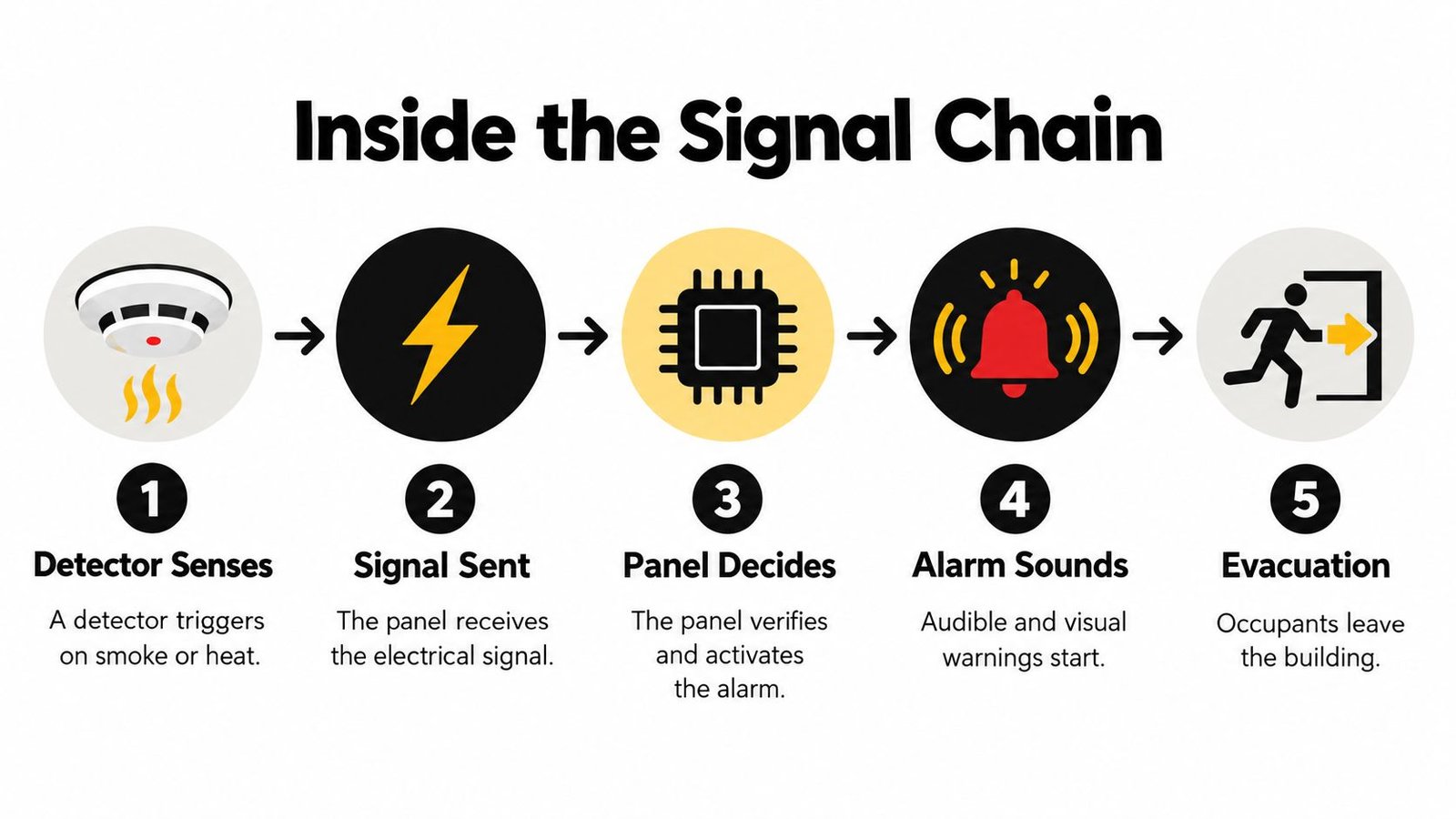
The basic route is easier to understand as a sequence.
From an input to a response
- Detection or manual action: A smoke or heat detector responds to its conditions, or a person operates a manual call point after discovering a fire.
- Signal reception: The panel receives the input and identifies its origin using the installed system's zone or device information.
- Configured action: The panel processes that input according to its programming and operates the required sounders, visual warnings, or voice-alarm arrangement.
- Human response: Occupants and premises staff follow the building's emergency procedure. The electronics don't make evacuation happen by themselves.
The word assesses sometimes causes confusion. A panel processes signals; it doesn't independently inspect the room or guarantee that an input represents a genuine fire. Unwanted detector activation can still produce an alarm, so suitable detection and correct configuration remain important.
The following video provides another visual reference for the equipment and its operation.
The response may extend beyond warning occupants. BS 5839-1's scope includes interfaces for smoke control, automatic door releases, gas or oil shut-off valves, and lift grounding. Engineers describe the relationship between an input and its required outputs as cause and effect.
That's why specifying a panel means documenting what each relevant event must initiate, rather than merely counting detectors.
Conventional vs Addressable Panels
The main difference is how precisely the panel identifies the source of an alarm. A conventional panel indicates an affected zone. An addressable panel can identify an individual connected device.
For a small retail premises, a clearly labelled sales-floor zone may provide useful location information. In a multi-tenant office or warehouse with separate bays, an individual detector description can make investigation more focused. These are illustrative decision scenarios, not rules that every shop or warehouse must follow.
Compare the information you need
| Criterion | Conventional Panel | Addressable Panel |
|---|---|---|
| Alarm location | Identifies the affected zone | Identifies an individual device |
| Layout suitability | Worth considering for simple, clearly divided premises | Worth considering for larger or more complex layouts |
| Investigation | Staff interpret the zone against the building layout | Staff use device identification and location information |
| Cable arrangement | Ask the designer to document circuit routes and monitored wiring | Ask the designer to document device circuits and their fault behaviour |
| Cost assessment | Compare the complete installed and maintained system | Include programming, interfaces, diagnostics, and future changes |
| Fault tolerance | Confirm what protection a wiring fault could affect | Confirm the proposed design's behaviour during wiring faults |
| Expansion | Check spare capacity and the consequences of extending zones | Check device capacity, compatibility, and programming requirements |
Avoid treating cable topology, price, or resilience as guaranteed by the panel category alone. A quotation should explain the actual design, not substitute a conventional or addressable label for an engineering specification. Ask what happens if a circuit is damaged and how staff will identify the affected protection.
The comparison of addressable and conventional fire alarm systems provides a useful starting point for discussing those options with an installer.
Selection rule: Choose the level of location information and control your building needs, then assess the complete system that delivers it.
A conventional arrangement is worth considering where zone-level identification is sufficient and the layout is straightforward. Addressable equipment becomes a stronger candidate when individual device identification, more involved cause-and-effect arrangements, or clearer investigation information matters. Neither choice removes the need for competent design, commissioning, and maintenance.
Reading the Indicators and Controls
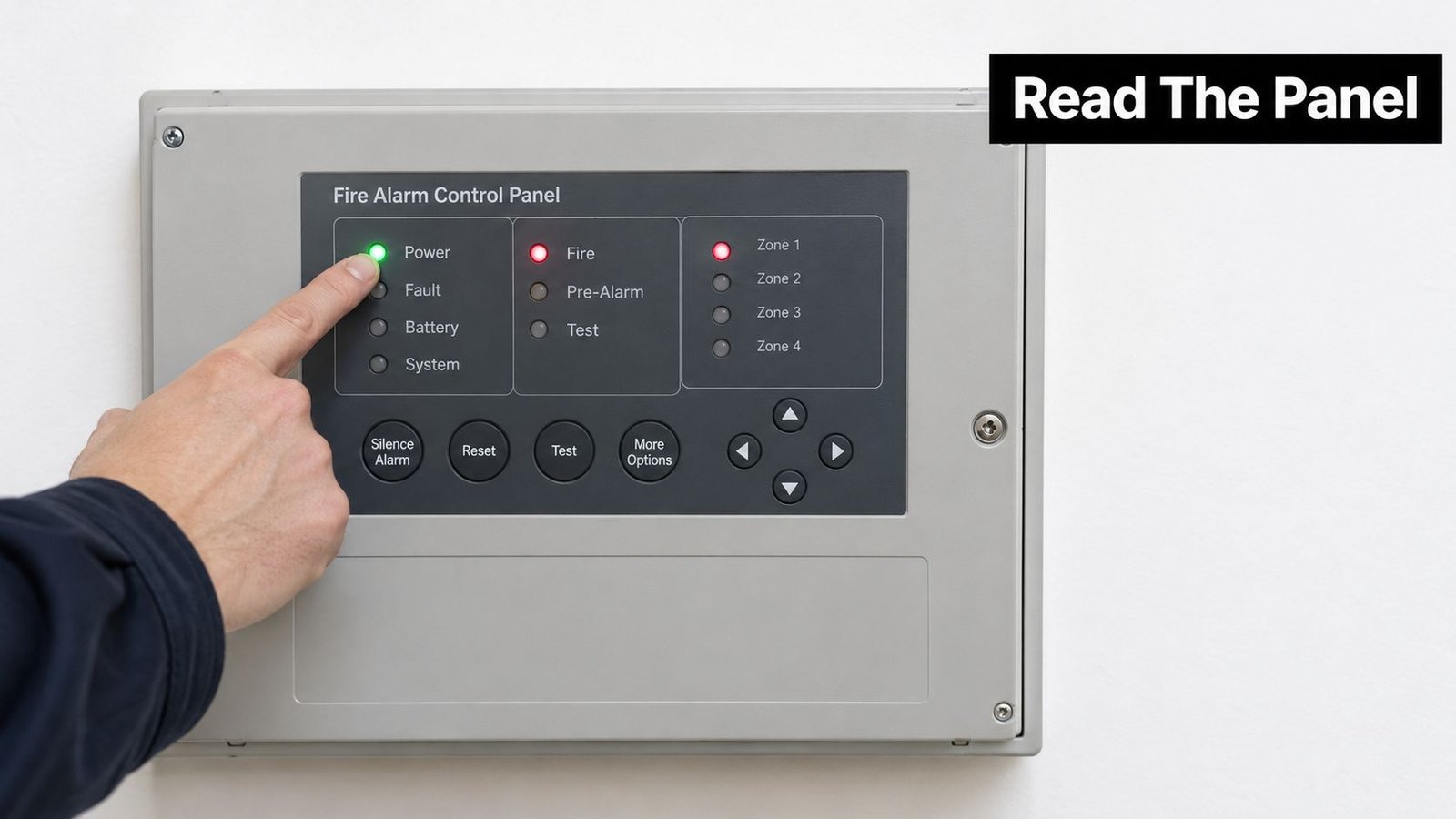
Read the label before interpreting the colour. The panel's instructions and the premises' operating procedure should explain the actual indications, flashing patterns, and permitted controls. Don't assume another building's panel works identically.
A power indication concerns the equipment's supply status; it isn't an all-clear certificate for the whole installation. A fire indication needs the building's emergency response, while a fault or disablement indication needs investigation into what protection may be affected.
Use the photograph as a reference for the fascia, not as an instruction to press a particular button.
Match the indication to the procedure
| Display or control label | What to establish |
|---|---|
| Power | Whether the indicated supply condition is normal for this panel |
| Fire | The displayed location and the required emergency response |
| Fault | The exact message and potentially affected equipment |
| Disablement | What has been intentionally taken out of service and why |
| Test | Whether authorised testing is underway and what it affects |
| Silence | Whether the control concerns the local buzzer or building sounders |
| Resound or evacuate | Who is authorised to operate it and under what circumstances |
| Reset | Whether investigation is complete and reset is permitted |
Amber fault, low-battery, loss-of-mains, and disabled-zone indications deserve attention because protection may be reduced. The maintenance expectations discussed below provide the context for responding to them; the colour alone doesn't identify the cause.
Silencing isn't repairing. Stopping the panel's local buzzer doesn't restore a damaged cable or reinstate disabled detection. Silencing evacuation sounders is a different action, with different consequences.
Keep a current operating instruction beside the panel and identify trained staff who can use it. If you're unfamiliar with the equipment, don't open the enclosure, disconnect power, or experiment with controls to make the display look normal.
Testing, Servicing, and the Reality of UK Fire Data
The newest dwelling-fire figures supplied by the Home Office make a useful distinction between having an alarm and receiving an effective warning. In England, in the year ending March 2025, a smoke alarm was present and operated as intended in 48% of dwelling fires; 19% involved an alarm that failed to operate, and 10% involved an alarm that didn't raise the alarm, according to the Home Office's dwelling-fire analysis.
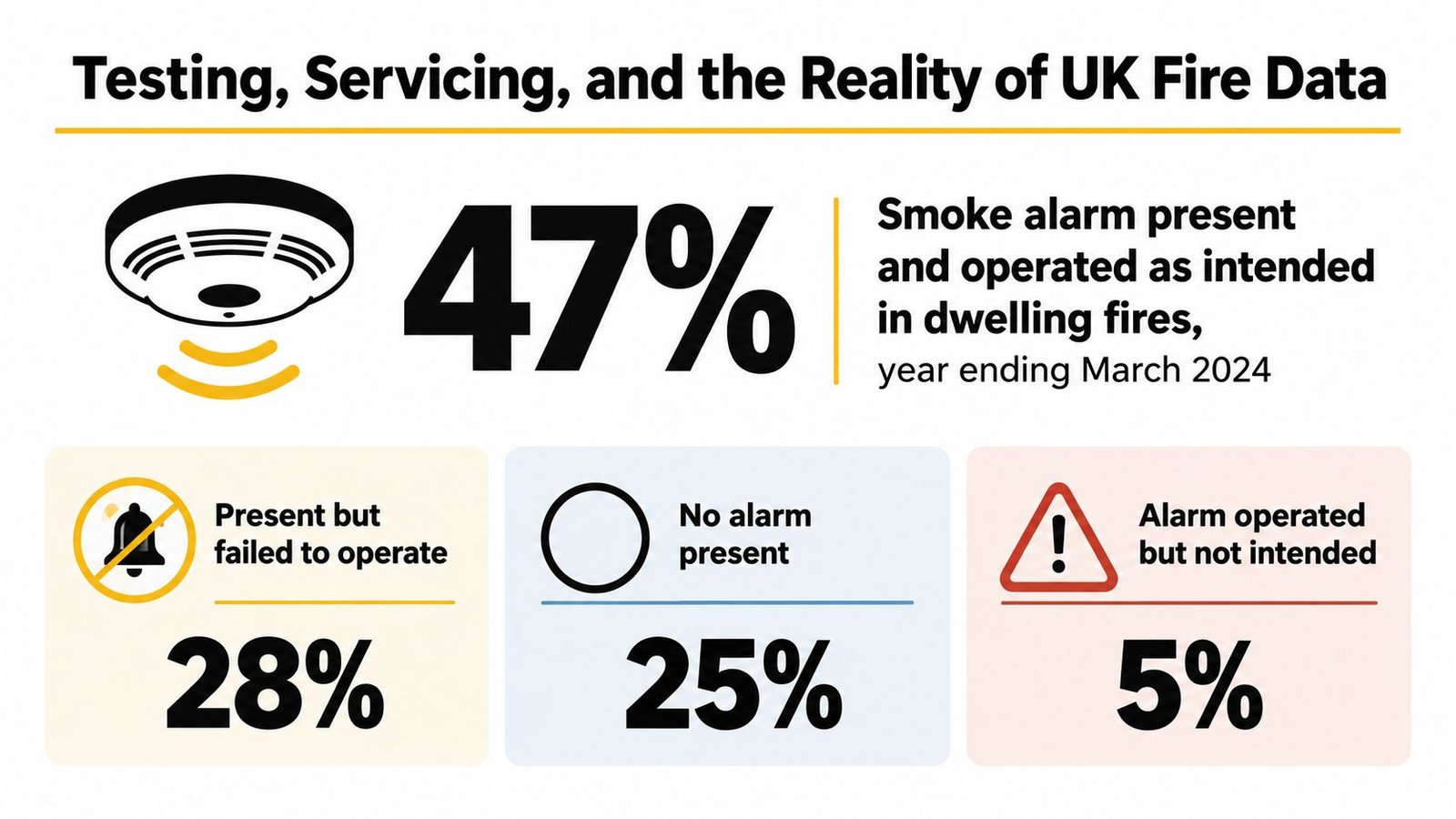
The preceding year's figures show the coverage problem: 6,084 dwelling fires, representing 24% of dwelling fires in England, occurred without a smoke alarm, and those incidents accounted for 34% of dwelling-fire fatalities, according to the year-ending-March-2024 fire analysis.
The graphic below relates to that earlier reporting period. Its supporting cards should not be used in place of the official figures quoted above.
Turn the evidence into maintenance decisions
These are dwelling-fire statistics, not commercial-panel failure rates. They demonstrate why coverage, power, and effective warning deserve separate checks; they don't prove that installing a panel alone prevents failed warnings.
BS 5839-1-associated maintenance guidance recommends risk-based inspection and servicing, with successive visits generally not exceeding six months. Use that expectation to arrange competent attendance, rather than treating a routine user test as a substitute for servicing. The UK fire alarm testing regulations guide can help you prepare questions about your premises' schedule.
- Check the whole warning route: Include detectors, panel indications, warning equipment, cables, and standby power in the agreed maintenance scope.
- Investigate unwanted alarms: Record the originating location and circumstances so the contractor can investigate instead of repeatedly resetting.
- Keep the history: Retain test results, service reports, defects, corrective work, and restoration records.
For homeowners seeking a separate domestic checklist, Premier Builders' Dublin house fire prevention tips are an additional resource, not a replacement for UK premises-specific advice.
What to Do When the Panel Shows a Fault
An amber warning needs a managed response, even when the evacuation sounders are quiet. A fault may affect only part of the installation, but you shouldn't assume the remaining protection is adequate without establishing what has happened.
The 2025 revision of BS 5839-1 highlights minimising disablement and informing premises management when significant protection is taken out of service. The Fire Industry Association's maintenance guidance also provides the servicing context described above.
Record, escalate, restore
- Capture the indication. Write down the exact message, zone or device information, and when you noticed it. Photograph the display if you can do so safely.
- Check authorised records. Look for planned work or a documented disablement. An intentional isolation isn't necessarily the same as an equipment fault, but the affected protection still needs managing and reinstating.
- Notify the responsible person. Tell the landlord, duty holder, or facilities manager what the panel shows. They should obtain competent advice about temporary precautions, continued occupation, and whether affected work needs to stop.
- Arrange competent attendance. Provide the engineer with the display information and details of recent building work. Don't disconnect equipment or attempt internal repairs.
- Document restoration. Record the cause, corrective action, checks completed, and when the affected protection returned to service.
If authorised by the operating instructions, a trained person may silence the local fault buzzer after recording and escalating the condition. That action must not replace investigation or be confused with silencing building evacuation sounders.
Practical rule: Manage the impairment, not just the noise.
Ask the attending contractor to explain what remained operational during the fault and whether further work is outstanding. Keep the service report with the system records so a later engineer doesn't have to reconstruct the incident from memory. If a fire indication or signs of fire accompany the fault, follow the emergency procedure rather than continuing routine troubleshooting.
How the Panel Connects to the Wider Safety System
A multi-tenant office illustrates why panel specification affects more than warning equipment. Different occupiers may share escape routes, door-release arrangements, building services, and a monitoring connection. The designer needs to establish how those arrangements work together without leaving each tenant to make assumptions.
The cause-and-effect interfaces described earlier must match the building's evacuation strategy. A capability listed in a panel brochure doesn't establish that the corresponding equipment has been installed, connected, programmed, or commissioned.
Coordinate the building, not just the electronics
- Remote monitoring: Confirm whether a connection exists, which conditions it transmits, and who receives and responds to them. Don't assume the panel automatically summons the fire service.
- Emergency lighting: Check the escape-lighting provision alongside the alarm design. Don't assume that sharing an installation contractor means the panel controls the lighting.
- Access and building services: Document the required release or control actions and verify the installed interfaces.
- Other security systems: Treat CCTV as a separate capability unless the specification establishes a defined integration. It isn't a substitute for fire detection.
The guide to fire alarm system integration is a useful starting point for a coordinated discussion between your alarm contractor and the people responsible for other building systems.
Physical changes need equal attention. If you're altering internal divisions or tenant layouts, include the building's fire-protection arrangements in the review; Partitioning Services Limited fire safety provides a related resource for that discussion. Don't assume the existing detector locations, zone descriptions, and evacuation arrangements remain suitable after refurbishment.
The finished specification should describe a complete response, including inputs, location information, warning outputs, interfaces, monitoring, and maintenance responsibilities. A property manager should be able to understand that response without opening the panel. Clear records and trained staff are what make the installed equipment usable when an alarm or fault occurs.
Wisenet Security Ltd offers conventional and addressable fire alarm design, installation, monitoring, and maintenance across South Wales and the South West. Book a free consultation to review your panel, detector coverage, required interfaces, and servicing arrangements, whether you're managing an existing system or planning a new installation.