

How Often Should Smoke Detectors Be Replaced in the UK
Smoke detectors should generally be replaced every 10 years, even if they still respond to the test button. The sensor can age while the sounder continues to work, so a passing beep isn't proof that the detector remains fit for purpose.
That distinction matters more than many homeowners realise. In England during the year ending March 2025, a smoke alarm was present but failed to operate in 19% of dwelling fires, while a further 10% had an alarm that didn't raise the alarm. Together, those failures accounted for 29% of dwelling fires (UK Government fire analysis).
For a homeowner in Cardiff, Bristol, Newport or Swansea, the practical answer is straightforward: check every detector's age, record the replacement date, test the system regularly and replace the complete unit at its tenth anniversary. Landlords, small-business owners, facilities managers and operators of multi-tenant buildings need the same discipline, plus an auditable record and a compatibility check where alarms are interlinked.
Table of Contents
- The 10-Year Rule and Why It Matters in the UK
- Why a Smoke Detector Ages Even When It Still Beeps
- Replacement Intervals by Detector Type
- When a Passing Test Button Is Not Enough
- Testing and Maintenance Between Replacements
- Why Landlords and Multi-Tenant Sites Need a Different Approach
- How to Replace a Smoke Detector Step by Step
- When to Bring in a Local Fire-Safety Specialist
The 10-Year Rule and Why It Matters in the UK
The single most useful sentence in UK domestic fire safety is this: replace smoke detectors every 10 years, even if they still pass a button test. The ten-year point applies to the complete detector, not just its battery. UK fire and rescue guidance explains that the detection mechanism can deteriorate with age while the power supply continues to work, which is why the alarm should be replaced at the end of its service life (UK Government home fire-safety guidance).
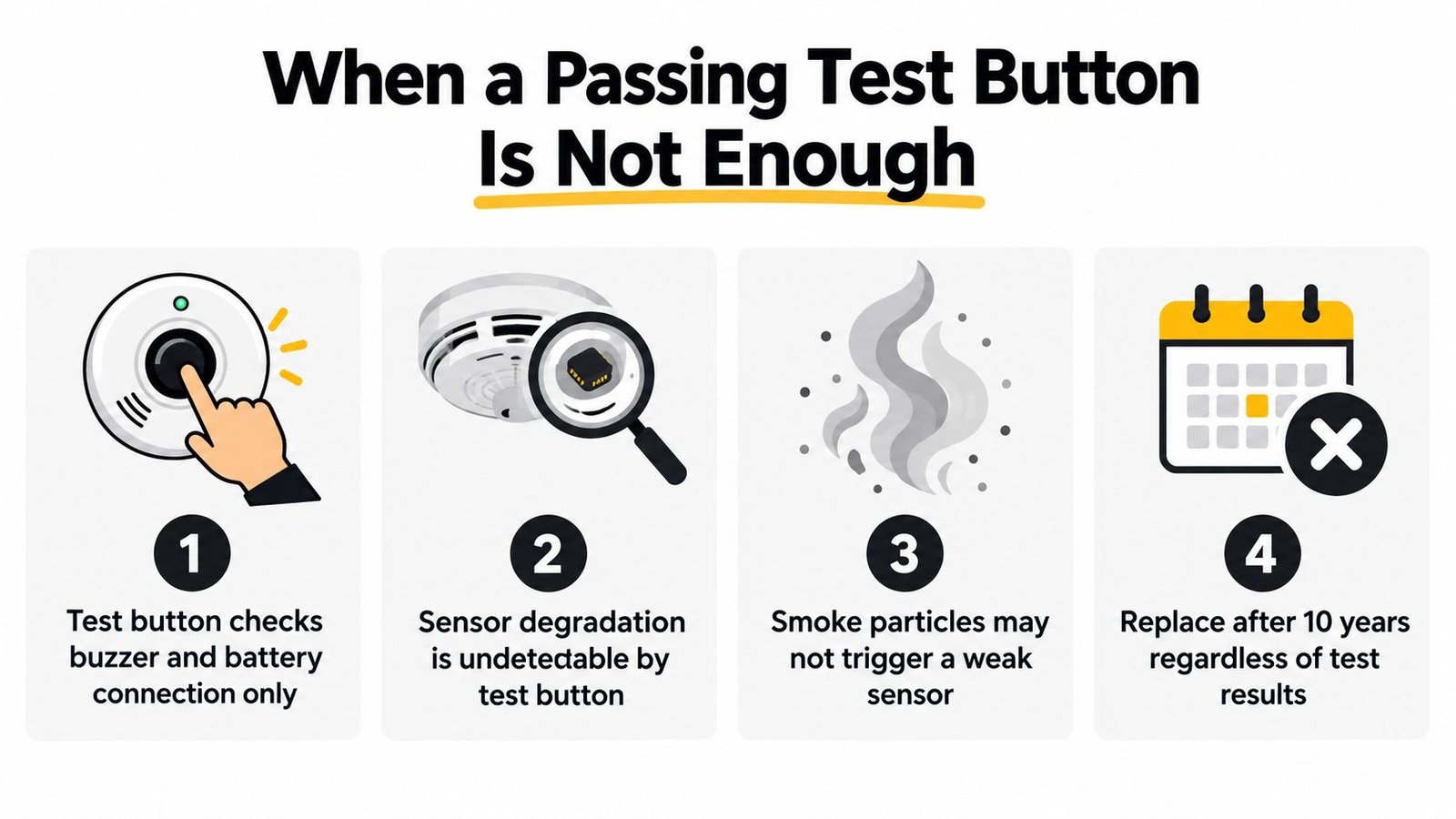
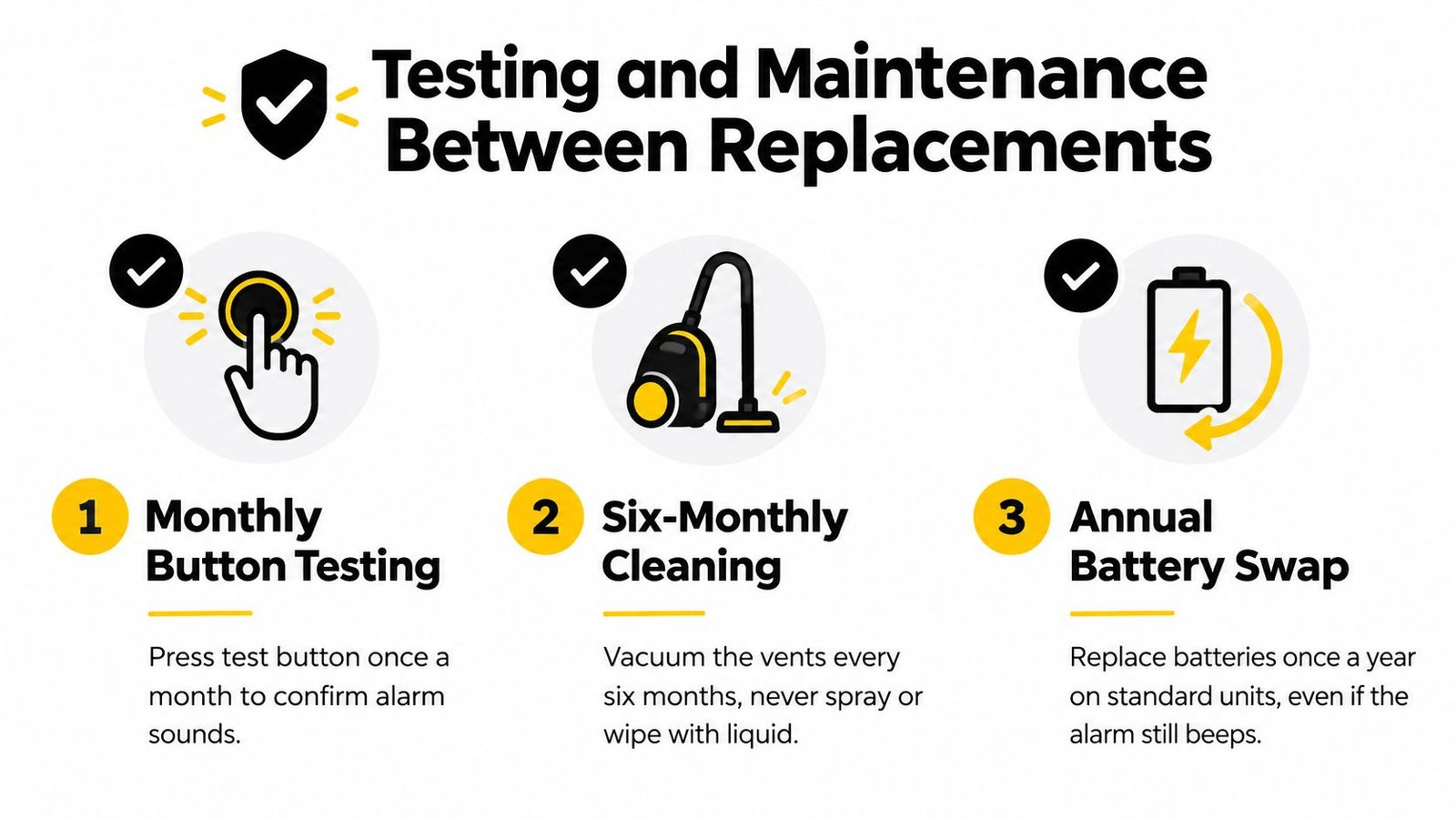
A test button answers a narrow question. It confirms the alarm can produce its warning sound and, depending on the design, that power is reaching the relevant circuit. It says nothing about the long-term condition of the sensing chamber, electronic components or internal contacts. Treating the button as an expiry check is like certifying a ladder by testing only one rung. The rung holds, the certificate gets signed, and the rest of the structure is left unexamined.
Who needs to act
This advice applies to more than owner-occupied houses.
- Homeowners should check every alarm, not only the one that has started chirping.
- Landlords should maintain a dated record for each property and each detector.
- Retailers and small businesses should account for alarms, interlinked systems and related fire equipment as part of planned maintenance.
- Warehouse and facilities managers need an asset register that identifies locations, models, installation dates and replacement requirements.
The risk isn't confined to obviously neglected properties. In England during the year ending March 2023, 93% of households reported having a working smoke alarm, up from 87% in 2012, yet 23% said they had never tested theirs (UK Government household fire-safety statistics). Ownership is high. Verification is patchy. That gap is where aged detectors hide.
Practical rule: a green light and a loud beep show that the alarm is functioning at the moment of testing. They don't extend the detector's intended service life.
The rest of the decision comes down to four questions. How old is the complete unit? What type of power supply does it use? Is it part of an interlinked system? Has its environment exposed it to dust, moisture, paint, grease or smoke? Answer those questions before deciding whether to change a battery, replace one alarm or renew the complete installation.
Why a Smoke Detector Ages Even When It Still Beeps
A smoke detector is a sensor, not just a siren. Inside the housing, a sensing chamber detects smoke-related changes and sends a signal to the alarm circuit. The test button checks the warning function, but it cannot recreate every condition the sensor must handle in a real fire.
A detector can work like a tyre with plenty of tread visible but hardened rubber underneath. The warning sound may still be fine, yet that test says nothing about how well the sensing chamber will react when smoke reaches it.
What changes inside the unit
Dust, decorating debris, humidity, airborne grease and other contamination can affect the sensing chamber. Electronic components and connections also age through ordinary use. A detector near a kitchen or utility area faces a harsher environment than one in a clean hallway, but neither should be kept indefinitely because the light still comes on.
Ageing is not always dramatic. It can show up as nuisance alarms, fault warnings, or a slower response that a routine button test will not expose. The unit may look normal and sound normal, yet still need replacement because its internal performance is no longer something you should trust.
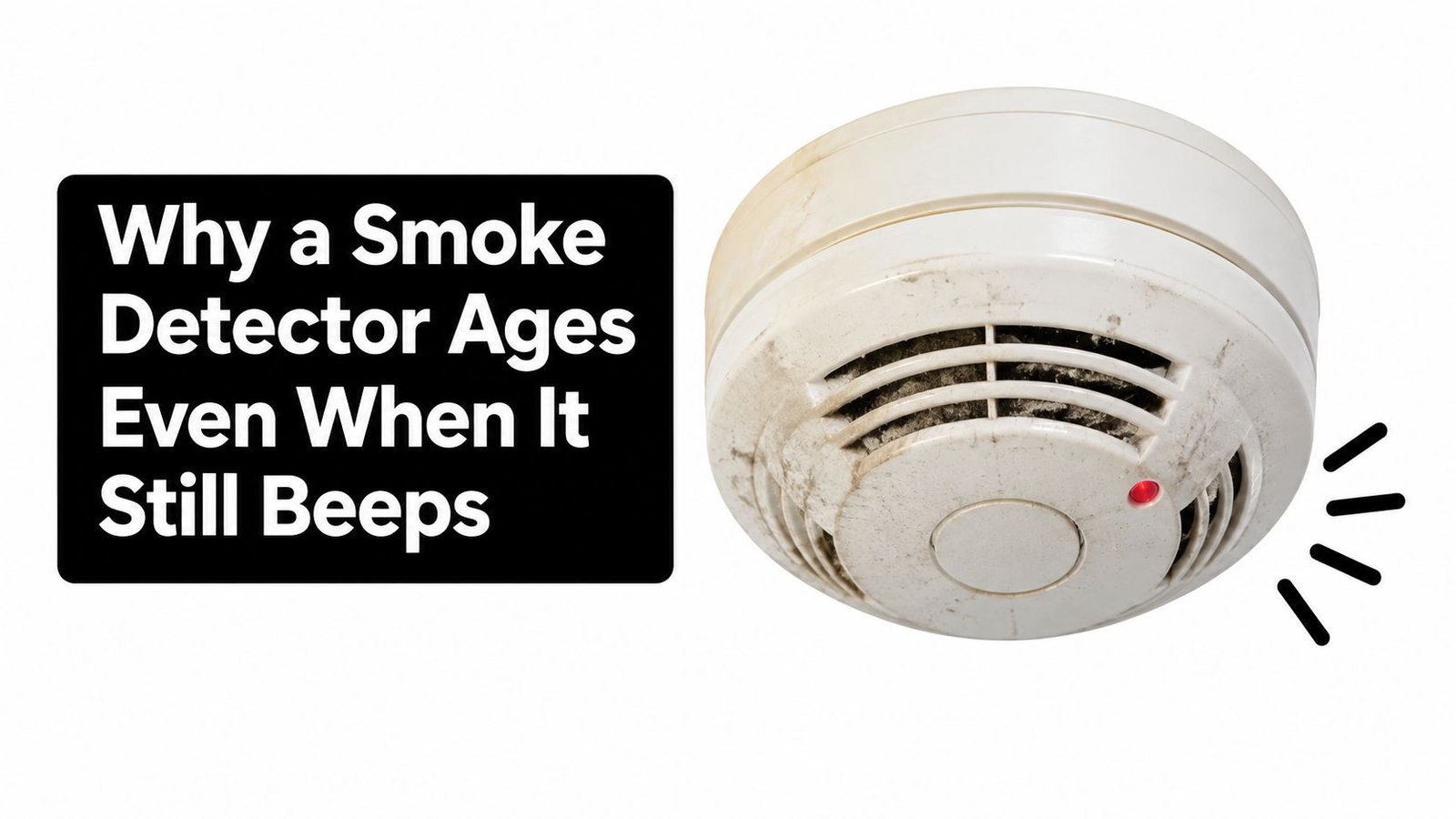
Fire and rescue guidance also points to sensor deterioration over time. The warning circuit can still work while the detection mechanism declines, which is why the complete alarm should be replaced on the recommended service-life schedule to keep detection effective.
What the button can and can't tell you
Use the test button, but read it correctly.
- It can confirm that the sounder works and the unit responds to the test command.
- It may confirm that battery or mains power is present for that check.
- It can't show that the sensing chamber still performs as it did when new.
- It can't remove contamination, age-related wear, or damage caused by decorating or renovation work.
A passing test button does not prove the detector is fit for continued service. Treat replacement as part of a reliability programme, not as an afterthought after the unit starts failing.
Replacement Intervals by Detector Type
The power source changes the maintenance routine, but it doesn't remove the age limit. Whether the alarm uses a replaceable battery, a sealed lithium cell or mains power, the sensing components still have a finite service life.
The main options
Standard battery-powered alarms are simple to install and easy to change. Their replaceable batteries still need testing and replacement according to the manufacturer's instructions. A new battery doesn't make an old sensing chamber new, so the entire detector remains subject to the ten-year replacement point.
Sealed 10-year lithium alarms reduce the chance that an occupant will remove or forget a battery. They're useful where access is difficult or where regular battery changes are likely to be missed. The sealed pack and detector are replaced as one unit when the stated service life ends.
Mains-powered interlinked alarms offer a connected warning arrangement, especially useful where occupants may not hear an alarm in another part of the building. Mains power doesn't prevent sensor ageing, and replacing one device in an older network can create compatibility and commissioning problems.
| Detector Type | Power Source | Battery Behaviour | Replacement Interval | Best For |
|---|---|---|---|---|
| Standard battery-powered | Replaceable battery | Test and replace the battery according to the manufacturer's instructions | Replace the complete detector every 10 years | Straightforward domestic replacement where access is easy |
| Sealed lithium | Sealed long-life battery | Replace the complete unit when the sealed power pack reaches end of life | Commonly 10 years, subject to the product instructions | Homes seeking lower routine battery intervention |
| Mains-powered interlinked | Mains supply, often with backup | Maintain any backup battery as specified | Replace the complete detector at 10 years and confirm system compatibility | Larger homes, connected installations and managed properties |
The critical distinction is battery interval versus device interval. A replaceable battery may need attention regularly, while the detector itself should still be removed and replaced at its tenth anniversary. A sealed unit may need no battery change during its designed life, but it doesn't become permanent.
For an interlinked installation, don't select a replacement by appearance alone. Check the manufacturer, model family, wiring arrangement or wireless protocol and any connection to a fire panel or emergency-lighting system. If you can't verify those details, treat the work as a system replacement rather than a like-for-like DIY swap.
When a Passing Test Button Is Not Enough
Many people make the same mistake: they press the button, hear the alarm and conclude that replacement can wait. That conclusion confuses an immediate function check with a service-life assessment.
The latest English fire data shows why that distinction matters. In the year ending March 2025, smoke alarms were present but failed to operate in 19% of dwelling fires, and a further 10% involved an alarm that didn't raise the alarm. The combined figure was 29% (UK Government analysis of fires and response times).
That doesn't mean every failure was caused by age. Coverage, positioning, contamination, power faults and other conditions matter. It does mean that ownership alone isn't enough. A detector must be appropriately located, maintained, powered and within its intended service life.
Separate the three checks
Use three different questions rather than one:
- Does it sound now? Press the test button according to the manufacturer's instructions.
- Is the unit maintained? Check the vents, power supply, mounting and visible condition.
- Is it still within service life? Confirm the installation or manufacture date and replace the whole device at 10 years.
The third question remains necessary even after a successful first check. If you need help with a battery-powered unit, the guidance on fire alarm battery replacement can support the practical maintenance decision, but changing the battery isn't a substitute for replacing an expired alarm.
A detector that has passed its test button may still be unsuitable if it has repeated nuisance alarms, visible contamination, physical damage or an unknown age. Don't wait for a dramatic failure signal. Fixed-date replacement is more dependable than relying on an electronic warning that may never appear.
Testing and Maintenance Between Replacements
The ten-year rule doesn't mean you can install a detector and ignore it for a decade. Replacement is one event in a maintenance cycle. Between replacements, the household or responsible person should follow a simple calendar and record what was done.
In England during the year ending March 2025, only 18% of households reported testing their smoke alarm at least monthly (UK Government fire-prevention statistics). That monitoring gap is avoidable, particularly when the test takes moments and can be attached to an existing household routine.
A practical maintenance calendar
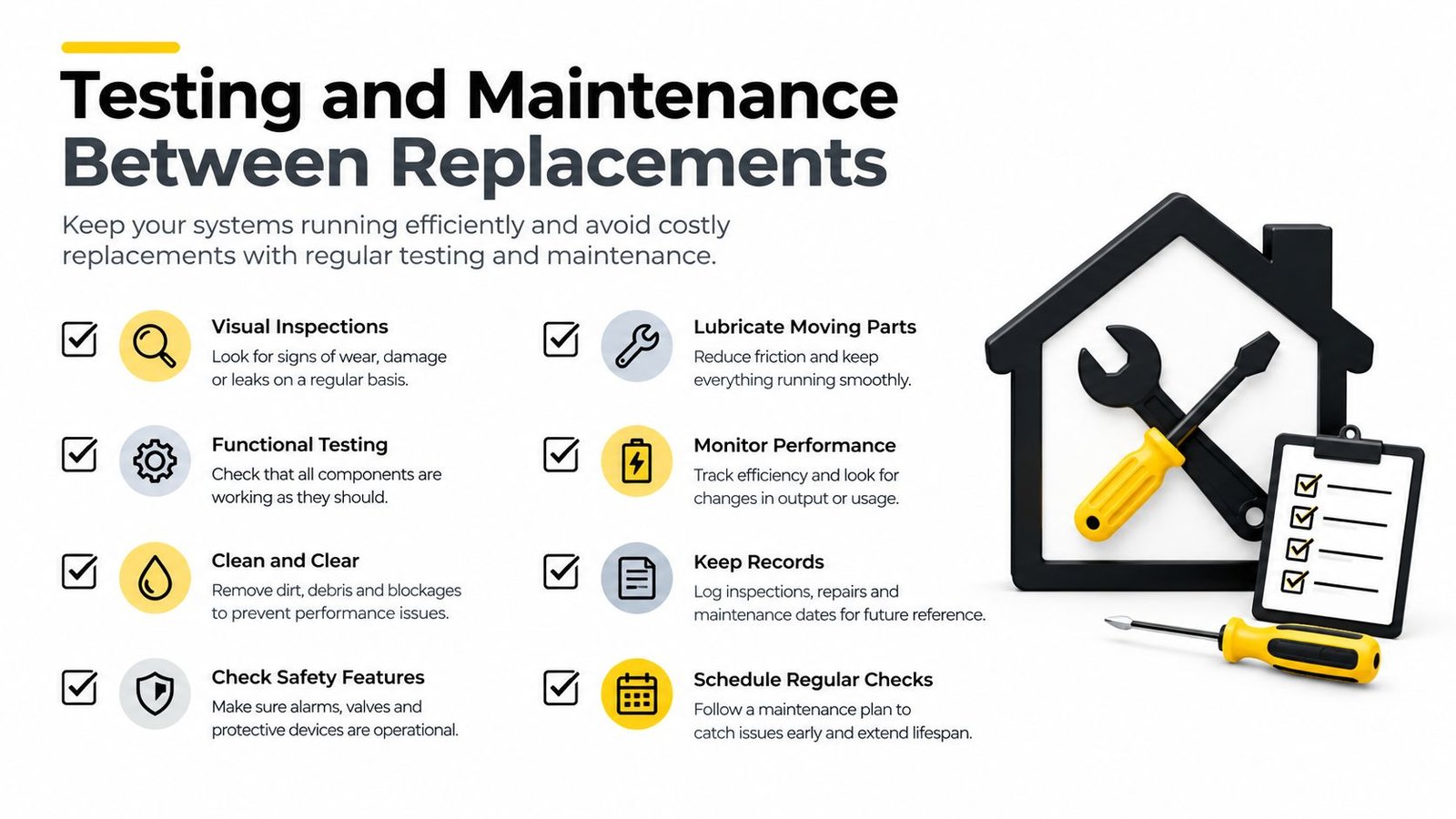
Monthly: press the test button on every alarm. Walk through the property rather than testing only the nearest device. Confirm that interlinked alarms behave as intended, if the manufacturer's instructions permit that test.
Every six months: inspect the housing and vacuum around the vents using a suitable attachment. Don't spray cleaner into the detector, soak it or cover it while decorating. If renovation dust has entered the unit, replace it sooner if cleaning doesn't restore reliable operation.
Annually: replace batteries in standard replaceable-cell units according to the manufacturer's instructions, and change them immediately after a low-battery warning. Sealed units don't receive an annual battery swap, but they still need testing and date-based replacement.
After a change to the property: reassess detector locations after building work, a conversion, a new partition or a change in how rooms are used. An alarm can't protect an area it doesn't cover, and replacing an old unit won't correct poor positioning.
Keep a small record beside the consumer unit or in the property file:
- Location: identify the room or circulation area.
- Date: record installation or manufacture information.
- Action: note tests, battery changes, cleaning and faults.
- Decision: record the replacement date or reason for earlier replacement.
For broader household organisation, owners can browse upkeep guidance for owners and add detector checks to the same recurring maintenance system. A written routine is more reliable than memory.
The key limitation is easy to miss: none of these activities extends the ten-year replacement point. Testing confirms current operation, cleaning reduces avoidable contamination and battery changes restore power. Only replacement renews the detector itself. For a clearer testing routine, use the guidance on how often fire alarms should be tested alongside the product manufacturer's instructions.
Why Landlords and Multi-Tenant Sites Need a Different Approach
A landlord can't manage a property on the assumption that an occupant will notice every fault. Tenants may not know the installation date, may not recognise a fault chirp or may be unable to reach a ceiling-mounted detector safely. The responsible person therefore needs a system that survives changes in occupancy.
The basic replacement interval remains the same, but the evidence trail needs to be stronger. Keep a property-level register showing each detector's location, type, installation date, replace-by date, test history and any remedial action. A dated record lets a landlord demonstrate that maintenance was planned rather than improvised.
Treat the installation as a system
Interlinked alarms create a common trap. Replacing one device because it has failed may leave the property with mixed generations, incompatible communication methods or inconsistent end-of-life dates. Before buying a replacement, identify the installed system and confirm that the new unit is approved for that network.
A multi-tenant building may also include emergency lighting, fire panels, manual call points or monitoring interfaces. A detector that appears interchangeable on the ceiling may not be interchangeable within the wider system. That is why landlords should assess the installation as a whole, particularly during refurbishment or a change of use.
For broader context on managing fire precautions in flats, landlords may find the Corinthian Surveyors London fire safety guide useful. It should complement, not replace, the specific requirements and professional advice relevant to the property.
Make the audit usable
A spreadsheet is sufficient for a small portfolio if it contains the right fields and someone updates it. A larger site may need asset-management software, inspection reports or a contractor-maintained log. The format matters less than the discipline.
Record:
- Property and location, including floor or room.
- Detector type and model, including whether it is mains-powered or wireless.
- Installation or manufacture date, with evidence where available.
- Next replacement date, set before the tenth anniversary.
- Test and fault history, including unresolved issues.
- Contractor and remedial action, where someone else completed the work.
Landlords should also plan assisted checks for older residents or occupants who can't safely reach alarms. Testing frequency and replacement frequency are separate obligations in practical terms. A detector can be within its service life and still be unreliable if nobody tests it, while a frequently tested detector can still be too old to retain as the primary safety measure. More detail on the specific issues affecting rental properties is available in this guidance on smoke detectors in rental properties.
How to Replace a Smoke Detector Step by Step
Replace an alarm as soon as it reaches its service-life date, or earlier if it fails testing, gives persistent fault warnings, suffers damage or has been contaminated by smoke, grease, water or renovation dust. In England during the year ending March 2023, alarms that were present but didn't operate or didn't raise the alarm were involved in 30% of dwelling fires (UK Government detailed fire analysis).
Use this procedure for a straightforward domestic unit. Stop and use a qualified professional for mains wiring, unfamiliar interlinked systems or any installation connected to a fire panel.
1. Identify the existing system
Remove the alarm from its base only as far as the manufacturer's instructions allow. Photograph the label, model, wiring arrangement and any interlink connection. Record its location and date before you remove it, because the old unit may be the only evidence of what was installed.
If several alarms are connected, don't assume that a visually similar replacement will communicate with the others. Confirm the exact compatible product family or arrange a system assessment.
2. Choose the correct replacement
Match the detector type to the room, the existing system and the manufacturer's instructions. Check whether the property needs a battery-powered, sealed lithium or mains-powered unit. If the detector is part of an interlinked network, compatibility takes priority over buying the cheapest individual alarm.
Replace all connected units together when they share the same age and the manufacturer or installer recommends coordinated renewal. That approach simplifies future records and prevents one new unit operating alongside a group approaching the end of service life.
3. Isolate mains power where applicable
For a mains-powered detector, isolate the relevant circuit before touching the wiring. Don't work on fixed electrical connections if you aren't competent to do so. A qualified installer can confirm isolation, preserve the correct interlink arrangement and test the completed circuit safely.
Battery-only alarms are simpler, but you still need to follow the product instructions for fixing points, orientation and any anti-tamper feature.
4. Install, label and test
Fit the new base securely, connect the unit as specified and press the test button. If the alarm is interlinked, verify the complete network rather than only the device you replaced. Check that the detector is unobstructed and positioned according to the manufacturer's instructions and applicable UK guidance.
Write the installation date and replace-by date on the unit or in the property record. Don't rely on the next occupant, a future owner or your memory to reconstruct its age.
5. Dispose of the old unit responsibly
Sealed lithium alarms and mains-powered electronic detectors shouldn't automatically go into general household waste. Use the manufacturer's disposal instructions or an appropriate electrical-waste route, and keep the replacement record with the property paperwork.
Yellowing, cracks, persistent chirping after a battery change, repeated nuisance alarms and visible contamination are reasons to act immediately. They aren't invitations to wait for the tenth anniversary.
When to Bring in a Local Fire-Safety Specialist
DIY replacement is reasonable for a simple, battery-powered detector when the occupant can identify the product, reach the fixing safely and follow the manufacturer's instructions. It becomes a poor choice when the property depends on interlinked alarms, mains wiring, a fire panel or a documented maintenance regime.
The dividing line is system consequence. If one incorrect connection can silence other alarms, create a fault on a panel or leave part of a building without coverage, the task needs more than a new ceiling device. The same applies where residents may be asleep behind closed doors, where tenants change regularly or where the premises holds stock, equipment or records that require wider protection.
Situations that justify professional support
Bring in a competent fire-safety specialist when:
- The alarms are mains-powered or hardwired: electrical isolation and correct termination matter.
- The system is interlinked: the replacement must communicate correctly with every other device.
- The property is an HMO or multi-tenant building: the owner needs consistent coverage and an auditable record.
- The premises is a shop, warehouse or industrial site: detector selection and positioning must reflect the building's use and environment.
- The site includes emergency lighting or a fire panel: changing one component can affect the wider life-safety system.
- The occupants need assistance: older residents and people with limited mobility may not be able to test or replace ceiling-mounted units safely.
- The installation is undocumented: a specialist can identify the system before a piecemeal replacement creates incompatibility.
A local provider can also coordinate fire alarms with other protective systems rather than treating each ceiling device as an isolated purchase. Wisenet Security Ltd provides fire alarm design, installation and maintenance, including conventional and addressable systems, emergency-lighting integration and ongoing maintenance. Its engineers also work across associated security systems, which can be useful where a property manager needs one coordinated record rather than several unrelated contractor files.
Ask for evidence, not just a fitting
A completed visit should leave useful information behind. Ask for the detector model, location, date of installation, test result, identified faults, remedial work and next planned replacement. For a larger system, request updated drawings or an asset register where appropriate.
The same principle applies outside the UK. A property manager comparing responsibilities across jurisdictions may encounter different local duties, such as those summarised in this overview of Central California fire code duties. That comparison reinforces the practical point: the applicable legal framework changes by location, but reliable records, suitable equipment and planned maintenance remain essential.
Keep this schedule with your property paperwork
Copy this into the consumer-unit folder, tenancy file or facilities register:
- Location: room, floor and detector position.
- Install date: record the installation date, manufacture date or both where available.
- Type: standard battery, sealed lithium, mains-powered, wireless or interlinked model.
- Replace-by year: set the tenth anniversary and schedule the work before it arrives.
- Monthly action: test every detector according to the manufacturer's instructions.
- Six-monthly action: vacuum vents carefully and check for contamination or damage.
- Annual action: review the full register and replace batteries in units with replaceable cells as instructed.
- Immediate action: replace a detector that fails testing, remains faulty after a battery change or has damage or contamination.
Use the first Sunday of October as the annual review point. Walk through the property, compare every detector against the record, test the system and book replacement work for units approaching the end of service life. A fixed date is easier to remember than an instruction to check sometime during the year.
Three signals mean don't wait:
- Persistent fault chirps after the battery or power supply has been addressed.
- Repeated nuisance alarms that continue after the environment and positioning have been checked.
- Physical damage or contamination, including cracks, fire exposure, water damage, heavy smoke deposits or renovation dust.
The rule to keep: replace the complete smoke detector every 10 years, test it routinely between replacements and use professional help when the alarm is part of a connected or managed fire-safety system.
For homeowners, a dated inventory may take one short evening. For landlords and businesses, a specialist survey can turn an uncertain collection of alarms into a documented programme with compatible equipment, clear responsibilities and planned renewal.
Wisenet Security Ltd can survey, install and maintain smoke alarm and fire alarm systems across South Wales and the South West, including Cardiff, Bristol, Newport and Swansea. If you own, let or manage a property with ageing or interlinked detectors, visit Wisenet Security Ltd to arrange a free, no-obligation survey.