Automatic Gate Installation Cost: UK Price Guide 2026
A fully installed automatic gate system in the UK typically costs £3,500 to £12,000, while basic manual gate fitting costs significantly less. A standard fitted garden gate is commonly around £250 to £700, so automation should be treated as an infrastructure project, not just a motor added to an existing gate.
You may be looking at a driveway that works perfectly well by hand, then wondering why one installer quotes a few thousand pounds and another comes back with a figure several thousand higher. In South Wales, that difference often comes from the ground beneath the gate, the route for power and control cables, drainage, access restrictions, and the safety equipment required for a compliant installation.
The gate panels and motor are only part of the job. A dependable system may also need foundations, ducting, wiring, control panels, photocells, safety edges, vehicle detection, access control, commissioning, and testing. A low quote can look attractive until you discover that excavation, electrical work, safety testing, or finishing repairs were excluded.
Table of Contents
- Understanding Automatic Gate Installation Cost Benchmarks
- Breaking Down Labour and Equipment Expenses
- Site Complexity and Technical Cost Drivers
- Real World Quote Scenarios by Property Type
- Evaluating Installer Quotes and Safety Compliance
- Long Term Value Through Maintenance and Integration
- Getting Expert Advice for Your South Wales Project
Understanding Automatic Gate Installation Cost Benchmarks
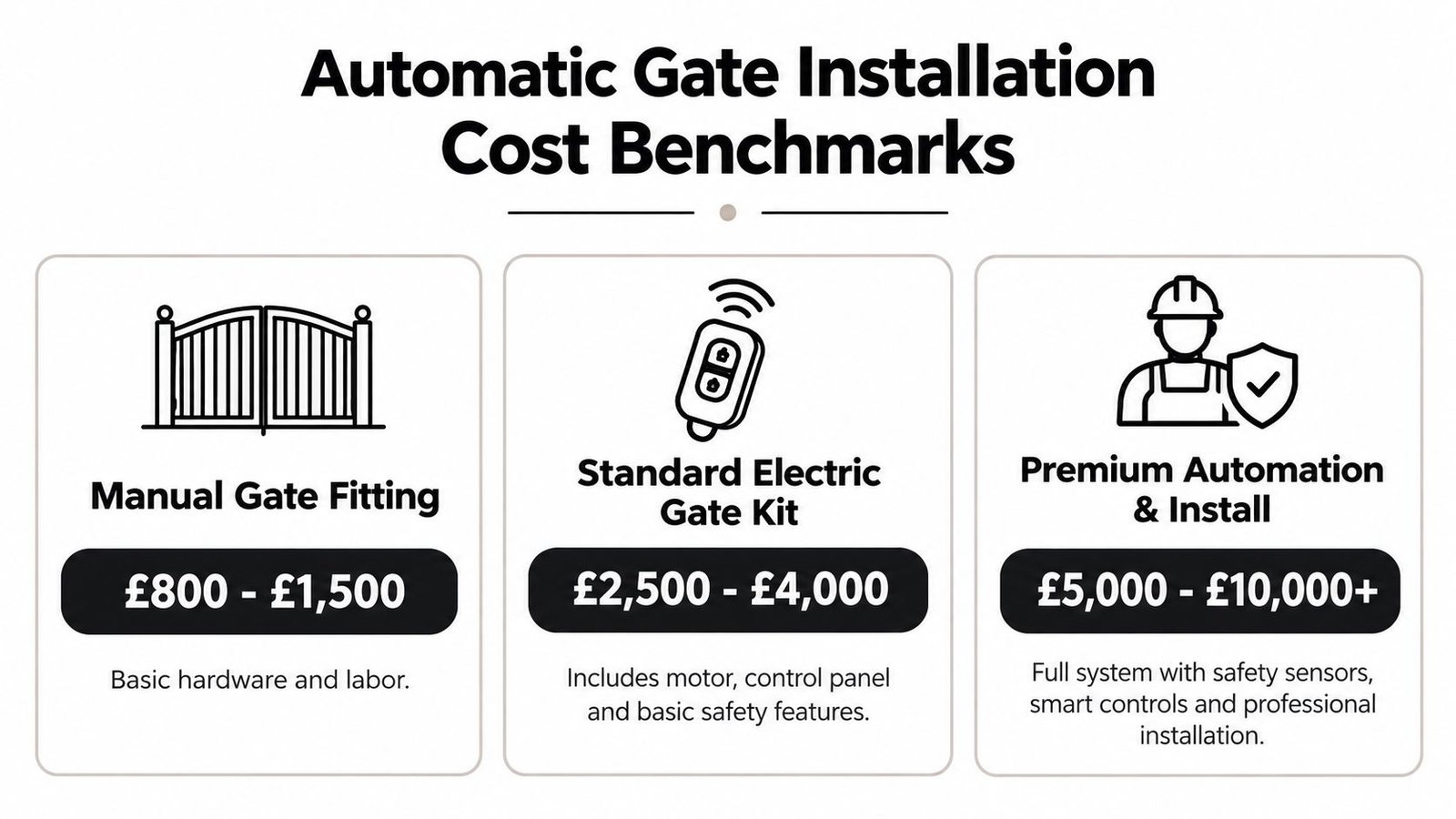
The first distinction to make is between manual gate fitting and a complete automated deployment. UK pricing guides place a standard fitted garden gate at about £250 to £700, while electric or automated gate work is often quoted at £2,000 to £3,000 for installation alone, with an average residential electric-gate job around £3,000 according to UK gate installation cost guidance.
A fully installed residential system commonly moves into the £3,500 to £12,000 range. That broader figure can include the gate, automation equipment, power supply, groundworks, safety components, access controls, commissioning, and remedial work around the installation. The difference between a basic fitting price and a complete system is therefore substantial, but it has a technical explanation.
What the price actually includes
A manual gate mainly requires structural fitting, hinges, posts, alignment, and finishing. Automation adds several connected systems:
- Motor units: Swing and sliding gates need operators matched to their size, weight, movement, and usage.
- Electrical infrastructure: Power must reach the motor and control equipment through suitable cabling and protected routes.
- Control equipment: Keypads, remotes, intercoms, GSM modules, and app-based access all add configuration work.
- Safety components: Photocells, safety edges, vehicle loops, and force testing help prevent the gate operating dangerously.
- Commissioning: The installer must set travel limits, test obstruction responses, configure users, and hand over the system properly.
That's why a motor advertised at an appealing price rarely represents the finished automatic gate installation cost. The motor has to operate a gate that is structurally sound, correctly balanced, and supported by safe electrical and mechanical infrastructure.
Practical rule: Treat any quote that focuses only on the motor as an equipment price, not a complete installation price.
The specification also affects long-term ownership. A cheaper system may suit a lightly used private driveway, but it may be a poor choice where several households, delivery drivers, or commercial vehicles use the entrance. For a useful perspective on the wider financial picture, compare the purchase decision with this resource on 2026 total ownership cost hydraulic, particularly where hydraulic equipment and servicing form part of the design.
Breaking Down Labour and Equipment Expenses
A professional quote usually makes more sense when you separate it into three broad areas: the automation kit, skilled labour, and groundworks. UK pricing guidance gives a detailed 2026 breakdown of roughly £800 to £2,500 for the automation kit, £1,200 to £3,000 for labour and groundworks, and £3,800 to £11,000 or more for a fully installed project with safety equipment. The same guidance places installation alone around £2,000 to £3,000, with total supply-and-fit packages commonly between £3,500 and £12,000. These figures are set out in electric gate installation price guidance.
The three main cost areas
The kit includes more than the operator. Depending on the design, it can include the control board, receivers, remotes, photocells, safety edges, battery backup, warning equipment, keypads, intercoms, or network-connected access control. A basic residential driveway may need a relatively straightforward setup, while a shared entrance needs better user management and clearer access records.
Labour covers mechanical fitting, electrical connection, configuration, testing, and handover. Installers also need to assess whether an existing gate is suitable for automation. A gate that drags, flexes, catches in the frame, or has worn hinges can overload the operator. Fitting a motor without correcting those faults usually creates repeat callouts rather than a saving.
Groundworks are where many quotes diverge. Excavation for ducts, concrete foundations, drainage channels, pillar reinforcement, and underground motor housings can require more time than the visible gate work. Restricted access can also mean that spoil, materials, and equipment must be moved through narrow entrances instead of brought directly to the work area.
| Component | Estimated Cost Range | Notes |
|---|---|---|
| Automation kit | £800 to £2,500 | Motor, controls, safety equipment, and selected access devices |
| Labour and groundworks | £1,200 to £3,000 | Installation, excavation, ducting, foundations, wiring, and setup |
| Fully installed project with safety kit | £3,800 to £11,000+ | Complete supply, installation, safety testing, and commissioning |
Questions to ask before accepting a quote
Ask whether the price includes the gate structure, electrical supply, trenching, concrete work, waste removal, safety testing, and connection to an intercom or access-control platform. Request a clear distinction between allowances and fixed-price work.
If you're comparing equipment, review the specifications rather than choosing by motor name alone. A specialist gate automation kit should be matched to the gate's dimensions, weight, cycle demand, exposure, and intended access method.
The low-thousands pricing pattern has remained broadly consistent, but the upper end has widened as buyers choose underground motors, integrated access control, and more extensive safety systems. That spread reflects specification and site conditions more than arbitrary pricing.
Site Complexity and Technical Cost Drivers
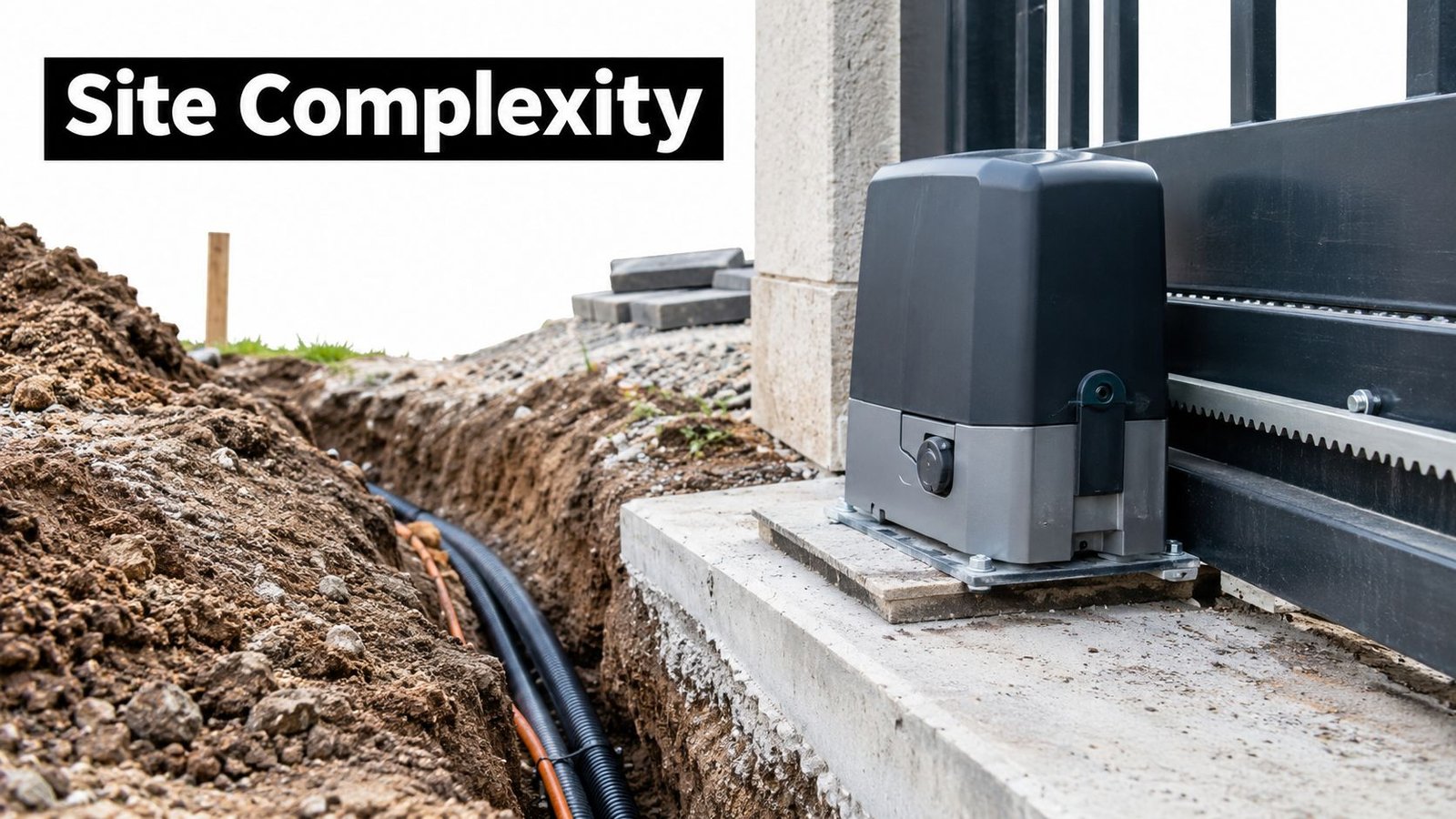
Gate style matters, but the site often matters more. A straightforward swing gate on sound ground with nearby power can be comparatively simple. A sliding gate on a sloping driveway, beside a retaining wall, with no existing cable route, becomes a civil-engineering and electrical project as well as a gate installation.
Why difficult sites cost more
Ground conditions determine how confidently an installer can establish the gate structure and motor base. Soft ground, uneven levels, existing concrete, poor drainage, or buried services can require additional investigation and preparation. An underground operator may look neat once finished, but it demands carefully formed chambers, drainage arrangements, and protected cabling.
Access affects labour efficiency. A narrow South Wales terrace, a steep rural driveway, or a commercial entrance that can't be closed for long may require more careful staging. Materials may need to be carried in, and the installer may have to coordinate work around residents, deliveries, or customer traffic.
Urban and commercial locations can move into higher price bands. UK pricing guidance cites £4,500 to £10,000 for standard automated driveway installations in London-focused examples, while commercial or difficult-ground installations can exceed £10,000. The cited cost drivers include foundations, drainage, cabling, constrained access, and the additional requirements of more complex premises. See this London automated gate total cost guide for the way location and specification widen the range.
Paying for security rather than convenience
Entry-level automation may provide remote opening and closing. Higher-spec systems can add app control, GSM access, safety edges, and in-ground loops. Those features aren't automatically worthwhile, but they can be justified where the gate serves several users, controls a valuable yard, or needs a reliable record of who has access.
For a property manager, remote user administration may reduce the need to issue physical remotes. For a logistics site, vehicle detection and safer closing behaviour can be more valuable than a cheaper motor. A professional gate automation installation should begin with the movement, users, risks, and site layout, rather than a preselected motor.
A higher equipment specification is justified when it removes a recurring operational problem. It isn't justified simply because the feature appears on a brochure.
Real World Quote Scenarios by Property Type
Price ranges become easier to understand when you attach them to actual project briefs. The following are planning scenarios, not case studies or fixed quotations. A site survey is still needed because the same gate type can require very different foundations, cabling, and access arrangements.
Residential driveway upgrade
A homeowner has an existing pair of driveway gates and wants remote opening from the car, with photocells and a keypad for regular visitors. The installer first checks the hinges, gate alignment, post strength, opening clearance, and the route from the consumer unit to the gate.
If the structure is sound and the power route is uncomplicated, this fits the homeowner benchmark of about £3,000 to £7,000 for a fully installed automatic or electric gate project, as reported in 2026 electric gate cost guidance. A South Wales property exposed to heavy rain may need particular attention to cable protection, drainage, corrosion resistance, and the condition of the gate posts. Those details can decide whether the project stays near the lower or upper part of the range.
Multi-tenant commercial car park
A block of flats or small business park needs controlled access for residents, staff, visitors, and contractors. A single shared remote system quickly becomes awkward because lost remotes need cancelling and temporary access must be managed manually.
Here, the quote may include a keypad, proximity credentials, intercom, GSM access, user permissions, and an audit trail. The installer may also need to coordinate the gate with CCTV so that users can be verified before entry. Guidance on commercial gate access control can help property managers think through user administration and access permissions before selecting equipment.
Groundworks become more important if the car park has existing tarmac, drainage channels, or shared underground services. The lowest quote may omit reinstatement or offer a basic controller that doesn't support the access policy the property needs.
Industrial logistics facility
An industrial entrance may handle larger gates, frequent vehicle movements, articulated deliveries, and stricter operational demands. Underground motors, reinforced foundations, vehicle loops, warning systems, safety edges, and strong access control can all be appropriate, depending on the risk assessment and traffic pattern.
Commercial and difficult-site installations can exceed £10,000, particularly where underground motors, ducting, foundations, and access-control integration require substantial labour and civil work. At this level, the right question isn't “Which motor is cheapest?” It's “Which design will operate safely, remain serviceable, and avoid disrupting deliveries?”
For all three scenarios, the gate itself is only one part of the brief. A good quotation describes how the system will be used, what happens during a power failure, how emergency access works, and who will maintain it.
Evaluating Installer Quotes and Safety Compliance
A quote should let you compare scope, not just totals. Two installers may use similar-looking equipment while allowing for very different levels of excavation, testing, documentation, and aftercare.
Read the specification line by line
Check that the document identifies the gate type, operator model, control panel, safety devices, access methods, cable routes, foundations, and surface reinstatement. “Installation included” isn't precise enough if it doesn't explain whether the installer has allowed for trenching, ducting, concrete, electrical connection, and waste removal.
Ask how the installer will demonstrate safe operation. The handover should cover obstacle detection, photocell response, safety-edge operation where fitted, force limitation, emergency release, and power-failure procedures. The installer should also explain what documentation you'll receive after completion.
Verify competence and accountability
For a domestic property, you may want to check insurance, electrical certification, warranty terms, and relevant trade accreditation. For a business, ask about SafeContractor accreditation, DBS-checked engineers where appropriate, risk assessments, method statements, and maintenance support.
If the gate forms part of a wider security system, check the relevant standards for that system. An integrated intruder alarm should align with BS EN 50131 where applicable. Don't assume that a gate installer who can fit a motor can also design access control, CCTV integration, or alarm interfaces properly.
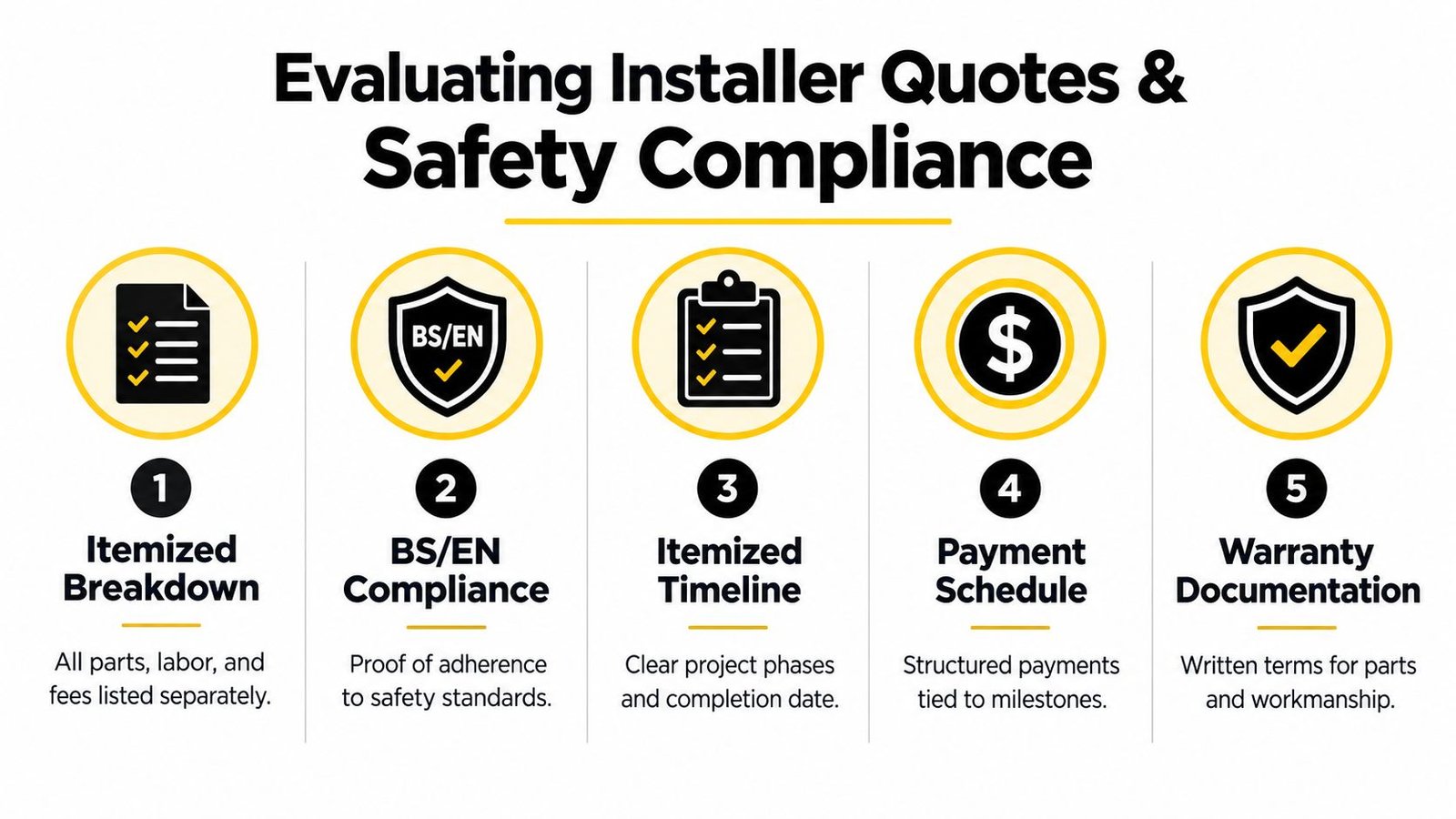
Use the following checklist during quotation meetings:
- Itemised scope: Confirm that equipment, labour, groundworks, electrical work, testing, and reinstatement are shown separately.
- Safety evidence: Ask how safety edges, photocells, force limitation, and commissioning will be tested and recorded.
- Programme clarity: Establish the work phases, site access requirements, expected completion point, and any dependencies.
- Payment structure: Tie staged payments to identifiable milestones rather than paying the full balance before commissioning.
- Warranty and support: Get written terms for parts, workmanship, callouts, exclusions, and future servicing.
The accompanying video can help you visualise the type of installation detail that should be discussed during a site assessment.
A quote that leaves safety testing vague isn't a bargain. It transfers uncertainty to the property owner, who may later face faults, unsafe operation, or an expensive return visit.
Long Term Value Through Maintenance and Integration
The initial automatic gate installation cost is only one part of ownership. Gates combine moving mechanical components with electrical controls, access devices, and safety sensors. Rain, grit, standing water, vehicle impact, and repeated use can expose small faults that become larger failures if nobody inspects them.
A maintenance visit should be practical rather than ceremonial. The engineer should check gate movement, hinges or rollers, motor fixings, cable entries, control equipment, photocells, safety edges, release mechanisms, and user controls. The system should also be tested in the conditions that matter to the site, including obstruction response and access during a power interruption.
Integration reduces operational friction
A gate that operates in isolation may leave staff managing several unrelated systems. Connecting it with CCTV, an intercom, intruder alarms, and access control can give authorised users a clearer process. For example, a receptionist may verify a visitor on video before releasing the gate, while a property manager can remove a departed tenant's access without collecting a remote.
Integration doesn't mean adding every available feature. It means choosing compatible equipment and agreeing how each system should behave. A contractor who understands CCTV, alarms, access control, and gate automation can usually diagnose faults more efficiently than several vendors working separately.
Choose serviceability at the design stage
Ask where the control panel will be mounted, how technicians will reach the motor, whether drainage can be cleared, and how replacement parts will be sourced. A visually neat underground installation can be a poor choice if water collects around the equipment or future servicing requires extensive excavation.
The cheapest long-term arrangement is often the one that balances durability, access, and maintainability. That may mean selecting above-ground equipment where the site is wet, improving the gate structure before automation, or specifying remote management where users and permissions change regularly.
Getting Expert Advice for Your South Wales Project
A reliable budget starts with a site survey, not a motor catalogue. Cardiff, Newport, Swansea, Bristol, and surrounding areas include compact urban driveways, exposed rural properties, steep approaches, commercial yards, and industrial entrances. Each setting creates different requirements for foundations, drainage, cable routes, access control, and maintenance.
Prepare a short project brief before contacting an installer. Include photographs of the gate and driveway, approximate opening width, whether the gate is sliding or swinging, the distance to the nearest suitable power point, the number of regular users, and any need for intercom, keypad, vehicle detection, CCTV, or remote management. Mention difficult access, shared ownership, delivery traffic, and any existing security equipment.
A professional assessment should establish whether the existing gate can be automated, whether the pillars or track need work, how power will reach the system, and which safety controls suit the movement pattern. It should also make exclusions visible, particularly electrical connection, excavation, drainage, surface repair, and ongoing servicing.
Wisenet Security Ltd provides gate automation installation and maintenance alongside CCTV, intruder alarms, access control, fire alarms, and video intercoms. Its South Wales and South West service area includes electric gates in Cardiff, with free consultations, DBS-checked engineers, SafeContractor accreditation, and more than 20 years of experience stated by the company.
Ask for an itemised proposal that explains the design, infrastructure, safety testing, handover, warranty, and maintenance arrangements. That gives you a meaningful basis for comparing automatic gate installation cost, rather than choosing between unexplained totals.
Wisenet Security Ltd can assess your driveway, commercial entrance, car park, or logistics site and design an automatic gate system around its real access and safety requirements. Visit Wisenet Security Ltd to request a free consultation and discuss a clear, site-specific quotation for installation, integration, and ongoing maintenance.