Install Burglar Alarm
You've probably reached the point where a quick online search has produced a confusing choice of kits, sensors and subscription plans. A wireless alarm looks easy to fit yourself, while an installer's quotation may seem to include far more than a control panel, a keypad and a siren. The important question isn't how to install a burglar alarm, but whether the finished system is designed for the property, accepted by your insurer and capable of delivering the response you expect.
A standards-led installation treats the building, its risks, its users and its signalling route as one system. That approach matters in a home, but it matters even more in a shop, warehouse, office, rental property or multi-tenant building where a poorly specified alarm can create false alarms, undermine insurance arrangements or fail to qualify for police response.
Table of Contents
- Why a Standards-Led Burglar Alarm Installation Matters
- Planning a Site Survey and Risk Assessment
- Choosing Wired Versus Wireless Alarm Systems
- Selecting and Placing Sensors and Detectors
- Control Panel Setup, App Alerts and Monitoring
- Cost Considerations and When to Hire a Professional
- Testing, Commissioning and Ongoing Maintenance
Why a Standards-Led Burglar Alarm Installation Matters
A homeowner comparing a self-install kit with a professional quotation may see similar-looking components in both boxes. The difference is usually hidden in the design work. A compliant system isn't just a collection of detectors that sends an alert when something moves. It's a graded installation, designed around the property's burglary risk and the likely capability of an intruder.
The UK's modern alarm framework grew from a significant standards change. BSI records list BS EN 50131-1:2006 as the core current standard for intrusion and hold-up system requirements, while earlier documents, including BS EN 50131-1:1997 and related pre-EN standards, were withdrawn. Industry guidance records the UK transition through PD 6662:2004, with the transition period ending on 1 December 2005, moving new installations towards the European standard route. The BSI publication index for BS EN 50131 also lists later component standards, including BS EN 50131-4:2019 and BS EN 50131-5-3:2017.
What the grading system changes
In practical terms, the standard asks the installer to match system resilience to risk. A straightforward home with limited exposure may need a different design from a commercial premises containing stock, cash, sensitive equipment or restricted areas. The alarm grade, detector supervision, tamper protection, power arrangements and transmission method all form part of that decision.
That's why buying individual components first can create problems. A detector may be technically compatible with a panel, yet the complete installation may still be under-specified for the site or unsuitable for an insurer's requirements. The same principle applies to wireless equipment. Radio communication can be appropriate, but the installer must consider signal reliability, battery supervision and the system's specified grade rather than treating wireless as automatically equivalent in every application.
Practical rule: Decide the risk, grade and signalling route before choosing the equipment. Don't make the equipment catalogue determine the security design.
A bell-only alarm can provide a visible and audible deterrent. A self-monitored system can send app notifications to nominated users. A monitored system connected through an approved Alarm Receiving Centre can support a different response pathway, but only when the installation, monitoring arrangement and user procedures meet the relevant requirements. As the plain-English guide to EN 50131 explains, the standards layer affects what the system can credibly do, not just how it looks on the wall.
The wider context also deserves attention. The Office for National Statistics recorded 224,518 burglary offences in England and Wales in the year ending December 2025, a 12% fall compared with the previous year, but that remains a substantial national burglary problem (ONS burglary data via the UK Data Service). Research material also highlights that an alarm's presence can alter burglary risk in some settings, particularly where it signals valuables or is poorly installed and maintained. The lesson is straightforward: an alarm only helps when its specification, installation and upkeep match the property.
Planning a Site Survey and Risk Assessment
Before buying a kit, walk the site as though you were trying to enter it. Start at the boundary and work towards the valuables. An installer isn't counting rooms for the sake of a quotation. They're identifying routes, concealment, likely attack points and the places where a detector could create either a useful alarm or an avoidable nuisance.
Use a repeatable survey sequence
Begin with the perimeter. Check gates, side passages, rear access, adjoining roofs, garages, sheds and areas hidden from neighbours or passing traffic. Note whether a burglar can approach a door or window without being seen, and record lighting, vegetation and access shared with other occupiers.
Next, map every entry point. Include external doors, patio doors, accessible windows, roof lights, internal doors separating a protected area and any route from an attached garage. Record the frame condition, opening direction, glazing type and whether a door is routinely used by residents, staff, cleaners or contractors.
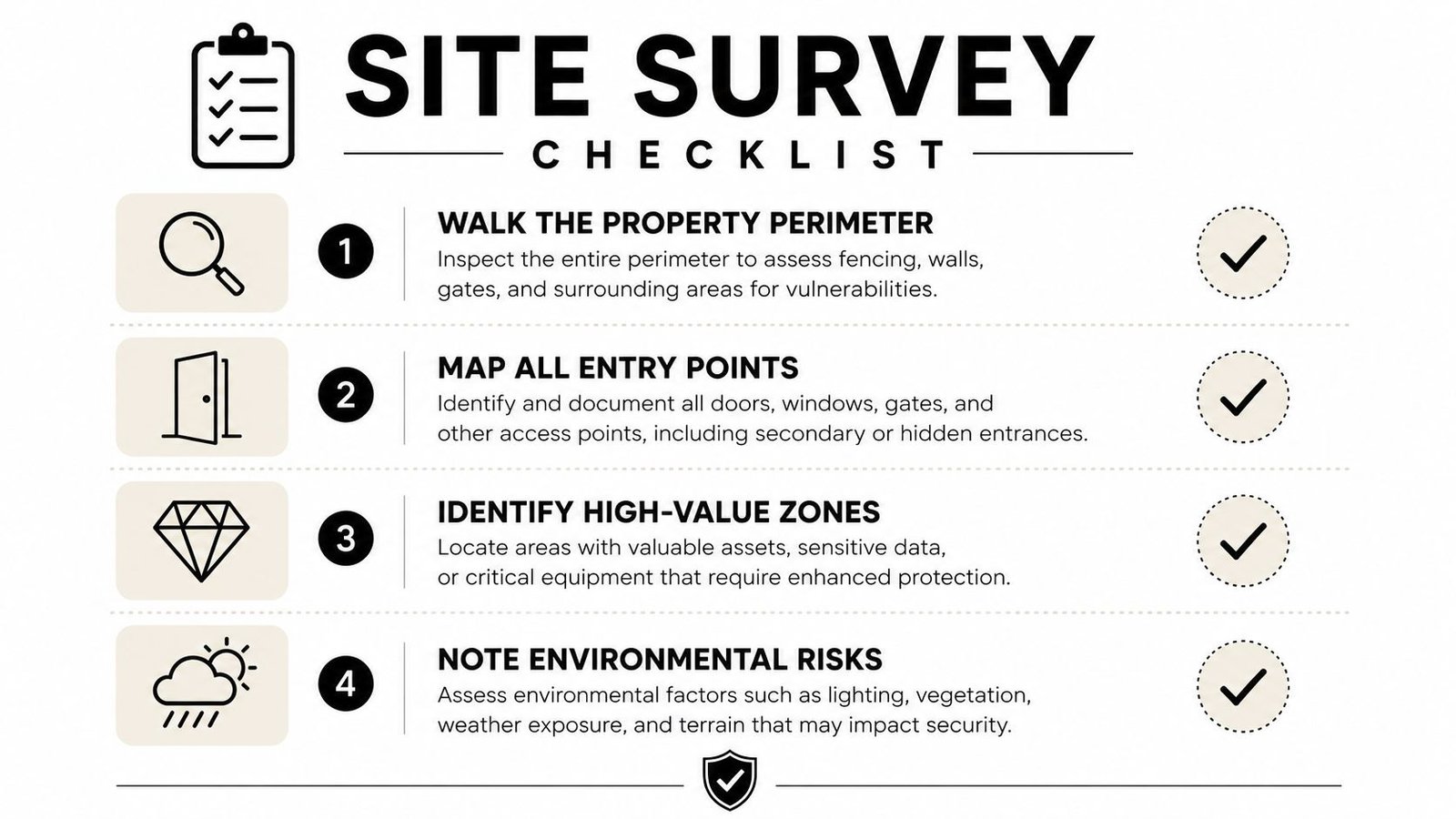
Then identify high-value zones. In a home, that might include a study, jewellery storage area or open-plan rear extension. In a business, it may be a cash office, server room, stockroom, loading area or manager's office. Don't assume the largest room is the most important one. Risk comes from what's held there, how accessible it is and how easily an intruder can reach it.
Record conditions that affect detection
Environmental conditions often decide whether a detector works reliably. A PIR facing a radiator, heater, sunny conservatory or moving curtain may behave differently from one in a stable hallway. Pets, air movement, reflective surfaces, delivery activity and temperature changes all belong on the survey record.
A useful checklist should capture:
- Entry point: Identify the opening, its normal use and the detector or contact proposed.
- Approach route: Record whether the intruder is likely to cross the detector, pass along it or avoid it.
- Environmental risk: Note pets, draughts, heat sources, sunlight, machinery and moving objects.
- Value and vulnerability: Mark the asset, room or process the alarm must protect.
- User behaviour: Record who sets the system, which doors remain open and when the building is occupied.
- Signalling expectation: Ask whether the insurer requires monitoring, a particular transmission grade or evidence from an approved installer.
For commercial premises, UK guidance generally treats Grade 3 as the minimum benchmark and notes that insurers often expect ATS4PLUS or an equivalent signalling arrangement. Those requirements come from the site's risk and the insurer's terms, not from a universal rule that every building needs the same equipment (NPSA intruder detection system guidance).
If cameras are part of the wider plan, keep privacy and surveillance obligations separate from alarm grading. For a useful comparison of how camera rules can vary by location and context, see this resource on legal rules for cameras in Brisbane. The legal framework isn't interchangeable with UK alarm standards, but the planning principle is useful: decide what you're monitoring, why you're monitoring it and who can access the information.
Choosing Wired Versus Wireless Alarm Systems
Wired and wireless systems can both be sensible choices. The right answer depends on the building, the required grade, the disruption you can tolerate and the maintenance discipline available after handover.
A wired installation remains attractive where cable routes are accessible. New builds, refurbishments and larger commercial premises can conceal cabling during construction, reducing visual impact and avoiding reliance on radio links for every detector. Wired devices also avoid routine sensor battery changes, although the panel and backup power arrangements still need servicing.
Wireless is often the practical answer for an occupied home, a listed building or a property where chasing walls would create unacceptable damage. It suits staged expansion and can reduce installation disruption. That convenience comes with responsibilities, including battery management, radio path verification and attention to interference or signal changes after the building is altered.
| Criterion | Wired | Wireless |
|---|---|---|
| Installation impact | More invasive in finished buildings, easier during construction | Lower disruption and well suited to occupied premises |
| Reliability considerations | Stable physical connection, with cable routes protected and tested | Requires radio strength checks, supervision and battery control |
| Expansion | Additional cabling may be needed | Often easier to extend, subject to system grade and radio limits |
| Maintenance | Less sensor battery work, but wiring and power still need checks | Batteries, signal quality and tamper supervision need attention |
| Typical fit | New builds, refurbishments and demanding commercial layouts | Homes, heritage properties and multi-tenant retrofits |
A hybrid system can combine wired contacts in accessible service areas with wireless detectors where cabling would be disruptive. That can be effective, but it still has to be designed as one compliant system rather than assembled from whichever devices are easiest to fit.
Wireless isn't automatically a compromise, and wired isn't automatically compliant. The grade, installation method and commissioning evidence matter more than the label.
When comparing equipment families, look beyond the marketing description and check how the proposed design handles detectors, warning devices, power supplies and radio-frequency interconnections. The overview of intruder alarm types can help a homeowner understand the broad categories before discussing a site-specific specification with an installer.
Selecting and Placing Sensors and Detectors
Detector choice should follow the route an intruder is likely to take, not the number of devices included in a package. A door contact tells you that an opening has changed state. A PIR detects movement across its field. A shock sensor may identify an attack before the door is opened. Each device protects a different stage of the intrusion.
Match the device to the opening
Use magnetic contacts on regularly used external doors and accessible windows, provided the frame and contact can maintain reliable alignment. A contact on a loose or distorted frame will create trouble. On vulnerable doors, a shock sensor can add earlier warning by detecting impact or attempted forcing, but its sensitivity must be set for the building rather than left at an aggressive default.
Glass-break detection can cover glazing that a PIR won't see effectively, particularly in shopfronts or large reception areas. It depends on the acoustic environment, so machinery, music, hard surfaces and repeated operational noise need consideration. A dual-technology detector can reduce nuisance activations in difficult spaces by requiring more than one detection condition, though it may also respond less readily in some circumstances.
PIRs work best when an intruder crosses the detection pattern. Avoid pointing them directly at windows, heaters, air-conditioning outlets or areas with strong sunlight. A hallway detector should protect movement through the route, while a room detector should cover likely approaches without creating a blind corner behind furniture or partitions.
Design for real occupancy
Pet-friendly PIRs can help in homes with animals, but they aren't permission to ignore placement. A large or active pet, furniture that allows an animal to climb into the detection field, or a sensor positioned too low can defeat the intended arrangement. Tell the installer about the animal's size, routine and access to protected rooms.
For a typical three-bedroom house, map the front and rear doors, accessible ground-floor windows, the main hallway, the staircase approach and any concealed extension or garage route. A small shop may need contacts at the public entrance, protection around the rear delivery door, detection across the sales floor and a separately managed stock or cash area. Panic buttons belong where staff can reach them discreetly, with clear procedures for accidental activation.
The guide to door and window sensors is useful when comparing contact-based protection with motion detection. Don't overfill a design with sensors that users will routinely bypass. A smaller, well-positioned and properly maintained arrangement is more useful than a crowded installation that generates nuisance alarms.
Control Panel Setup, App Alerts and Monitoring
The control panel is the point where the installation becomes an operating system rather than a box of components. It receives detector signals, supervises faults and tamper conditions, controls setting modes and passes alarm information to the chosen notification route.
Mount the panel where it's protected from casual attack but accessible to authorised users and service engineers. Enrol each device individually, label zones in plain language and check that the displayed description matches the physical location. “Zone 4” isn't useful to a tenant or keyholder at two in the morning. “Rear stockroom door” is.
Set entry and exit delays around actual behaviour. A front-door delay that's too short encourages users to leave doors open while unsetting. One that's too long gives an intruder unnecessary time. Test the route with every regular user, including staff carrying bags, parents managing children and cleaners arriving outside normal hours.
Choose the notification route deliberately
A bell-only system relies on the siren and people nearby noticing and acting. A self-monitored system sends app notifications to nominated users, but it also relies on those users having connectivity, battery life, availability and a clear response plan. An ARC-monitored system passes signals to an Alarm Receiving Centre, which follows agreed procedures and can support keyholder or police notification pathways where the required conditions are met.
A Unique Reference Number, or URN, isn't a general alarm registration that any app can create. Police notification depends on the approved installer, the approved ARC, the system's compliance with the applicable requirements and proper false-alarm management. Guidance for UK consumers stresses that monitored alarms can support police notification only within that framework, and that repeated false alarms can lead to the loss of police response (Crimestoppers security-system guidance).
Confirmed-alarm design under BS 8243 is central to that process. The system needs to provide the confirmation and signalling behaviour expected for the response pathway, rather than sending one unverified activation. App alerts still have a place, especially for everyday awareness, but they aren't a substitute for URN-linked compliance.
For readers comparing phone-based safety tools alongside property protection, this top personal safety apps review offers separate context. Personal safety applications and intruder alarms solve different problems, so don't treat a phone alert as evidence that an alarm qualifies for police response.
At handover, ask the installer to demonstrate setting, part-setting, unsetting, alarm cancellation, app permissions, user management and the response procedure for an accidental activation. If nobody can explain what happens after a signal leaves the panel, the monitoring choice hasn't been properly understood.
Cost Considerations and When to Hire a Professional
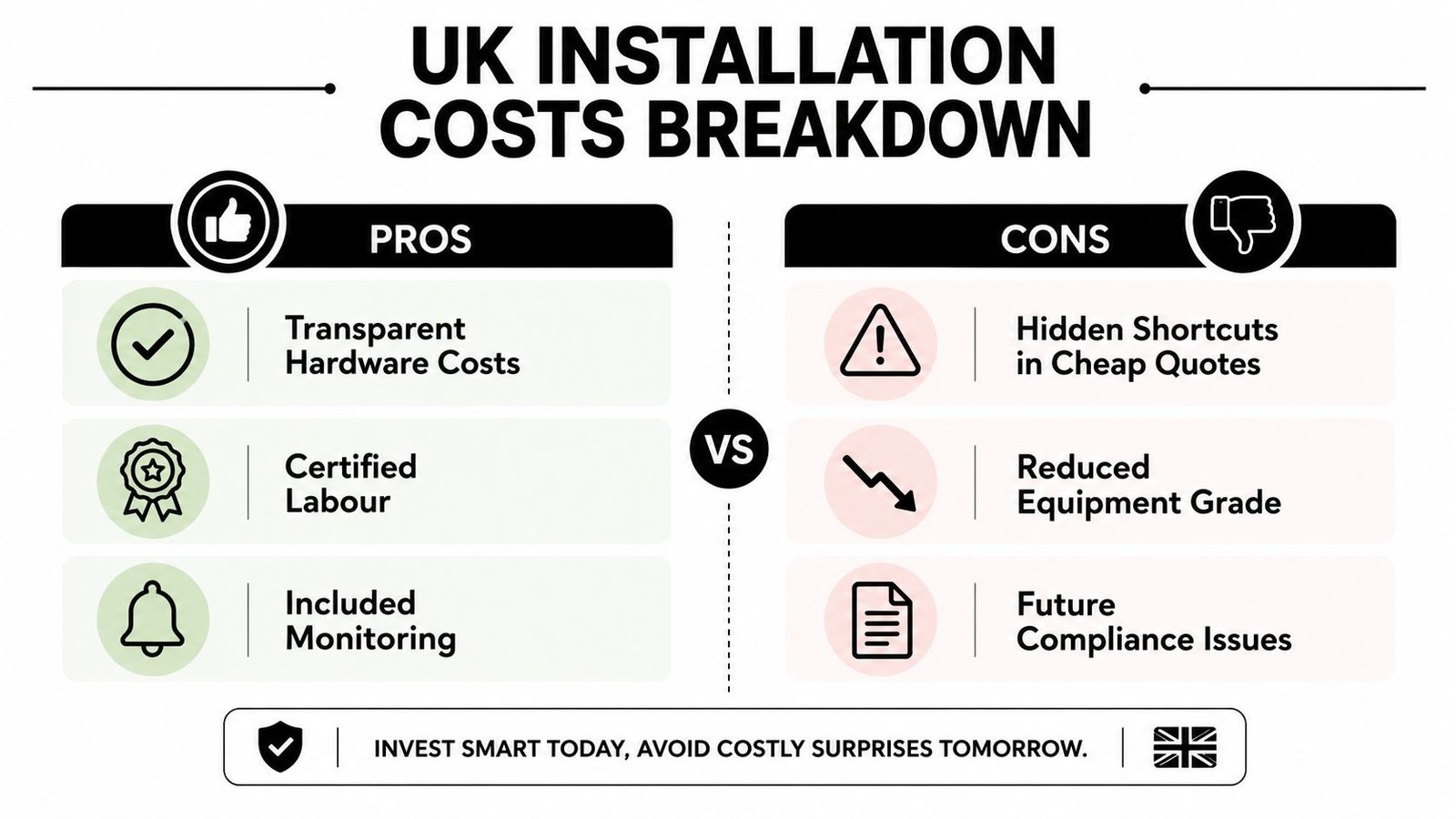
A meaningful alarm quotation separates hardware, labour, signalling, monitoring and maintenance. Two systems can look similar at the keypad while differing substantially in detector grade, transmission resilience, backup power, commissioning time and the paperwork required for insurance or police response.
Cheap quotes often hide their savings in design rather than in the plastic casing. The installer may omit a difficult entry point, specify a lower grade than the insurer expects, use a notification route that doesn't support the desired police pathway or leave maintenance outside the quoted scope. Those omissions only become visible when an insurer asks for evidence or a false alarm causes a response problem.
Where the money goes
Hardware cost reflects more than the panel. Count every detector, contact, warning device, power supply, backup arrangement, keypad, communicator and enclosure. A demanding commercial design may also require higher-grade components, more protected routes and more detailed commissioning.
Labour includes the survey, cable routes or radio planning, installation, programming, testing and handover. A professional quotation should also state whether app configuration, user training, certification, monitoring setup and remedial visits are included. Monthly charges may apply for ARC monitoring, while maintenance creates an ongoing cost that protects reliability and supports any compliance arrangement.
For commercial premises, ask how the proposal meets the risk assessment and whether the insurer has specified a grade or signalling arrangement. UK guidance identifies Grade 3 as a general minimum benchmark for commercial premises and notes insurer expectations around ATS4PLUS or an equivalent arrangement (NPSA security-manager guidance). A domestic bell-only system may be entirely reasonable for one property, but it shouldn't be presented as equivalent to a monitored, insurer-aligned commercial system.
Ask these questions before accepting a quote:
- What grade is being proposed: Is the grade documented, and what site risks led to that choice?
- What response is included: Is the system bell-only, self-monitored or ARC-monitored?
- What does the insurer require: Has the specification been checked against the policy?
- What happens after handover: Are servicing, batteries, call-outs and monitoring terms clear?
- Who carries out the work: Can the installer explain its approval status and provide compliance documents?
Approval and competence matter because a poorly installed system can create both safety and contractual problems. This wider discussion of unlicensed security installer risks isn't UK-specific guidance, but it reinforces a sound procurement principle: verify who is responsible for design, installation, testing and ongoing support before allowing work to begin.
DIY can be suitable for a straightforward, audible-only domestic system where police response and insurer certification aren't required. Hire a professional when the property is complex, the insurer specifies a standard or grade, the system must connect to an ARC, multiple users need managed access, or the consequences of a failure extend beyond one household.
Testing, Commissioning and Ongoing Maintenance
The installation isn't finished when the last sensor is screwed into place. Commissioning proves that the design works as intended, that users can operate it without confusion and that the signalling route behaves correctly under fault and alarm conditions.
Start with a complete walk-test. Open every protected door and window, trigger every motion detector, test shock devices using the approved method and confirm that panic buttons follow the agreed process. Check each zone at the panel and compare the displayed description with the physical location. A missing label can delay a keyholder's response when several signals arrive together.
Verify the system in layers
Test the external warning device and any internal sounders, then check tamper circuits on the panel, detectors, bell box and accessible junction points. Disconnect or simulate power failure according to the manufacturer's commissioning procedure, and confirm that the system reports faults rather than continuing with a hidden weakness.
Wireless devices need a signal-strength check at their final installed positions, not just beside the panel during setup. Doors, walls, stored stock, metal racking and later building work can affect radio performance. Confirm battery supervision and record device identifiers so future maintenance can distinguish a genuine low battery from a communication issue.
The signalling route needs its own test. Verify the app path for self-monitored systems, the ARC path for monitored systems and the agreed cancellation procedure. The operator or engineer should explain what constitutes an alarm, what constitutes a fault and who receives each notification.
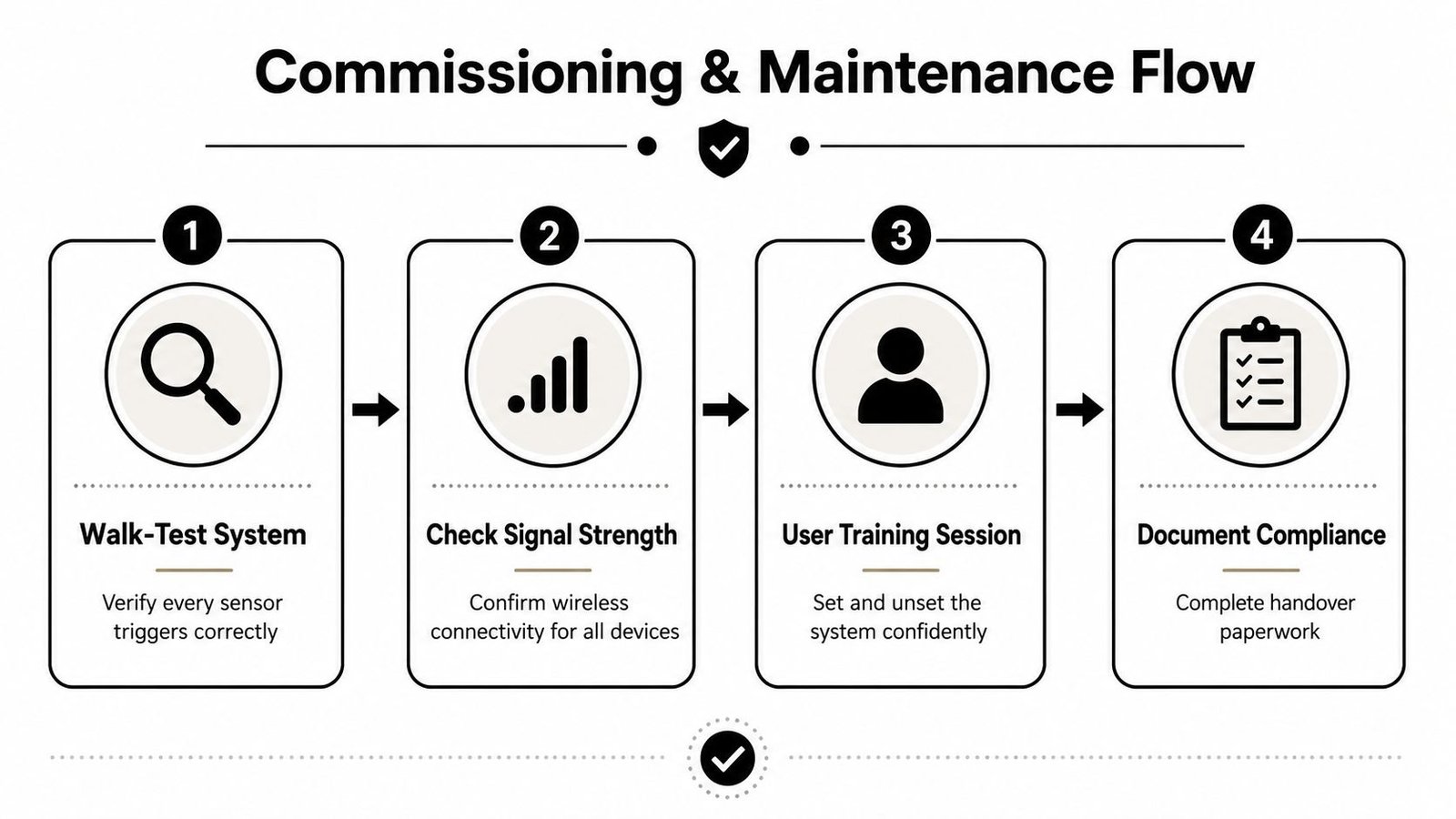
Handover standard: A user should be able to set, unset, part-set, cancel an accidental alarm and report a fault without guessing.
Train the people who create the false alarms
False alarms have historically been the sector's most persistent technical and operational problem. UK police-referenced history records approximately 1.25 million to 1.47 million false-alarm calls annually in the early 1990s, or roughly 2.35 down to 2.19 false alarms per system, with over 92% of alarm calls in the five years to 1993 attributed to equipment, communication or user error (BSI guidance on confirmed alarm conditions). The figures are historical, but the practical lesson remains current: detector placement alone won't control nuisance activations.
Train users to close protected doors before setting, keep windows in the correct state, follow entry routes and avoid lending codes casually. Explain how pets, contractors, cleaners, deliveries and temporary changes to room layouts affect the system. Every keyholder needs the alarm company's contact details, the cancellation process and a clear instruction not to repeatedly unset and reset a system that's reporting a fault.
Common causes are mundane:
- Unclosed openings: A rear door left ajar during setting can produce a preventable activation or an insecure property.
- Poor contact alignment: Movement in a door or window can interrupt the contact circuit.
- Blocked detection fields: New shelving, decorations or stored stock can create blind spots or affect a detector.
- Environmental movement: Heating, ventilation, sunlight, curtains and loose objects can trigger unsuitable PIR arrangements.
- User uncertainty: People who don't understand part-setting or entry delays often improvise under pressure.
BS 8243's confirmed-alarm approach is intended to improve the quality of alarms passed for police response. It doesn't remove the need for correct installation or sensible user behaviour. If an ARC or police service raises a false-alarm concern, investigate the cause promptly rather than treating the warning as an administrative issue.
Keep a written maintenance rhythm
At every service, inspect the panel, power supply, warning devices, detectors, contacts, tamper protection and signalling equipment. Test a representative range of functions according to the system specification, and carry out a complete functional check where the maintenance arrangement requires it. Wireless systems need particular attention to battery condition and communication supervision, while wired systems still need inspection for damaged cables, loose connections and altered room layouts.
A practical property schedule should include:
- Routine user checks: Users should test the system through the agreed procedure, report faults and confirm that app or keyholder contacts remain current.
- Planned servicing: Arrange servicing at the interval required by the system, insurer, monitoring arrangement and installer's maintenance terms. Don't assume one interval suits every property.
- After-change inspection: Reassess the system after building work, new partitions, changed stock layouts, new pets, heating changes or altered occupancy.
- Annual documentation review: Check certificates, service records, user lists, ARC details, emergency contacts and insurer requirements.
Four questions UK users ask
What triggers real police response? A bell or app alert alone doesn't guarantee it. Police notification depends on an approved installer, an approved ARC, a valid URN arrangement and compliance with the relevant NPCC-linked requirements. Confirmed-alarm operation, documented commissioning and effective false-alarm control remain essential. Consumer guidance also warns that police response can be withdrawn after repeated false alarms (Crimestoppers UK security-system advice).
Can a DIY installation be URN-linked? Don't assume it can. UK guidance states that new installations seeking police response since June 2019 must conform to PD 6662:2017 and BS 8243, with the necessary approval, monitoring and procedural arrangements (NSI intruder-alarm guidance). A consumer can install an alarm for local or self-monitored use, but a URN-linked outcome requires the complete approved pathway, not merely compliant-looking devices.
What affects insurance acceptance? The insurer's specification comes first. Ask for the required grade, signalling arrangement, installer approval and maintenance evidence before work starts. A system can deter intrusion yet still fail to meet a policy condition if the design, paperwork or servicing doesn't match what the insurer requested.
How often must an alarm be serviced? There isn't one universal interval that can be applied safely to every UK system. Follow the insurer's terms, the monitoring agreement, the system specification and the installer's maintenance recommendation. Arrange an earlier review after faults, repeated activations, refurbishment, changes in occupancy or any alteration that affects detector coverage or radio paths.
The most reliable installation is the one people can operate, engineers can maintain and insurers can recognise. Treat commissioning paperwork and user training as part of the security system, not as extras left behind after the tools are packed away.
Wisenet Security Ltd designs, installs and maintains burglar alarms for homes, businesses, warehouses and multi-tenant properties across South Wales and the South West, with bell-only and monitored options, app alerts and pet-friendly sensors. For a site survey tied to BS EN 50131, PD 6662 and your insurer's requirements, visit Wisenet Security Ltd and arrange a consultation.