Fire Alarm Sounder Guide: Types, Standards & Placement
You can stand under a ceiling sounder during a weekly test and still miss the point completely if the unit's been fitted behind a racking bay, above a noisy extractor, or in a corridor nobody uses. I've seen that happen in small warehouses, offices, and car parks, and the result is always the same, people assume the system is fine because the panel is healthy, then the alarm is too weak, too sharp, or too badly placed to do its real job when it matters.
A fire alarm sounder is the part that turns a control panel decision into an unmistakable human warning. That sounds simple until you deal with machinery noise, sleeping occupants, sensitive ears, or a building where one “loud” unit on paper turns into a weak signal once distance, doors, shelving, and absorption get involved. The difference between a system that complies on paper and one that effectively clears a building is usually the sounder, not the detector.
Table of Contents
- Why a Fire Alarm Sounder Is More Than Just a Loud Noise
- How a Fire Alarm Sounder Actually Works
- Main Types of Fire Alarm Sounders and Where Each Fits
- UK Standards, Volume and Placement Requirements
- Wiring Sounders Into Conventional and Addressable Systems
- Choosing the Right Sounder for Different Premises
- Testing, Maintenance and Common Sounder Faults
- When to Call a Professional Installer
Why a Fire Alarm Sounder Is More Than Just a Loud Noise
A site can pass a quick sound test and still fail in real life. I once walked into a small warehouse where the staff had been told the alarm was “fine”, but the sounder at the back had been mounted behind a run of racking, so the test tone never really reached the busy work area. The control panel did exactly what it was supposed to do, the human warning was the weak link.
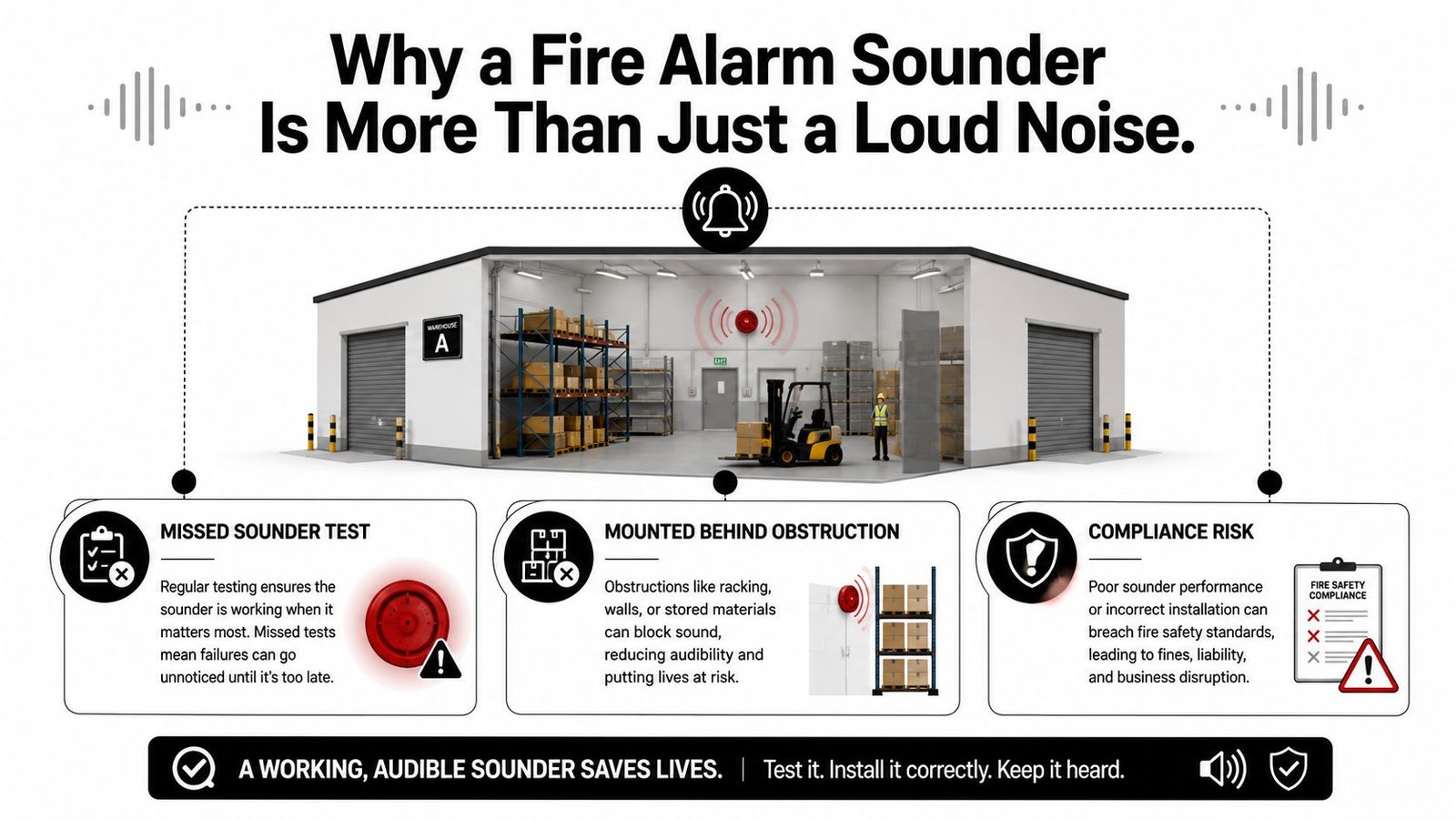
The job of a fire alarm sounder is not to be loud in the abstract. Its job is to be audible where people are, against whatever noise is already there, and to remain clear enough that they react quickly instead of hesitating. That's why the practical target is an audibility margin over background noise, not a box rating taken in isolation.
Practical rule: if the sounder can't be heard over the real noise in the room, it's not doing its job, no matter how impressive the label looks.
That's the part many quick searches miss. They stop at “how many dB does it make”, but the important questions are different: which type fits the building, where it should go, how it gets wired, and when the installation needs a specialist rather than guesswork. If you want a general compliance overview to compare with site practice, the guidance in this fire safety compliance resource is a useful starting point.
The rest of the decision comes down to four things. Choose the right sounder type, put it in the right location, test it against the actual ambient noise, and know when the job has moved beyond a simple replacement. Get any one of those wrong and a compliant system can still fail people in the evacuation.
How a Fire Alarm Sounder Actually Works
A house doorbell is the easiest comparison. You press a button, the circuit closes, and a chime tells someone inside that a decision has been made outside the door. A fire alarm sounder works on the same basic principle, except the “button” is a fire panel or detector logic, and the result has to move people out of a building, not just answer a door.
From panel signal to audible warning
The panel sends power or a control signal down the notification circuit, and the sounder converts that input into a tone, pulse, or voice message. On combined devices, the same unit can also drive a beacon or strobe, which is why you'll often see sounder-beacons in places where a sound-only warning isn't enough. In mixed environments, that combination helps because different occupants process warnings in different ways.
The key point is that the sounder is part of the life-safety chain. It's not a detector, and it's not a standalone nuisance buzzer. It's the final human-facing stage that has to work after all the upstream decisions have been made correctly.
Conventional, addressable, and voice notification
Conventional circuits are the simpler form, all linked devices sound together, so they're often easier to retrofit into smaller premises. Addressable systems treat each sounder or sounder base as an identifiable device, which gives more control for zoning and staged evacuation. Voice alarm sounders go further and deliver spoken instructions or recorded messages instead of only a tone, which matters in larger buildings where a single alarm noise isn't always the clearest instruction.
That matters because notification isn't just about volume. It's about what the person hears, how quickly they understand it, and whether the message makes sense under stress.
Field note: if occupants can't tell whether the noise is a fire warning, a fault, or a routine test, the system has already lost useful time.
The last thing to pin down is what a sounder is not. It isn't a smoke detector, it isn't an intruder alarm bell, and it isn't a battery gadget you can hang anywhere without checking the panel, coverage, and circuit design. Once you see it as the alarm's voice rather than a noisy accessory, the rest of the choices start making sense.
Later in this section, the disassembled unit image helps show why those apparently simple red boxes are doing several jobs at once. 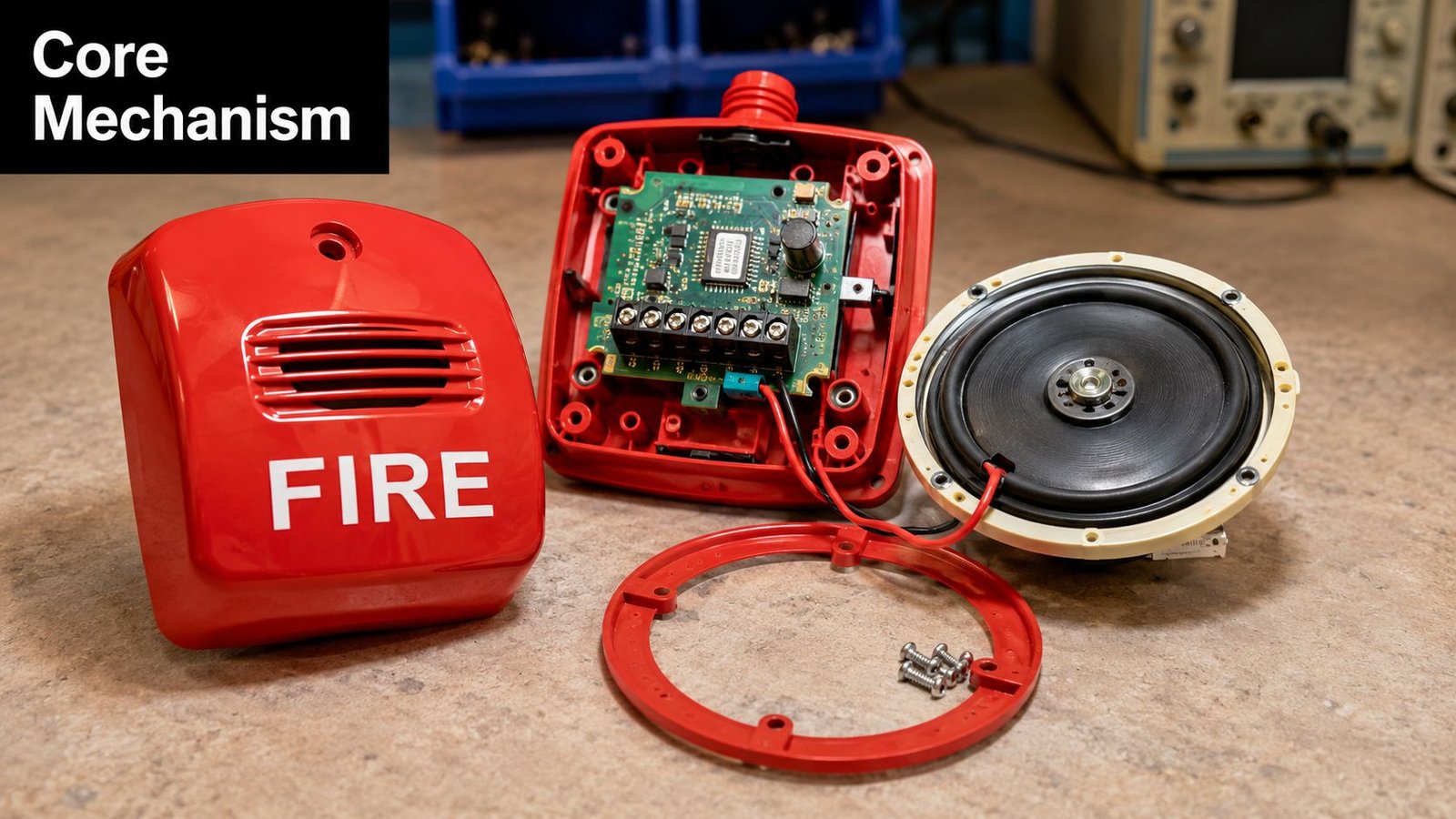
Main Types of Fire Alarm Sounders and Where Each Fits
The right sounder for a corridor in an office is rarely the right sounder for a care home bedroom or a high-bay warehouse. I've learnt to treat the product choice as a building-type decision first and a device decision second. The building tells you what people need to hear, and the device follows from that.
Comparing the main families
Motorised bells still turn up in older premises, and people recognise them immediately, but they offer little control over tone shape. Electronic piezo sounders are the modern default in many offices, shops, and HMOs because they're compact, flexible, and easy to distribute around a site. Sounder-beacons add visual alerting for noisy or hearing-impaired environments, while voice alarm systems suit larger or more complex buildings where spoken instructions improve response.
| Type | Typical Output | Best Fit Premises | Key Strength |
|---|---|---|---|
| Motorised bell | Strong mechanical alert | Older buildings and legacy systems | Familiar, simple warning |
| Electronic piezo sounder | Flexible audible output | Offices, shops, HMOs | Compact and adaptable |
| Sounder-beacon | Audible plus visual alert | Plant rooms, car parks, accessible routes | Better for noisy or mixed-ability occupants |
| Voice alarm system | Spoken instruction | Schools, hospitals, transport hubs | Clearer direction during evacuation |
A basic sounder-beacon is often the sensible middle ground where you need both audibility and visibility without building a full voice system. In contrast, a voice alarm is worth the extra complexity when confusion would slow evacuation, or where staff need to give staged instructions instead of a single blast.
Tone choice changes who wakes up
For sleeping-risk settings, frequency matters as much as output. Guidance cited in fire-alarm literature notes that 520 Hz signals are more effective at waking occupants than the typical 3150 Hz tone used in general notification, which is why bedrooms, hotels, and care settings often need a different approach from daytime workplaces. The practical lesson is simple, the “right” sound for awake people isn't always the right sound for sleepers.
If the building contains bedrooms, pick the sounder for the sleeper, not for the engineer who's standing there with the test button.
That's also where context beats habit. A hotel corridor, a factory floor, and a student residence can all need compliant notification, but they don't need the same frequency, same tone shape, or same mix of visual support. The best product is the one that matches the occupants, not the one that's easiest to order in bulk.
UK Standards, Volume and Placement Requirements
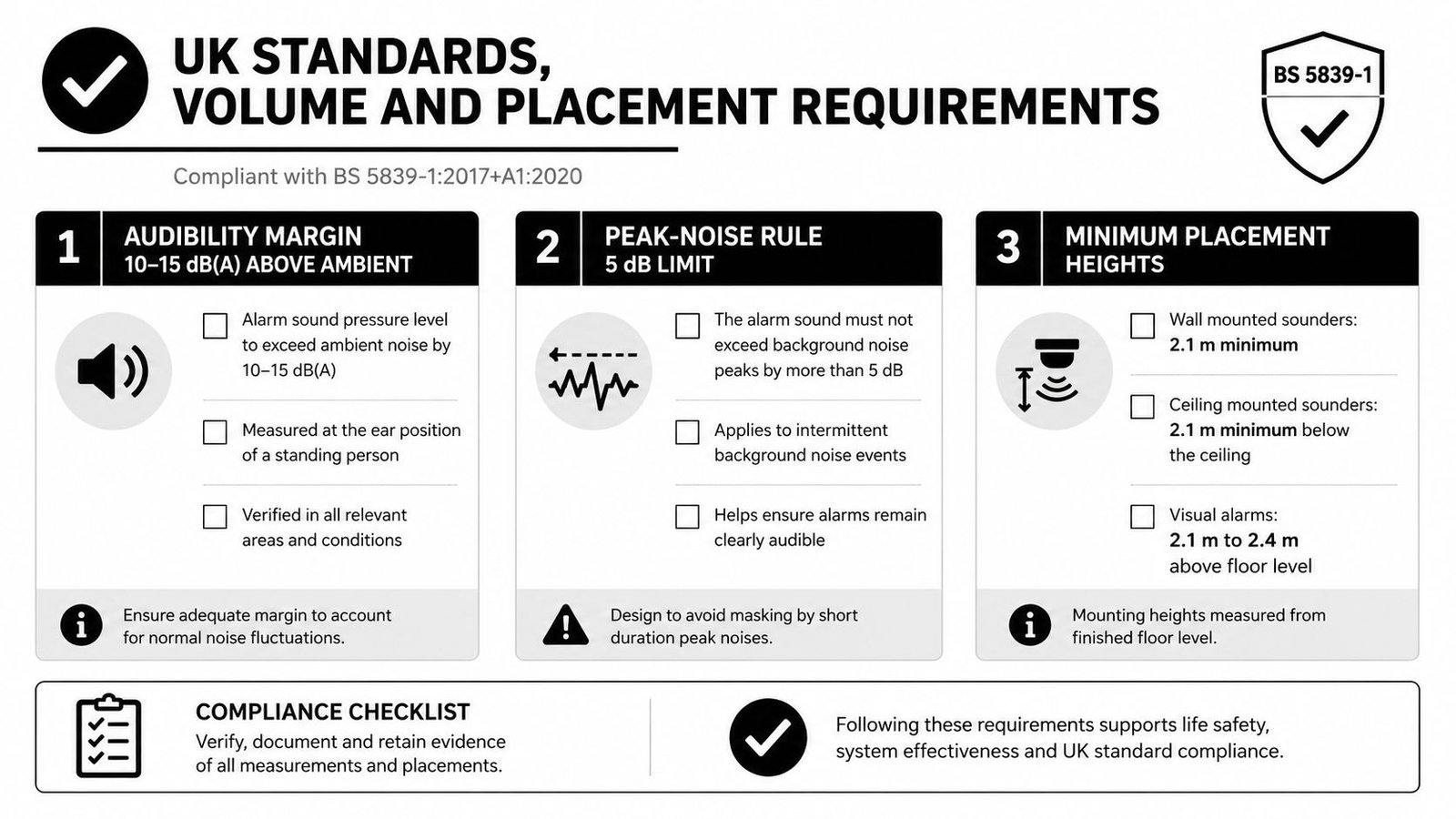
A sounder rated at 100 dB(A) on the box can still fail if it's placed badly or if the room noise is too high. UK guidance for acoustic design focuses on the audibility margin over ambient sound, not just a fixed output figure. In practice, the alarm should sit about 10 to 15 dB(A) above the background, with a minimum final level of 65 to 70 dB(A) or at least 5 dB above background in the protected area, depending on the space and the measured noise floor. Industry guidance on sounder audibility and placement makes the same practical point, sounders must be checked in the room, not assumed from the packaging.
What the numbers mean on site
The useful way to read BS 5839-1 is this, accessible areas need at least 65 dB(A), but noisy spaces often need more headroom to stay reliable. Industry coverage of the standard also notes that notification appliances in public areas must exceed ambient sound by 15 dB, or by 5 dB above the loudest ambient sound lasting 60 seconds or more, while private-mode areas need 10 dB above ambient with the same peak-noise rule. That's why a warehouse with intermittent machinery noise can fail even when the nominal rating looks generous.
Placement matters just as much. The practical guidance is to mount sounders where line of sight is preserved and, outdoors, generally 10 to 15 metres above ground and clear of nearby obstructions so the sound isn't masked or carried past the target area. That sits neatly alongside building fabric choices, including materials and finishes that help maintain compliance, as seen in resources on meeting A2 fire safety regulations where fire performance and installation context are discussed together.
Tone shape and occupant sensitivity
Volume isn't the whole story either. UK guidance from the Fire Industry Association notes BS 5839-1:2025 recommends at least 65 dB(A) throughout accessible areas, but also highlights a maximum of 120 dB(A), and says sweep sounds are less likely to be appropriate because they can be more startling than 2-tone alternating sounds in the 550 to 825 Hz range. That matters in schools, clinics, and mixed-use buildings where sensory sensitivity is part of the occupancy profile.
The rule of thumb I use is blunt. Measure the room, identify the loudest normal noise, and place the sounder so the received sound still clears the margin after doors, shelves, machinery, and absorption have done their worst. Anything less is a guess with a certificate attached.
Wiring Sounders Into Conventional and Addressable Systems
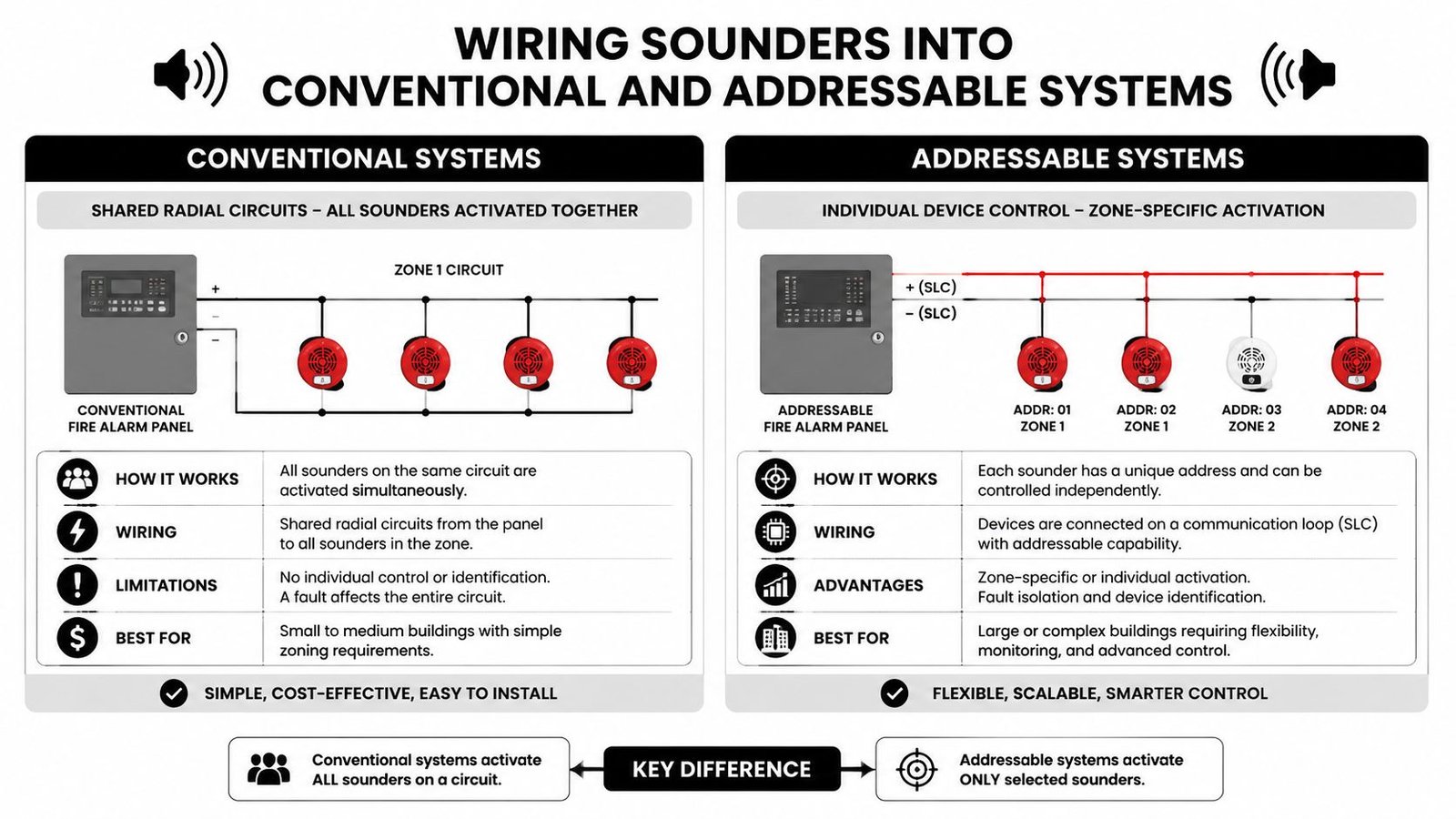
The sounder you choose only works as well as the circuit behind it. In smaller retrofits, a conventional sounder circuit is often the quickest path because the devices share a common arrangement and sound together. In larger or more complex premises, addressable systems usually pay back the extra design effort because each sounder base can be identified, zoned, and controlled more precisely.
Conventional circuits in plain terms
Conventional sounder circuits are easier to understand and often easier to retrofit into older buildings. All sounders on the circuit activate together, which is fine when the whole building needs one clear evacuation message. The trade-off is that fault finding can be less granular, and the design has to be checked carefully so one weak section doesn't drag down the whole notification path.
Addressable loops and future flexibility
Addressable sounder bases add control. Each device sits on the loop as an identifiable point, which supports staged alarm strategies, zoned activation, and clearer fault isolation. That's why they suit offices, schools, and multi-tenant buildings where you may need to alert one area before another, or isolate a problem without losing sight of the whole system.
For a practical comparison from a security and fire-integration angle, it's useful to look at the wider design logic in commercial fire alarm systems installation. The same principle applies here, the more complex the building, the more you gain from a system that can be traced and controlled device by device.
The parts that get missed
Loop loading, cable type, and end-of-line components all affect whether the system works under fault and under alarm. Wireless sounders can make sense in listed buildings, finished offices, or temporary installations where cabling would cause damage or delay, but they still need proper supervision and a design that accounts for coverage. In the field, the most expensive mistakes usually come from a general electrical install being treated like a life-safety notification circuit.
Installer's reality: if the sounder circuit was drawn up after the first fix instead of before it, you're usually solving the wrong problem.
That's why the circuit choice should follow the building's operational pattern. A simple radial may be enough for a compact fit-out, but a busy, changing site deserves more intelligence at the loop level.
Choosing the Right Sounder for Different Premises
A site with quiet corridors and a sleeping risk does not need the same warning pattern as a plant room, a loading bay, or a public lobby. I start with who has to hear it, then I look at what they are hearing it over, because audibility margin is what separates a sounder that meets the drawing from one that does the job on site.
Homes and HMOs
In a small home or HMO, one electronic sounder may be enough if the layout is simple and the escape routes are short. Battery backup and clear audibility in bedrooms matter more than extra features. If people are asleep, tone choice matters as much as level, and low-frequency notification is often the better fit because it is more likely to wake occupants without being harsh or easily ignored.
Offices, retail units, and mixed-use buildings
Small offices and shops often suit an addressable layout when the building is likely to change over time. Sounder-beacons help above plant rooms, at reception desks, or in any area where visual confirmation supports the alarm. In mixed-use buildings, the challenge is not just hearing the signal, it is cutting through everyday noise, movement, and background conversation.
That is where the wider system design starts to matter. A sensible alarm layout follows the building use, and if you are comparing device choices across different parts of a site, the planning approach in commercial fire alarm systems installation shows why device placement and control strategy have to work together.
Warehouses, industrial sites, and car parks
Warehouses and industrial premises usually need higher-output sounders, careful mounting height, and outdoor or IP-rated units where dust or weather is part of the environment. Car parks are similar, especially where traffic, ventilation, and echo make audio-only warning unreliable. In those spaces, sounder-beacons and voice capability can be the difference between a notice and a prompt to evacuate.
Noise level is only part of the job. In a busy yard or a machine hall, you need enough audibility margin to cover forklifts, extract fans, compressor noise, and the general clatter that eats into a weak alarm.
For higher-risk or specialist environments, a broader systems view helps. The practical decisions in mastering industrial refrigeration systems are a reminder that equipment choice has to match the operating environment, not just the brochure.
Hotels, care homes, and sleeping-risk settings
Hotels and care homes sit in a different category because waking people is the main challenge, not just alerting them. Low-frequency 520 Hz sounders are usually the better fit here, and they still need checking against the achieved sound level after installation losses. Voice alarm can be justified when staff need clear instructions for phased evacuation or assisted movement.
In sleeping-risk areas, the best sounder is the one that gets the person moving without causing confusion.
Sensory sensitivity also matters. Some occupants react badly to sharp, high-pitched tones, so the sounder choice has to balance wake-up performance, compliance, and the way people in that building will respond.
The decision process is practical. Start with occupant vulnerability, then noise, then building complexity, and only then decide whether sound-only, sounder-beacon, or voice alarm is the right fit.
Testing, Maintenance and Common Sounder Faults
A sounder that works on test can still fail under load, which is why maintenance has to be routine rather than reactive. Weekly testing should be done from a different call point each week, so the whole system gets exercised over time instead of the same easy location being checked repeatedly. Quarterly visual and functional checks catch the problems staff tend to miss, and annual servicing by a competent engineer is where the deeper faults usually show up.
If you want a simple duty-holder schedule to compare with your own logbook, the practical guidance in how often fire alarms should be tested is worth keeping close to hand.
Faults I look for first
Outdoor units often fail because dirt or insect ingress dulls the output or blocks the grille. Intermittent sound can point to a failing capacitor, especially when a unit responds during a quick test but drops out later. On addressable systems, a silent device can be a loop fault rather than a dead sounder, so the panel history matters as much as the device itself.
A few checks are safe to make in-house, provided the site procedure allows it.
- Listen for uneven output: a weak or distorted tone often tells you more than a passing test beep.
- Inspect the casing: damage, grime, or obvious blockage can reduce audibility without showing a hard fault.
- Record everything: note the device ID, time, location, and what happened in the fire logbook.
- Escalate recurring issues: anything intermittent, circuit-related, or linked to several devices should go straight to the servicing company.
For some mixed-alarm environments, it also helps to understand related warning behaviours. A useful overview of alarm tone interpretation appears in smoke alarm safety advice, especially where residents may confuse one warning pattern with another.
The habit that keeps buildings safe is boring but effective. Test, log, inspect, and escalate early. That keeps you aligned with the Regulatory Reform order without forcing you to become a fire engineer overnight.
When to Call a Professional Installer
There comes a point where swapping a sounder stops being a simple maintenance job and becomes a design and compliance issue. New builds and major refurbishments should go straight to a specialist, because audibility has to be proven on paper before devices go on the wall. A change of use, repeated false alarms, or an insurer asking for evidence of BS 5839-1 compliance all mean the system needs a proper audit rather than another isolated fix.
A professional installer brings three things that matter on site. First, a design that shows the alarm can be heard where it needs to be heard, including the awkward corners, plant rooms, and back-of-house areas where noise is often highest. Second, commissioning paperwork that stands up to insurers and the fire authority. Third, ongoing maintenance that keeps the logbook, certificates, and emergency lighting integration in one place.
What to ask before you sign
Ask whether the engineer holds third-party accreditation, whether they are manufacturer-trained on the panel being used, and whether they have worked on your building type before. A warehouse, a hotel, and a multi-tenant office all create different notification problems, and that experience shows up in the first design review, not the final invoice. If the existing system is more than ten years old and has not been audited properly since, treat that as a prompt for a full review, not a quick parts swap.
The best installers also talk about audibility margin. A sounder that passes a basic test in a quiet room may still struggle once conveyors start, extractor fans ramp up, or sleeping risk means you need a tone that wakes without creating unnecessary distress for sensory-sensitive occupants. That is the practical trade-off, a louder device is not always the better choice if the tone is harsh, fatiguing, or poorly placed.
If you are comparing fire protection work with other industrial maintenance disciplines, the approach in mastering industrial refrigeration systems is a good reminder that complex assets reward planned servicing, not piecemeal intervention.
The practical bottom line is simple. DIY can fit a box to a wall, but it cannot prove audibility, certification, and system integration with the same confidence a specialist can. When the building, the occupants, or the insurer needs certainty, bring in the installer who designs for the noise in the room, not the number on the label.
If you need a fire alarm sounder system that is designed around the building, not guessed from a catalogue, Wisenet Security Ltd can help with specification, installation, and ongoing maintenance across homes, offices, warehouses, and mixed-use sites. Visit Wisenet Security Ltd to arrange a proper discussion about audibility, placement, and compliance for your premises.