Emergency Lighting Testing: UK Dutyholder Guide 2026
You're usually not standing in a bright plant room when emergency lighting testing matters. You're at the end of a shift, key switch in hand, walking a quiet corridor and checking whether every exit sign still does what it's supposed to do when the mains go off. That's the job, not the paperwork, and it's why the routine has to be treated as a live safety control rather than an awkward monthly chore.
Table of Contents
- Why Emergency Lighting Testing Matters in UK Premises
- UK Test Schedule and Regulatory Framework
- Running the Monthly Functional Test
- Carrying Out the Annual Full-Duration Test
- Measuring Illuminance and Escape Route Coverage
- Common Failures and When to Call a Professional
- Building a Year-Round Compliance Routine
Why Emergency Lighting Testing Matters in UK Premises
A dutyholder can stand in a dark corridor, press a test control, and see the emergency fittings come on. That moment can look reassuring. It is not enough on its own, because compliance depends on whether the lamps, batteries, duration, and escape route coverage all hold up together.
Under UK fire safety law, the responsible person carries the duty for safe arrangements, and emergency lighting sits squarely inside that responsibility. The technical benchmark is BS 5266-1, so emergency lighting testing is not a paper exercise, it is part of showing that people can still find their way out if the mains supply fails. If a fitting does not work, or a route stays dim, that weakness sits with the person who controls the premises.

Why shortcuts fail on site
The common shortcut is to press the test button, see the lamp glow, and move on. That only confirms the fitting responded. It does not confirm that the battery will carry the load for the required period, that the head is positioned correctly, or that the route remains visible where people walk.
Practical rule: if the test only proves the lamp came on, it has not proved the route is safe.
That gap matters in warehouses, retail units, HMOs, and multi-tenant buildings, where one weak fitting can leave a long stretch of circulation space underlit. In storage sites, emergency lighting also has to sit alongside the wider fire strategy, so it helps to compare it with fire safety systems for storage sites, especially where racking, compartmentation, and escape routes all affect each other.
The same discipline applies to the rest of the site routine. If your building already follows a structured fire alarm testing cycle, use that same care here. The emergency lighting logbook should show more than a signature, it should show that someone checked the installation properly and recorded what they found.
UK Test Schedule and Regulatory Framework
A site walk in the UK usually starts with the calendar, because emergency lighting is checked on a layered schedule. Central battery systems get a daily check, the installation gets a monthly functional test, and once a year it must pass a full duration test that proves it will stay lit for the emergency period. The point that catches people out is the 3-hour, 180-minute annual test, which is the UK benchmark and not the 90-minute figure often repeated in NFPA-based material. BS 5266-1 guidance sets out that cadence clearly.
UK Emergency Lighting Test Cadence
| Test Type | Frequency | What It Checks | Who Typically Performs It |
|---|---|---|---|
| Daily check for central battery systems | Daily | Basic status and immediate fault visibility | Site staff or responsible maintenance personnel |
| Monthly functional test | Monthly | Lamps illuminate from battery power and recharge afterwards | In-house team or maintenance contractor |
| Annual duration test | Annually | Full endurance over the rated emergency period | Competent person or maintenance contractor |
The daily check is there to catch obvious faults early where central battery gear is involved. The monthly test confirms that the fittings respond and return to charge, while the annual test proves that the batteries and control gear can carry the load for the full expected period. Each layer deals with a different failure mode, and the logbook should show that the person doing the work understood which one they were carrying out.
UK premises also need the emergency lighting programme to sit inside the wider fire strategy, not beside it as a separate habit. For storage facilities, emergency lighting must integrate with wider fire safety systems for storage sites, because racking layouts, compartmentation, and escape routes affect one another. The same practical discipline should apply to scheduled fire alarm compliance, since a dutyholder who treats one life-safety system casually usually leaves gaps in the others.
Imported guidance causes trouble here because it often blurs the UK duration requirement or treats the inspection rhythm as optional. In a UK building, that is the wrong standard to work from. If an inspector or insurer asks what regime was used, the answer needs to point back to BS 5266-1 and the actual records, not a generic checklist.
The programme should be written down as a maintenance calendar, not left in someone's head. In a warehouse, a block of flats, or a mixed-use building, the emergency lighting dates should sit alongside the other statutory checks, and the logbook should show the date, the result, and any defects that were followed up. If the paperwork only proves that somebody turned up, it does not prove that the installation was checked properly.
Running the Monthly Functional Test
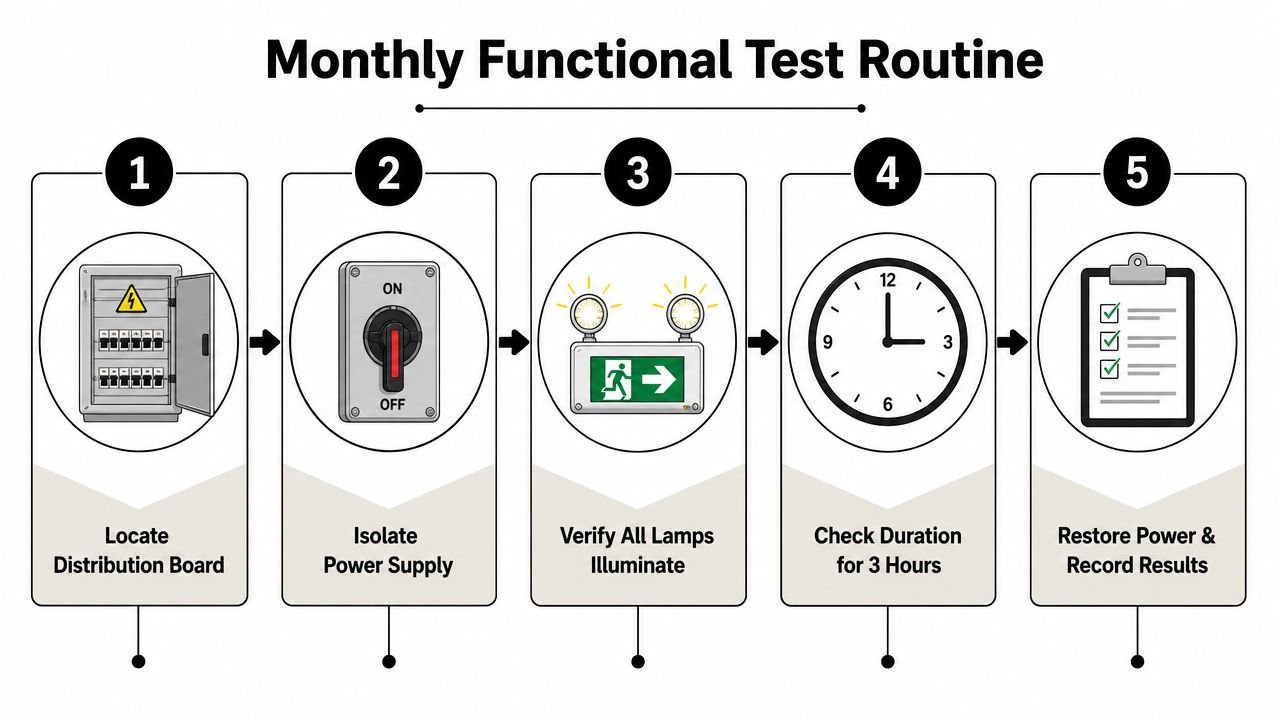
A monthly functional test should be done like a proper site check, not a quick press-and-forget job. Start at the distribution board, isolate the emergency lighting circuit in a controlled way, and then walk the escape route instead of only looking at the fitting you have just switched on. The point is to confirm that the lamps run from battery power and recover correctly afterwards, while each circuit is checked in sequence so one fault does not hide several missed luminaires.
The sequence that actually works on site
Begin with the exact circuit you are about to disturb. If the building has a site register of luminaires, use it. That is how you avoid skipping a fitting tucked behind shelving, a plant room door, or a sign partly hidden by a new partition.
Then work through the building in the same order every time. Consistency makes omissions easier to spot, and it gives the logbook a clear pattern that the next competent person can follow.
- Isolate the supply carefully. Use the test key or simulated mains failure method specified for the system, and do not improvise.
- Check every fitting lights. Look for the obvious failures first, then note anything dim, flickering, or slow to stabilise.
- Walk the escape route. Stay off the fitting itself and confirm the route remains visible where people would move.
- Restore power and verify recharge. A lamp that returns to normal quickly is only part of the check, because recharge behaviour matters as well.
- Record what you saw. The logbook should show which circuit was tested, which defects were found, and who is responsible for repair.
A monthly button-press that never leaves the plant room is a weak test. It may show the lamp can wake up, but it does not prove the route is covered. It also says nothing useful about battery behaviour under discharge, which is why the site walk is the part that tells you whether the system is doing its job.
The log entry should be plain, factual, and useful to the next person who opens the book. Write down the date, the circuit or area tested, the result, any missing fittings, and whether the system recharged normally after restoration. If a luminaire shows corrosion, a loose connection, or an odd voltage drop, note it immediately, because those faults can look acceptable in a short run and still fail later.
Carrying Out the Annual Full-Duration Test
The annual full-duration test is the point where the installation either proves itself or exposes its weak spots. A short functional check only shows that the fitting responded to a button press. The full-duration run shows whether the battery can keep the lamp going under load, and that is where tired cells, loose terminals, and corrosion usually show up.
Schedule the test for a time the building can tolerate. In occupied offices, shared residential blocks, logistics sites, and retail premises, it is better to manage the work circuit by circuit than to put the whole site under test at once. That keeps disruption under control and avoids creating unnecessary risk while people are still using the escape routes.
The run also needs someone watching the fittings, not just the clock. Dimming, flickering, or early cut-out means the system is struggling. If a unit drops out before the required duration, treat it as a defect and record it that way.
Site discipline matters more than speed. The annual run only counts if someone is watching for weak points as the battery discharges.
Once normal power is restored, check that the fittings return to charge and settle back into normal operation. If they do not, the fault may sit in the charging circuit, and that needs attention before the next test cycle. A lamp that relights is only part of the story, the recharge behaviour has to make sense as well.
The logbook should show the duration achieved, the area or circuit tested, and the recharge outcome. If a fitting fails during the run, write down when it failed, what action was taken, and whether the unit was removed, repaired, or re-tested. The record should be specific enough for the next competent person to see what happened without guessing.
The common mistake is to treat a light that stayed on for a short time as proof that the system is fine. The annual duration test exists because batteries age and their capacity changes under real load. The only honest check is to run them for the full period and see whether the installation still holds together.
Measuring Illuminance and Escape Route Coverage
A lamp that comes on is not the same thing as a route that's properly lit. In UK practice, the test has to tell you whether the escape path is illuminated to a measurable standard, which means looking at the floor level along the route rather than just checking the fitting itself. The practical point is that the weakest part of the installation is usually coverage, not the absence of light from the lamp.
A properly calibrated light meter belongs in this part of the job. The readings should be taken along the egress route, with particular attention to the lowest-light points, because those are the places that expose poor aiming, obstructions, or deterioration over time. Guidance for inspection work specifies 1 foot-candle along the exit path and 0.1 foot-candle elsewhere, with readings checked at multiple points and the lowest value documented so you can see what the route receives inspection guidance on emergency exit lighting.
Where to measure
The obvious mistake is to measure only at the fitting and assume the whole area is acceptable. That misses the actual problem, because light can be blocked by shelving, ductwork, signage, changes of direction, stair edges, or poor positioning of the head.
Measure where people move.
- Changes of direction. Corners often show whether the head is aimed properly.
- Stairs and thresholds. These can create visual breaks that matter more than a bright fitting nearby.
- Midpoints between luminaires. These are often the lowest-light points in open routes.
- Obstructions and narrowings. Shelving, columns, and door furniture can all steal usable light.
- The floor plane. That's where the route has to work for the person walking it.
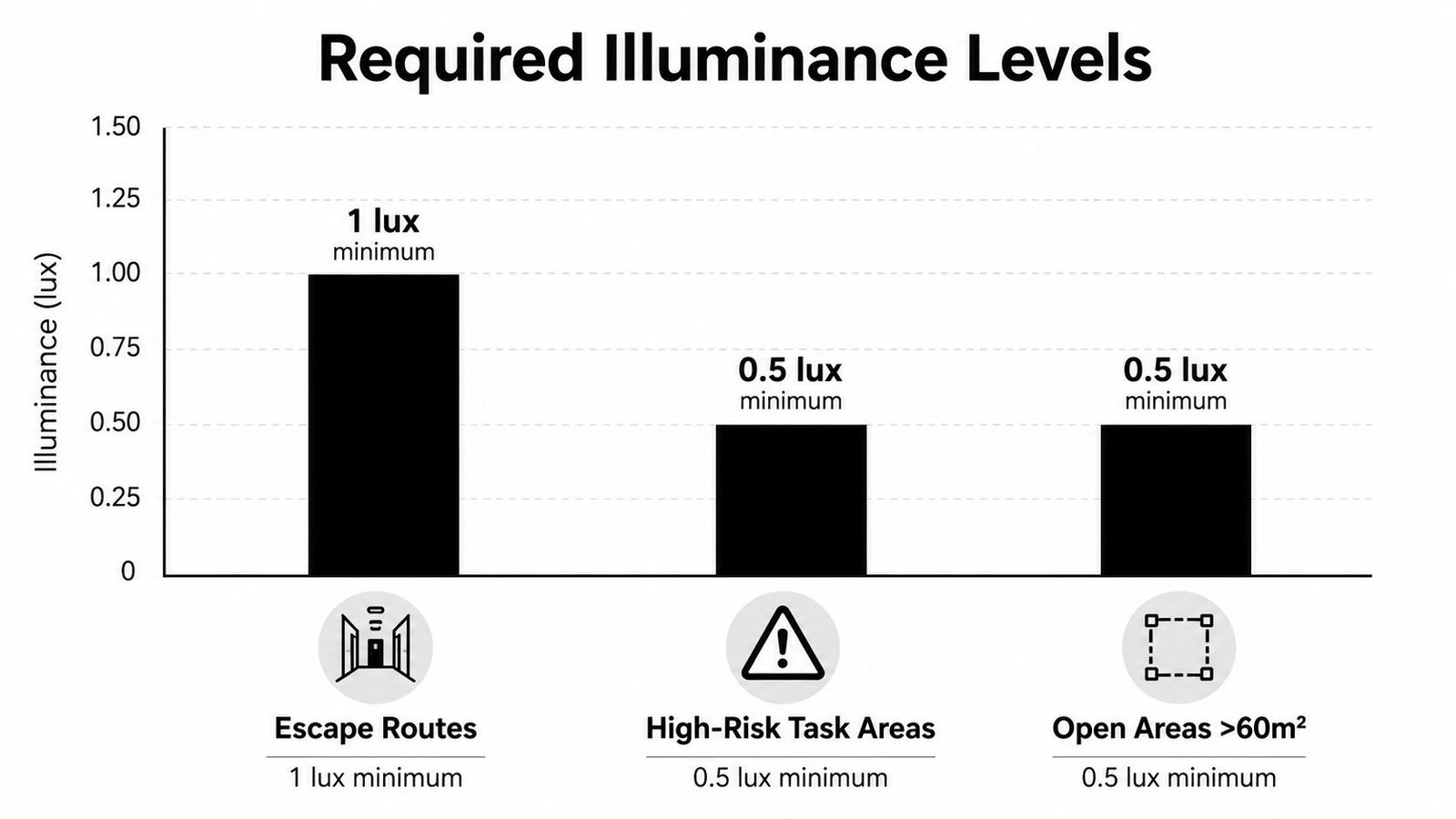
Measurements are more reliable when the meter has good cosine correction and low-range sensitivity, because poor instruments can distort the result at low light levels. If there's background light from another source, subtract it where necessary so the emergency lighting reading isn't inflated by normal internal lighting. That distinction matters in offices, warehouses, and mixed-use buildings where daylight or residual lighting can mask a weak emergency route.
The value of this step is honesty. It turns the test from “it came on” into “it illuminated the route to a measurable standard”, which is the standard dutyholders need when they're defending a record, explaining a defect, or making a repair decision.
Common Failures and When to Call a Professional
A failed fitting doesn't always mean the same thing. Sometimes it's a simple lamp issue, sometimes it's the battery, and sometimes the fault sits deeper in the charger, circuit, or distribution board. The job of the dutyholder is to separate a one-off fix from a system problem and record the result properly, then escalate when the fault pattern points beyond routine maintenance.
Triage Guide for Common Emergency Lighting Faults
| Fault Symptom | Likely Cause | In-House Fix | Call a Professional |
|---|---|---|---|
| Lamp does not illuminate on test | Failed lamp or local fitting issue | Replace lamp if the system design allows simple replacement | Yes, if multiple fittings fail or the fault repeats |
| Lamp illuminates briefly, then cuts out | Weak battery or battery degradation | Replace battery if competent and authorised | Yes, if batteries fail across more than one fitting |
| Fitting recharges poorly after test | Charger fault or battery connection issue | Check obvious connections if trained | Yes, for charger investigation or repeated recharge issues |
| Light level is poor even though the lamp is on | Mis-aimed head, obstruction, or degraded coverage | Adjust head if within local competence | Yes, if route coverage still fails after adjustment |
| Several fittings on one circuit fail together | Circuit or distribution problem | Check the circuit status and obvious supply issue | Yes, immediately |
| Corrosion or loose terminals found | Deterioration at battery or connection points | Isolate and report, do not force a temporary fix | Yes, because the issue may recur under load |
A healthy system gives you consistent behaviour. When a cluster of fittings starts failing, or the same unit keeps dropping out after replacement, that's no longer a lamp-change job. It's an electrical fault, and it should be investigated by a competent engineer rather than patched over with repeated resets.
If your wider fire-safety schedule already depends on competent external support, emergency lighting should sit in the same category. Many dutyholders who arrange a fire alarm installation review also use that same contractor relationship to manage emergency lighting defects, because the two systems often share the same compliance culture and logbook discipline.
Keep the documentation blunt and specific. Write the symptom, the likely cause if known, the action taken, and whether the site can remain safe while awaiting repair. If the defect affects the escape route itself, don't minimise it in the logbook. The person reading it later needs facts, not reassurance.
Building a Year-Round Compliance Routine
Emergency lighting compliance isn't a one-off project, it's a repeating duty that has to survive busy weeks, staff changes, and half-finished maintenance jobs.
The easiest way to keep it under control is to run the same rhythm all year and make the logbook the source of truth. If the record is thin, the compliance story is thin too. That's the document insurers, fire authorities, and the responsible person will look at first.
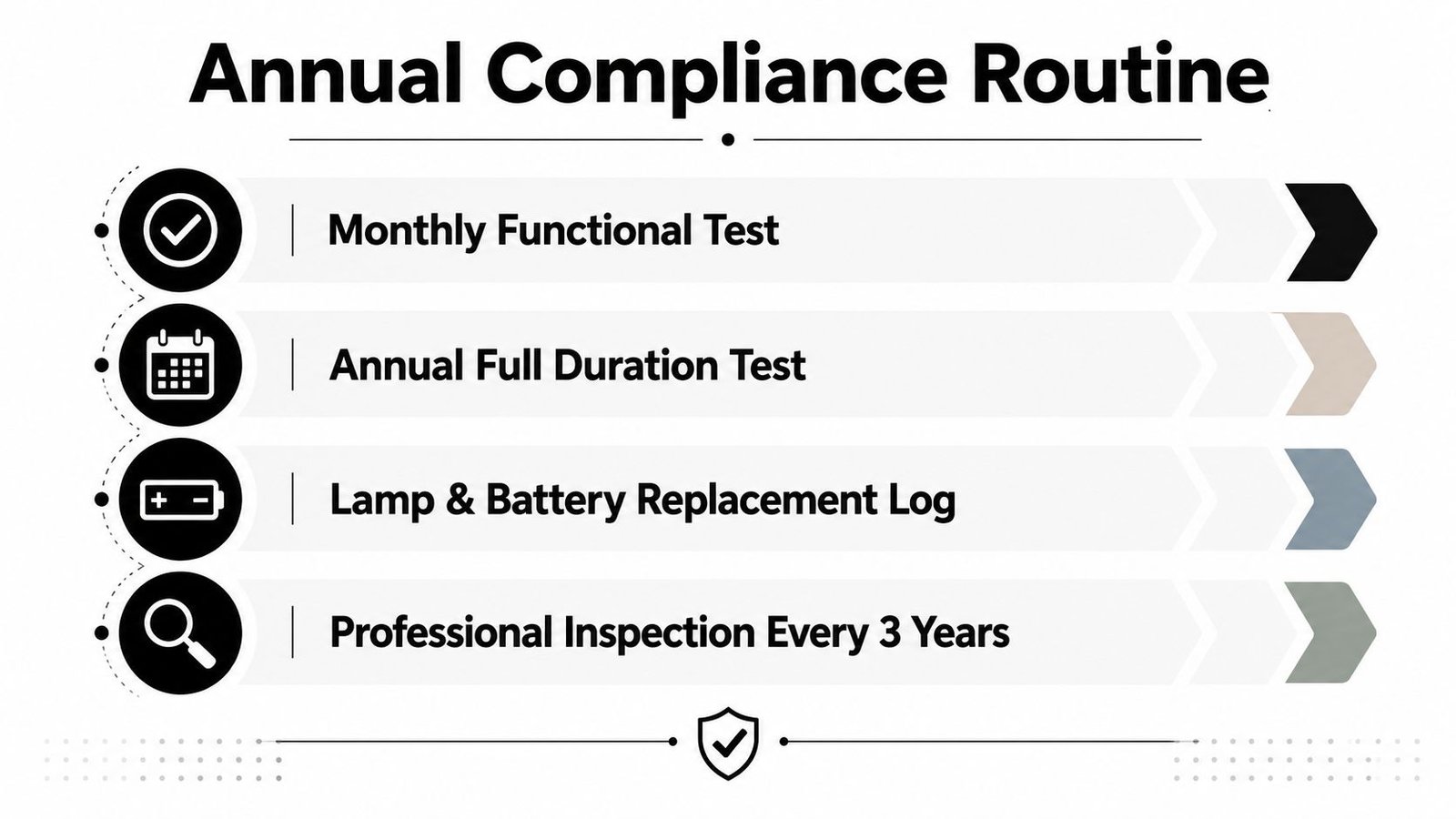
Keep the routine simple
- Monthly Functional Test. Confirm the fittings illuminate from battery power, then recharge correctly.
- Annual Full Duration Test. Prove the system runs for the full emergency period and recovers afterwards.
- Lamp and Battery Replacement Log. Record every swap, fault, and follow-up action.
- Professional Inspection. Bring in a competent engineer when the defect pattern suggests more than routine maintenance.
A useful way to think about this is the same discipline used in best practices for disaster recovery, regular testing only works if it is scheduled, recorded, and reviewed after the fact. The same principle applies here, because an emergency system that has not been exercised under real conditions is only an assumption.
For ongoing compliance references, keep your own notes aligned with a clear internal standard such as fire safety compliance guidance, then file the emergency lighting records where the next responsible person can find them quickly.
If you need a competent local partner to test, repair, or audit your emergency lighting programme in Cardiff, Bristol, Newport, Swansea, or across South Wales and the South West, contact Wisenet Security Ltd and ask for a proper site review rather than a rushed sign-off.