Intercom System Installation: Your 2026 Guide
You're usually looking into an intercom after something small but annoying keeps happening. Deliveries get left in the wrong place. Staff have to leave reception to check the door. A family member opens the gate without knowing who's there. Or a tenant keeps saying the current buzzer “works most of the time”, which usually means it's on the way out.
In South Wales and the South West, the decision is rarely just about adding a speaker by the door. Older masonry walls, awkward gate positions, patchy Wi-Fi at the boundary, and mixed-use premises all change what will and won't work. A neat-looking unit bought online can become a frustrating install if the cable run is wrong, the lock release is underpowered, or the signal drops exactly where the panel needs to go.
A proper intercom system installation should solve a daily access problem and keep working in bad weather, during busy periods, and after the novelty wears off. That's the difference between a box on the wall and a system that enhances security.
Table of Contents
- Securing Your Front Door in South Wales
- Choosing the Right Intercom for Your Property
- The Professional Installation Workflow
- Budgeting for Your Intercom Installation
- DIY vs Professional Installation The Real Trade-Offs
- Integrating Intercoms with CCTV and Access Control
- Common Questions About Intercom Installations
Securing Your Front Door in South Wales
A front door, side gate, trade entrance, or reception door is where security becomes practical. It's the point where someone asks for access and you decide whether they should get it. Traditional locks and a standard doorbell don't give you much information, and that's why so many properties now move to managed entry systems.
Across the wider UK security sector, demand for integrated systems continues to rise. The UK Security System Services industry, which includes intercom installation, is projected at £2.1 billion in 2026 according to IBISWorld's UK security system services market overview. That matters locally because homes, offices, warehouses, and apartment entrances around Cardiff, Newport, Swansea, and Bristol increasingly need more than a latch and a bell push.
For a homeowner, the problem is often simple. You want to know who's at the gate before you walk down the drive or open the front door. For a business manager, it's usually about control. You don't want deliveries, contractors, visitors, and staff all relying on an unsecured entrance or someone shouting through a glass door.
A good entry system doesn't just identify visitors. It reduces interruptions, stops bad habits, and gives people a consistent way to manage access.
There's also a wider shift toward controlled entry in everyday life. If you're comparing property access with vehicle access, this guide on secure keyless access for vehicles is useful because it shows the same principle in another setting. Convenience only helps if the access method is reliable and properly secured.
What people usually want from an intercom
Most buyers are not asking for “an intercom” in the abstract. They're asking for one of these outcomes:
- Know who is outside: Audio may be enough for some doors, but video is often the better answer where parcels, unknown callers, or out-of-hours arrivals are common.
- Open the door remotely: Useful for receptions, offices, busy family homes, and gated entrances.
- Keep a cleaner access routine: Staff, residents, and regular visitors should have a predictable route in.
- Avoid false confidence: A cheap unit that looks modern but fails in rain, glare, or weak signal conditions is worse than no upgrade at all.
In practice, the right system depends less on brochure features and more on the building, the gate, the cabling path, and how people use the entrance every day.
Choosing the Right Intercom for Your Property
The wrong way to buy an intercom is to start with the fanciest screen or app. The right way is to work backwards from the entrance, the users, and the building fabric. A detached house with a single gate post needs a different solution from a Bristol listed property, a Newport warehouse office, or a multi-tenant entrance with regular deliveries.
What suits a home is not always right for a business
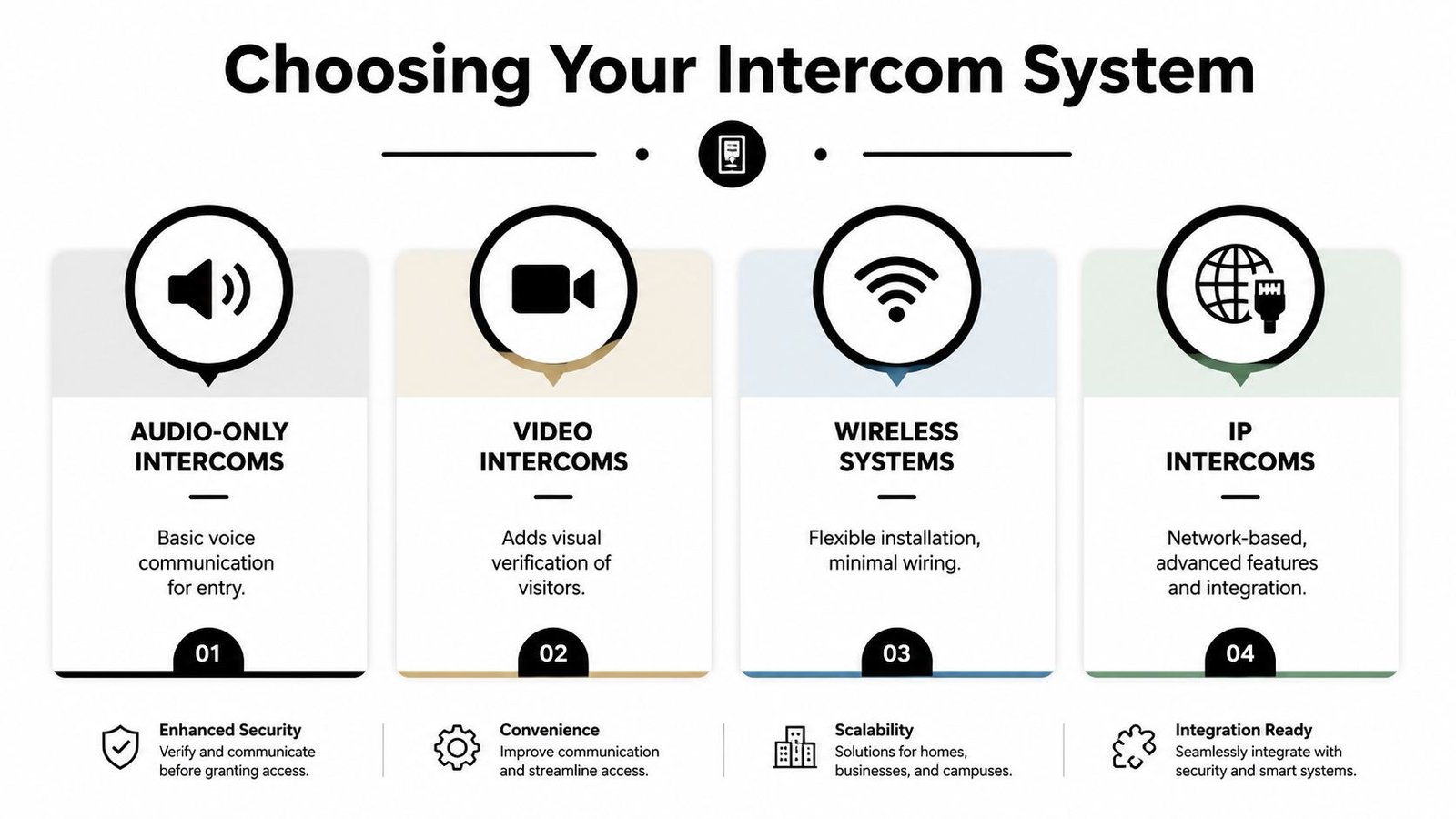
Audio-only intercoms still have a place. They're straightforward, often easier to maintain, and they do the core job of letting someone speak to a visitor before release. They make sense on simple single-door setups where the user already expects known callers.
Video intercoms are the better fit where visual verification matters. Homes with deliveries, offices with shared entrances, and any site where unknown visitors arrive benefit from seeing the person before granting entry. If you want a residential example, this page on a video intercom system for home is a useful reference point.
Wireless systems are attractive because they avoid disruptive cable runs. In practice, they work best where the mounting position has stable connectivity and the structure doesn't fight the signal. They're often the right answer for retrofit work where chasing walls would cause unnecessary damage.
IP intercoms are usually the strongest option for commercial sites or higher-spec residential projects. They integrate more cleanly with CCTV, access control, remote management, and smartphone answering. They also demand better network planning. That's where many poor installs go wrong.
Intercom system comparison
| System Type | Key Feature | Reliability | Ideal For |
|---|---|---|---|
| Audio-only | Voice communication for entry decisions | Strong when kept simple and properly wired | Single entrances, basic residential use |
| Video | Visual verification of callers | Strong if camera position, lighting, and power are right | Homes, receptions, parcel-heavy sites |
| Wireless | Minimal cabling and flexible retrofit | Depends heavily on signal quality at the exact mounting point | Listed buildings, light retrofit projects |
| IP | Network-based control and integration | Excellent when network design is done properly | Offices, multi-tenant sites, integrated security setups |
A practical way to choose
Use the property, not the product brochure, as the starting point:
- Terraced home in Cardiff: Video is often worth the extra cost because callers may stand close to the lens and parcel handling is frequent.
- Listed building in Bristol: Wireless or carefully planned low-impact cabling may be the deciding factor if fabric disturbance is restricted.
- Industrial unit in Newport: IP-based kit is often the better route if you need the intercom to work with access control, gates, or a staff entry log.
- Block or shared entrance: You need to think beyond the outdoor panel. The user side, permissions, and release method matter just as much.
Practical rule: Buy for the entrance conditions first. Buy for features second.
The best systems are usually the ones that look slightly less exciting on paper but suit the building properly.
The Professional Installation Workflow
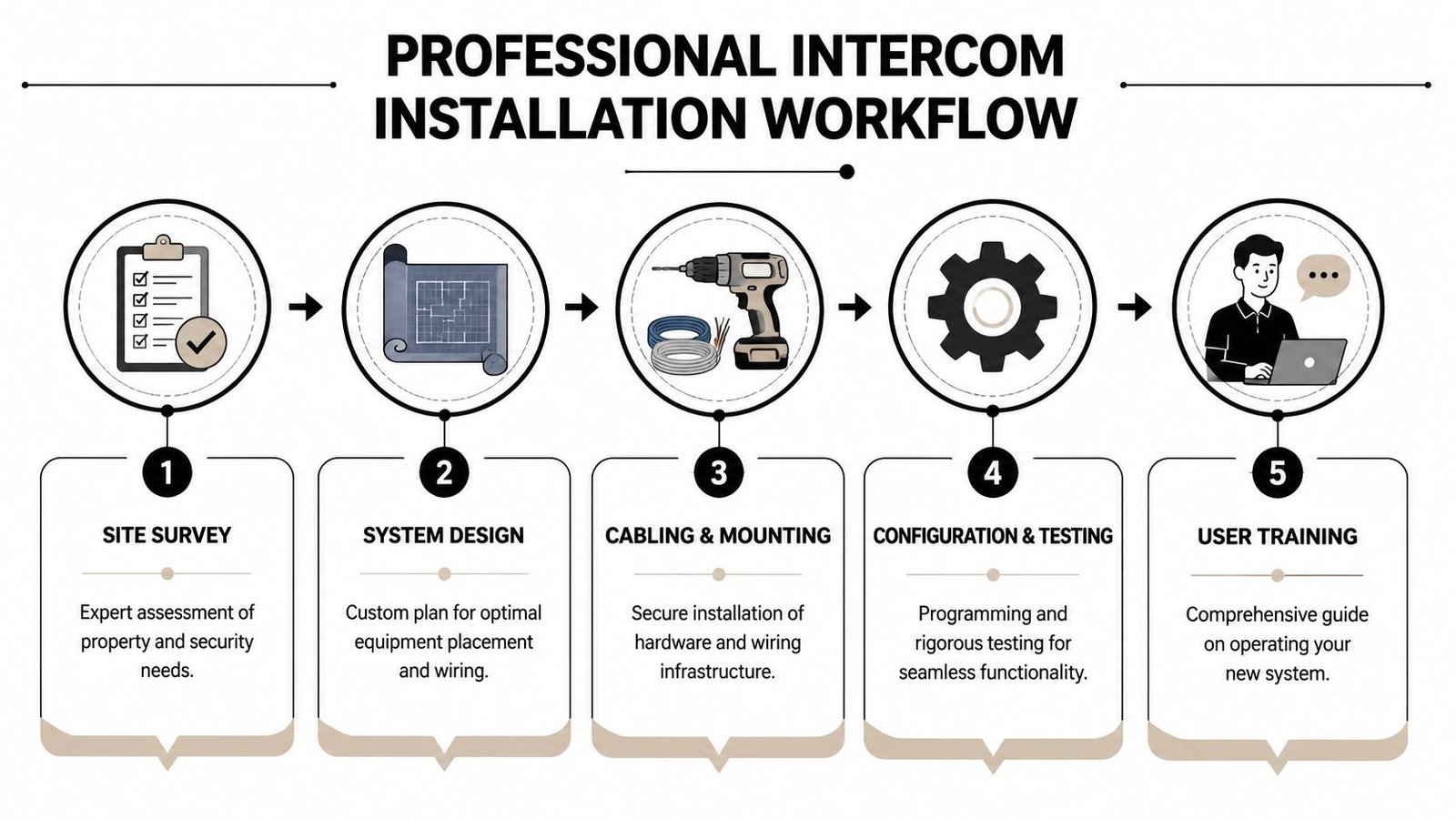
Most intercom problems don't start after installation. They start before it, when nobody checks the gate post, the cable route, the lock type, the power requirements, or the actual signal at the mounting point. That's why a proper workflow matters.
What happens before any drilling starts
The first visit should answer practical questions, not just product questions. Where will visitors stand. Is there glare from the sun. Is the gate post metal. Is the wall solid stone. Does the lock need fail-secure or fail-safe behaviour. If the entrance is remote from the building, can the cable route stay protected and serviceable.
This matters even more in older South Wales housing stock and rural properties. The often-missed issue is the network reliability gap in older masonry homes. Standard guides skip over this, but Nimbio's installation guidance notes that network setup errors account for 35% of post-install issues in smart access systems. On-site, that usually means a signal that looked acceptable near the house but becomes unstable at the actual gate or entry post.
Test the exact mounting location, not the area around it. A strong result two metres away doesn't guarantee a stable panel once it's fixed in place.
The stages that decide whether the system lasts
After the survey, the installer should design the system around power, comms, mounting, and user behaviour.
Site survey and specification
The installer confirms entry points, visitor flow, indoor monitor positions, app requirements, and release hardware. On larger properties, future expansion is considered.Cabling and containment
Structured cabling matters more than many clients expect. For UK audio and video door entry systems, structured cabling should follow BS 6701, and the specification referenced by FLD Electrical's technical structured cabling guide includes a minimum cable cross-sectional area of 0.6mm² for 24V DC power feeds to prevent voltage drop beyond 10% over 50-metre runs. That's directly relevant on larger homes, apartment entrances, and sites where the gate is well away from the building.Mounting and environmental protection
Outdoor panels need more than a neat fixing. Angle, height, weather exposure, tamper resistance, and water ingress protection all affect long-term reliability.
Before handover, there should also be structured testing. This overview of what is involved in the installation process of an access control system gives a useful parallel because intercoms tied to door release or gate control have many of the same commissioning requirements.
A short demonstration helps clients understand what a proper install looks like in practice:
The checks that separate a tidy install from a dependable one
A professional commissioning process should include:
- Audio clarity checks: Speech must remain intelligible at the panel and inside the property.
- Release testing: The lock or gate should operate cleanly without delayed release or intermittent triggering.
- Night and weather checks: Camera exposure, call button visibility, and audio behaviour often change after dark or in wind.
- User handover: Residents or staff should know how to answer, release, and deal with missed calls or visitor events.
An intercom system installation is only finished when it has been tested under the same conditions the property sees in real life.
Budgeting for Your Intercom Installation
Installation budgets frequently deviate when only the door station is costed, overlooking other essential components. The panel represents only a fraction of the total expenditure. Elements such as labor, cabling, power supplies, lock interfaces, network integration, and building-specific challenges are frequently equally significant.
What you are actually paying for
In the UK, Checkatrade's intercom cost guide says a typical intercom installation can range from £100 to £1,000 for the system and installation combined, with hard-wired systems averaging £300 for the unit alone, wireless intercoms averaging £250 for the system only, and video wireless intercom systems averaging around £650 for the system unit. The same guide notes that total installation costs can rise up to £15,000 for large-scale customised jobs.
That range is wide because there is no single “standard install”. A one-door house with a short cable run is not the same as a gated commercial entrance, a shared residential block, or a rural property where power and communications need extra thought.
Where budgets usually go wrong
The mistake is assuming every quote covers the same scope. It doesn't. Ask exactly what has been included.
- Hardware: External panel, internal monitor if used, power supply, brackets, housings, release relay, and any smart credentials.
- Installation labour: Cable routing, drilling, containment, surface making-good, programming, and testing.
- Door or gate integration: Some sites need additional work to connect cleanly with locks, magnets, automatic gates, or existing controllers.
- Ongoing costs: Some app-based or cloud-managed systems have subscriptions, and some owners prefer a maintenance arrangement.
The cheapest quote often removes the work you needed most. Survey time, network testing, and proper commissioning are the first things stripped out when a price looks unusually low.
A basic hard-wired intercom system and installation can start in the £200 to £1,000 bracket, while wireless video systems average around £650 for the unit alone, based on the same UK intercom pricing reference. The useful question isn't “what's the cheapest intercom”. It's “what does this entrance need to work properly for the next few years”.
If you're comparing quotations, ask each installer to state what happens if the site survey reveals signal problems, damaged existing cabling, or a lock release that needs upgrading. That's where surprise costs usually appear.
DIY vs Professional Installation The Real Trade-Offs
DIY intercom kits are tempting because the product pages make the process look clean and straightforward. For a very simple internal system, or a basic replacement where cable routes and power are already sorted, a competent person can sometimes manage it.
That said, most failed intercom projects don't fail because the owner couldn't mount the unit. They fail because the system choice was wrong, the power path was weak, the network assumptions were wrong, or the release hardware wasn't understood properly.
Where DIY can work
DIY makes the most sense when the job is genuinely contained:
- Simple replacement: Like-for-like swap on an accessible entrance with serviceable existing infrastructure.
- Low-risk setup: No complex gate automation, no shared occupancy, no business-critical access point.
- You accept the limits: You may not get the same level of finish, integration, or future support.
For some homeowners, that trade-off is acceptable. If the unit is standalone and the consequences of downtime are minor, it can be a reasonable choice.
Where it usually comes unstuck
The trouble starts when the install has hidden complexity. That includes long cable runs, stone walls, metal gate posts, electric strike compatibility, app setup, or integration with CCTV and access control.
Professional installation earns its keep because it deals with the parts clients don't usually see:
- Correct specification: Matching the panel, power supply, cabling, and release method to the actual entrance.
- Reliable commissioning: Testing under load, in real conditions, before handover.
- Cleaner security posture: Fewer shortcuts in setup, fewer exposed weak points, and fewer half-working features left switched on.
- Support after handover: If something drifts out of tolerance or a setting needs changing, the system can be maintained rather than guessed at.
A tidy DIY installation can still be a poor security installation. Neat cable clips don't fix wrong voltage, bad Wi-Fi, or an unreliable release circuit.
There's also accountability. On an office, school, warehouse, apartment entrance, or automated gate, downtime becomes everyone's problem very quickly. In those cases, professional work is less about convenience and more about reducing operational risk.
Integrating Intercoms with CCTV and Access Control
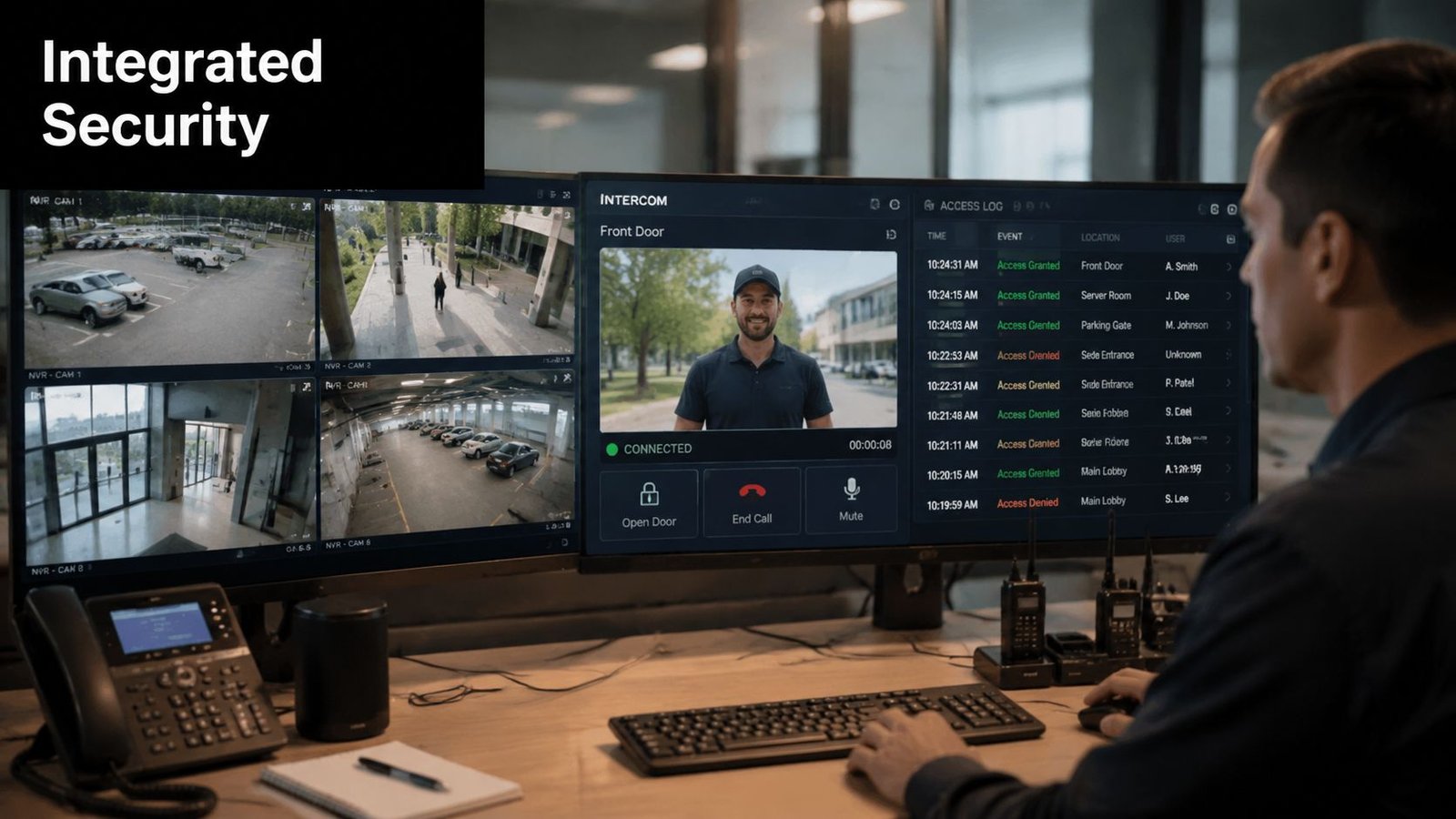
A modern intercom is strongest when it isn't working alone. If the panel rings a handset and opens a door, it can still do a useful job. But once you connect it properly with CCTV and access control, the system becomes far more useful day to day.
Why the intercom should not stand alone
At a reception entrance, the intercom tells you someone wants to come in. CCTV shows what happened before they pressed the button, what they did after release, and whether anyone followed them through. Access control decides who can bypass the intercom entirely with a fob, card, code, or biometric credential.
For managers of shared sites, this combination removes a lot of daily friction. Visitors use the intercom. Staff use managed credentials. Cameras provide visual context when there's a dispute, missed delivery, or after-hours entry issue.
Good integration removes friction
A well-integrated setup usually delivers these practical advantages:
- One joined-up entry process: Visitors call in. Authorised users credential in. Both routes fit the same security plan.
- Better incident review: If there's confusion at an entrance, camera footage and intercom events make it easier to understand what happened.
- Cleaner control in shared properties: Property managers can separate resident access, contractor access, and temporary permissions more sensibly.
- Remote response: On many systems, a responsible person can verify and release access without standing near the door.
If you manage apartments, mixed-use buildings, or business centres, these Multi-tenant access control architectures are worth reading because they frame the access side of the problem clearly. The intercom is only one part of the wider entry design.
The best integrated systems feel boring in use. People enter the right way, visitors get handled properly, and nobody needs to invent workarounds.
That's usually the sign the design is right.
Common Questions About Intercom Installations
Practical answers homeowners and managers usually need
Can an intercom be fitted in an older or listed property?
Usually, yes, but the method matters. Surface-mounted containment, low-disruption cable routes, or carefully chosen wireless options may be more appropriate than invasive chasing. The right answer depends on the entrance position and what the building will allow.
What happens if the internet drops on an IP intercom?
That should be discussed before installation, not after. For rural UK properties in particular, Swiftlane's guidance on wireless apartment intercom systems highlights the importance of contingency planning for power or internet loss, including backup options such as battery storage or cellular failover. If the intercom controls an important entrance, ask what still works during an outage and how release is handled safely.
Do I need video, or is audio enough?
If callers are mostly known and the entrance is simple, audio may be fine. If you deal with deliveries, unknown visitors, vulnerable occupants, or a busy front entrance, video usually adds meaningful value.
How long does an installation take?
It depends on the property, the cabling route, and whether the intercom is standalone or integrated with locks, gates, or other systems. A survey provides an accurate timeline. Without one, any timeline is guesswork.
What should I ask an installer before approving the job?
Ask what they checked on site, what happens during a power or network problem, how the release hardware is being handled, and what testing is included before handover.
A reliable intercom system installation should make access easier, not more complicated. If you're planning a system for a home, office, gate, warehouse, or shared building in South Wales or the South West, a proper site survey is the part that protects the whole investment.
If you want practical advice on the right setup for your entrance, Wisenet Security Ltd provides site surveys, design, installation, and maintenance across South Wales and the South West. If you're comparing options for a house, business premises, gate, or shared building, get a no-obligation quote and make sure the system is designed around the property, not just the product brochure.