Your Guide to CCTV and Alarm Systems in South Wales & SW
If you're reading this after a restless night, you're probably in a familiar spot. The shop shutters are down in Bristol, the warehouse gates are locked in Newport, or the kids are asleep upstairs in Cardiff, and you're still wondering whether your current setup would help if something happened tonight.
Initial considerations often focus on camera resolution or alarm app features. That's usually the wrong starting point. In South Wales and the South West, the better questions are simpler. What are you protecting, what are the weak points, and will the system you install give you usable evidence and a reliable response without causing privacy problems or constant false alarms?
That matters because UK security systems have changed a lot. CCTV in the UK has roots in public-sector and transport use, and one of the most cited milestones was the spread of cameras in public spaces after the 1993 murder of James Bulger, which accelerated adoption in the 1990s. Over time, CCTV moved from basic analogue deterrence into evidence-grade digital systems built for crime reduction and compliance, as noted in this UK CCTV history overview.
Table of Contents
- Securing Your Property A Guide for South Wales and the South West
- First Steps Defining Your Security Needs
- CCTV Systems Explained From Cameras to Cloud
- Intruder Alarm Systems Unpacked Bells Wires and Beyond
- The Power of Integration How CCTV and Alarms Work Together
- UK Compliance and Installation Best Practices
- Choosing Your Security Partner in South Wales
Securing Your Property A Guide for South Wales and the South West
Security looks different on the ground depending on where you are. A terraced street in Bristol brings different problems from a detached home on the edge of Swansea. A small office in Cardiff Bay doesn't need the same design as a trade counter in Newport or a yard on an industrial estate.
That's why generic advice often fails. It tells everyone to buy more cameras, fit a louder siren, and turn on every app notification. In practice, that usually leads to poor coverage, nuisance alerts, and footage that's no use when you need to identify someone.
After working with properties across South Wales for years, the pattern is consistent. What works is a system built around the site, not around a product brochure. For a home, that might mean covering the front approach, rear access, and side gate while keeping cameras away from a neighbour's windows. For a business, it might mean narrowing coverage onto the shutter, till area, loading bay, and staff entrance rather than trying to watch every square foot badly.
Three things usually decide whether a system will do its job:
- Detection at the right point: You want to know when someone reaches a meaningful boundary, not after they've already moved through the building.
- Useful images, not just footage: Recording movement isn't enough if you can't identify a face or vehicle when it matters.
- A response you can act on: Bells alone have their place, but the stronger setups tell you what happened, where it happened, and whether it needs immediate action.
Practical rule: Protect choke points first. Front doors, rear doors, gates, shutters, side alleys, and shared entrances usually matter more than broad scenic views.
Good cctv and alarm systems don't have to be complicated. They do have to be thought through properly. If you're in Cardiff, Bristol, Swansea, or the surrounding areas, the right design usually comes down to layout, privacy, access patterns, and how the property is used after dark.
First Steps Defining Your Security Needs
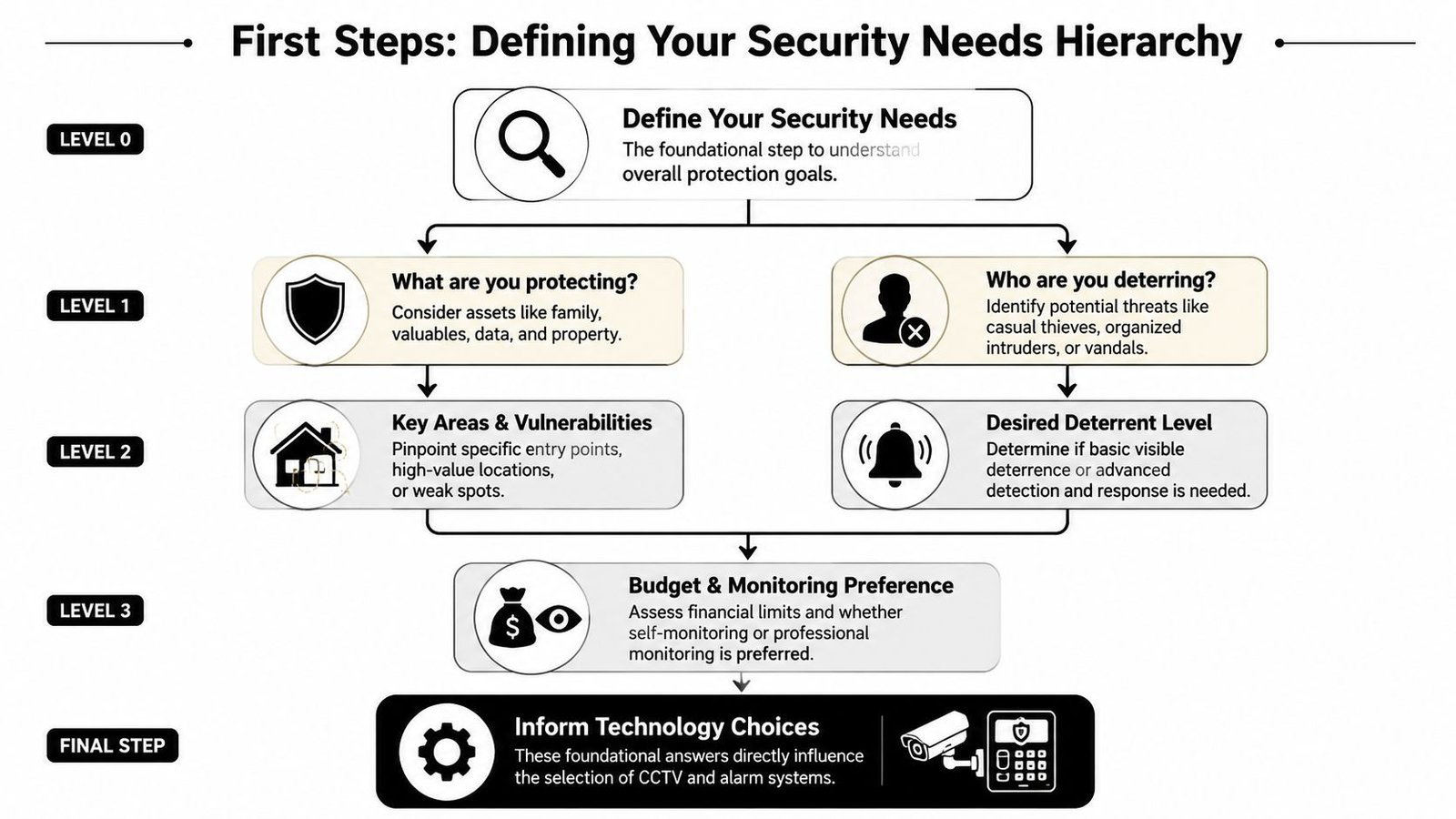
Before you compare brands, apps, or prices, get clear on the problem. A family home, a retail unit, and a warehouse can all buy cameras and alarms, but they shouldn't buy the same system.
Start with the risk not the kit
Write down what matters most on your property. Not in marketing language. In plain terms.
Ask yourself:
- What are you protecting? Family, stock, tools, vehicles, confidential areas, staff, or access routes.
- Where would someone try first? Front entrance, rear lane, side gate, shutter, roofline access, shared hallway.
- What outcome do you want? Deterrence, identification, immediate alerting, recorded evidence, or all of them.
- Who needs to respond? You, a keyholder, staff, a site manager, or a monitoring centre.
- How much disruption can installation cause? This matters a lot in occupied homes, open shops, and older buildings.
A common mistake is trying to solve every problem with one device. A wide-angle camera over a driveway might show movement, but it may not give enough detail at the gate. A single PIR in a hallway might trigger an alert, but it won't tell you whether the event was genuine.
If you can't say exactly which door, gate, room, or route worries you most, you're not ready to choose equipment yet.
How needs change by property type
A useful survey changes depending on the building and the people inside it.
| Property type | Main priority | What usually works | What often fails |
|---|---|---|---|
| Home | Peace of mind and clear alerts | Discreet external cameras, door protection, pet-tolerant internal detection where needed | Over-covering public pavement or relying on one camera for the whole frontage |
| Small business | Entry control and incident evidence | Focused coverage on tills, entrances, delivery points, and alarmed internal routes | Cheap self-fit kits with poor night images and weak notification settings |
| Warehouse or yard | Perimeter awareness and vehicle/person identification | Layered alarm zones, gates covered properly, targeted cameras on access points | Very wide fields of view that record movement but don't identify anyone |
For homeowners, pets and neighbours change the design. For retailers, staff routines matter. For warehouses, delivery times, shutter access, and out-of-hours movement become the key issues.
A sensible brief often looks like this:
- Homeowner in Cardiff: Front door coverage, side passage detection, rear garden alerting, and app access without filming the neighbour's path.
- Landlord in Bristol: Shared entrance coverage, compliant signage, controlled recording, and sensible retention settings.
- Warehouse manager in Newport: Vehicle gate images, alarm verification after hours, and fewer nuisance callouts from poor sensor placement.
When people skip this step, they usually overspend in the wrong places and underspecify the areas that matter.
CCTV Systems Explained From Cameras to Cloud
A modern CCTV setup is easiest to understand if you think of it as a working chain. The cameras are the eyes. The recorder is the memory and control point. The software is what lets you search, review, and react. If one part is weak, the whole system feels poor.
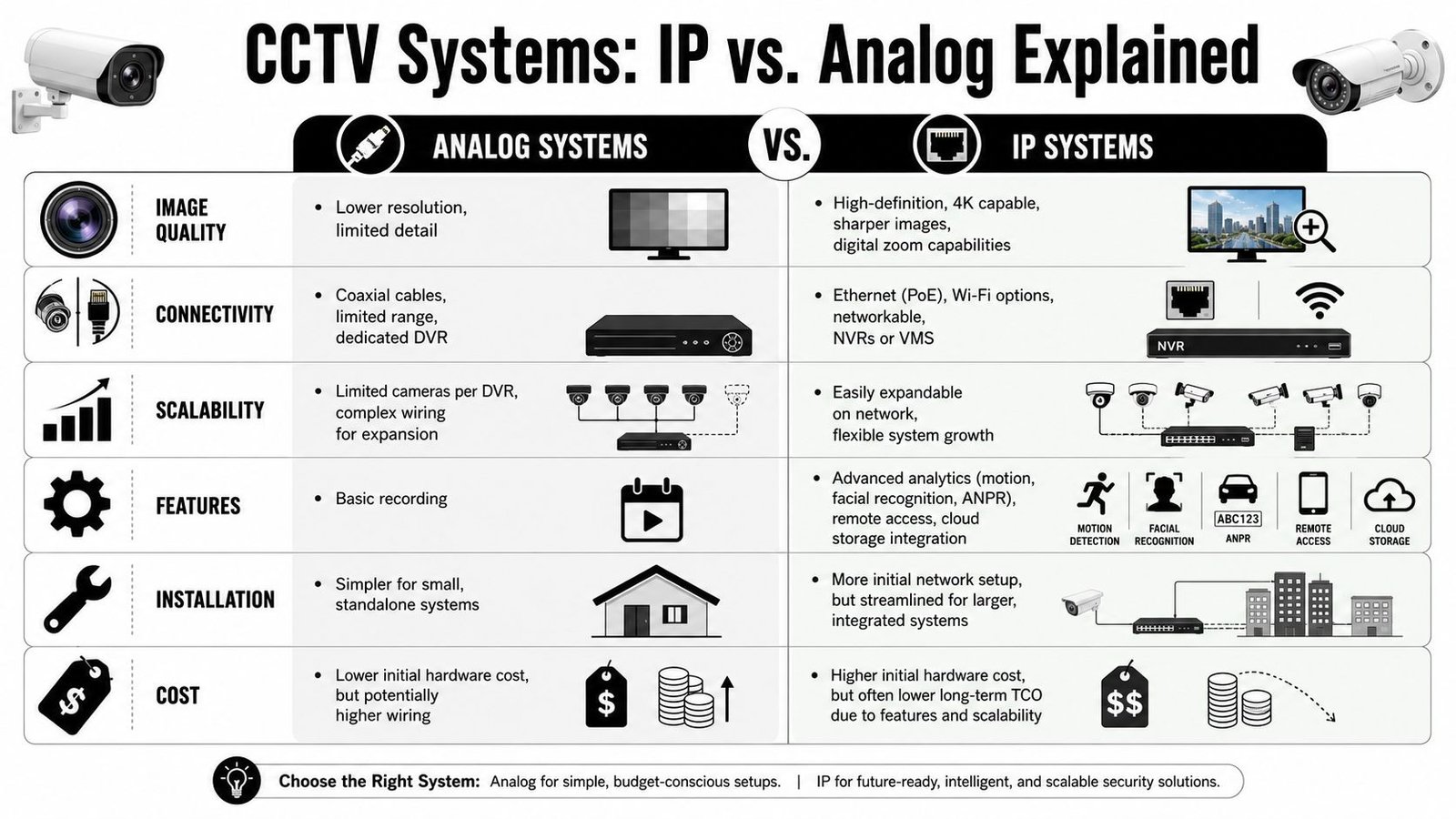
How a modern CCTV system actually works
On most current installs, cameras send video to a recorder such as an NVR in an IP system or a DVR in an older analogue-style setup. The recorder stores footage, manages schedules, and usually handles remote access through an app or browser platform.
The camera choice matters, but the placement and scene setup matter just as much. For UK residential and commercial CCTV, the key trade-off is pixel density. Systems with 1080p, 4MP or 4K sensors are preferred for entrances and gates where identification matters, but only when the lens and field of view are matched properly to the target area, as explained in this guide to pixel density and CCTV camera selection.
That single point saves people from a lot of disappointment. A high-resolution camera mounted too high, aimed too wide, or pointed into poor lighting still gives poor evidence.
Here is a practical way to consider it:
- Wide overview cameras are good for seeing movement patterns, vehicle flow, and general activity.
- Tighter identification cameras are for faces at doors, number plates at gates, and handoff points like counters or loading bays.
- Low-light support only helps when the angle, reflection, and exposure are controlled properly.
For a deeper side-by-side explanation, Wisenet Security has a useful breakdown of the difference between IP cameras and HD analog CCTV.
A short visual explanation helps here:
Choosing the right camera for the job
Different housings suit different environments. The wrong camera type often creates maintenance issues, blind spots, or poor results at night.
- Dome cameras: Useful for soffits, entrances, and indoor areas where you want a tidy look and some resistance to casual tampering.
- Bullet cameras: Better when you need a more obvious deterrent and a clear directional view over a path, gate, driveway, or yard line.
- PTZ cameras: Best reserved for larger sites where someone will actively use the pan, tilt, and zoom functions. They don't replace fixed cameras on critical points.
A PTZ can look impressive on a large commercial site, but if it's watching one corner, it isn't watching the rest at that same moment.
For homes in dense streets, I usually favour fixed cameras with deliberate angles. For small businesses, a mix of overview and choke-point coverage is more dependable than one camera trying to do everything.
What the cloud and mobile access really change
People often hear "cloud CCTV" and assume it solves everything. It doesn't. What it usually improves is accessibility, off-site backup options, and easier review when you're not on the premises.
A practical benefit is this: if you're away from your property, you can check an alert quickly, review footage, and decide whether the event needs action. That's useful only if the system is secure as well as convenient. If you're using remote viewing and smart devices, it's worth tightening the network side too. This practical guide shows how to protect your Wi-Fi and smart devices so your cameras and apps don't become the weak point.
Good cctv and alarm systems use remote access to reduce uncertainty. Badly set up ones just send you noise.
Intruder Alarm Systems Unpacked Bells Wires and Beyond
An intruder alarm is often still pictured as a bell box and a keypad by the front door. Modern systems are far more useful than that, but only when the design suits the building and the grade suits the risk.
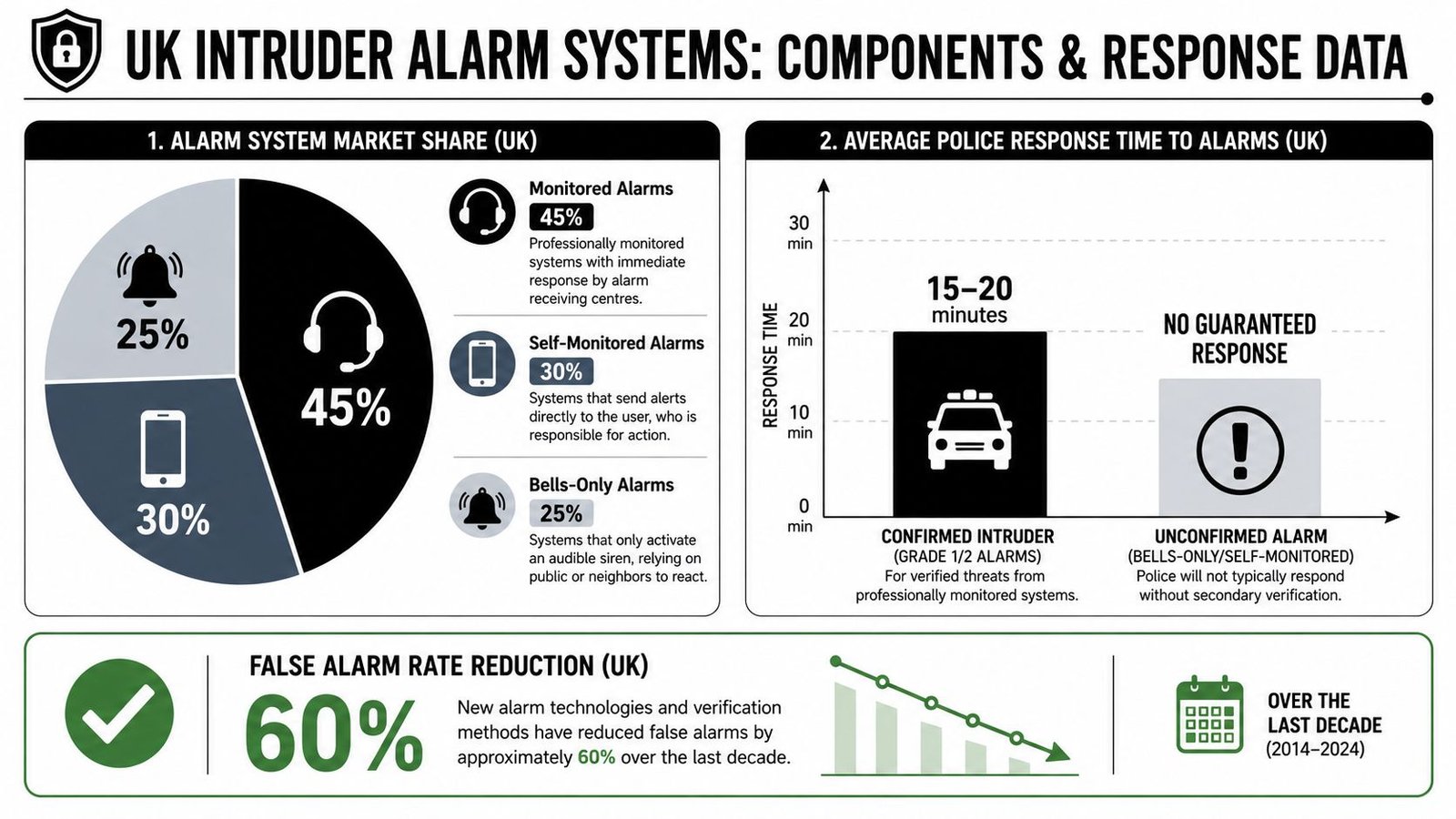
The parts that matter
Every intruder alarm has the same basic job. Detect an unauthorised event, signal it reliably, and trigger the right action. The difference between a solid system and a frustrating one usually comes down to device choice and commissioning.
The core components are straightforward:
- Control panel: The system's decision-maker. It handles zones, arming modes, event logs, and signalling.
- PIR detectors: These pick up movement and are common in rooms, hallways, and circulation routes.
- Door and window contacts: Simple and effective for perimeter protection.
- Shock or vibration sensors: Useful where forced entry is a concern, especially on vulnerable doors, shutters, or glazing.
- External and internal sounders: These deter, warn, and help localise the event.
- Signalling path: This is what gets the event out to a user or monitoring point.
The strongest alarm designs don't rely on one sensor type. They layer perimeter and internal detection so an intruder has to pass through more than one meaningful point without being picked up.
Wired or wireless depends on the building
There's no universal winner between wired and wireless. The right choice depends on construction, disruption tolerance, and long-term maintenance.
Wired systems usually make more sense in new builds, refurbishments, and commercial sites where cabling routes can be planned cleanly. They suit larger systems well and reduce battery management.
Wireless systems are useful in finished homes, heritage properties, flats, and occupied premises where cable runs would be too disruptive. The trade-off is battery maintenance and the need for careful device siting and signal planning.
A practical comparison looks like this:
| Type | Strong points | Trade-offs |
|---|---|---|
| Wired | Stable physical connections, good for larger or more permanent layouts | More installation work, more visible disruption in finished properties |
| Wireless | Faster fitting in occupied spaces, less chasing and lifting | Battery changes, signal planning, and more attention to servicing |
What BS EN 50131 means in practice
For UK intruder alarms, BS EN 50131 is the benchmark that matters most. It sets expectations for detection reliability, tamper resistance, and signalling for different risk environments, and it affects insurance compliance and police response, as outlined in this reference to BS EN 50131 and alarm grading.
In plain English, the grading process helps match the system to the property. A modest domestic setup doesn't need the same level of engineering as a higher-risk commercial premises. But both still need the right devices in the right places, proper tamper protection, dependable backup power, and testing that proves the system works when it should.
On site, grade matters less than fit. A formally suitable system still performs badly if the detectors are badly placed, the entry route is wrong, or maintenance gets ignored.
Modern alarm systems can also send smartphone alerts, support part-setting, and use pet-friendly detectors where needed. Those features are useful, but they don't compensate for weak layout. A pet-tolerant detector can help in a Swansea home with a dog moving overnight. It won't fix a detector that's aimed into the wrong traffic path or installed in a poor environment.
The Power of Integration How CCTV and Alarms Work Together
A camera system and an alarm system in the same building don't automatically make an integrated setup. Plenty of properties have both, but they operate as two separate islands. That's better than having neither, but it still leaves a gap when an incident happens.
Two separate systems are not the same as one joined-up system
Value comes when an alarm event triggers the relevant camera action straight away. That can mean recording a bookmarked clip, pushing a live view to the app, or highlighting the camera tied to the activated zone.
Without integration, the sequence is clumsy. An alert comes in. You don't know whether it's a genuine break-in, a delivery driver, a staff mistake, or a sensor issue. You then log in, search manually, scrub through footage, and try to line up the times.
With integration, the system does the joining-up for you. If a rear door contact triggers after hours, the camera covering that door and the approach route become the first thing you check. That shortens the time between event and decision.
Wisenet Security outlines this joined-up approach in its overview of integrated security systems.
Where integration makes the biggest difference
On a warehouse unit, one of the most useful combinations is a shutter or perimeter alarm linked to CCTV covering the same line of approach. If the alert is genuine, you see it quickly. If it's not, you avoid turning a minor issue into a full keyholder panic.
In retail, integration helps after closing time. A stockroom PIR, rear exit contact, and camera covering the service corridor give a much clearer picture than a siren and an app notification on their own.
For homes, the same principle applies on a smaller scale:
- Front approach plus door alert: You know whether someone merely walked up or actively tested entry.
- Side passage plus rear camera: You see whether movement continued toward the back of the property.
- Garage or outbuilding alarm plus video clip: You can tell the difference between a real intrusion and a harmless trigger.
Good integration doesn't just give you more data. It gives you the right context at the moment you need it.
Well-designed cctv and alarm systems earn their keep. They reduce hesitation. They also cut down the fatigue that comes from chasing alerts with no clear visual confirmation.
UK Compliance and Installation Best Practices
The technical side gets most of the attention, but compliance and installation quality decide whether the system becomes an asset or a headache. That's especially true in Cardiff, Bristol, and other dense urban areas where homes, flats, shops, and public space sit tightly together.
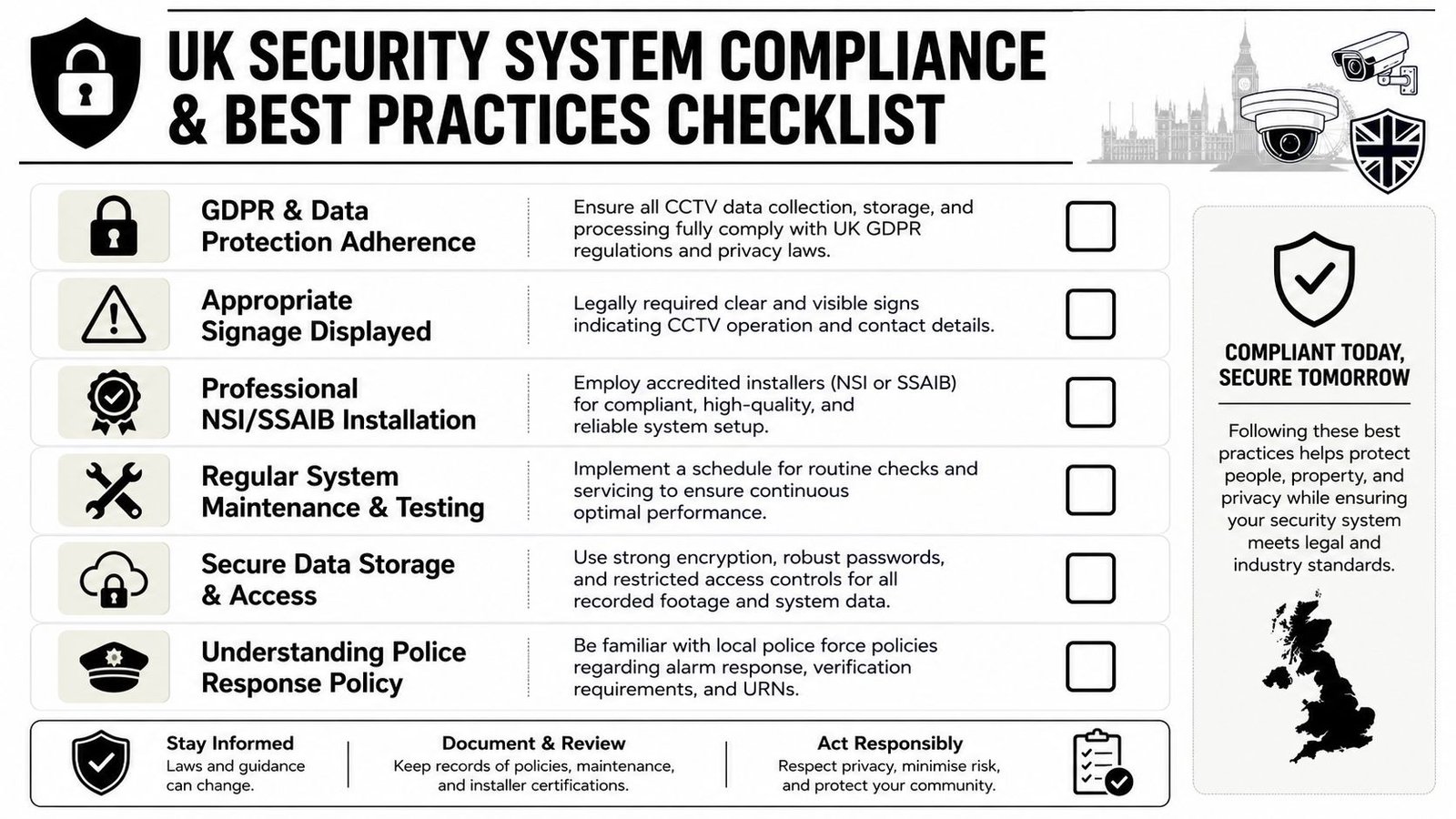
Privacy matters more in dense streets and shared spaces
A major issue people miss is privacy-compliant CCTV design. In denser South Wales and South West settings, especially terraced housing, flats, and mixed-use buildings, operators need to minimise capture of bystanders and public pavements, which affects camera angle, trigger setup, and what areas are recorded, as covered in this article on planning camera angles with privacy in mind.
That has practical consequences on site.
A front camera on a Bristol terrace shouldn't casually sweep half the street if the actual aim is to protect your doorway and small front boundary. A communal entrance camera in Cardiff needs tighter framing and clear purpose. A rear camera overlooking a lane has to be positioned so it protects access to your property without drifting into neighbouring gardens or windows.
Three habits help immediately:
- Aim for your boundary and approach routes: Not the widest possible view.
- Use activity triggers carefully: Recording every passer-by on the pavement creates noise and raises privacy issues.
- Make signage and retention sensible: If you're capturing identifiable footage, you need the operational side sorted too.
Good installation beats impressive specifications
A poor install can ruin good equipment. I see this most often with cameras mounted too high, alarms placed for convenience rather than detection quality, and devices fitted without much thought to how the building behaves at night.
The better installations share the same traits:
| Area | Good practice | Weak practice |
|---|---|---|
| Camera placement | Angle matched to the target zone | Wide, high overview with little usable detail |
| Alarm devices | Sensors placed on real entry paths and risk points | Sensors fitted where cabling is easiest |
| Night performance | Lighting, reflection, and scene contrast checked | Infrared relied on without testing the scene |
| Ongoing use | Users trained on arming, reviewing, and response | System handed over with little explanation |
For the legal side of surveillance in business settings, this guide to CCTV and GDPR in the UK is worth reading before you finalise a commercial installation.
What a compliant setup should include
Compliance isn't just paperwork. It shows up in daily use.
A solid setup should include:
- Clear purpose: Each camera and detector should exist for a defined reason.
- Controlled access: Not every staff member or household member needs full admin access.
- Retention rules: Keep footage for a justified period, not indefinitely by default.
- Maintenance checks: Lenses get dirty, batteries age, and detection drifts if no one checks it.
- Installer accountability: You want a company that designs to recognised standards and can support the system after handover.
The neatest install isn't always the best one. The best one is the one that still works properly in bad weather, low light, and normal day-to-day use.
DIY kits can be fine for very basic needs, but once insurance, shared access, staff areas, or monitored response enter the picture, professional design becomes far more important.
Choosing Your Security Partner in South Wales
A poor installer choice usually shows up after the job is finished. The cameras miss the gate that matters. The alarm works on paper but throws false activations when the building cools down at night. Six months later, nobody on site is confident changing a user code or pulling footage for an incident.
That is why installer selection matters as much as product choice, especially across South Wales and the South West. A system for a Cardiff rental flat, a Bristol terraced house, or a Newport trade unit should not be designed the same way. Building layout, boundary lines, lighting, access habits, insurer requirements, and neighbour privacy all change the job.
What to look for in an installer
In the UK, alarm design is heavily shaped by standards, and BS EN 50131 is one of the benchmarks insurers and monitoring providers look for. If you need a system that stands up with insurers or is suitable for police response, the installer's method and certification status matter, not just the hardware brand, as explained in this summary of UK alarm standards and market practice.
Ask direct questions during the quoting stage:
- What property types do they handle regularly? Dense Bristol terraces, rural edges outside Swansea, and multi-unit commercial sites in Cardiff all create different coverage and access issues.
- How do they survey a site? A proper survey should deal with entry routes, lighting, user behaviour, and likely nuisance triggers.
- What happens after installation? Servicing, battery changes, detector testing, firmware updates, and callout terms should be clear.
- Who gets trained at handover? Someone on site should know how to arm the system properly, review footage, manage permissions, and deal with an alert without guesswork.
- How do they document the system? You want zone lists, device locations, user access details, and a record of what was agreed.
Local knowledge counts for a lot here. Terraced housing in Bristol often means tighter camera angles, shared access points, and more care around public pavements. Industrial estates around Newport or Port Talbot tend to need better perimeter thinking, stronger out-of-hours coverage, and clearer procedures for staff and delivery traffic.
Wisenet Security Ltd installs and maintains CCTV, intruder alarms, access control, fire alarms, and related systems across South Wales and the South West.
What a proper survey should feel like
A proper survey feels like a risk discussion with someone who has seen the same problems before.
The installer should ask who opens up, who locks up, where people cut through, which doors are used out of hours, and what has gone wrong before. They should also check the parts of the site that cause actual trouble. Rear lanes in Cardiff. Side returns on Bristol homes. Roller shutters, yards, and poorly lit loading areas on South Wales industrial sites.
Key points they should cover include:
- Access patterns: Who comes and goes, and when
- Previous incidents: Useful for understanding weak points
- Out-of-hours activity: Cleaning staff, shift changes, late deliveries, or family routines
- Privacy and neighbouring property: A regular issue with residential CCTV and mixed-use sites
- Your main goal: Deterrence, evidence, verified alerts, or a combination
Good installers spend time walking the site, checking sight lines, and questioning assumptions. Cheap quotes often come from generic packages built before anyone has looked properly at the property. That is how people end up with blind spots, repeated false alarms, or systems that fail to match the building's day-to-day use.
Price still matters. So does the cost of getting it wrong. A better installation usually starts with more questions, not more kit.