
UK Security Gates Installation: Guide & Costs 2026
You're probably at the point where the driveway, yard entrance, depot gate line, or shared access road no longer feels properly controlled. People come and go too easily. Deliveries arrive when nobody's near the front. Staff use one entrance, visitors use another, and the whole setup relies too much on habit instead of a clear access system.
That's usually when clients in South Wales and the South West start looking at security gates installation seriously. They want stronger perimeter control, but they also want to know what they're buying. Not just a gate leaf and a motor, but the full picture. Groundworks, cabling, intercoms, safety edges, photocells, handover, servicing, and the legal side if the gate is powered.
In the UK, that distinction matters. Industry guidance treats force testing, entrapment protection, and risk assessment as essential parts of installation because powered gates can create serious injury risks if they're poorly designed. In practice, that means a security gate installation is a regulated security and safety system, not just a fencing job, as noted in this UK gate installation overview.
Table of Contents
- Your Complete Guide to Security Gate Installation
- Choosing Your Gate Type Material and Automation
- The Pre-Installation Blueprint Surveys and Regulations
- Selecting Your Installer and Budgeting for Success
- The Installation Process From Groundwork to Handover
- Post-Installation Care Maintenance and Safety Checks
- Frequently Asked Questions About Gate Installation
Your Complete Guide to Security Gate Installation
A good gate solves three problems at once. It controls entry, improves site discipline, and gives you a clear point where visitors, vehicles, and residents interact with the property. A poor one creates new problems. Slow access, nuisance faults, unsafe closing force, awkward vehicle turns, and a maintenance burden nobody planned for.
That's why the early decisions matter more than is generally understood. Before anyone talks about black aluminium, timber infills, underground motors, GSM entry, or smartphone control, the right question is simpler. What does this entrance need to do every day? A family home in Cardiff has different demands from a warehouse yard in Newport or a multi-tenant block near Bristol.
The strongest results usually come from treating the entrance as a working system, not a product.
Practical rule: If the gate design doesn't account for vehicles, pedestrians, deliveries, and emergency access from the start, the problems show up after installation when they're harder and more expensive to correct.
For a domestic property, that might mean deciding whether you need privacy, child safety, visitor screening, or just a reliable automated entrance that doesn't eat up driveway space. For a commercial site, it often means separating staff access from delivery access, deciding who can open the gate and when, and making sure the gate ties into CCTV, intercoms, and access credentials cleanly.
A proper project usually follows this path:
- Survey the entrance. Measure widths, levels, side room, sight lines, and cable routes.
- Choose the gate style. Swing, sliding, or another format that suits the site.
- Match the automation. Intercom, keypads, fobs, card access, ANPR integration, or simple remote control.
- Build in safety from the start. Not as an upgrade later.
- Commission and document the system. Including user rules and maintenance expectations.
Why UK installations need a different mindset
In South Wales and the South West, weather, slopes, narrow entrances, and mixed-use properties affect gate choices more than showroom photos do. Exposed coastal air can be hard on finishes and hardware. Rural entrances often need longer cable runs. Shared developments need clearer user control and stronger handover documentation.
That local reality is why experienced installers spend more time on layout, access method, and safe operation than on appearance alone. Security gates installation works best when the gate, automation, safety devices, and user behaviour are planned together.
Choosing Your Gate Type Material and Automation
The gate itself should follow the site. Not the other way round. Most installation mistakes start when someone chooses a style because it looks right online, then tries to force that design onto a driveway or yard that doesn't suit it.
Start with the site, not the brochure
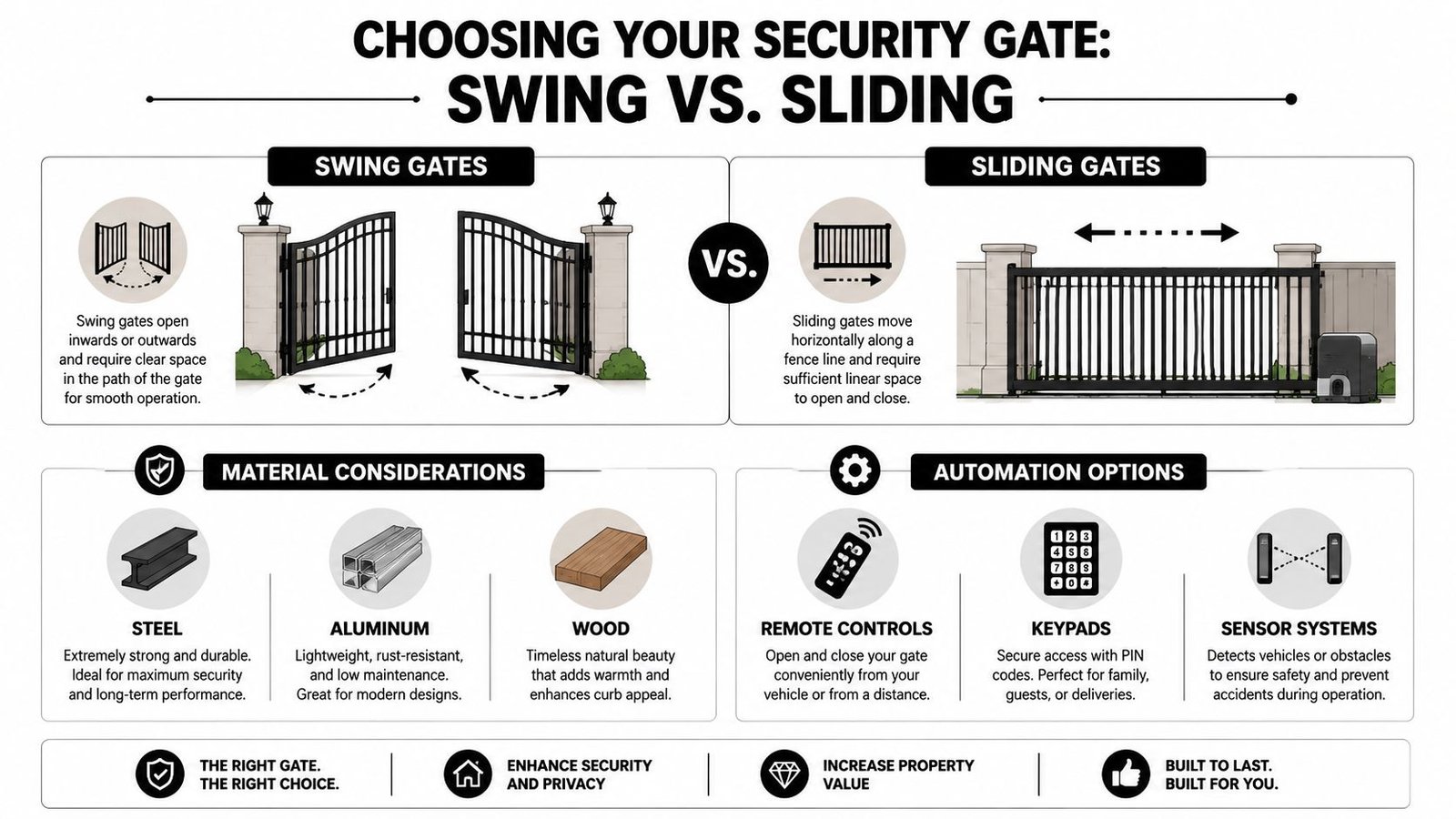
A swing gate is often the cleanest option when there's enough room for the leaves to open safely and the ground levels allow smooth movement. Domestic properties often suit swing gates because they look traditional and can be built in many styles. They do, however, need a clear opening arc. If cars stop too close, if the drive rises sharply, or if pedestrians cross the opening path, the design can become awkward quickly.
A sliding gate suits tight entrances, shorter forecourts, and sloping approaches where a swing gate would foul the ground or vehicle path. It needs lateral run-back space along the fence or wall line, plus sound groundwork and accurate alignment. On commercial sites, sliding gates are often easier to control because the movement is predictable and the open position is easier to secure.
A simple comparison helps:
| Gate type | Usually works well for | Main limitation |
|---|---|---|
| Swing gate | Level drives, traditional homes, wider openings | Needs clear swing area |
| Sliding gate | Sloped sites, short forecourts, yards, tighter vehicle control | Needs side run-back and precise ground prep |
Material choice changes more than appearance
Material affects weight, maintenance, motor sizing, and the way the gate ages in British weather.
- Steel or wrought-style metal: Strong, rigid, and well suited to a more defensive look. It's a solid choice where impact resistance and visual deterrence matter, but it needs proper finishing and long-term care.
- Aluminium: Lighter and easier on motors and hinges. It's popular where clients want a modern finish with lower upkeep.
- Timber: Good for privacy and softer visually on rural or residential sites. It can work very well, but the frame and automation must account for weight changes, moisture, and wind loading.
A handsome gate that's too heavy for the opening, the posts, or the motor setup won't stay handsome for long.
Automation should match how the entrance is used
Automation choices should follow the people using the gate. A private house may only need remotes, a keypad, and a video intercom. A managed building might need fobs, audit trails, timed access, and remote release. A warehouse entrance may need separate controls for staff and larger vehicles.
This is also where integration matters. If you're trying to understand how motors, controls, and electrical switching fit into the wider system, a background read on understanding VFDs and MCCs is useful because it shows how motor control logic affects reliability and safe operation in more complex setups.
For homeowners and site managers comparing hardware packages, looking at a gate automation kit is a practical starting point because it shows the sort of components a complete system may include, from operators and control boards to safety devices and access accessories.
The Pre-Installation Blueprint Surveys and Regulations
Most failures are predictable before the first hole is dug. The entrance is too tight. The slope is wrong for the chosen gate. The post positions don't allow the right hinge geometry. Nobody planned where the power and data cables would run. Or the client has been quoted for automation without a proper allowance for safety devices and testing.
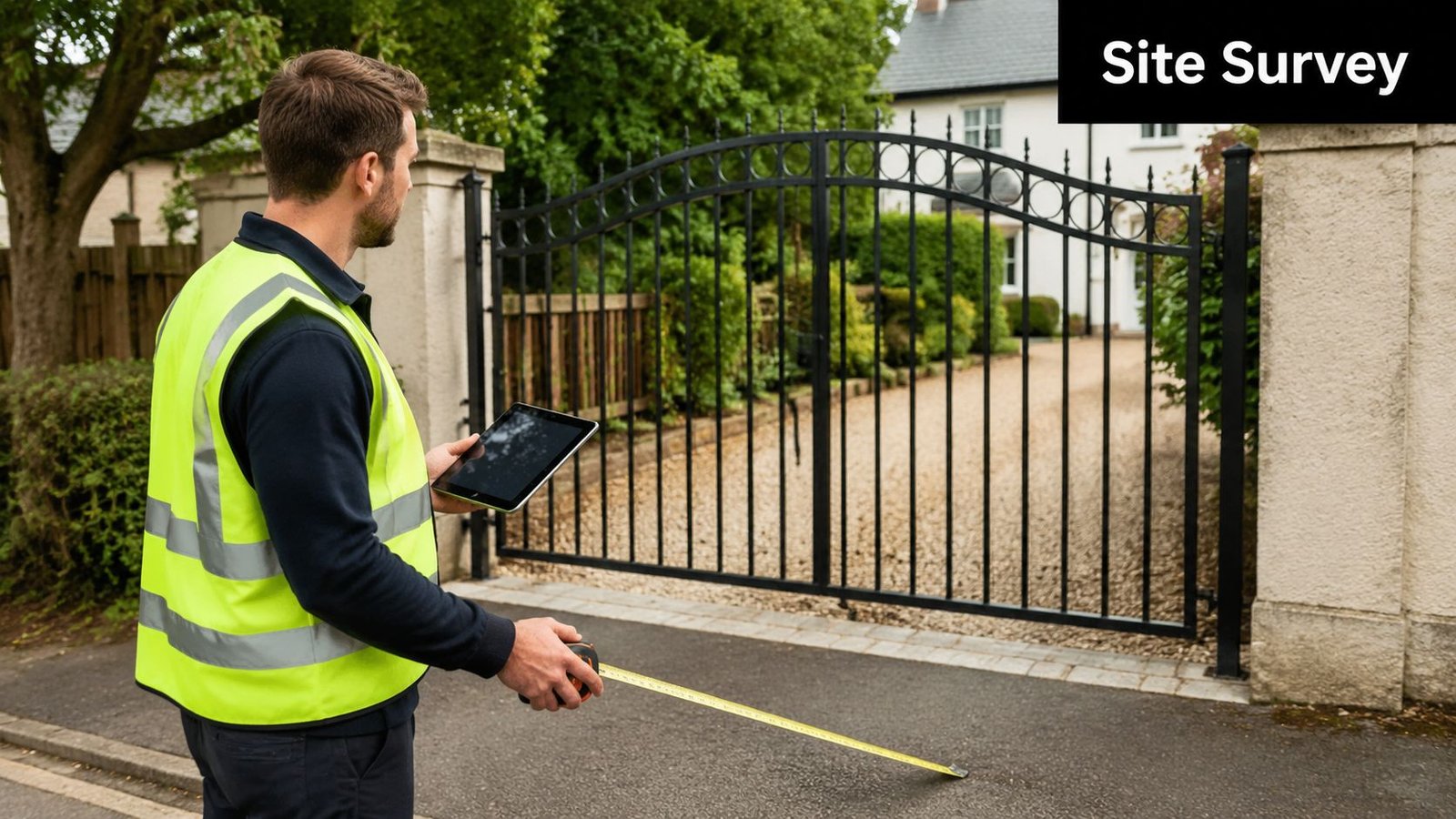
That's why the site survey matters so much.
What a proper survey needs to cover
A proper survey doesn't stop at gate width. It should examine how the entrance behaves in daily use.
Key survey items include:
- Opening width and clearances: The installer needs the true clear opening, not a rough tape measure from wall to wall.
- Ground levels and slope: This often decides swing versus sliding before aesthetics even enter the conversation.
- Vehicle path: Vans, trailers, delivery lorries, and turning circles all matter.
- Pedestrian movement: People shouldn't be forced into the gate travel zone.
- Services and cable routes: Power, data, drainage, and any buried services need checking before excavation.
- Post and foundation conditions: Existing brick piers may look sound but still be unsuitable for the load and motion of an automated gate.
A useful on-site rule is to verify the full opening envelope before hardware is fixed. Measure the clear opening, confirm the gate can swing or slide without fouling pedestrian routes, mark anchor points with the gate held plumb, and test manual travel before automation is energised, as shown in this installation method reference.
What UK safety rules mean on site
In the UK, practice differs sharply from many generic online guides. The Health and Safety Executive treats powered gates as a significant safety issue because crushing and entrapment hazards are real. Professional installations therefore require risk assessment and safety features such as photocells and pressure-sensitive edges, with the whole arrangement treated as one system where a failure in one part can affect both security and legal compliance, as described in this powered gate safety overview.
That has practical consequences for the specification:
- Photocells help detect a person or vehicle in the gate path.
- Pressure-sensitive edges protect trapping points.
- Force settings and safe stopping behaviour must be checked in operation, not assumed.
- Documentation and maintenance planning should be part of handover, especially for commercial and shared sites.
If you're comparing local options for an electric gate installation in Cardiff, use the survey stage to ask direct questions about safety devices, user control, and the commissioning process. If the answers are vague, that's a warning sign.
Selecting Your Installer and Budgeting for Success
The gate itself matters. The installer matters more. Two companies can quote for what looks like the same job and deliver very different outcomes because one prices a complete system and the other prices a gate plus a motor and leaves the difficult parts buried in small print or missing entirely.
Cheap gate work usually looks cheapest on paper because the quote strips out what clients don't yet know to ask for.
What separates a proper installer from a cheap quote
Start with the basics. You want a contractor who can show insurance, relevant trade credibility, and engineers who are suitable to work on occupied residential or commercial sites. For security-related work, DBS-checked engineers and a clean, documented handover process matter. For commercial clients, SafeContractor status is a useful sign that the company understands controlled site working.
Then look at how they talk about the project. A proper installer asks about traffic flow, users, delivery patterns, emergency access, and long-term maintenance. A weak one jumps straight to gate style and colour.
If the quotation spends more space describing the gate finish than the safety devices, cabling route, and commissioning, it's probably not a complete specification.
How to read a quotation properly
A usable quotation should separate the job into recognisable parts. Not every firm formats it the same way, but you should be able to identify:
| Quote item | What you want to see |
|---|---|
| Gate and structure | Material, finish, size, support method |
| Automation | Operator type, control board, access devices |
| Groundworks | Foundations, track or posts, ducting |
| Electrical works | Power supply, wiring, weatherproof connections |
| Safety equipment | Photocells, edges, setup and testing |
| Handover | User training, manuals, maintenance guidance |
Watch for vague phrases such as “automation included” with no detail, or “subject to site” attached to critical parts that should already have been surveyed.
Budgeting is easier when you compare whole-life value, not just installation spend. A properly specified system often costs more upfront because it includes the unseen work that keeps the entrance reliable and compliant. That's usually a better result than paying less, then paying again for remedial safety work, control issues, or repeated callouts. For wider security planning, this guide to 2026 security system costs in the UK helps place gate automation alongside CCTV, alarms, and access control in a single budget.
The Installation Process From Groundwork to Handover
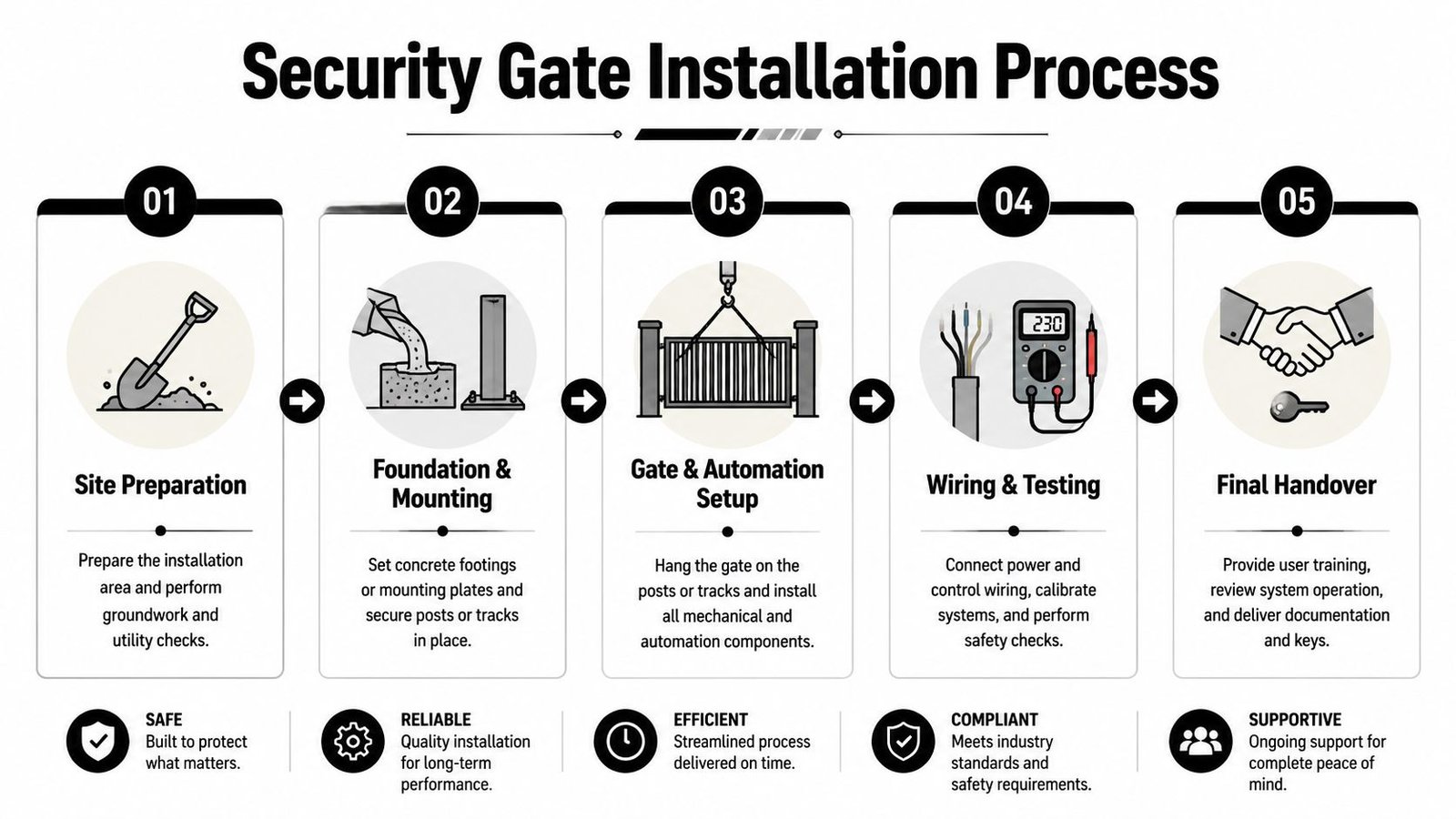
By the time the installation team arrives, the best jobs already feel settled. The gate type is confirmed. Cable routes are known. Foundation positions are marked. Access control has been agreed. The remaining work is physical, electrical, and procedural.
That doesn't mean it's simple. It means the complexity has been managed properly.
Groundworks and mechanical fitting
The first stage is normally excavation, ducting, and foundation work. Sliding gates need accurate support and track or cantilever preparation. Swing gates need posts or piers that can carry the load without twisting over time. In both cases, cable routes for power, intercoms, safety devices, and exit controls need to be protected from moisture and accidental damage.
On larger or more congested sites, careful excavation matters. If you want a useful overview of cleaner trenching methods around buried services, Booms Up Civil Group NDD gives a good explanation of non-destructive digging principles. The article is Australian, but the method is relevant anywhere buried utilities are a concern.
Once the base is ready and cured, the gate is mounted and aligned. This is the point where rushed installers get into trouble. They try to make the automation compensate for poor geometry. It won't. The gate should move smoothly by hand before anyone relies on motors and electronics.
Wiring, integration and commissioning
After the mechanical side is right, the automation and controls go in. Motors are fixed, control boards are wired, and safety devices are connected. If the project includes intercoms, card access, keypads, vehicle loops, or CCTV-linked verification, those parts are integrated at this stage.
A short walkthrough video helps clients picture the sequence:
Professional commissioning is where the installation is either validated properly or merely switched on and hoped for. A common technical pitfall is underestimating foundations and safety-device setup. Good practice involves isolating power, mounting the motor on a cured concrete pad, wiring to the control board, testing photocells and safety edges, then running repeated open and close cycles with obstruction tests so the gate stops or reverses correctly before handover, as described in this automatic slide gate opener guide.
The same source notes that the HSE reported around 18,000 work-related non-fatal injuries to workers were due to being struck by a moving vehicle in 2022/23 in the UK, which is a useful benchmark for why installers must control vehicle and pedestrian interfaces during construction and final testing in busy environments.
A proper handover should include:
- User demonstration: How to open, close, override, and isolate safely.
- Access issue handling: What to do if a remote is lost or a user changes.
- Safety awareness: Which areas must be kept clear.
- Documentation: Manuals, settings records, and maintenance expectations.
Post-Installation Care Maintenance and Safety Checks
A gate can be perfectly installed and still become unsafe later if nobody maintains it. That's the part many buyers underestimate. They think the hard work ends at handover. In reality, handover is where the responsibility changes hands.
Powered gates live outdoors, move under load, and depend on aligned hardware, responsive safety devices, and clean control signals. Dirt in the track, damaged photocells, worn hinges, loose fixings, or altered force settings can all change how the gate behaves.
Why install and forget is the wrong mindset
HSE guidance on powered gates stresses that they can trap, crush, or strike people if they're poorly designed, installed, or maintained. It also makes clear that ongoing management and documented maintenance are part of UK compliance, not optional extras, as discussed in this guide on security gate risks and upkeep.
That matters most on busy sites. Family homes with children, rental properties with changing occupants, depots with delivery traffic, and shared developments all have one thing in common. The people using the gate may not be the people who arranged the installation. If nobody checks the system, faults can sit unnoticed until the gate behaves unpredictably.
A safer gate isn't always the heaviest or most complicated one. Often it's the one that people can see clearly, use correctly, and keep maintained.
One local provider, Wisenet Security Ltd, offers gate automation alongside CCTV, intercoms, and access control, which is useful when a site needs one contractor to maintain the full entrance system rather than separate trades for each part.
What you should check yourself
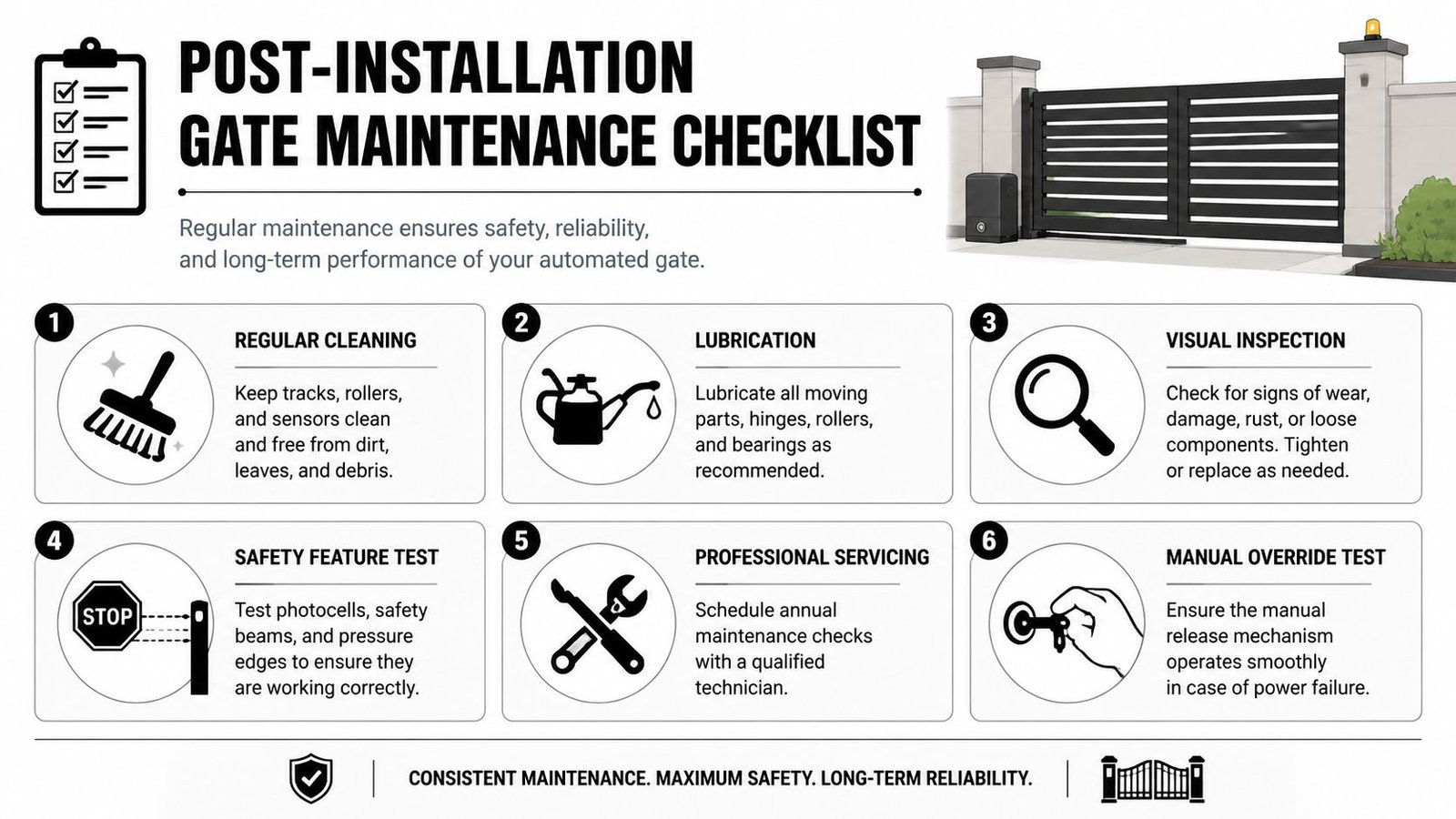
Owners and site managers can do basic visual and functional checks between engineer visits. That doesn't replace servicing, but it does catch obvious issues early.
- Keep travel areas clear: Remove leaves, gravel, mud, and any debris from tracks, stops, and sensor lines.
- Watch the movement: Look for jerking, scraping, sagging, or unusual noise.
- Test safety devices: Confirm photocells and protective edges react properly during a controlled test.
- Check the manual release: Make sure it can be operated if power is lost or the system faults.
- Review user behaviour: Gates get damaged when drivers tailgate or pedestrians cut through the travel zone.
For a parallel example from another moving entrance system, this piece on keeping your garage door running smoothly is worth a look. Different equipment, same principle. Mechanical access systems stay safer when owners clean, inspect, and service them regularly.
Frequently Asked Questions About Gate Installation
Some questions come up on nearly every job, especially once clients understand that the gate is part of a wider access and safety system rather than a stand-alone item.
Common Gate Installation Questions
| Question | Answer |
|---|---|
| Do I need a sliding gate or a swing gate? | It depends on space, slope, and vehicle movement. Swing gates suit sites with clear opening space. Sliding gates suit tighter or sloping entrances if there's enough side run-back. |
| Can a gate work with intercoms, fobs, CCTV, and access control? | Yes, if the system is designed as one integrated setup from the start. That's usually the cleanest way to manage visitor access, resident entry, and recorded verification. |
| Is maintenance really necessary if the gate is new? | Yes. A new gate still needs inspection and servicing because safety devices, moving parts, and alignment can change over time with weather, traffic, and daily use. |
A final practical point. Ask any installer who will service the gate after handover, what checks are included, and how faults are logged. If they only want to discuss installation day, you're not hearing the full life-cycle cost or responsibility.
If you're planning a gate project in South Wales or the South West, Wisenet Security Ltd can assess the entrance, advise on gate type, automation, intercom and CCTV integration, and provide ongoing maintenance support for residential and commercial sites.