How Often Should Fire Alarms Be Tested? a UK Guide
For businesses in the UK, fire alarms should be tested weekly. For homes, a monthly test is the recommended best practice, and that's usually the clearest starting point if you're wondering how often should fire alarms be tested.
If you're a shop owner in Cardiff, a landlord in Swansea, or a homeowner in Bristol staring at a control panel or smoke alarm and thinking, “Am I doing this often enough?”, you're not alone. Fire alarm testing gets muddled because people mix up quick user checks with formal servicing, and they also assume a house, a café, and an industrial unit all follow the same routine. They don't.
What works in practice is simple. Occupied business premises need a disciplined weekly test routine. Homes need a habit that people will maintain, which is why monthly testing is the sensible benchmark for domestic alarms. Then there's the other layer. User testing tells you whether the system still functions today. Professional maintenance tells you whether the system is still fit for purpose under UK fire safety duties and BS 5839.
In South Wales and the South West, I see the same pattern repeatedly. Smaller sites often under-test because everyone is busy, while larger sites overcomplicate a task that should take a few minutes and a good logbook. If you want a broader view of practical fire safety for facilities, that resource is useful alongside the property-specific guidance below.
Table of Contents
- Your Guide to Fire Alarm Testing
- Why Regular Fire Alarm Testing Is Non-Negotiable
- Fire Alarm Testing Schedules for Different Properties
- How to Perform a Weekly Fire Alarm Test
- Mastering Your Fire Safety Logbook
- When to Call for Professional Fire Alarm Servicing
Your Guide to Fire Alarm Testing
If you manage a premises, the first thing to get straight is this. Testing frequency depends on the property type and the level of responsibility attached to it. A homeowner pressing the button on a hallway smoke alarm isn't carrying the same duty as the responsible person for a salon, workshop, warehouse, school, or block common area.
The property decides the routine
For a typical house or flat, monthly testing is a practical habit. It suits domestic life because people can pair it with another regular task, like checking post, changing calendars, or paying household bills. In domestic settings, the biggest failure point usually isn't a complicated panel issue. It's neglect. Dead batteries, removed heads, dust, or an alarm everyone assumes is fine because it hasn't made a noise.
For a business, the standard has to be tighter. Staff, visitors, contractors, tenants, and delivery drivers all depend on the warning system doing its job instantly. In a small Newport office that may mean one sounder circuit and a few call points. In a mixed-use building in Bristol, it may mean several zones, panel indications, shared circulation routes, and different occupancy patterns across the day.
Practical rule: If people work there, shop there, store goods there, or sleep there under someone else's management, testing can't be left to guesswork.
South Wales and South West realities
Local properties add their own wrinkles. Older terraced buildings converted into offices can have awkward layouts and legacy wiring. Retail units can be empty at some times and packed at others. Industrial sheds can be noisy enough that audibility is a real concern, not a paperwork issue.
That's why the right question isn't only “how often should fire alarms be tested”. It's also “what kind of test can the occupier carry out safely and reliably, and when does the job move into professional territory?” Once you separate those two jobs, the whole subject becomes much easier to manage.
Why Regular Fire Alarm Testing Is Non-Negotiable
A fire alarm system isn't compliant because it's installed. It's compliant and useful only when somebody knows it still works.
A test proves the whole warning chain
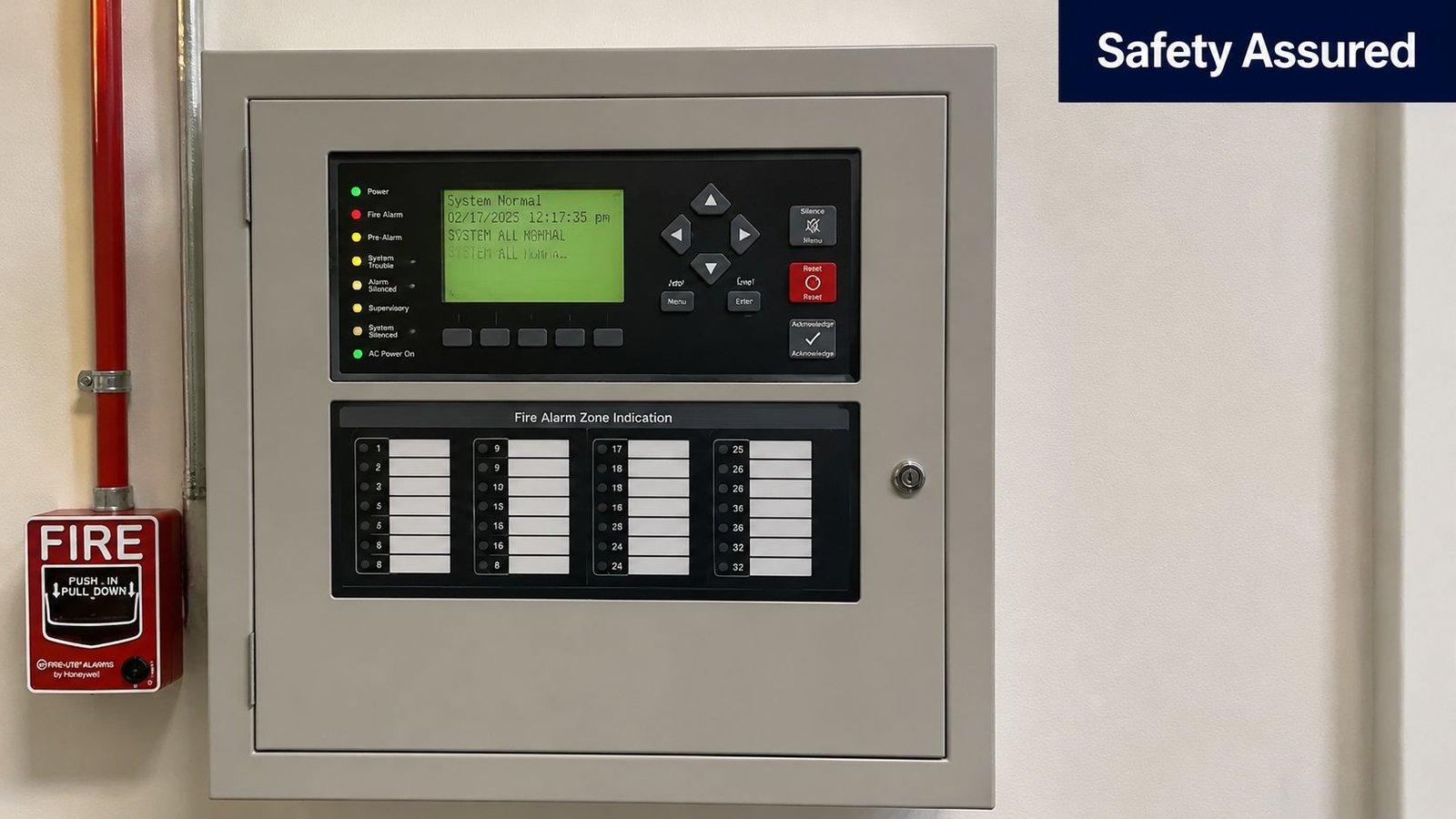
The best way to think about it is like an MOT mindset for life safety equipment. A panel that looks healthy at first glance can still hide a real-world failure. Sounders fail. Faults latch. Zones get isolated and forgotten. A damaged device or standby issue can sit there unnoticed until the day you need the system most.
In UK practice, weekly user testing is treated as a reliable standard in occupied premises because it helps catch failed sounders, latched faults, isolated zones, and similar issues before they become a false sense of security, as explained in this UK fire alarm testing guidance from Ajax Systems. The same guidance is useful because it highlights the technical point many people miss. A proper user test checks the end-to-end alarm path, not just whether the panel has power.
That matters in real buildings. A detector, a manual call point, a panel indication, and the final audible warning all sit in the same chain. If one link fails, the occupants don't get a dependable warning.
The responsible person can't treat this as optional
For business premises in Wales and England, the responsible person has a legal duty to keep fire safety measures in working order. That duty sits with whoever controls the premises in practice, often the employer, owner, managing agent, or person with day-to-day control. The law doesn't reward good intentions. It expects a routine.
A weekly test is one of the clearest ways to show that routine exists and is being carried out properly. It also creates evidence. If a fault appears, there should be a record, an action, and a follow-up.
If you're trying to tighten compliance processes across a site, this guide to mastering fire safety compliance is a helpful companion to the operational points here.
A system no one tests becomes a comfort blanket, not a safety measure.
Fire Alarm Testing Schedules for Different Properties
The answer changes with the premises. That's where many people get caught out.
Residential homes and rented domestic property
For homes, monthly testing is the best practical routine. Press the test button on each alarm, confirm the sounder operates, and if the alarms are interlinked, make sure the linked warning works as expected. For owner-occupiers, that's straightforward. For landlords, it's still sensible between tenancy events, even though the day-to-day user test is often handled by the occupant.
Domestic systems usually fall under a different part of BS 5839 than commercial systems. In plain terms, the expectation is less about weekly formal call-point rotation and more about making sure the alarms in the actual living space still warn people properly. Simpler systems need simple habits.
Commercial premises and SMEs
For businesses, the benchmark is much firmer. The Fire Protection Association says commercial premises should have fire alarms tested weekly to make sure there has not been any major failure and that the system is still working correctly, in its guidance on how often commercial fire alarms should be tested. That weekly schedule is the most consistently cited baseline for occupied non-domestic buildings in UK guidance.
That applies neatly to the kinds of sites common across Cardiff, Newport, Swansea, Bristol, and the wider region:
- Retail units: Staff turnover is common, layouts change, and audibility can be affected by stock and shopfitting.
- Offices: Hybrid occupancy can make complacency worse. Empty desks don't remove the duty to test.
- Restaurants and cafés: Busy services make it easy to postpone routine checks. That's exactly how they get missed.
- Multi-tenant commercial buildings: Shared systems need clear responsibility, not assumptions between occupiers.
If a site uses app-based access, managed entry, or remote oversight, tools that centralise smartphone access for properties can help building managers keep site routines organised, but they don't replace the physical fire alarm test itself.
Industrial sites warehouses and louder environments
Industrial premises need the same discipline, but the practical risks are different. In a warehouse, fabrication unit, or logistics building, background noise, shuttered compartments, and changing internal layouts make audibility and visibility more important. A quick test that nobody hears at the far end of the unit is not a good test.
That's also where system type matters. A straightforward guide to conventional fire alarm systems can help if you're trying to understand whether your panel and zoning arrangement suit the premises you're operating.
| Property Type | User Test Frequency | Who Performs It | Professional Service |
|---|---|---|---|
| Residential home | Monthly | Homeowner or occupier | Competent professional when faults appear, after alterations, and as required for the system |
| Rented domestic property | Monthly in practical use | Occupier, with landlord oversight where applicable | Competent professional when faults appear, after alterations, and as required for the system |
| Commercial SME | Weekly | Responsible person or trained site staff | Routine servicing by a competent fire alarm engineer |
| Industrial or warehouse site | Weekly | Responsible person or trained site staff | Routine servicing by a competent fire alarm engineer |
| Multi-tenant non-domestic premises | Weekly | Responsible person, managing agent, or designated staff | Routine servicing by a competent fire alarm engineer |
For most businesses, the mistake isn't not knowing the rule. It's assuming someone else on site is handling it.
How to Perform a Weekly Fire Alarm Test
A weekly fire alarm test should be short, controlled, and recorded properly. On a small business site, it often takes only a few minutes if the process is set up properly.
Near the start of the routine, keep this checklist visible to whoever carries out the test:
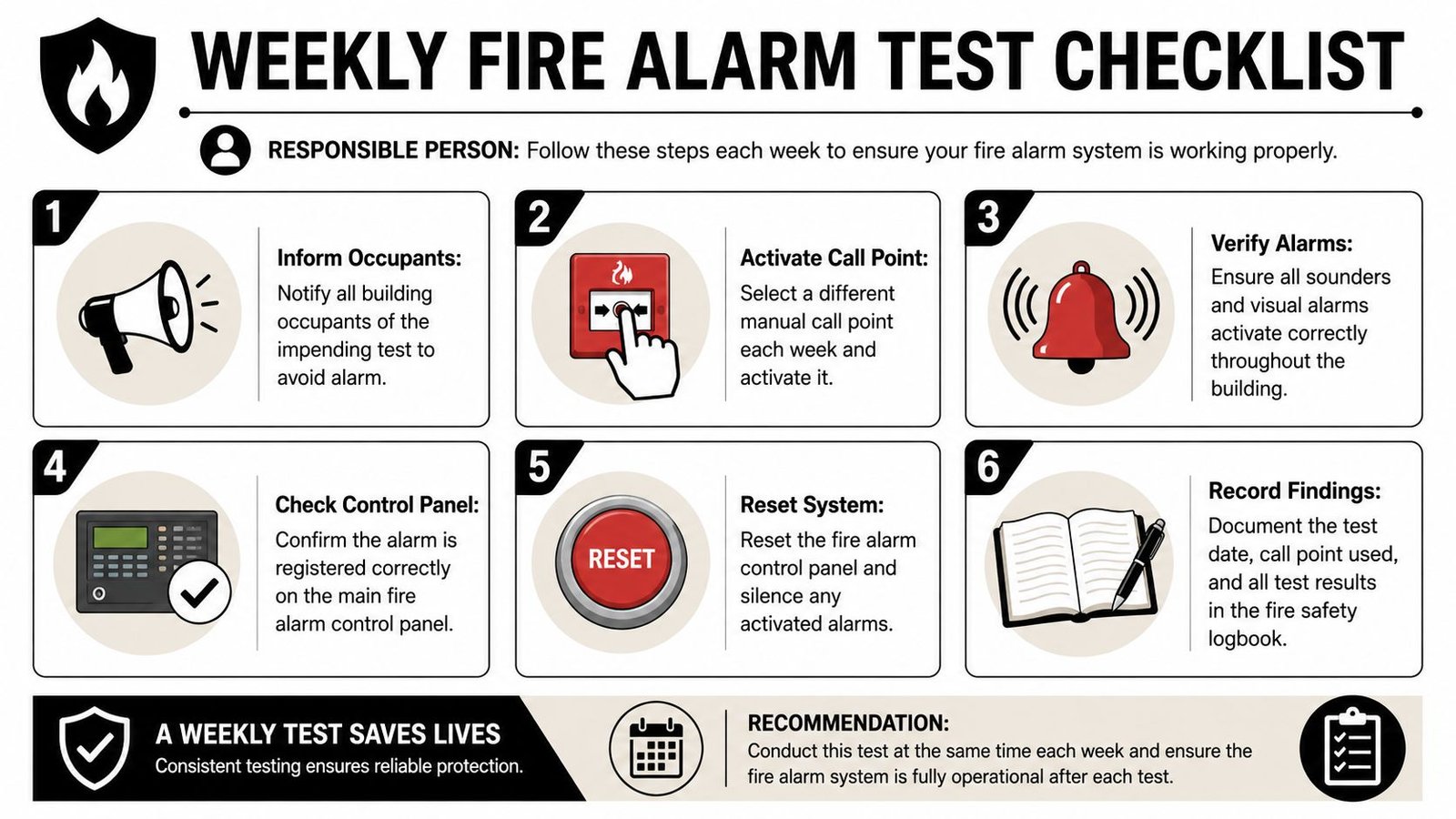
The five-minute routine that actually works
Tell people first. Let staff, tenants, or regular occupiers know the test is about to happen. If the system reports to a monitoring centre, notify them before you trigger anything.
Check the panel status. Before touching a call point, look at the control panel. If it's already showing a fault or isolation, note that before the test starts.
Use a different manual call point each time. Rotation matters. Don't stand at the same point every week because it's near reception and easy to reach.
Activate the call point with the proper key or test method. Don't improvise. Use the correct tool for the device.
Confirm the alarms operate. Someone should verify that the sounders, and any visual alarms where fitted, can be detected in the building.
Check the panel indication. The panel should identify the activation correctly. If the wrong zone appears, that needs investigation.
Reset the system fully. Make sure the alarm is silenced, reset, and back to normal condition. Never leave a site assuming the panel has recovered on its own.
Write it down immediately. Date, time, call point used, result, and any fault or oddity observed.
This walkthrough is easier to follow when you can see a live demonstration:
Mistakes that cause trouble later
The worst habits are always the small ones.
- Testing the same point every week: It creates a false impression of coverage.
- Forgetting to notify monitoring: That can trigger unnecessary escalation.
- Ignoring weak audibility: If a back office, plant room, or loading area can't hear the signal properly, the test has done its job by exposing that problem.
- Leaving paperwork until later: People forget details. Log it on the spot.
A well-run weekly test should feel routine, not dramatic. If it turns into confusion every time, the process needs tightening.
Mastering Your Fire Safety Logbook
A fire safety logbook is more than admin. For a business, it's one of the first things an enforcing officer, auditor, insurer, or service engineer will want to see. If the book is incomplete, people start asking whether the testing routine exists at all.
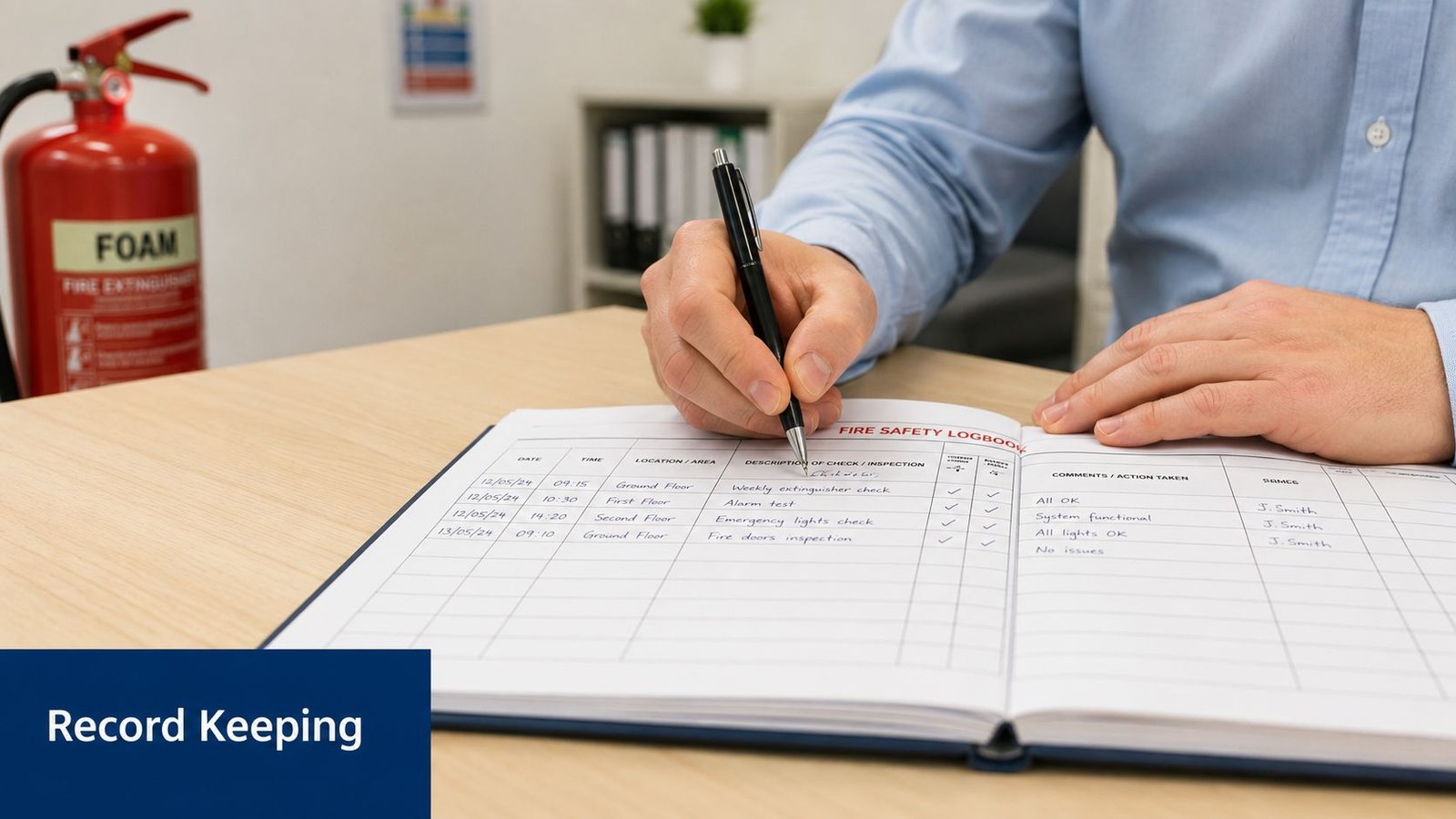
What to record every time
Commercial logbooks should be clear enough that another competent person can read them and understand exactly what happened. For each user test, record:
- Date and time: Keep the timing consistent where possible.
- Device or call point used: Be specific, not vague. “Rear warehouse exit call point” is better than “back alarm”.
- Outcome: Note whether the sounders operated and whether the panel displayed the activation correctly.
- Faults found: Record anything unusual, even if the system still sounded.
- Action taken: If you reported it, isolated a zone temporarily, or arranged an engineer, say so.
- Name or signature: The person who carried out the test should be identifiable.
Keep this simple: A short, accurate entry made immediately is better than a perfect one written from memory three days later.
Homes can be simpler but still need a record
Homeowners don't need the same formal paperwork culture as a commercial site, but some record is still good practice. A reminder in your phone, a calendar note, or a household maintenance app is enough for many domestic settings. The point is consistency.
For landlords and managed residential property, informal memory isn't enough. If alarms are part of your responsibilities, keep a dated trail of checks, faults, and remedial work. It protects occupants first, and it also protects you when questions are asked later.
When to Call for Professional Fire Alarm Servicing
A user test and a professional service are not competing options. They do different jobs, and you need both.
User tests and engineer servicing are not the same job
User testing answers a basic question. Does the system still respond and warn people today?
Professional servicing goes further. An engineer checks the condition of the system, investigates faults properly, tests devices more thoroughly, reviews power supplies and control equipment, and confirms the system remains suitable and maintainable. On commercial premises, that servicing needs to be planned, not left until the panel starts beeping.
The same distinction matters after building alterations. If you've changed partitions, repurposed rooms, expanded storage, or altered occupancy, the fire alarm arrangement may no longer match the risk. A quick weekly activation won't answer that.
For readers comparing broader maintenance expectations, this fire detection services guide from Securitec Security is a useful external reference point on the role of proper servicing alongside routine checks.
Call a professional when any of these happen
You should escalate to a competent fire alarm engineer when:
- A weekly test exposes a fault: Don't just note it and carry on.
- The panel shows a persistent fault or isolation: If it remains after reset, it needs technical attention.
- A sounder or beacon doesn't operate properly: Especially in warehouses, plant areas, and larger commercial units.
- The building layout has changed: New walls, new uses, new obstructions, new occupancy patterns.
- The system has become difficult for staff to manage: If nobody on site is confident with the panel, the arrangement needs reviewing.
- Scheduled maintenance is due: Planned servicing should happen before the system gives you a reason to regret postponing it.
If you're managing sites across South Wales or the South West, it helps to have a maintenance plan rather than a call-out-only approach. This overview of alarm system maintenance is useful for understanding what a structured support arrangement should include.
A good rule is straightforward. Occupiers can carry out the routine test. Fault diagnosis, servicing, system alterations, and compliance-led maintenance belong with a competent professional.
If you need help with fire alarm testing, servicing, upgrades, or ongoing maintenance in South Wales or the South West, Wisenet Security Ltd can support homes, SMEs, warehouses, and multi-site properties with practical, compliant fire safety systems and dependable local engineering support.