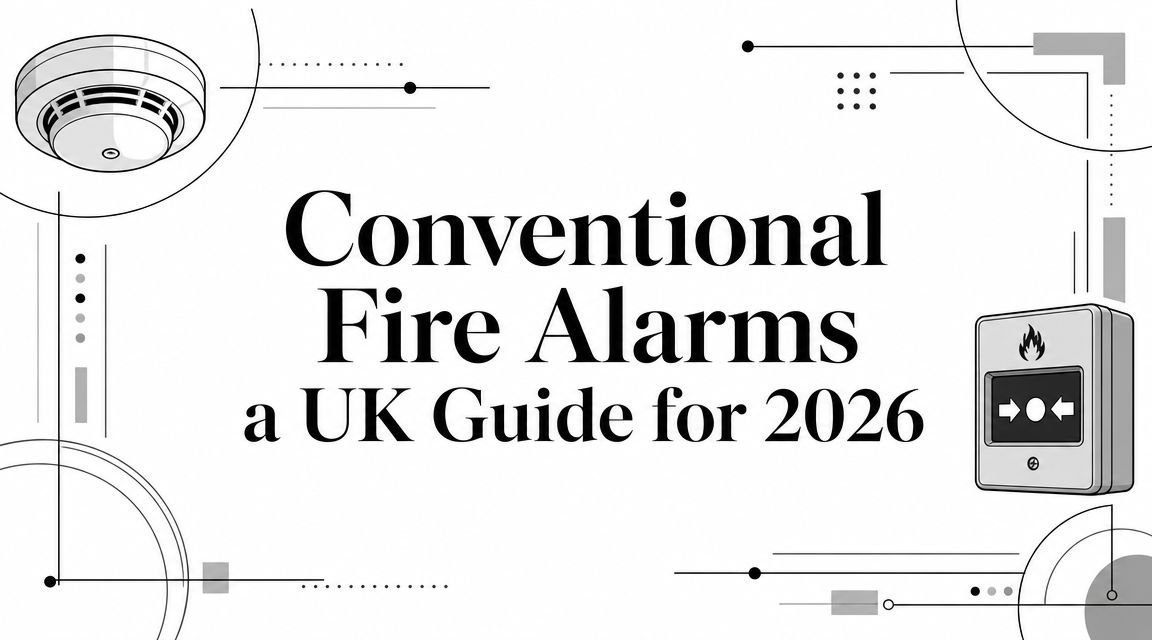
Conventional Fire Alarms a UK Guide for 2026
You're probably weighing up a familiar choice. Your current panel is ageing, a refurb is coming up, or you've just taken on a small unit in Cardiff, Bristol, Newport or Swansea and need a fire alarm that's compliant without becoming a project in its own right.
That's where conventional fire alarms still come into the conversation. They're simple, widely understood, and often a sensible fit for smaller premises. But the key decision isn't just about the upfront quote. It's about how quickly your team can respond, how easy faults are to trace, what BS 5839 means in day-to-day practice, and whether the system will still suit the building a few years from now.
If you run a shop, office, workshop, warehouse, HMO, or mixed-use property in South Wales or the South West, this guide will help you judge that choice properly.
Table of Contents
- How Conventional Fire Alarm Systems Work
- The Key Components of a Conventional System
- Conventional vs Addressable Fire Alarms Compared
- Is a Conventional System Right for Your Premises
- UK Fire Alarm Regulations and Maintenance
- Typical Costs and Monitoring Services
- Choosing a Local Accredited Fire Alarm Installer
How Conventional Fire Alarm Systems Work
Think in zones, not individual devices
The easiest way to understand conventional fire alarms is to think about an old set of Christmas lights. If one part of the string causes a problem, you know which string is affected, but you still have to inspect along it to find the exact point.
A conventional fire alarm system works in much the same way. Devices are grouped into zones. The control panel can tell you which zone has gone into alarm, but it can't tell you the exact smoke detector or manual call point that triggered it. In UK fire alarm planning, that zone-based arrangement remains a core concept because it's simpler and usually lower cost for smaller or less complex premises, as described in this overview of zone-based smoke detector system design.
That's why conventional systems have traditionally been common in small offices, shops, workshops and straightforward warehouse spaces. If the building is easy to search, knowing the general area may be enough.
Practical rule: A conventional system tells you where to start looking, not exactly what has activated.
The signal path in plain English
Here's the chain reaction in simple terms:
A detector senses smoke or heat
A smoke detector or heat detector in one zone reacts to conditions that match its operating threshold.The zone circuit reports to the panel
The wiring for that zone sends the alarm condition back to the control panel.The panel identifies the zone
The panel lights or displays the affected area, such as office area, first floor, rear store, or warehouse bay.The sounders activate
Bells, sirens or other alarm devices operate so people in the building know to evacuate or follow the site procedure.Someone has to investigate the zone
A responsible person, keyholder, or attending engineer then needs to locate the actual detector or call point involved.
That final step is where many buyers underestimate the trade-off. In a single open-plan retail unit, a quick search might be straightforward. In a building with treatment rooms, stock areas, partitions, shared corridors, or several tenants, the time needed to search a zone can become a serious operational issue.
The signal path in plain English
Conventional fire alarms are often described as basic. That can make them sound outdated, but basic isn't the same as poor. In the right premises, simple wiring and clear zone indication can be reliable and easy for staff to understand.
The problem comes when buyers assume “small building” automatically means “conventional is right”. If your layout is awkward or staffing is thin, the panel's lack of device-level detail can create friction every time there's an alarm, fault, or investigation.
The Key Components of a Conventional System
The panel, detectors, call points and sounders
A conventional system is made up of a few core parts. Each one has a single job, which is part of why these systems are often viewed as straightforward and dependable.
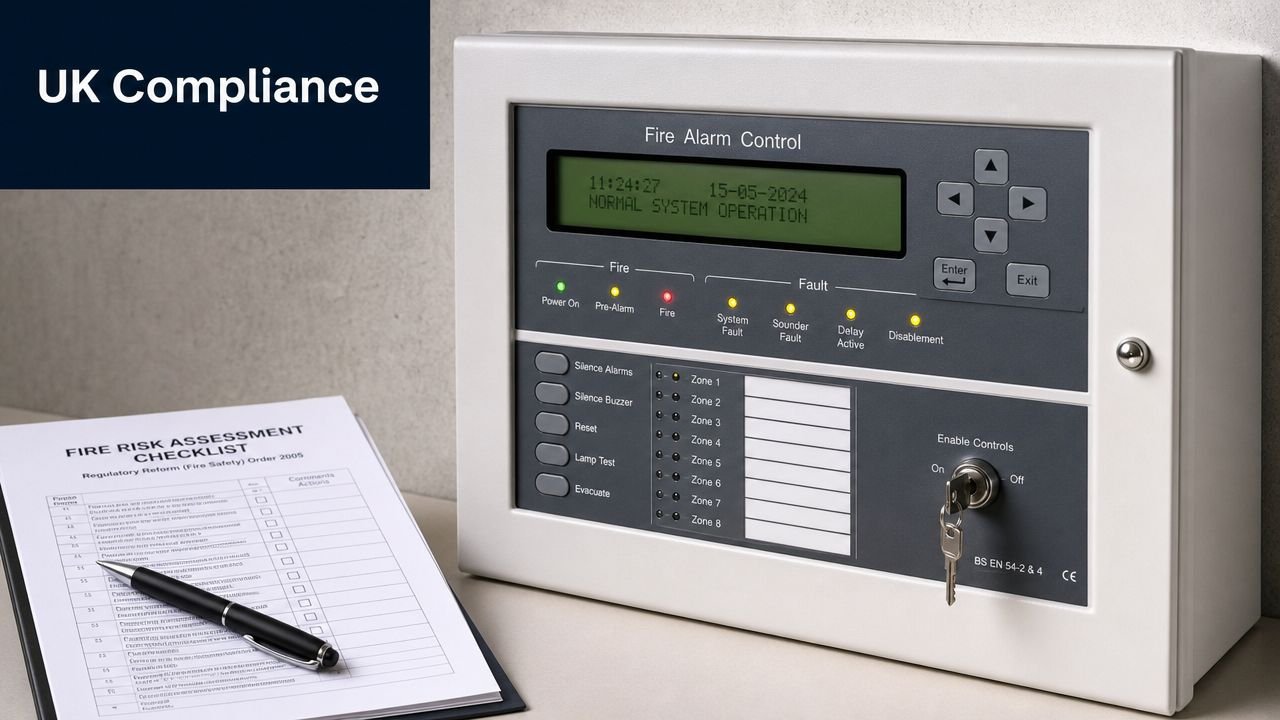
The fire alarm control panel is the hub. It receives signals from each zone, shows the affected area, manages faults, and activates the alarm devices. If you've ever seen a wall-mounted panel with zone lamps and controls behind a locked door, that's the system's decision point.
Smoke detectors and heat detectors are the sensing devices. Smoke detectors are used where smoke is likely to be the earliest sign of fire. Heat detectors are often chosen for places where normal fumes, steam, or dust could lead to unwanted activations if smoke detection were used.
Manual call points give people a way to raise the alarm by hand. These are the break-glass units placed on escape routes and near exits.
Sounders or bells are the warning output. Once the panel receives an alarm condition, these devices tell occupants to act.
What you're actually buying
If you're pricing up conventional fire alarms, it helps to picture the system as a set of practical layers rather than one product.
- Detection layer means the smoke and heat detectors that watch over the premises.
- Manual activation layer means the call points staff or visitors can use if they discover a fire.
- Control layer means the panel that interprets what the circuits are telling it.
- Warning layer means the sounders that notify everyone in the building.
A lot of confusion comes from thinking the panel does all the intelligence. In a conventional system, most of the intelligence is in the layout and zoning plan. If the zones are designed sensibly, the building is easier to manage. If they're too broad or awkward, every alarm becomes harder to interpret.
Good conventional design isn't just about fitting equipment. It's about creating zones that a real person can investigate quickly under pressure.
That's why two conventional systems can look similar on a quote but perform very differently once the building is occupied.
Conventional vs Addressable Fire Alarms Compared
A practical side-by-side view
The usual summary is simple. Conventional means zone-based. Addressable means device-specific. That's true, but it doesn't fully explain the day-to-day implications.
According to this comparison of conventional and addressable fire alarm system differences, UK conventional systems typically use radial circuits and identify the alarm's zone rather than the exact device. That makes them well suited to smaller or simpler premises, but it also means slower incident localisation during a response.
| Feature | Conventional | Addressable |
|---|---|---|
| Alarm location | Shows the zone | Shows the exact device |
| Wiring style | Separate radial circuits by zone | Loop-based device network |
| Fault finding | Search within the zone | Panel points to the device |
| Best fit | Smaller, simpler layouts | Larger or more changeable sites |
| Upfront cost trend | Usually lower | Usually higher |
| Future changes | Can be more awkward | Usually easier to expand or reconfigure |
Why the differences matter in daily use
If you own a small single-storey premises with clear sight lines, a conventional panel may give you all the information you need. The staff hear the alarm, check the affected zone, and act.
If you manage a building with several rooms, changing occupancy, or areas that aren't always staffed, an addressable system starts to earn its keep. It removes the need to search a whole zone just to find the source.
That matters for more than true fire events. It matters during maintenance, after minor faults, and when a detector triggers unexpectedly and someone has to work out what happened.
Here's the simplest way to frame it:
- Choose conventional if the building is easy to divide into sensible, easy-to-search areas.
- Choose addressable if time spent searching could slow response, disrupt operations, or create confusion.
- Choose with future changes in mind if you expect extra rooms, partitions, tenants, or operational complexity.
A lower purchase price can be sensible. It can also be misleading if the layout forces staff to waste time tracing alarms and faults.
There's also a mindset issue. Many buyers compare the systems as if one is old and one is modern. A better comparison is this: conventional is simple and rugged; addressable is precise and informative. Neither is automatically right. The building decides.
Is a Conventional System Right for Your Premises
When conventional makes good sense
A conventional system can still be a very practical choice if your premises are modest in size and simple to understand during an alarm.
It tends to suit buildings where the affected zone can be checked quickly by staff who know the layout well. Typical examples include a compact retail shop, a small office suite, a workshop with a clear internal arrangement, or a warehouse with open space and few subdivisions.
Ask yourself these questions:
- Can someone reach and inspect the zone quickly? If the answer is yes, the lack of exact device identification may not be a major drawback.
- Is the layout stable? Conventional systems are easier to live with when rooms, partitions and uses don't keep changing.
- Do trained people stay on site? If there's usually a responsible person available to investigate, zone-only information may be manageable.
When it becomes a false economy
The pressure point is often not installation cost. It's the time and uncertainty created later.
The fire service attended 38,000 false fire alarms in non-dwelling premises in England in 2023/24, according to this discussion of false alarms and conventional system limitations. That figure matters because every unnecessary investigation, staff disruption, and avoidable callout puts more focus on how efficiently a site can handle alarm events.
Conventional fire alarms can become a false economy in premises like these:
- Mixed-use buildings where office, storage and customer areas overlap.
- Multi-tenant properties where one alarm affects several occupiers and no one has instant visibility.
- Sites with higher staff turnover where fewer people know the building well enough to search calmly and quickly.
- Buildings with phased occupancy where some parts are quiet or locked at certain times.
A small premises on paper can still be operationally complex. That's common in South Wales and the South West, where older buildings are often adapted over time rather than built for one fixed use.
A simple test
If the panel says “Zone 3”, would your team know exactly where to go, who should go, and how long a proper check would take?
If yes, conventional may be a sound option.
If the honest answer is “it depends who's on shift”, that's a warning sign. In that situation, a more informative system may save time, reduce disruption, and age better as the building changes.
UK Fire Alarm Regulations and Maintenance
What EN 54 and BS 5839 mean in practice
For a business owner, landlord or managing agent, the key point is this: the system must be suitable for the building and maintained properly. Compliance isn't just about having a panel on the wall.
UK conventional panels and related equipment are commonly specified to comply with EN 54 and align with BS 5839 recommendations. For example, Eaton's documentation for an 8-zone conventional panel states certification to EN54 Parts 2 and 4 and says it is designed to meet BS5839 recommendations, as shown in Eaton's EN 54 and BS 5839 panel documentation.
In plain English:
- EN 54 is about the equipment standard. It tells you the panel and related components are built to recognised fire detection and alarm requirements.
- BS 5839 is the code of practice that shapes design, installation, commissioning, servicing and user responsibilities.
If you want a plain-language refresher on BS 5839 fire alarm compliance, that guide is a useful reference before you compare installers or service contracts.
Maintenance is part of compliance
A compliant installation can still become a poor system if routine checks slip. Fire alarms fail in practice when people assume installation is the end of the job.
That's not a new problem. UK home smoke-alarm penetration reached an estimated 85 percent by November 2013, but around 30 percent of those alarms were estimated not to work because of dead batteries, missing batteries, or age-related failure, according to this history of smoke alarm adoption and non-working alarms. The context is domestic, but the lesson carries over clearly. Protection depends on ongoing upkeep, not just initial fitting.
Practical maintenance usually includes:
- User checks such as making sure the panel shows normal condition and faults are acted on.
- Routine testing of call points, sounders and other functions on a planned basis.
- Professional servicing to inspect devices, batteries, panel operation and records.
- Logbook discipline so alarms, faults, tests and engineer visits are documented.
For a practical schedule, this guide on how often fire alarms should be tested is a helpful starting point.
A short video can also help demystify what proper testing and upkeep involve in real premises.
The biggest compliance mistake isn't always choosing the wrong panel. It's choosing a reasonable panel and then letting testing, records, and servicing drift.
Typical Costs and Monitoring Services
Upfront costs versus ongoing costs
Initial inquiries about conventional fire alarms often focus on installation cost. That's fair, but it's only one part of the picture.
Your total cost usually falls into two groups:
- Initial costs cover the panel, detectors, call points, sounders, cabling, installation, commissioning and handover.
- Ongoing costs cover servicing, fault callouts, replacement parts, periodic testing support, and any monitoring arrangement.
Conventional systems often appeal because the initial outlay is lower than an addressable alternative in a simple building. That can be the right decision. But it's worth asking what happens later if faults are harder to trace or the building layout changes.
If you're budgeting properly, include maintenance from the start rather than treating it as an afterthought. A clear service agreement helps you compare like with like. This overview of alarm system maintenance planning is useful for understanding what should be included.
Bell-only or monitored
Monitoring changes how the alarm is handled after activation.
A bell-only system raises a local alarm on site. People in the building hear the warning and follow the evacuation or investigation procedure. This can be suitable where the premises are occupied whenever the risk is present and there's always someone responsible to respond.
A monitored system is linked to an Alarm Receiving Centre. If the system activates under the agreed signalling arrangement, trained operators can follow the reporting process. That can be valuable for sites that may be unoccupied, lightly staffed, or more exposed to out-of-hours risk.
A practical way to choose is to ask:
- Who responds if the building is empty?
- Who verifies alarms outside trading hours?
- How costly is disruption from false or unclear activations?
Bell-only is simpler. Monitored adds another layer of response. Neither is universally better. It depends on your occupancy pattern, risk profile, insurer expectations, and how the premises operate in practice.
Choosing a Local Accredited Fire Alarm Installer
Why local knowledge matters
The installer matters almost as much as the panel choice. A well-designed conventional system with sensible zones and a good maintenance plan will usually serve you better than a poorly thought-out installation with impressive paperwork.
Local knowledge helps more than many buyers realise. Installers working regularly across South Wales and the South West are used to the building stock in places like Cardiff, Newport, Swansea and Bristol. That includes converted properties, mixed-use units, small industrial sites and older premises that have been altered over time.
What to check before you appoint anyone
Don't just ask for a quote. Ask how they've approached the building.
Look for these signs:
- Clear zoning logic so you can understand how an alarm will be investigated in practice.
- Relevant accreditations because they show the company has been assessed against recognised standards.
- DBS-checked engineers if staff will be working in occupied homes, schools, care settings or sensitive business environments.
- Ongoing support so installation, servicing and fault response don't get split across several firms.
Professional maintenance matters because fire alarms only protect people when they remain operational. Historical figures show wide smoke-alarm adoption in UK homes, yet a significant share were estimated not to work due to dead or missing batteries and age-related issues, as noted earlier in the article. The same principle applies in commercial settings. Neglect undermines protection.
If you're reviewing providers for a new or replacement system, it helps to compare their approach to fire alarm installation services as well as their ongoing maintenance capability.
A local accredited company should be able to survey the premises, explain whether conventional is still appropriate, and say plainly when an addressable system would be the safer long-term call.
If you need advice on conventional fire alarms for a shop, office, warehouse, HMO or mixed-use building in South Wales or the South West, Wisenet Security Ltd can help. Their team works across Cardiff, Bristol, Newport, Swansea and surrounding areas, offering fire alarm design, installation, monitoring and maintenance with DBS-checked engineers and practical local support. A site survey can quickly tell you whether a conventional system is the right fit or whether your building would benefit from a more future-ready alternative.