
8 Key Types of Intruder Alarms for 2026
It is 3 AM. You hear a knock from downstairs, then silence. In that moment, the difference between alarm types becomes very real. The right system should identify the point of entry, trigger the correct response, and avoid wasting your time with nuisance alerts.
Across South Wales and the South West, I regularly see homes and business premises fitted with alarms that do one job reasonably well, but miss what the property needs. The choice is not merely between one alarm brand and another. It comes down to how the system signals, how detection is layered, how cleanly it can be installed, and whether it meets the grade and response expectations tied to the risk. For many sites, BS EN 50131 is part of that decision, especially where insurers, landlords, or monitored signalling are involved.
A small terraced house, a rural detached property, and a multi-unit commercial building should not be specified in the same way. Wired systems often suit new builds and major refurbishments because cable routes can be planned properly. Wireless systems often make more sense for finished properties where disruption needs to stay low. Monitoring, app control, and sensor choice also need to match the day-to-day use of the building, not just the worst-case scenario.
This guide focuses on those practical trade-offs. It covers the alarm types that matter, where each one performs well, and the installation points that are often missed until false alarms or coverage gaps start causing problems. If you are still weighing up the wider case for fitting a system at all, this guide on whether an intruder alarm system is worth having gives useful context before you settle on the right setup.
If your security plan also includes cameras, keep the legal side in view and review security camera laws for rental properties before finalising the design.
Table of Contents
- 1. Wired Intruder Alarm Systems
- 2. Wireless Intruder Alarm Systems
- 3. Pet-Immune Motion Detection Systems
- 4. Glass Break Detection Sensors
- 6. 24/7 Professional Monitoring Services
- 6. 24/7 Professional Monitoring Services
- 7. Mobile App and Remote Arm Disarm Control
- 8. Multi-Sensor Integration and Smart System Technology
- 8-Point Comparison of Intruder Alarm Types
- Your Next Step Towards Total Peace of Mind
1. Wired Intruder Alarm Systems
Wired alarms are still the benchmark when a property needs dependable signalling, fixed infrastructure, and fewer variables. They suit permanent installations where you can cable properly through walls, ceilings, risers, or containment. In commercial work, they're often the right answer when you want stable device communication and stronger resistance to casual tampering.
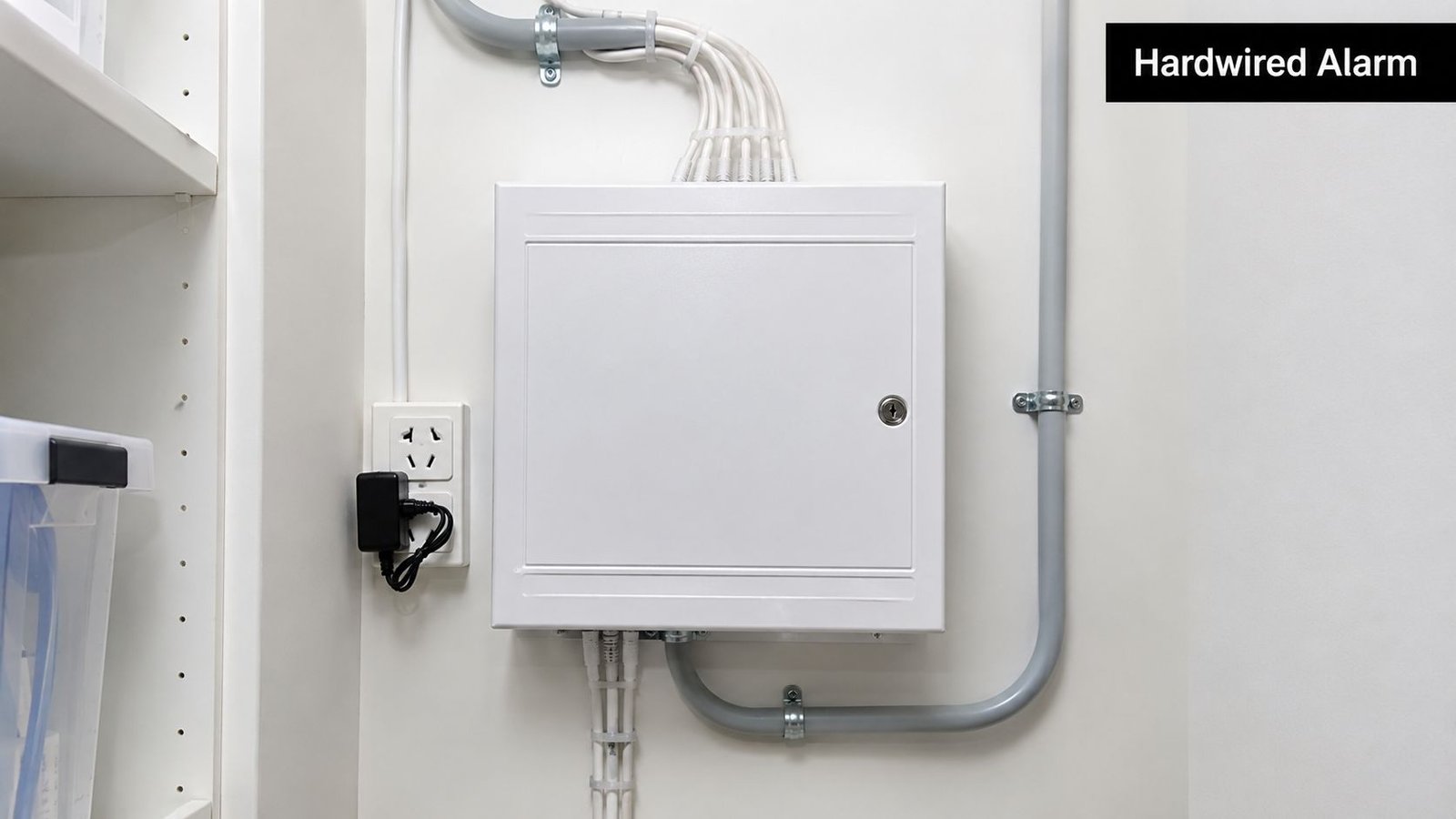
In South Wales, wired systems make most sense in new office builds, schools, warehouses, larger retail units, and homes going through major renovation. If walls are already open, it's the right time to run cable for contacts, PIRs, sounders, keypad positions, and future extras such as CCTV integration or monitored signalling.
Where Wired Systems Make Sense
A wired system doesn't rely on battery changes at every detector, and it isn't exposed to the same radio issues as wireless equipment. That doesn't mean it's maintenance-free. You still need proper power supply design, battery backup at the panel, sensible zoning, and clean termination work.
Practical rule: If the building is being refurbished, wire it now. Retrofitting later usually costs more and gives a worse finish.
For higher-risk sites, the conversation should move beyond brand names and onto grading. UK specification decisions are usually driven by BS EN 50131 risk grading, especially the distinction between Grade 2 and Grade 3 for matching domestic and commercial resilience requirements, including stronger protection against tampering and signal-jamming, as discussed in this intrusion alarm market overview covering BS EN 50131 grading.
What to Get Right at Installation
The failure point with wired alarms usually isn't the technology. It's poor design. I'd rather see a modestly sized, well-zoned wired system than an oversized specification with detectors in bad positions and no thought given to entry routes.
- Plan cable routes early: Run containment with spare capacity, especially in offices and mixed-use premises.
- Use layered detection: Pair perimeter contacts with internal PIR coverage rather than relying on motion detection alone.
- Allow for monitoring later: Even if you start bells-only, leave space for communicator upgrades and ARC connection.
- Think about users: A warehouse and a family home need different setting routines, entry times, and part-set options.
If you're weighing the basic value question first, this guide on whether an intruder alarm is worth having is a sensible place to start.
2. Wireless Intruder Alarm Systems
Wireless alarms have moved from being the compromise option to being the default choice for many retrofits. In existing homes, rented properties, small offices, salons, cafés, and holiday lets, they're often the cleanest installation route because they avoid chasing walls and major disruption.
That matters because the focus of security efforts is generally on lived-in homes, trading premises, and occupied offices, not empty shells, where speed and neatness count. In market forecasts, wireless burglar alarm systems are projected to account for 55.4% of total revenue in 2025, with the broader burglar alarm market projected to grow from USD 7.3 billion in 2025 to USD 14.6 billion by 2035 at a 7.2% CAGR, according to Future Market Insights' burglar alarm systems market report.
Why Wireless Leads Many Retrofits
Wireless is usually the practical winner in Cardiff terraces, Swansea semis, flats, and small business units where decoration matters and access for cabling is awkward. App-connected panels, battery-backed PIRs, door contacts, and external sounders can usually be fitted with less disruption than a hardwired equivalent.
That said, easy installation doesn't mean careless installation. Detector siting, radio path testing, signal margins, and battery management still matter. A bad wireless design can become an unreliable system very quickly.
Wireless Pitfalls to Avoid
Most wireless problems come from overconfidence. Someone assumes a detector will reach the panel, fixes everything in place, and only then finds out a steel beam, foil-backed insulation, or a plant room is killing the signal.
Wireless is excellent for retrofit work. It's a poor substitute for proper surveying.
A few habits keep wireless systems dependable:
- Survey radio conditions first: Metalwork, utility cupboards, thick stone walls, and large appliances can all affect performance.
- Keep the hub sensibly placed: Central is usually better than hidden in the worst signal location.
- Use maintenance reminders: Battery neglect causes avoidable service calls and user frustration.
- Match the property to the system: A compact shop and a long warehouse are very different radio environments.
For many homes and small premises across the South West, wireless is the most practical of the different types of intruder alarms. It just needs disciplined setup, not plug-and-play assumptions.
3. Pet-Immune Motion Detection Systems
Pet-friendly motion detection solves a very specific problem. You want internal detection, but you don't want the dog setting it off every time it wanders into the hall overnight. When these detectors are chosen and positioned properly, they can reduce nuisance activations without leaving obvious gaps.

Pet-immune sensors are common in family homes, holiday cottages, small veterinary premises, and some managed rental properties where animals are part of normal occupancy. They're not magic devices. They're still motion detectors, and they still need a proper understanding of room layout, furniture, stairs, and where the pet moves.
How Pet-Friendly Detection Actually Works
UK intruder alarm guidance commonly refers to motion detectors and perimeter contacts as core elements of system architecture, and industry explainers also note the broader use of PIR, microwave, dual-technology detectors, and magnetic reed switches in layered alarm design, as described in this guide to burglar alarm types and detection approaches.
That layered approach matters with pets. If a pet-friendly PIR is your only detector in a room with patio doors, you're asking one device to make too many judgement calls. A better design usually combines pet-tolerant internal detection with contacts on accessible doors and windows.
Placement Matters More Than the Box
I've seen perfectly good pet-immune detectors behave badly because they were aimed across sofas, into bright sun, or toward stairs where the dog effectively becomes “taller” as it climbs. Installer discipline matters more than brochure claims.
A practical setup usually includes:
- Correct mounting height: Follow the detector's intended range and pattern, not guesswork.
- Clear field of view: Avoid radiators, direct sunlight, moving curtains, and vents.
- Perimeter support: Add door and window contacts so the system doesn't rely only on the PIR.
- Real testing: Walk-test with the pet's usual movements in mind, not just a human crossing the room.
Here's a useful visual example of how pet-friendly detection is commonly explained and positioned in the field.
4. Glass Break Detection Sensors
Glass break sensors are specialist tools. They're useful when a likely entry route involves glazing, especially shopfronts, patio doors, side windows, or display areas. They're not a replacement for contacts or motion detectors. They're an extra layer for a specific attack path.
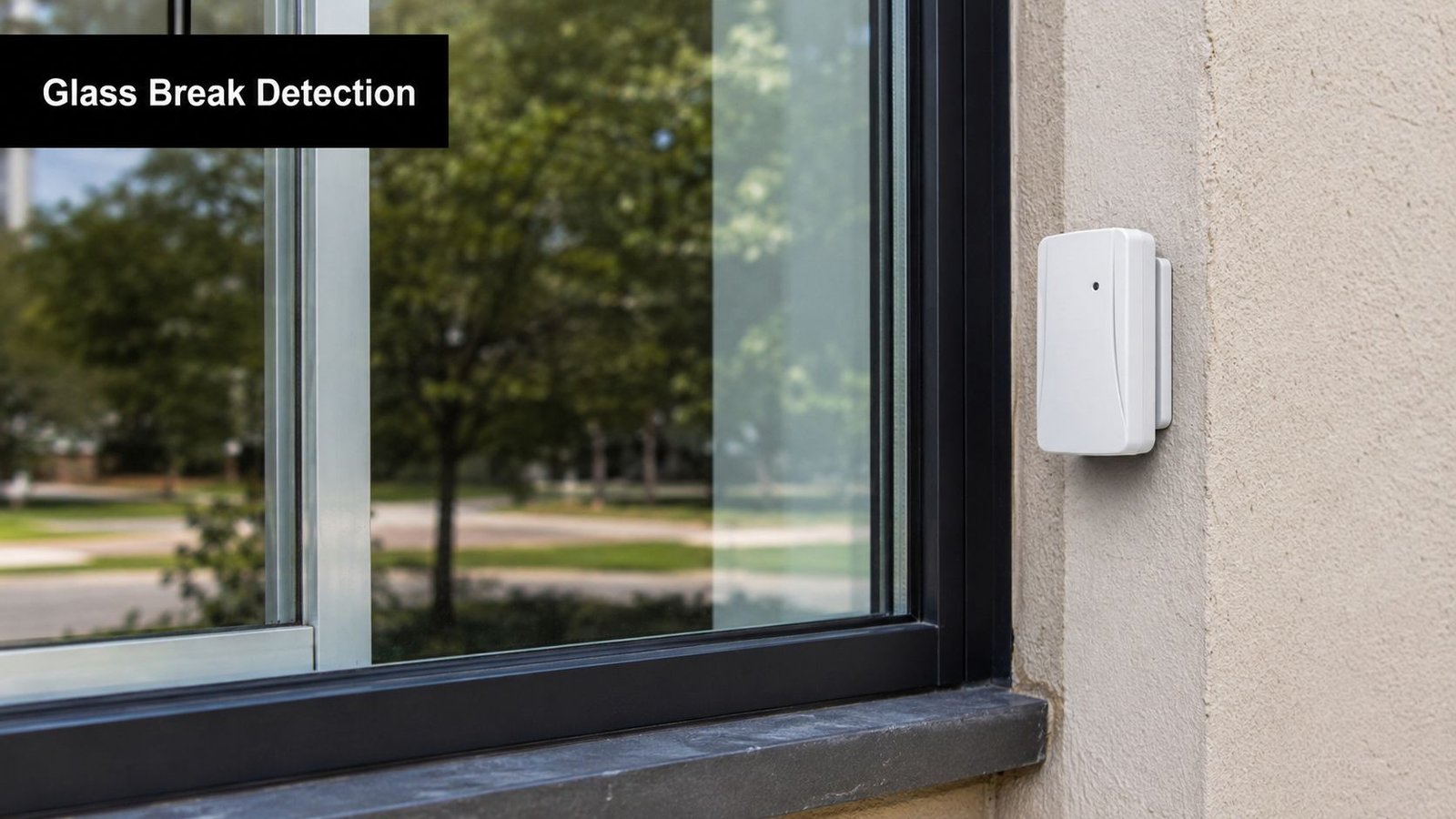
In retail units around Cardiff or Bristol, they can be a good fit for front glazing where an intruder might smash and reach. In houses, they're useful in conservatories, rear extensions with large panes, and rooms where broad glazed openings would otherwise leave a detection blind spot until someone is already inside.
Best Use Cases for Glass Break Sensors
These detectors work best when the attack risk is glass-led. If the main vulnerability is a poorly secured back door or an unsecured side gate, a glass break unit won't fix the underlying problem.
Good use cases include:
- Shopfront glazing: Where breaking glass is a realistic first move.
- Large rear doors: Especially sliding or French doors with extensive glass.
- Display windows: Where the target may be visible from outside.
- Mixed perimeter design: Combined with contacts and internal PIRs.
In glazed areas, detection should start at the perimeter and continue inside. Don't rely on one sensor type.
Where They Underperform
Glass break sensors can disappoint in noisy or acoustically awkward spaces if they're chosen or positioned poorly. High ceilings, soft furnishings, background audio, unusual glazing types, and odd room geometry can all affect performance.
That's why I usually treat them as a supplement, not the centrepiece. If a business owner asks me which of the types of intruder alarms does the most work day to day, I'll usually point to contacts and well-positioned motion detection first. Glass break comes in when the glazing exposure justifies it.
6. 24/7 Professional Monitoring Services
A common failure point is not detection. It is what happens after detection.
A siren may be enough if neighbours are close, someone is usually on site, and the building is low risk. For a rural property in South Wales, a vacant unit on an industrial estate, or a business with insurer conditions attached, that approach often leaves too much to chance. Monitoring routes alarm signals to an Alarm Receiving Centre, where trained operators follow an agreed response plan instead of relying on somebody nearby hearing a bell.
That changes how the whole system should be specified. Once an alarm is monitored, signal paths, zone text, setting routines, and detector layout all matter more because operators need clear events they can act on. Under BS EN 50131, the grading, environmental class, and method of signalling should match the site risk and the consequences of a missed activation or repeated false alarm. On commercial work across the South West, that usually means discussing dual-path signalling, confirmation logic, and user procedures before choosing extra detectors.
Police response is another area where clients often have the wrong expectation. A monitored system does not mean instant police attendance on every single activation. In practice, response depends on the signalling method, the response level in place, and whether the activation has been confirmed in line with current policy and the way the system has been configured.
Good monitoring starts with good design. A poor layout sends poor information faster.
For homes, monitoring often makes sense where the property is empty during long working hours, used as a second home, or has known access issues at the rear or side. For businesses, it becomes far more persuasive where there is stock, tools, controlled drugs, IT kit, or regular periods with no staff on site. I also recommend it where keyholders are not local. Waiting for a drive from Cardiff, Newport, Bristol, or further into the South West can turn a small incident into a larger loss.
The service model matters as much as the hardware. Clients should ask who receives the signal, what happens on a confirmed activation, how keyholder calls are handled, what faults are reported, and what level of maintenance is required to keep the signalling path compliant. If you need a plain-English overview of what a monitored alarm system is, that guide covers the basics. For an operational comparison from another market, protecting your venue with monitoring is also worth reading.
From an installation point of view, monitored systems reward tidy engineering. Clear zone labels, sensible entry routes, properly separated areas, and detector choices that support confirmation all reduce wasted callouts and user confusion. That is usually the difference between a monitored alarm that helps in a real incident and one that creates noise, cost, and avoidable resets.
6. 24/7 Professional Monitoring Services
Monitoring changes the purpose of an alarm. A bells-only system warns people nearby. A monitored system is designed to send signals through an alarm transmission system to a continuously manned alarm receiving centre, where operators can assess the activation and follow the agreed response path.
That distinction matters far more than most buyers realise. If your building is remote, regularly unoccupied, high value, or insurer-sensitive, monitoring often matters more than adding yet another detector.
What Monitoring Changes in Practice
Under UK guidance, police attendance for monitored systems can depend on sequential confirmation. In plain terms, two qualifying alarm activations must be received at the ARC within defined periods before police are asked to attend, as explained in this BIBA guidance on intruder alarms and monitored response.
That's why better system design reduces wasted callouts. A monitored setup should be planned around verified escalation, not simple noise. Sequential confirmation, sensible zoning, and a realistic sensor mix all improve outcomes.
If you want a straightforward explanation of the service model, this page on what a monitored alarm system is covers the basics well. For a general comparison of monitored response concepts, this article on protecting your venue with monitoring is also useful background reading.
Who Should Pay for Monitoring
Not every property needs ARC monitoring. A small occupied house in a quiet cul-de-sac may be fine with local signalling and mobile alerts. A warehouse on an industrial estate, a pharmacy, a retail unit with high-value stock, or a landlord managing an often-vacant building is a different calculation.
Client advice I give often: If no one reliable will act on an alarm at 2 AM, don't pretend a siren alone solves the problem.
Monitoring is one of the most important dividing lines between different types of intruder alarms because it changes what happens after detection, not just how detection starts.
7. Mobile App and Remote Arm Disarm Control
Remote control is one of the most requested alarm features now, and for good reason. It solves real user problems. You can check whether the system is set, receive alerts, arm a vacant property from your phone, or let a manager confirm that a site was locked properly after closing.
For homeowners in Cardiff heading away for the weekend, for landlords managing vacant flats, and for business owners juggling several premises, app access can make a system much easier to live with. Convenience, though, only helps if it doesn't create sloppy habits.
Useful Control or Just a Gadget
App control is useful when it supports routine management. It's less useful when people use it as a crutch because the underlying user setup is poor. If everyone shares one code, no one understands part sets, and notifications are left at default, the app won't fix the discipline problem.
The best setups use remote access for specific tasks:
- Setting confirmation: Check that staff or family armed the system.
- Targeted notifications: Receive meaningful alerts, not every minor event.
- Log review: See openings, setting times, and user actions.
- Multi-site oversight: Useful for landlords, small chains, and property managers.
How to Keep Remote Access Safe
Cloud and app-connected systems are becoming more common, but recent industry coverage still leaves a gap around where AI, cloud monitoring, and verification help and where they create new issues such as privacy concerns, connectivity dependence, and alert fatigue, as discussed in this analysis of intrusion alarm systems and newer verification trends.
A few practical controls matter more than any app interface:
- Enable two-factor authentication: Don't leave alarm control protected by a weak reused password.
- Define user permissions: Cleaner, guest, manager, and family member shouldn't all have the same rights.
- Use backup procedures: If the app is unavailable, people still need a clear way to set and unset the system.
- Review notifications: Too many alerts train users to ignore the important ones.
Remote control is one of the most useful modern types of intruder alarms features, but it works best when paired with disciplined user management.
8. Multi-Sensor Integration and Smart System Technology
The strongest alarm systems rarely depend on one detector type. They combine perimeter contacts, internal motion detection, external warning, and where appropriate, glass break, vibration, video verification, or smart automation. The core benefit comes from correlation. One signal may be ambiguous. Several signals together are usually much clearer.
That's especially true in commercial premises, larger homes, HMOs, and mixed-use buildings where occupancy patterns change throughout the day. A smart system should help users and monitoring operators understand context, not just forward more alarms.
Layered Detection Beats Single Devices
There's a clear content gap in the market around alarm type versus alarm outcome. Many guides list bells-only, monitored, wired, and wireless options but don't really explain which designs reduce false alarms, improve response, or suit specific UK building classes such as homes, shops, warehouses, and HMOs, a gap highlighted in this discussion of intruder alarm detection types for businesses.
In practice, layered systems work because they separate convenience from resilience. Wireless devices may be ideal in one zone, while wired devices make more sense in another. A warehouse office, stock room, roller shutter entrance, and rear fire exit don't all need the same sensor strategy.
BS EN 50131 and Smarter System Design
When clients ask about “smart alarms”, I bring the discussion back to two things. Compliance and outcome. Fancy app features don't matter much if the system isn't graded correctly, isn't monitored appropriately, or isn't designed around actual intrusion routes.
The better benchmark in the UK is BS EN 50131. Your installer should be thinking about grade, tamper protection, signalling path resilience, user setting routines, and how the building is used. If you want a plain-English overview of system logic and components, this explainer on how alarm systems work is a useful reference.
A smart alarm isn't smart because it has more features. It's smart when the right detectors, signalling path, and response plan work together without creating avoidable false alarms.
For homes and businesses across South Wales and the South West, multi-sensor integration is often the best route when you need a system that's usable day to day and defensible from a compliance point of view.
8-Point Comparison of Intruder Alarm Types
| Item | Implementation complexity | Resource requirements | Expected outcomes | Ideal use cases | Key advantages |
|---|---|---|---|---|---|
| Wired Intruder Alarm Systems | High, invasive wiring, professional installation required | Cables/conduit, certified installers, UPS, minimal ongoing power cost | Extremely reliable, tamper‑resistant, long lifespan | New builds, banks, commercial properties needing Grade 3–4 | No RF interference, low operating costs, meets highest standards |
| Wireless Intruder Alarm Systems | Low–Medium, quick, non‑invasive install; site survey recommended | Battery-powered sensors, reliable broadband/mobile, periodic battery replacement | Flexible, scalable protection with remote alerts | Existing buildings, rentals, SMEs, residential homes | Fast install, portable sensors, smartphone integration |
| Pet-Immune Motion Detection Systems | Low–Medium, correct placement and calibration required | Specialized pet‑immune PIR sensors, installer calibration; compatible with wired/wireless systems | Reduced false alarms from pets while maintaining interior coverage | Homes with pets, animal facilities, vet clinics | Minimises pet-triggered alarms; maintains full interior protection |
| Glass Break Detection Sensors | Low, targeted placement and sensitivity tuning | Acoustic/vibration sensors, calibration per environment, possible multiple units | Early detection of forced window entry; complements other sensors | Ground-floor windows, shop fronts, galleries, storefronts | Detects glass breaches early; covers large glazed areas with few units |
| Contact Sensors (Door & Window) | Low, simple mounting; labour increases with many points | Magnetic reed sensors (wired or wireless), many units for full perimeter | Immediate detection of opened entry points; foundational perimeter defence | All properties as first line of defense | Proven, low-cost, highly reliable perimeter detection |
| 24/7 Professional Monitoring Services | Medium, ARC integration and verification procedures needed | Monitoring subscription, reliable comms, ARC-approved connections and protocols | Verified rapid response, reduced false-alarm penalties, insurance benefits | Commercial businesses, high-value homes, insurance-mandated systems | Continuous oversight, police liaison, documented incident response |
| Mobile App & Remote Arm/Disarm Control | Low–Medium, app/cloud setup and security configuration | Reliable internet/mobile, cloud subscription, smartphones, two‑factor auth recommended | Real-time alerts and remote control; faster situational awareness | Busy homeowners, property managers, landlords, multi-site owners | Remote management, instant notifications, multi-user access |
| Multi-Sensor Integration & Smart Systems | High, complex design, programming, ML tuning; expert integrator required | Diverse sensor array, advanced control platform, cloud/ML services, ongoing updates/support | Significantly fewer false alarms, correlated detection, automation & centralized control | Large commercial sites, luxury developments, campuses, secure facilities | Comprehensive, scalable detection with intelligent correlation and future-proofing |
Your Next Step Towards Total Peace of Mind
Knowing the types of intruder alarms is useful, but it isn't enough on its own. The key difference comes from matching the system to the property, the people using it, and the level of response you require. A family home in Newport, a retail unit in Bristol, a warehouse outside Swansea, and a managed HMO in Cardiff shouldn't all be protected in the same way.
That's where many alarm projects go off course. People compare panels, apps, and headline features, but they don't spend enough time on the basics. Entry routes, detector placement, part-setting needs, maintenance access, user habits, and whether the property needs bells-only or monitored signalling. In UK practice, those details matter because intruder alarms are usually specified by installation method, signalling pathway, detection mix, and BS EN 50131 risk grading, not by whatever product name appears first on a quote.
For homes, a strong setup often means combining door and window contacts with well-positioned internal motion detection and sensible app alerts. For businesses, the conversation usually needs to go further. You may need graded equipment, better tamper resistance, monitored signalling, and a layout that supports verified escalation rather than nuisance activations. If the building is vacant for long periods, stores valuable stock, or has a history of false alarms, design quality matters more than adding extra devices.
Local knowledge helps too. Properties across South Wales and the South West vary a lot. Older stone buildings, terraced housing, shopfront glazing, rural outbuildings, and mixed-use premises all create different installation constraints. A local installer who understands those building types can usually spot issues early, from awkward cable routes and RF dead zones to shared access points and poor keypad placement.
If you're planning a new system or replacing an unreliable one, ask for a proper survey. Ask how the design aligns with BS EN 50131. Ask whether the proposed grade suits the risk. Ask how the system will handle pets, part sets, out-of-hours openings, and user mistakes. Those are the questions that lead to a system you'll trust.
For property owners in Cardiff, Bristol, Swansea, Newport, and the surrounding areas, Wisenet Security Ltd is one relevant local option for survey, design, installation, and maintenance. The company works across intruder alarms and wider electronic security systems, which is useful when the right answer includes monitoring, CCTV, access control, or a combination of them.
If you're in South Wales or the South West and want practical advice on the right alarm for your property, Wisenet Security Ltd can arrange a free, no-obligation survey and help you design a system that fits the building, the risk level, and the way the site is used.