Access Control Systems for Businesses: The Smart Guide
The UK access control market is projected to expand from USD 524.6 million in 2024 to USD 830.7 million by 2030, so access control systems for businesses have become mainstream infrastructure rather than an optional security upgrade. The practical question for most owners isn't whether to modernise, but how to retrofit an older building without creating excessive cost, disruption, or safety risk.
A traditional key can open a door, but it can't tell you who used it, restrict access by time, or be cancelled remotely when an employee leaves. Electronic access control adds those capabilities, yet the technology is only one part of the decision. The door, frame, wiring routes, fire arrangements, user permissions, software, and ongoing support all determine whether the installation works in daily life.
For a business in Cardiff, Bristol, Newport, or Swansea, the strongest design usually starts with the existing premises rather than a catalogue of devices. A sound retrofit preserves usable hardware where possible, improves weak points where necessary, and introduces a system that staff can manage without turning every access change into a call-out.
Table of Contents
- Why Access Control Has Become Essential for UK Businesses
- Understanding Different Access Control Technologies
- Key Features Every Business Should Evaluate
- Compliance and Safety Requirements in the UK
- Cost, Deployment Options, and Return on Investment
- Real-World Use Cases Across Industries
- Getting Started with Wisenet Security Ltd
Why Access Control Has Become Essential for UK Businesses
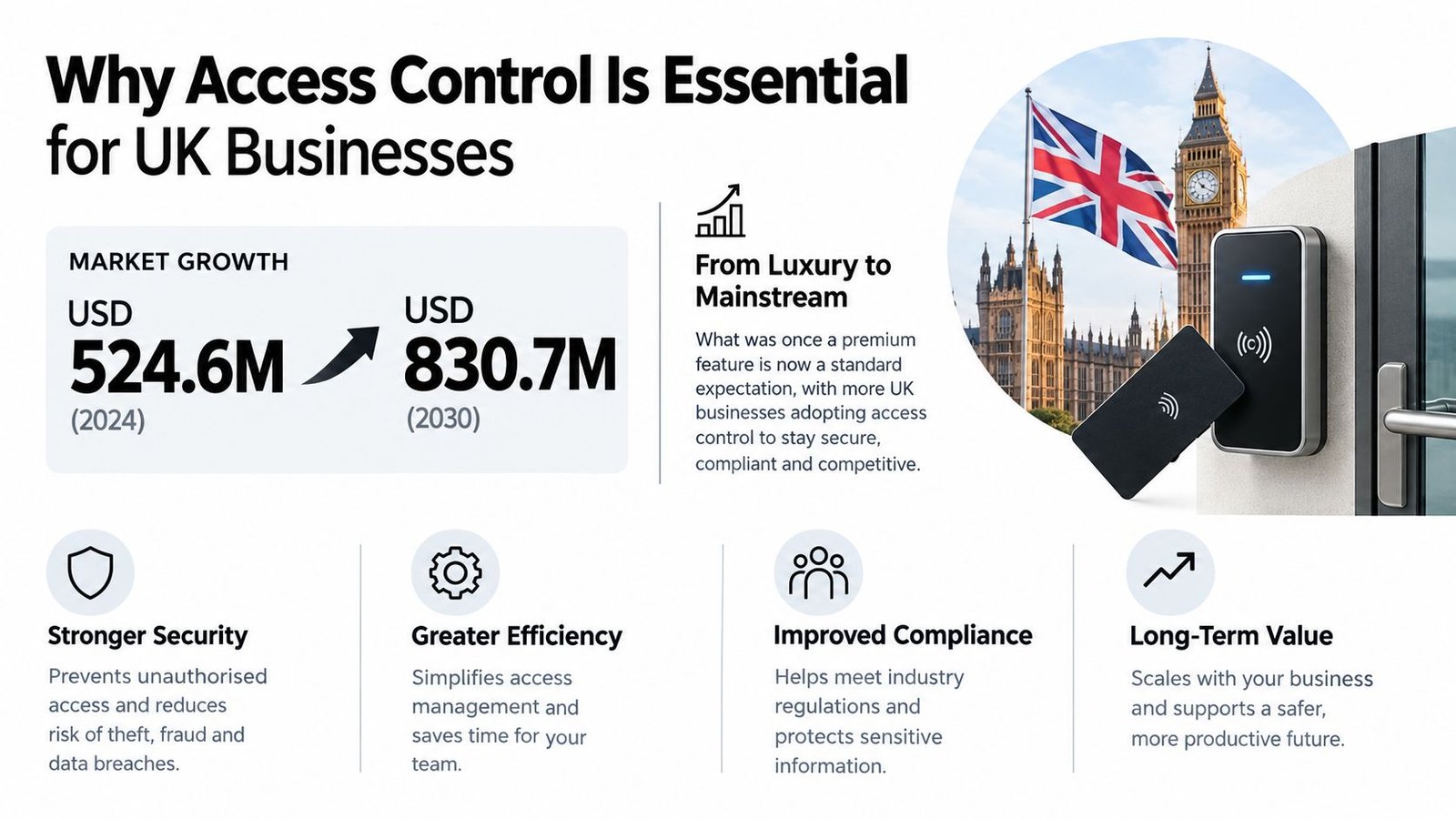
The UK access control market is expected to grow from USD 524.6 million in 2024 to USD 830.7 million by 2030, with an 8.1% CAGR projected for 2025 to 2030, according to Grand View Research's UK access control market outlook. That expansion reflects a change in how business owners view controlled entry. Access control is no longer limited to high-security sites. It now supports everyday administration, staff movement, visitor handling, and evidence gathering after an incident.
Consider a small office in Cardiff that still relies on a ring of keys. A former employee may have returned theirs, but the business can't easily prove that every copy is accounted for. A manager also has to arrange access manually for cleaners, contractors, or a colleague arriving outside normal hours. A suitable electronic system replaces that uncertainty with permissions, schedules, and an event history.
The move from keys to controlled infrastructure
This doesn't mean every business needs facial recognition or a fully cloud-managed platform. It means the entry method should match the building's actual risks and operating patterns. A retailer may need a keypad for a staff entrance, while a warehouse may need fobs that distinguish employees from delivery personnel. A multi-tenant property may need separate permissions for each occupier and a simple process for revoking access.
The market outlook also identifies hardware as the largest revenue-generating segment in 2024, which makes sense in retrofit work. Older premises often need compatible locks, readers, controllers, power supplies, and door adjustments before software can deliver any benefit. The most attractive dashboard won't compensate for a door that doesn't close reliably or a lock that conflicts with emergency escape arrangements.
Practical rule: Treat access control as a building project with a software layer, not as a reader bolted onto a door.
The right installation gives a business controlled entry, audit trails, and a route to integration with CCTV, intruder alarms, intercoms, or fire systems. It can also reduce the administrative friction caused by lost keys and changing staff roles. Those benefits explain why access control is becoming part of normal business infrastructure, but they don't remove the need for careful site planning.
Understanding Different Access Control Technologies
The best credential is the one your people will use consistently and your administrators can manage properly. A keypad may suit a small shop, while a warehouse with changing shifts may need individually assigned fobs. Mobile credentials can be convenient for offices, but they shouldn't be selected without considering lost phones, depleted batteries, visitors, and offline access.
| Technology | Security Level | Setup Cost | Best For | Key Limitation |
|---|---|---|---|---|
| Keypad | Basic to moderate | Lower | Small offices, shops, staff-only doors | PINs can be shared |
| Card or fob | Moderate to strong | Moderate | Offices, warehouses, shared facilities | Credentials can be lost or passed to others |
| Biometric | Strong identity assurance | Higher | Restricted rooms and high-control areas | Requires careful data protection and enrolment |
| Mobile and cloud | Moderate to strong, depending on configuration | Variable | Multi-site teams, flexible offices, remote administration | Depends on phones, batteries, connectivity, and user adoption |
Keypads and cards
A keypad is straightforward. Staff enter a PIN, and the controller checks whether it should release the lock. For a small Newport retailer with a single staff entrance, that simplicity may be more valuable than a complex credential programme. The weakness is accountability. If several people share one PIN, the event log records the code or permission, not necessarily the individual.
Cards and fobs provide clearer user-level control. A Bristol warehouse can assign each worker a credential, restrict access to certain zones, and cancel a fob without changing the lock. They remain practical in busy environments because users don't need a personal smartphone, though businesses need a process for reporting and cancelling lost credentials.
Biometrics and mobile access
Biometrics, such as fingerprint or facial recognition, link entry to a physical characteristic. That can improve identity assurance where credential sharing is a serious concern, but it also creates additional privacy duties. The ICO's guidance on biometric data for time and access control treats biometric data used to uniquely identify a worker as special category data.
Mobile credentials let users present a phone instead of a card. They can work well for property managers, flexible offices, and teams that already rely on smartphones. For multi-occupancy premises, it can be useful to review related operational approaches such as workflows for room-by-room rentals, particularly where access permissions change between rooms, tenants, or booking periods.
For businesses assessing biometric options, Wisenet's biometric access control information can help frame the discussion around reader choice, user management, and practical deployment. The decision should still begin with the door and workflow, not the most advanced credential on the supplier's list.
Key Features Every Business Should Evaluate
A business shouldn't compare access control systems by reader appearance or app design alone. The important question is whether the system joins doors, people, permissions, records, and emergency behaviour into one manageable operation.

Start with the building's future
A growing Southampton business may begin with one entrance and a restricted office, then add another floor, a storage area, or a second site. Scalability means the original platform can accommodate those changes without forcing a complete replacement. Ask the installer how new doors, users, sites, and credential types will be added, and whether the existing controller and software architecture can support them.
Integration matters just as much. Access events become more useful when the system can work with CCTV, alarms, intercoms, and fire equipment. A forced-door event linked to associated video can help an administrator understand what happened, while an alarm input may trigger a defined security response. The installer should explain precisely what each integration does rather than just listing compatibility on a proposal.
Test daily administration, not only installation
Remote management can save time for organisations with multiple premises or limited on-site staff. It should allow authorised administrators to add users, cancel credentials, adjust schedules, and review events without travelling to every door. Cloud management may simplify this process, but the proposal should explain connectivity requirements and what happens if the connection is unavailable.
Audit logs need more than a long list of timestamps. Check whether administrators can search by person, door, event type, and time period, and whether the records can support an investigation. Time and attendance can be useful when it connects access events to an agreed workplace process, but access records shouldn't automatically be treated as a complete record of working time.
Use this vendor checklist:
- Scalability: Can the system grow with additional doors and sites?
- Integration: Can it exchange useful events with CCTV, alarms, intercoms, and fire systems?
- Remote management: Can authorised staff manage permissions securely away from the premises?
- Audit logs: Are events searchable, understandable, and retained according to policy?
- User management: Can role-based access, temporary credentials, and leavers be handled quickly?
- Emergency egress: Does the design preserve safe exit under normal power loss and alarm conditions?
The last item outweighs a fashionable feature. A system with excellent reports but unsafe fire behaviour isn't a sound business installation.
Compliance and Safety Requirements in the UK
A compliant access control installation begins with the intended use of the building. An office, warehouse, care setting, retail unit, and multi-tenant property can have different risks, door types, users, and escape arrangements. The installer must assess those conditions before choosing the locking method.
Biometric data needs a separate privacy process
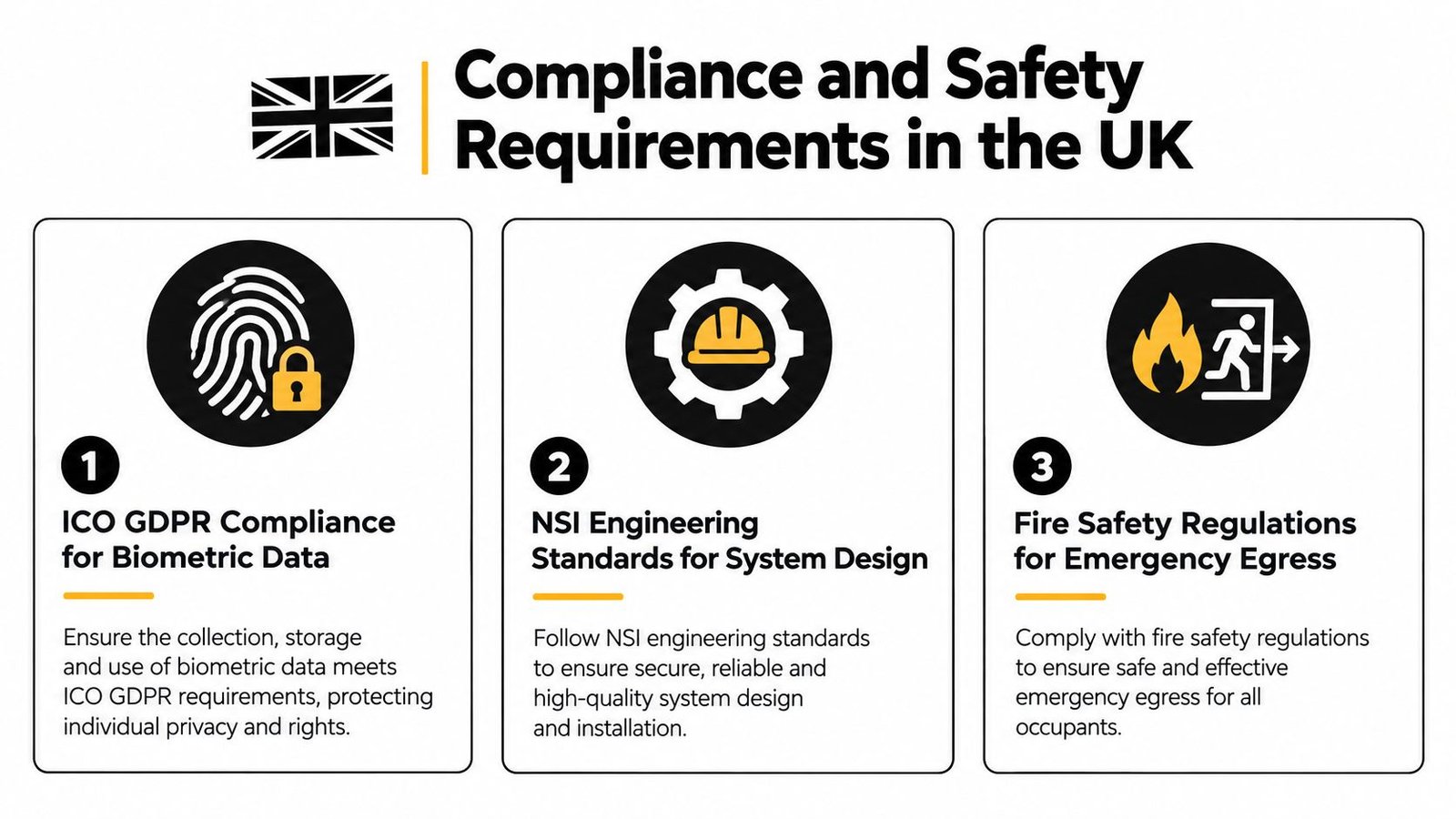
The ICO states that biometric data used to uniquely identify a worker is special category data. A business must complete a Data Protection Impact Assessment before deployment, and the ICO advises storing encrypted biometric templates rather than raw images. It also advises avoiding co-storage of biometric data with associated identity records to reduce risks linked to reverse engineering and disclosure. These requirements make biometrics a governance decision as well as a security decision.
A sensible process includes:
- Define the security problem the biometric system is meant to solve.
- Assess whether a less intrusive credential could achieve the same purpose.
- Complete the DPIA before deployment.
- Set retention, access, enrolment, and deletion controls.
- Confirm how the system handles leavers, failed enrolments, and support access.
Businesses considering connected surveillance should also understand the wider issues covered in Wisenet's guide to CCTV and GDPR in the UK.
Door engineering and emergency escape
NSI workplace guidance says designers and installers should consider risk assessment during design. UK practice references BS EN 60839-11-1, BS EN 60839-11-2, and NSI NCP 109 for electronic access control, as described in NSI's workplace access control guidance. These references point to a practical requirement: the reader, lock, controller, logging, and fail-safe or fail-secure behaviour must suit the building's threat model and evacuation needs.
Fire alarm integration needs particular care. If a controlled door remains locked in a way that prevents safe escape, the security benefit is outweighed by the life-safety risk. A professional design should document what happens during alarm activation, power failure, request-to-exit operation, and other foreseeable faults.
Safety comes before convenience. A door's escape function must remain clear to the people inside, even when the access system is unavailable or responding to an emergency.
Cost, Deployment Options, and Return on Investment
A retrofit quote should separate equipment, door preparation, cabling, configuration, training, and ongoing support. Two systems with similar reader prices can have very different total costs if one requires extensive wiring, replacement door hardware, or out-of-hours installation.
The available UK market data points strongly towards retrofit work. A Mordor Intelligence outlook estimates that retrofit projects represented 69.55% of 2025 activity, while hardware accounted for 61.05% of market share. The same source forecasts the market growing from USD 502.62 million in 2026 to USD 702.89 million by 2031, but those figures are a separate market outlook from the earlier projection and shouldn't be treated as a direct replacement for it. The practical message is consistent: many buyers are adapting existing premises, and hardware compatibility remains central.
| Business Type | System Tier | Cost Range | Deployment Time | ROI Factors |
|---|---|---|---|---|
| Small retailer or office | Basic | £800 to £2,000 | Depends on doors and wiring | Fewer key replacements, controlled staff entry |
| Warehouse or office | Mid-range | £2,500 to £6,000 | Depends on zones and door condition | Zone control, audit records, administration time |
| Larger or multi-site organisation | Comprehensive | £8,000 to £15,000+ | Depends on integration and rollout scope | Central management, operational visibility, scalable permissions |
The cost ranges above are planning figures supplied in the brief, not universal quotations. A site survey is still needed because an older timber door, steel frame, restricted cable route, or unsuitable closer can change the installation scope.
Hardware, cloud, and operating costs
Hardware-heavy work can be worthwhile when the building needs new locks, readers, controllers, or power infrastructure. Software-focused systems may reduce some on-site work, but they can introduce licensing and connectivity costs. The verified market outlook forecasts cloud and access-control-as-a-service software growth at an 8.45% CAGR, while a separate source identifies hardware as 61.05% of market share in its 2025 UK estimate. Those figures describe market direction, not a guaranteed saving for a particular business.
Cloud administration can reduce travel and simplify user changes, especially across several premises. It also creates questions about subscriptions, internet dependence, offline operation, data handling, and who owns the administrative account.
Measure the return properly
Security return is not limited to preventing a break-in. A business may gain value through:
- Reduced key administration: Lost keys can create disruption and replacement work.
- Faster leaver management: Administrators can cancel electronic credentials without changing every lock.
- Time and attendance workflows: Access events may support agreed processes when configured appropriately.
- Tenant service: Property managers can issue and withdraw access without arranging physical handovers.
- Incident investigation: Searchable records can help establish which credential opened a door.
Ask suppliers to show the expected operating cost over the system's life, not just the installation price. That comparison exposes whether a cheap retrofit will become expensive to maintain.
Real-World Use Cases Across Industries
A neighbourhood retailer doesn't need the same access design as a logistics hub. The useful comparison is not between brands. It's between the business problem and the control method.
A Newport retail chain might start with a staff entrance and a shared key. A keypad could solve basic entry, but individually assigned fobs would provide clearer accountability and make leaver management easier. If the business links access events to an agreed time-and-attendance workflow, managers may spend less time reconciling manual records and more time dealing with exceptions. That doesn't guarantee a financial saving, but it gives the business a cleaner operational record.
A Bristol warehouse usually needs zones rather than one undifferentiated door. Office staff may need the main entrance, warehouse teams may need stock areas, and contractors may require temporary access to a loading zone. A fob-based system can apply those permissions separately, while audit logs help managers review unusual movements after an incident.
Property, flexible work, and vehicle access
A Swansea property manager faces a different problem. Tenants, cleaners, maintenance workers, and visitors may need access at different times. Mobile credentials can reduce physical key handovers, provided the manager has a process for lost phones, guest access, expired permissions, and users without a suitable device. Businesses also considering flexible occupancy may find practical context in guidance on how to plan hot desking in 2026, because desk allocation and door permissions often need to work from the same occupancy assumptions.
Car parks benefit from a clear separation between authorised and unauthorised vehicle access. A gate or barrier can use a credential, permit, intercom, or vehicle identification method selected for the site. The design should also account for tailgating, visitor handling, emergency access, and what happens when the control system loses power.
The more mature use cases connect access with other systems. CCTV can provide video context for a door event, while alarms can flag forced or held-open doors. Those integrations should support a defined response, not just produce more notifications for someone to ignore.
Getting Started with Wisenet Security Ltd
A retrofit project should follow a clear lifecycle:
- Consultation: Discuss the people, doors, risks, operating hours, and future plans.
- Site survey: Inspect door condition, frames, existing locks, escape routes, wiring options, and integration points.
- System design: Select keypad, card, fob, biometric, or mobile credentials according to the workflow.
- Installation: Fit readers, locks, controllers, power supplies, contacts, and related equipment with minimal avoidable disruption.
- Configuration: Create users, roles, schedules, access zones, alerts, and reporting rules.
- Testing and training: Test valid and invalid credentials, emergency behaviour, door states, logs, and administrator tasks.
- Maintenance: Arrange inspections, fault support, software attention, and future changes.
Wisenet Security Ltd provides integrated security installations covering access control, CCTV, intruder alarms, fire alarms, intercoms, and gate automation. Its stated service includes keypad, card, fob, biometric, and facial-recognition readers, together with remote management, user logs, and time-and-attendance integration. The company also identifies DBS-checked engineers, over 20 years of experience, SafeContractor accreditation, and partnerships with Hikvision, Paxton, Pyronix, and Fike as part of its service profile.
The installation process should be documented rather than left to assumptions. Businesses can review what's involved in installing an access control system before approving a proposal, then ask the installer to explain any difference between the general process and the specific premises.
A good consultation should leave you with a door schedule, credential recommendation, integration plan, emergency behaviour, maintenance approach, and transparent cost assumptions. That information makes competing proposals easier to compare.
Here is a short overview of the type of integrated security work businesses may consider:
For businesses across South Wales and the South West, including Cardiff, Bristol, Newport, Swansea, and surrounding areas, a free consultation can turn an older building into a manageable, properly planned access environment.
Wisenet Security Ltd can survey your existing doors, design access control around your staff and visitors, and integrate it with CCTV, alarms, fire systems, or intercoms where appropriate. Visit Wisenet Security Ltd to request a free consultation and discuss a practical retrofit plan for your business.