Security Alarm System for Shop Guide
A loud external siren is not a security plan. It may startle an intruder, alert neighbours and draw attention to a premises, but it doesn't verify what happened, preserve evidence or guarantee police attendance. A properly designed security alarm system for a shop must detect an intrusion early, communicate reliably, support verification and give staff a safe, documented response process.
That matters because retail crime remains an operational problem even when broad burglary figures are declining. The Office for National Statistics burglary data for the year ending March 2024 recorded 266,489 burglary offences across residential and non-residential categories, while only 7.9% of non-residential burglary offences resulted in a charge or summons. Prevention, rapid detection and usable evidence therefore deserve more attention than a louder bell box.
Table of Contents
- Retail Crime Data And What An Alarm Actually Delivers
- Understanding Compliance And Police Response Rules
- Choosing Between Monitored And Bell Only Systems
- Strategic Sensor Placement And System Integration
- Selecting A Certified Installer And Maintenance Plan
- Evaluating Costs And Planning Your Next Steps
Retail Crime Data And What An Alarm Actually Delivers
A loud siren is not a security strategy. It can deter an intruder and alert people nearby, but it does not verify the event, preserve evidence or secure police attendance. For a shop, the useful question is not how much noise the alarm makes. It is whether the system detects an intrusion, communicates it reliably, supports verification and produces information that people can act on.
The British Retail Consortium Crime Survey 2025 reported 20.4 million customer-theft incidents in the UK, with retail crime costs approaching £4.2 billion. It also found that 61% of retailers rated the police response to retail crime as poor or very poor. Those figures do not make alarms pointless. They show why a shop alarm must sit inside a response chain that supplies useful information, rather than relying on a bell to do the whole job.
Practical rule: Use the siren for deterrence and notification. Do not treat it as proof that police will attend or that an investigation will succeed.
Why retail premises need layered protection
The UK Government's Commercial Victimisation Survey 2023 estimated that 26% of business premises, approximately 409,000 premises, experienced at least one measured crime during the survey period. Burglary, including attempted burglary, affected 8% of business premises, while theft affected 14%. Wholesale and retail premises had higher exposure, with approximately 2 in 5 premises experiencing at least one crime in the combined 2022 and 2023 results.
These figures cover England and Wales, not a particular town, county or trading area. They should not be presented as a local burglary rate. They do show why alarm design should follow the premises, including its doors, shutters, windows, stock, staff routines and delivery access.
A practical system may combine:
- Perimeter detection, such as door contacts, shutter contacts and detectors for accessible windows.
- Internal detection, covering sales floors, stockrooms, offices and routes an intruder must use.
- Video verification, with cameras recording the approach, entry point and movement inside.
- Reliable signalling, sending alarm events to nominated users or an alarm-receiving centre.
- A response procedure, defining what staff, keyholders, monitoring operators and managers do next.
Physical layout affects security as well. Moving shelving, checkout positions or stockroom access can create blind spots, alter movement routes and change which alarm zones make sense. Reviewing flexible retail layout ideas alongside camera views and detection zones helps prevent a refit from weakening coverage.
Evidence beats volume
A bell-only system may make an intruder leave before taking more stock. It normally cannot show the police what triggered the alarm, whether anyone remains inside or which route was used. A phone alert gives a keyholder faster awareness, but the recipient still has to see it, assess it and respond safely.
A stronger record joins the alarm event to time-synchronised CCTV, a defined detection zone, relevant access-control records and a written incident log. That combination helps the retailer describe the event accurately, locate usable footage and support an insurer's investigation. It also limits the time spent searching through hours of recording.
The installer and retailer should agree the response before commissioning. Ask: What happens when the alarm activates, who verifies it, how is the message transmitted and what evidence will be available afterwards?
Understanding Compliance And Police Response Rules
A shop alarm isn't compliant merely because it has a recognised detector or a convenient smartphone app. The installer should design the complete system, including detectors, control equipment, signalling, installation, response procedures and maintenance.
For a UK shop, the relevant framework includes BS EN 50131 for intruder alarm system design, BS 8243 for installation and confirmed-alarm arrangements, and BS EN 50518 for alarm-receiving-centre operations. ProtectUK also makes the operational position clear: police won't normally attend an audible-only alarm unless additional evidence supports a genuine incident. (ProtectUK guidance on alarms and CCTV)
Confirmed activation and the police route
Police response isn't created by connecting a bell to a phone app. Premises seeking police response generally need to meet National Police Chiefs' Council requirements, including a police Unique Reference Number, or URN, and confirmed activation procedures.
In practical terms, confirmation may come from two independent alarm events, such as a door contact followed by an internal detector. The arrangement must be designed to reduce false dispatches while still notifying nominated keyholders immediately. The exact route depends on the system, the receiving centre, the installer's accreditation and the police force's requirements.
The alarm-receiving centre should also have a documented process for receiving events, contacting keyholders and escalating confirmed activations. Ask the installer to explain that process in plain English. If the answer is limited to “you'll get an app notification”, the proposal hasn't addressed the full response requirement.
Why signalling path matters
A single communication route has an obvious weakness. A cut cable, local service failure or deliberate interference can stop an alarm message reaching its destination. Dual-path signalling uses two independently monitored paths, commonly a fixed broadband or IP connection alongside a mobile route, and can report the loss of the primary path.
This doesn't mean that adding a SIM card automatically creates a compliant system. The panel, communicator, antenna position, standby power, battery capacity and transmission configuration must support the required signalling performance. An installer should identify the intended grade and explain how the system reports communication failure.
Commercial shops with a significant threat profile should generally be assessed towards Grade 3, while Grade 2 may suit lower-risk commercial premises. The correct grade depends on the risk assessment, building, stock, access arrangements, insurer requirements and local conditions. The specification should record the reasoning instead of using a grade as a marketing label.
Alarm System Compliance And Response Matrix
| System Type | Signalling Path | Police Response Eligibility | Insurance Acceptance |
|---|---|---|---|
| Bell-only intruder alarm | Audible bell, with no monitored transmission | Normally not eligible for police attendance from the bell activation alone | May be accepted for basic deterrence, subject to the policy and risk assessment |
| App-alerted alarm | Internet, mobile or another user notification route | Doesn't by itself establish confirmed activation or police attendance | May satisfy some requirements, but the policy wording must be checked |
| Professionally monitored alarm | Monitored signalling to an alarm-receiving centre, preferably with resilient paths | Can support confirmed activation arrangements where NPCC and police-force requirements are met | More likely to meet demanding conditions when designed, installed and maintained to the required standard |
For a useful explanation of alarm terminology, including what certification language means in practice, retailers can understand the meaning of SSAIB alarm certification. Certification doesn't remove the need for a site-specific design, but it gives the owner a better basis for judging the installer and the proposed response route.
Choosing Between Monitored And Bell Only Systems
The best response model depends on what happens after activation, not on the number of features listed on a quotation. A shop owner comparing bell-only, app-alerted and professionally monitored systems should consider who is available, who can verify an incident and who can attend safely.
Bell-only systems
A bell-only alarm is the simplest arrangement. It can create an immediate audible deterrent, announce an activation to people nearby and provide a visible warning that the premises is protected. It may suit a low-risk unit where neighbours are dependable and the owner accepts that the alarm won't create a managed remote response.
Its weakness appears after the bell starts. There may be no reliable way to distinguish a genuine intrusion from a user error, weather damage or a technical fault. The retailer must decide whether to attend, find another keyholder or wait for information from someone nearby. Attending an empty shop alone at night is unsafe, particularly when the owner doesn't know whether the intruder has left.
App-alerted systems
An app can be useful for arming status, event notifications and remote awareness. It gives a manager more information than a bell-only system, especially when the app is linked to a camera view or a clear alarm zone.
It still puts the response burden on the user. Phones can be muted, alerts can be missed and a tired keyholder may become desensitised after repeated false activations. The owner must also have a written process covering who receives notifications, who contacts other keyholders and when nobody should attend until the premises has been checked by an appropriate service.
App control is therefore an enhancement, not a substitute for professional monitoring where the shop needs a managed response. Retailers considering the operational differences can review this explanation of what a monitored alarm system does.
Professionally monitored systems
A professionally monitored alarm sends events to an alarm-receiving centre. Operators can follow a defined procedure, use available audio or video verification, contact nominated keyholders and support escalation where the event meets the required confirmation criteria.
Monitoring doesn't guarantee police attendance. That distinction matters. The system still needs the correct design, signalling, confirmation method, URN and ongoing maintenance. Monitoring does, however, reduce the dependence on one shop owner noticing a phone alert and making a safe decision at an inconvenient hour.
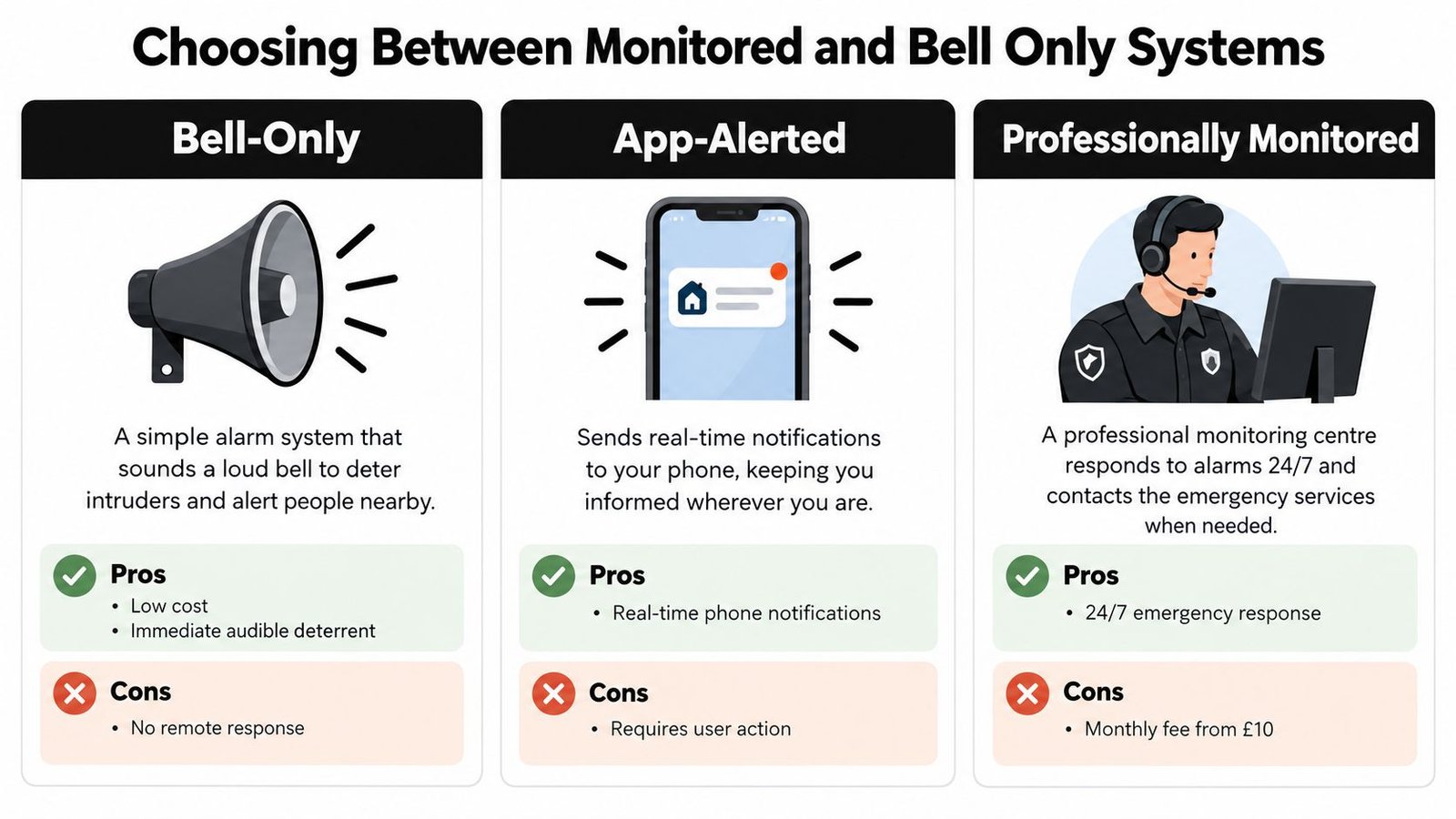
The cost trade-off is straightforward. Bell-only systems avoid ongoing monitoring charges but leave response and verification with the owner. App-alerted systems add convenience but preserve that responsibility. Professionally monitored systems introduce recurring charges and more complex maintenance, but they provide a structured response layer that may be proportionate for isolated premises, valuable stock, repeated incidents or businesses without staff available overnight.
A good quotation should state what each model includes, what it excludes and what happens when an alarm activates. It should also identify false-alarm handling, keyholder responsibilities and the process for updating contact details.
Strategic Sensor Placement And System Integration
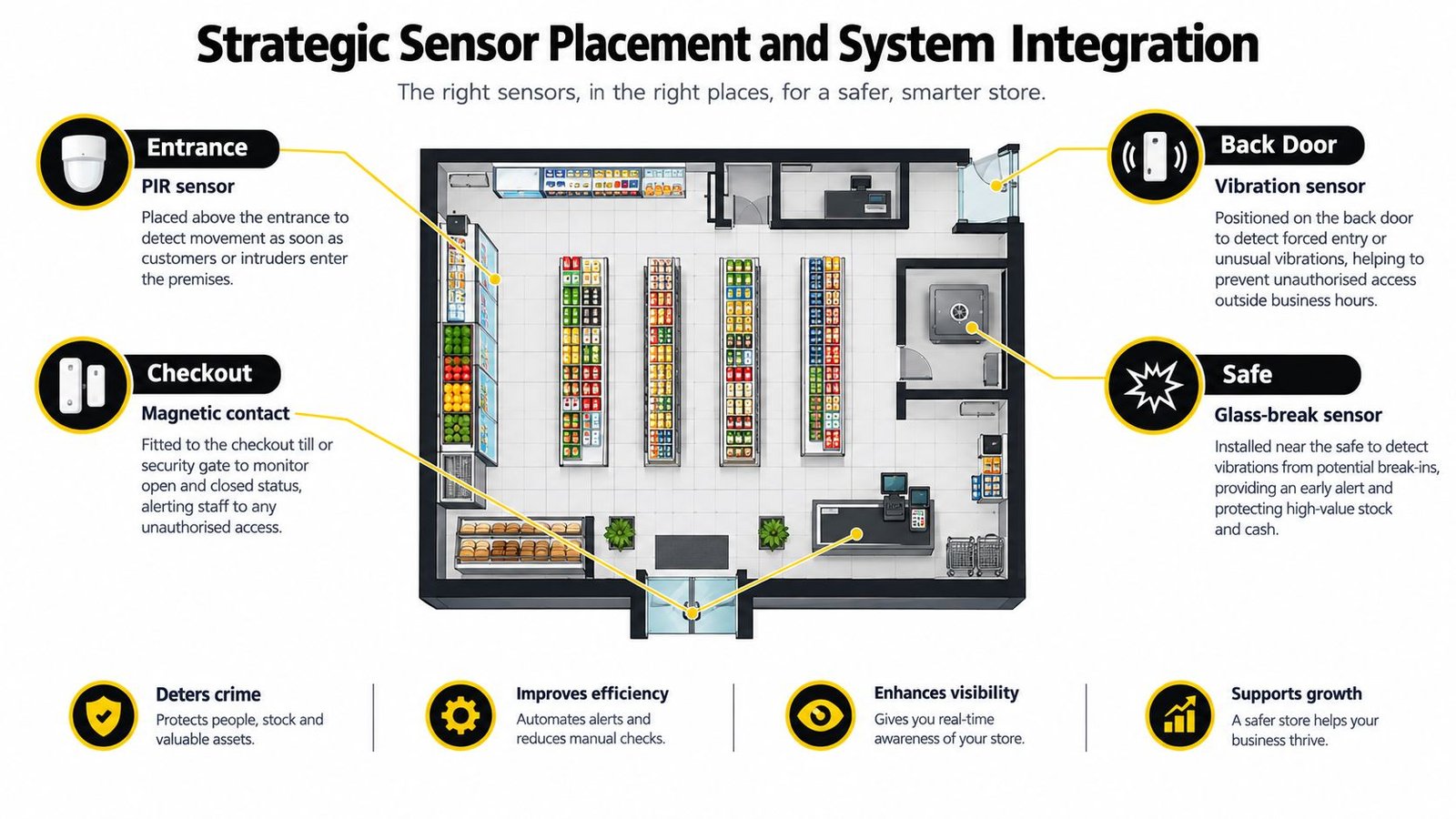
A loud siren is only one part of a shop alarm system. The useful question is whether the design can detect an attack, identify the affected area, support a safe response and preserve evidence. Start with a walk-through of how someone could enter, move through the premises and reach stock, cash, records or equipment. The crime-exposure figures noted earlier confirm that a generic kit is poor value when it ignores the building.
Start with the outside shell
Fit contacts to the main entrance, rear doors and other accessible doors so the panel registers when a protected opening changes state. Shutters need separate consideration. A shutter contact can identify opening, while a shock or vibration sensor may detect an attack before the shutter is fully raised.
Review accessible windows, roof lights and lightweight roof routes as well. A unit with a flat roof, adjoining buildings or a concealed rear alley presents a different perimeter risk from a shop facing a busy, well-lit frontage. The survey should record these routes rather than treating every external opening alike.
Use different detectors for different jobs
Movement detectors can protect sales floors, corridors, offices and stockrooms. Position them around shelving, displays, heating sources, sunlight and normal staff movement. Pet-friendly detectors may suit premises where animals remain overnight, but correct positioning and testing still matter.
Protect higher-risk areas more precisely. A stockroom door, safe area or records office can use a separate zone so an activation identifies the location involved. Clear naming helps the keyholder and monitoring operator act quickly. “Zone 4” says little, while “rear stockroom PIR” gives immediate context.
Connect alarms to evidence
CCTV should cover the approach to the premises, entry points and the routes a person may take inside. It needs suitable lighting, reliable recording and time settings that match the alarm panel and access-control system. A camera several minutes out of sync can make the incident timeline harder to establish.
Integration should produce useful events, not just place several systems beside one another:
- Alarm to CCTV: An alarm activation should open the relevant camera views or create a searchable event marker.
- Access control to alarm: Staff-only doors should distinguish authorised use from unexpected access.
- Video to reporting: Exported footage should show enough of the approach, action and departure to support an investigation.
- Fire separation: Fire detection requires its own compliant design and response logic. An intruder alarm is not a substitute for it.
- Staff procedures: Employees need clear instructions for setting and unsetting zones, reporting faults and avoiding entry after an overnight activation.
A system also needs sensible naming, documented zones and tested communication between devices. Otherwise, the owner may receive an alarm without knowing where to look, while useful footage remains difficult to find.
Retailers comparing alarm, CCTV, access control and physical protection providers can compare physical security vendors before requesting a final specification. Compare more than hardware brands. Check whether the installer can make the systems exchange useful events, preserve a coherent incident record and support practical action after an activation.
Selecting A Certified Installer And Maintenance Plan
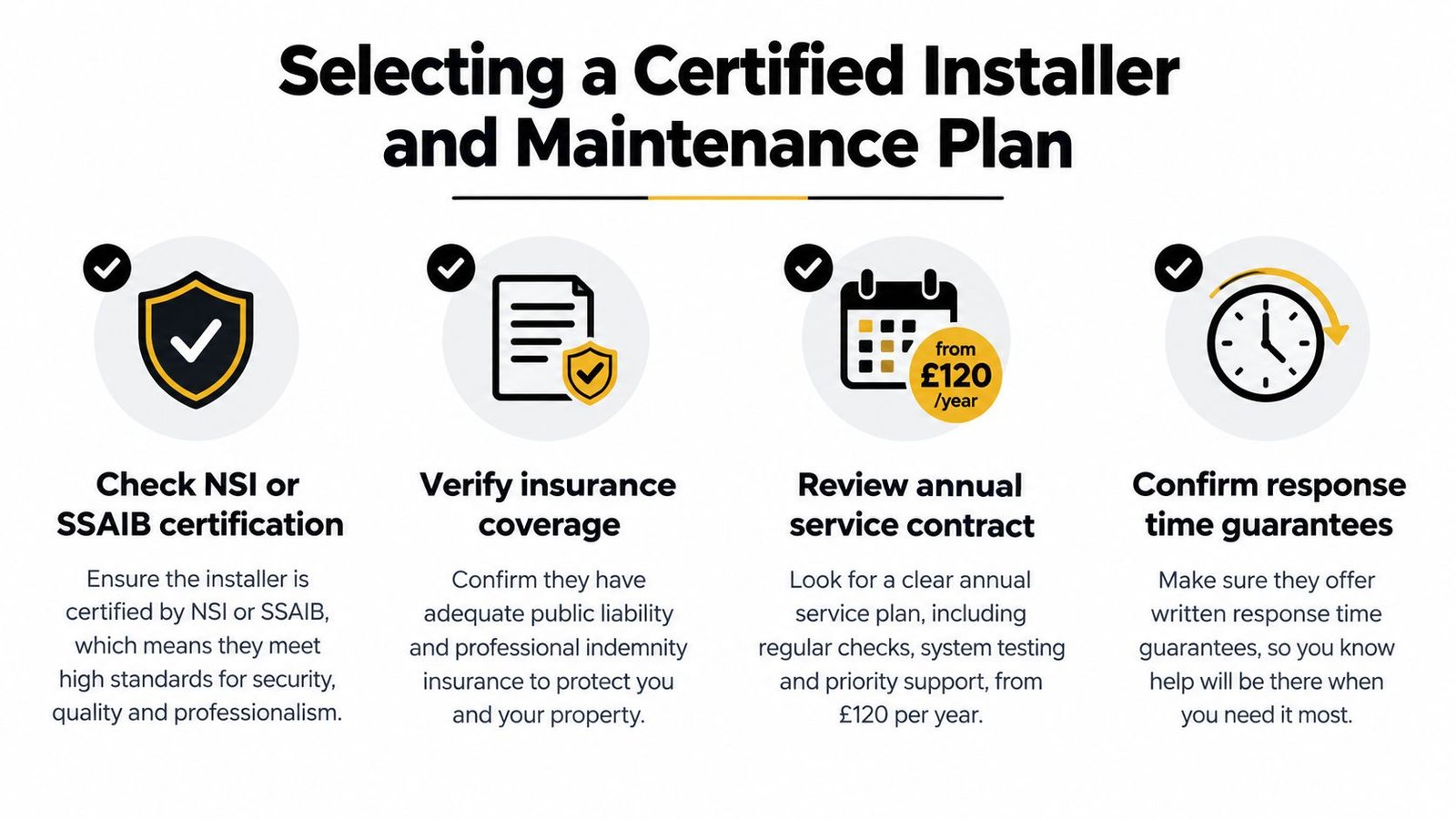
The installer determines whether the system works as designed. A reputable quotation should explain the risk assessment, proposed grade, detector locations, signalling route, confirmation method, user permissions and service obligations. If it only lists equipment models and a total price, you can't properly compare it with another proposal.
Look for relevant certification, insurance, competent engineers and experience with commercial premises. NSI and SSAIB certification can provide useful assurance where the insurer or police-response route requires an approved company. SafeContractor accreditation, DBS-checked engineers and evidence of work on similar shops are also sensible checks.
Manufacturers such as Hikvision, Paxton, Pyronix and Fike may appear in a broader integrated specification, but a recognised brand doesn't compensate for poor design. Ask who will commission the system, who will hold the documentation and how faults will be handled outside trading hours.
What a proper service visit includes
Independent UK guidance recommends at least annual servicing for alarm systems and six-monthly servicing for systems linked to an alarm-receiving centre for police response. The service should test detectors, tamper circuits, standby power, event logging, communication paths and keyholder escalation, not just confirm that the external bell sounds. (ACE guidance on intruder alarm systems)
The engineer should inspect equipment for damage, confirm that doors and shutters still close correctly, check battery condition and test the loss of each signalling path. They should also review whether the shop layout has changed. New shelving, a relocated checkout or a converted stockroom can create blind spots without anyone realising it.
Maintenance protects the response route
A monitored system depends on accurate information. Contact names, telephone numbers, opening schedules, user permissions and keyholder availability should be reviewed regularly. Staff changes must result in prompt removal of former users and addition of authorised personnel.
False alarms deserve investigation rather than dismissal. A recurring activation may come from a poorly positioned detector, a door that moves, an unreliable battery, a communication fault or an unclear setting procedure. Repeated nuisance events create fatigue and can undermine confidence in the system.
Service standard: A maintenance visit should leave you with a record of what was tested, what failed, what was changed and what action remains outstanding.
A maintenance agreement should state response arrangements, parts coverage, attendance terms and whether the company supports the relevant police-response requirements. Keep certificates, service reports and system drawings with your insurance records. They provide evidence that the protection is being managed rather than abandoned after installation.
Evaluating Costs And Planning Your Next Steps
A shop alarm quote means little without the specification behind it. Cost depends on the building, protected doors and windows, internal zones, cable routes, signalling resilience, monitoring, CCTV integration, access control and the service arrangement after installation.
Compare systems that perform the same job. A bell-only package mainly announces an activation on the premises. A monitored, dual-path system is designed to transmit an event, support verification and follow a defined response process. The cheaper quote may therefore leave important risks uncovered.
Compare the specification, not just the price
Ask each installer to identify:
- Protection level: Which doors, windows, shutters, roof routes, stockrooms and offices are covered?
- System grade: Which grade does the risk assessment require, and why?
- Signalling: Is the system single-path or dual-path? How will it report a communication failure?
- Response: Is it bell-only, app-alerted or connected to an alarm-receiving centre?
- Confirmation: What creates a confirmed activation, and does the arrangement support the intended police-response route?
- Integration: Can alarm events connect to CCTV, access control or another relevant system?
- Ownership: Who controls user permissions, recordings, passwords and system documentation?
- Maintenance: What will the engineer test, and how often will servicing take place?
Check the insurance wording before approving the design. A policy may specify a system grade, approved installer, monitoring arrangement or maintenance interval. The installer can explain how the technical design meets those requirements, but the insurer decides what the policy accepts. Ask for any required standard or approval in writing.
Prioritise prevention and usable evidence
Low charge rates for non-residential burglary make prevention, rapid verification and usable evidence more valuable than a siren alone. The ONS crime in England and Wales, year ending March 2024 data cited earlier supports that practical conclusion, without turning the closing decision into a repeat of the opening statistics.
A shop does not need every available device. A contact on a vulnerable door, a correctly configured detector and a camera covering the approach may provide better protection than extra hardware that causes false activations or produces confusing footage. Spend first on weak points, reliable signalling, clear zones and a response process. Add features only when they address a defined risk.
A practical decision sequence
Begin with a site survey. Ask the installer to explain the proposed response from the first door opening through to the final report. Review insurance conditions, choose a response model that matches staffing and risk, approve the design, then schedule installation when the shop can operate safely around the work.
After commissioning, train every relevant user. Test setting and unsetting, keyholder calls, alarm zones, camera exports and fault reporting. Keep a written escalation plan where managers can find it, and update it when staff, opening hours or the building change.
A security alarm system for shop premises earns its keep by reducing uncertainty. It detects the right event, sends the message through a resilient route, helps the appropriate person verify what happened and preserves evidence for a police report or insurance claim. That connected process matters more than the volume of the siren.
Wisenet Security Ltd designs, installs and maintains commercial intruder alarms, CCTV, access control and related fire protection for shops across South Wales and the South West. Its services include bell-only and monitored options, BS EN 50131 installations and integrated evidence-led systems. Arrange a site survey through Wisenet Security Ltd to review the premises, insurance requirements, response model and maintenance plan before committing to an alarm system.