
Fire Alarm Testing Signage: UK Compliance Guide 2026
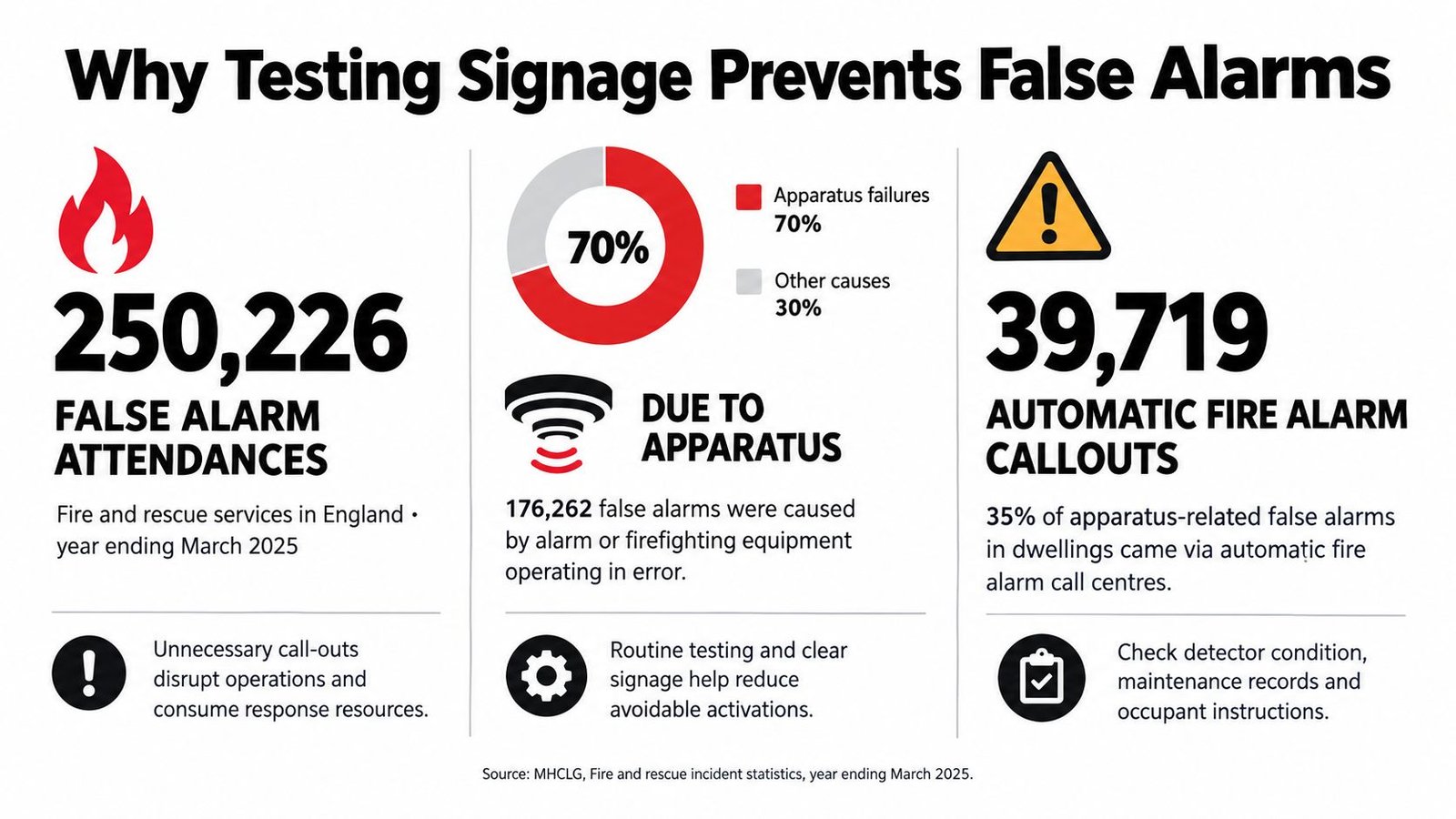
Fire and rescue services attended 250,226 false alarms in England in the year ending March 2025, and 70% were attributed to apparatus, so effective fire alarm testing signage must do more than display a compliance message. It should tell people what is happening, who controls the test, and what they must do if the alarm sounds unexpectedly.
A sign won't repair a faulty detector or replace a fire-safety log book. It can, however, prevent a routine test from becoming an avoidable evacuation, an unwanted alarm transmission, or a dangerous misunderstanding around a manual call point. In premises across South Wales and the South West, the most useful notices are treated as part of the operating procedure, not as stickers applied after the engineer has left.
Table of Contents
- Why Testing Signage Prevents False Alarms
- Legal Requirements and Required Wording
- Placement and Visibility Best Practices
- Site-Type Specific Approaches
- Coordinating Occupant Notifications
- Practical Tips and Common Mistakes
- Building Your Testing Signage System
Why Testing Signage Prevents False Alarms
The scale of unwanted alarm activity changes how fire alarm testing signage should be judged. In England, fire and rescue services attended 250,226 false alarms in the year ending March 2025, with 70% attributed to apparatus according to the official fire and rescue incident statistics. Equipment faults matter, but people also create risk when they don't understand whether a sound is a genuine evacuation signal, a planned test, or the result of work nearby.
A common example is a retail unit testing its alarm before opening. An engineer activates a manual call point, staff hear the sounders, and a contractor at the loading bay sees a temporary notice saying only “testing”. The contractor assumes the alarm is active, calls the emergency contact, and a staff member starts moving customers towards an exit. In another building, a notice remains beside a call point after the test has ended. A later occupant reads it as permission to ignore the next sound.
That confusion is avoidable. The sign must distinguish a planned test from a genuine alarm without weakening the instruction to evacuate when an alarm sounds unexpectedly.
What the notice needs to control
A useful notice answers four questions at a glance:
- What is happening? State that the fire alarm system is undergoing a planned test.
- When is it happening? Give the test window, particularly where visitors, tenants, or contractors share the site.
- Who is responsible? Display the responsible maintenance company's name and telephone number at the main control panel, as required by South Wales Fire and Rescue Service guidance based on BS 5839. The South Wales fire-safety log-book guidance also links the notice to the wider maintenance record.
- What should people do? Tell occupants not to evacuate solely because of a clearly announced test, but make clear that an unexpected alarm still requires the building's emergency procedure.
The wording should never say “ignore the alarm”. That phrase is short, memorable, and unsafe. Use a time-limited instruction tied to the named test period instead.
Practical rule: A testing notice should reduce uncertainty, not reduce vigilance.
Why apparatus and people belong in the same control
The official statistics identify apparatus as the cause of most false alarms recorded in England during the stated period, but signage can't correct every technical fault. Its role is narrower and practical. It helps engineers, staff, and occupants recognise a controlled test, prevents repeated questioning during the work, and makes it less likely that someone activates a nearby device because they mistake it for a door release or another control.
That makes placement important. A notice beside the panel supports the engineer and responsible person. A short, accessible announcement at reception supports visitors. A temporary notice near affected areas supports people who won't pass the control room. Each should be removed or updated when the test ends.
Legal Requirements and Required Wording
The legal mistake is to treat a sign as proof that testing has taken place. In UK premises, the written record is the evidence. The amended Fire Safety Order requires testing and maintenance arrangements to be recorded in writing from 1 October 2023, as described by Manchester Fire and Rescue Service guidance. A notice can support that process, but it doesn't replace the log book, competent inspection, defect records, or remedial action.
South Wales Fire and Rescue Service guidance based on BS 5839 says a manual call point or detector should be operated during each weekly test, with alternative devices selected on a strict rotation. The device used must be identified and the result entered in the fire-safety log book. The guidance also says the maintenance company's name and telephone number should be displayed at the main control panel.
The information to display
A durable panel notice should contain:
- System identity: Identify the building, alarm system, or control panel it relates to.
- Maintenance responsibility: Name the company responsible for alarm maintenance.
- Contact details: Include a telephone number that staff and attending engineers can use.
- Testing instruction: State that the system is subject to planned testing and identify the responsible person or role.
- Test-period warning: Explain what occupants should expect and how long the planned activity is expected to continue.
- Emergency distinction: State that an unexpected alarm must be treated as a real emergency and that occupants must follow the evacuation procedure.
A practical example might read:
FIRE ALARM SYSTEM UNDER PLANNED TEST
Test arranged by: [responsible person or company]
Contact: [telephone number]
During the stated test period, alarm signals may sound. Do not evacuate solely because of the announced test. If the alarm sounds unexpectedly, or the test has ended, follow the building evacuation procedure immediately.
Test condition must be ended and the system returned to normal operation after testing.
The bracketed fields must be completed with site-specific information. A generic sign with no contact details fails at the point where people need accountability.
How the weekly routine affects the notice
The weekly test normally uses one manual call point at a time, with rotation through the building. A separate UK fire-safety log-book specification says the test should normally take about one minute or less, use a different manual call point each week, and record the date and result in the log book. For a building with 52 manual call points, a strict one-point-per-week rotation would take 52 weekly tests, approximately one year, to cover the full set, unless the risk assessment or system arrangements require a faster cycle. These figures come from the UK fire-safety log-book specification_0.pdf1_.pdf).
Don't print a fixed schedule unless someone will maintain it. A notice that says “tested every Tuesday” becomes misleading when a bank holiday, site closure, or engineer visit changes the routine. Use a stable description of the weekly requirement, then record the actual device, date, result, faults, and corrective action in the log book.
For a practical overview of the wider legal framework, see this guide to UK fire alarm testing regulations. The important distinction remains simple: signage communicates the process, documentation demonstrates that it happened.
Placement and Visibility Best Practices
A notice hidden behind a reception folder has little operational value. Place fire alarm testing signage where the person making a decision will see it before touching the system, entering the affected area, or directing other people.
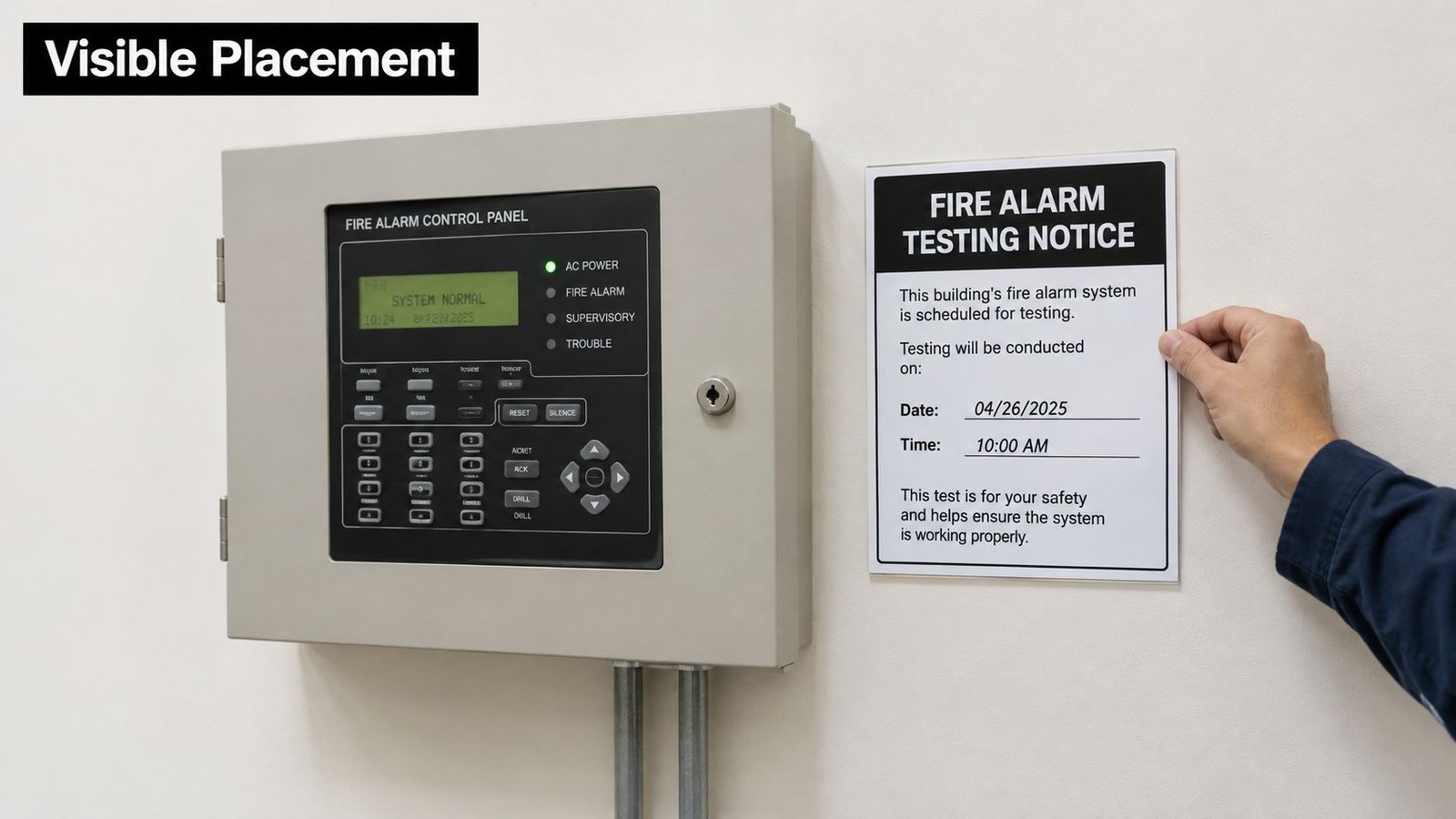
Start at the main control panel. The notice should be durable, fixed securely, and positioned where it remains readable when the panel door is open. Keep the maintenance contact visible, don't cover indicator lights or controls, and don't attach temporary paperwork in a way that obscures fault signals. The panel area should also identify any alarm-receiving-centre connection and any test or isolation condition.
A practical placement sequence
- At the panel: Display the maintenance company, telephone number, testing instructions, and the distinction between an announced test and an unexpected alarm.
- At test controls and call points: Use contextual notices where staff or contractors could confuse a manual call point with a door-release button. Never cover the red device, its operating instructions, or the route to it.
- At reception and entrances: Tell visitors that planned testing may produce alarm signals. Include the responsible contact or reception route for questions.
- In affected work areas: Use temporary notices near loading bays, kitchens, workshops, plant rooms, and refurbishment zones where noise, dust, heat, or contractor activity could trigger concern.
- At the end of the test: Remove temporary notices immediately after the system is reinstated and the panel shows normal operation.
The manual call point guidance is useful when deciding how to explain the device without making it look like a routine switch. People must understand that the call point is for raising an alarm, not for opening a door or acknowledging a test.
Visibility depends on the environment
In an office, a clean, high-contrast panel notice may be enough for staff, supported by an email or reception message. In a warehouse, use a sign that remains legible around dust, vehicle movement, and changing work zones. In an industrial site, avoid placing paper notices near heat, moisture, chemicals, or cleaning equipment. In an apartment building, use a notice that residents can understand quickly and combine it with tenant communication.
Lighting matters too. A notice that reads well in daylight may disappear in a dim plant room. Avoid glare, clutter, and small type. Use plain language, strong contrast, and a heading that states the purpose immediately. Don't use red text for every line, because excessive warning colour reduces hierarchy and can make the sign look like a general evacuation instruction.
Site-Type Specific Approaches
The same sign won't work equally well in an apartment block, a shop, a warehouse, and a car park. Each site has different audiences, movement patterns, noise levels, and risks of accidental activation. The best approach combines a permanent panel notice with temporary, location-specific communication.
Residential blocks
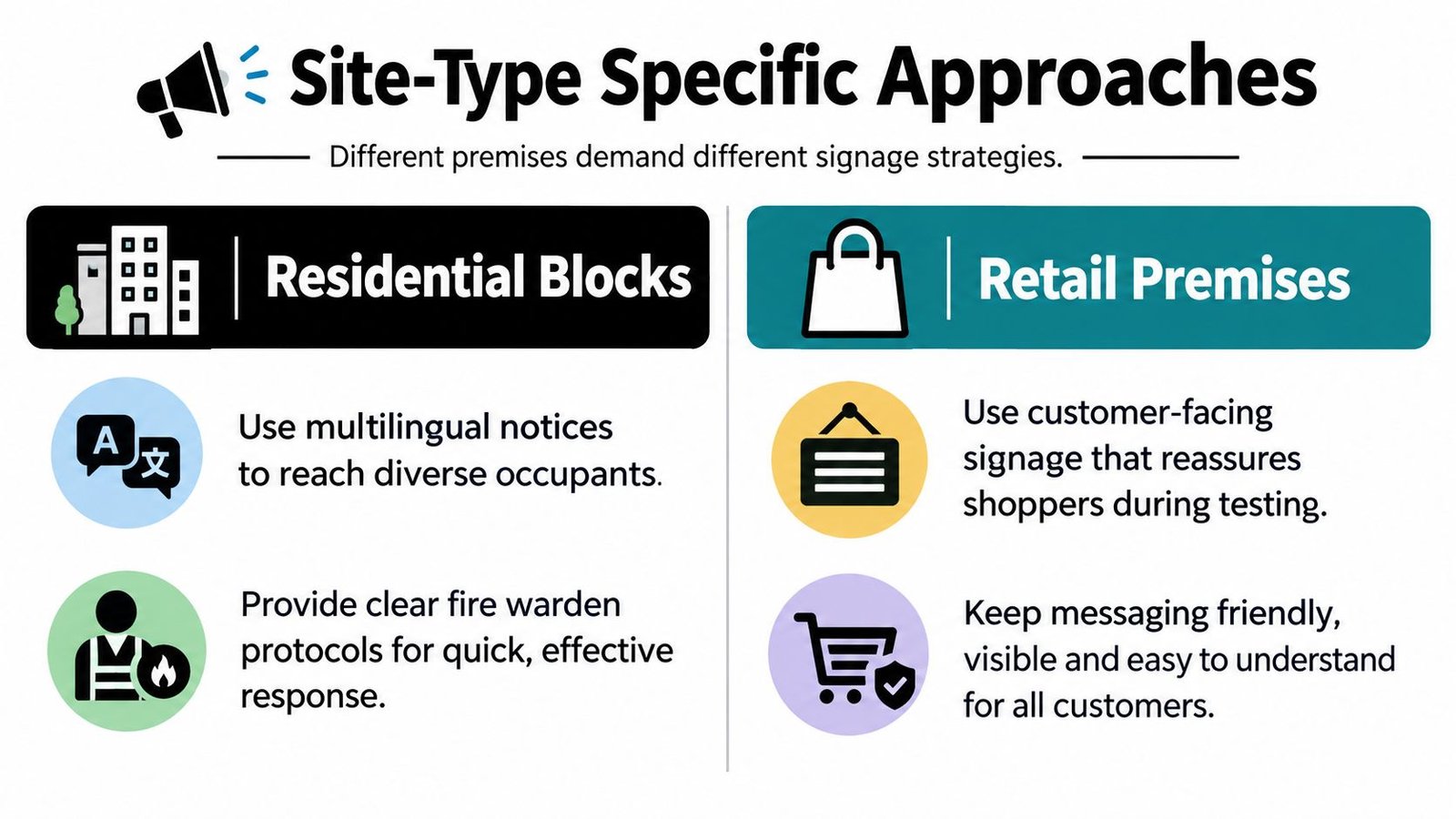
Residents may not share a first language, work predictable hours, or recognise the difference between a fire alarm and another building alert. Put the permanent notice near the panel in the common area, then issue advance messages through the managing agent, tenant portal, letterbox notice, or reception team. Use translated summaries where the resident profile requires them, but keep the emergency instruction consistent across every language.
The notice should identify the planned window, affected areas, expected sound, and a contact for questions. It should also tell residents that an alarm sounding outside the announced period must be treated as an emergency. Fire wardens and managing agents need a separate procedure covering access, vulnerable residents, contractor supervision, and confirmation that the panel has returned to normal.
Retail premises
Customers shouldn't be left to interpret a technical notice. Put a concise customer-facing message at the entrance and till area, while keeping the detailed instruction at the panel and staff points. A staff briefing should explain who can authorise the test, how the test is announced, where customers are directed if the signal sounds unexpectedly, and who contacts the engineer or alarm-receiving centre.
The trade-off is reassurance versus prominence. A small sign hidden behind promotional material won't help. An oversized warning placed at the entrance may alarm shoppers before the test begins. Use calm wording, a clear time window, and a staff-led announcement.
Warehouses and logistics hubs
Warehouses need signs that survive frequent movement and remain visible to forklift operators, agency workers, delivery drivers, and contractors. Place temporary notices at pedestrian entrances, welfare areas, loading bays, security cabins, and contractor sign-in points. Don't rely on a panel notice in an office when much of the workforce may never pass it.
Link the notice to the permit and briefing process for hot works, maintenance, and temporary isolation. The alarm-receiving-centre connection must be managed through the proper testing procedure, not by asking workers to ignore sounders. The South Yorkshire Fire and Rescue log-book guidance stresses controlled testing, correct device rotation, verification of outputs, reset, notification, and recording.
Car parks and shared industrial sites
In car parks, drivers may see a sign only briefly and may be distracted by traffic, barriers, or headlights. Use short wording at pedestrian entrances, lifts, stair doors, pay stations, and security points. Don't depend on a sign visible only from a moving vehicle.
Shared industrial sites need an agreed notice owner. Identify which tenant, facilities manager, or contractor controls the test, who coordinates the common alarm system, and how each occupier receives the start and completion message. Temporary signs are flexible during refurbishment, while permanent panels provide continuity. Use both, and remove temporary material when the work ends.
Coordinating Occupant Notifications
A sign reaches only the people who see it. A reliable testing plan reaches people before the test, during the alarm activity, and after the system has been restored. That matters particularly in multi-tenant premises, where a property manager may control the panel but not know which contractors, visitors, shift workers, or residents are present.
London Fire Brigade recorded automatic fire alarms as 34% of all its incidents in 2025, representing 47,500 calls, and identifies testing without taking the system offline as one cause of false alarms in its automatic fire alarm guidance. The communication process should therefore support the technical controls, including ARC notification and correct test isolation.
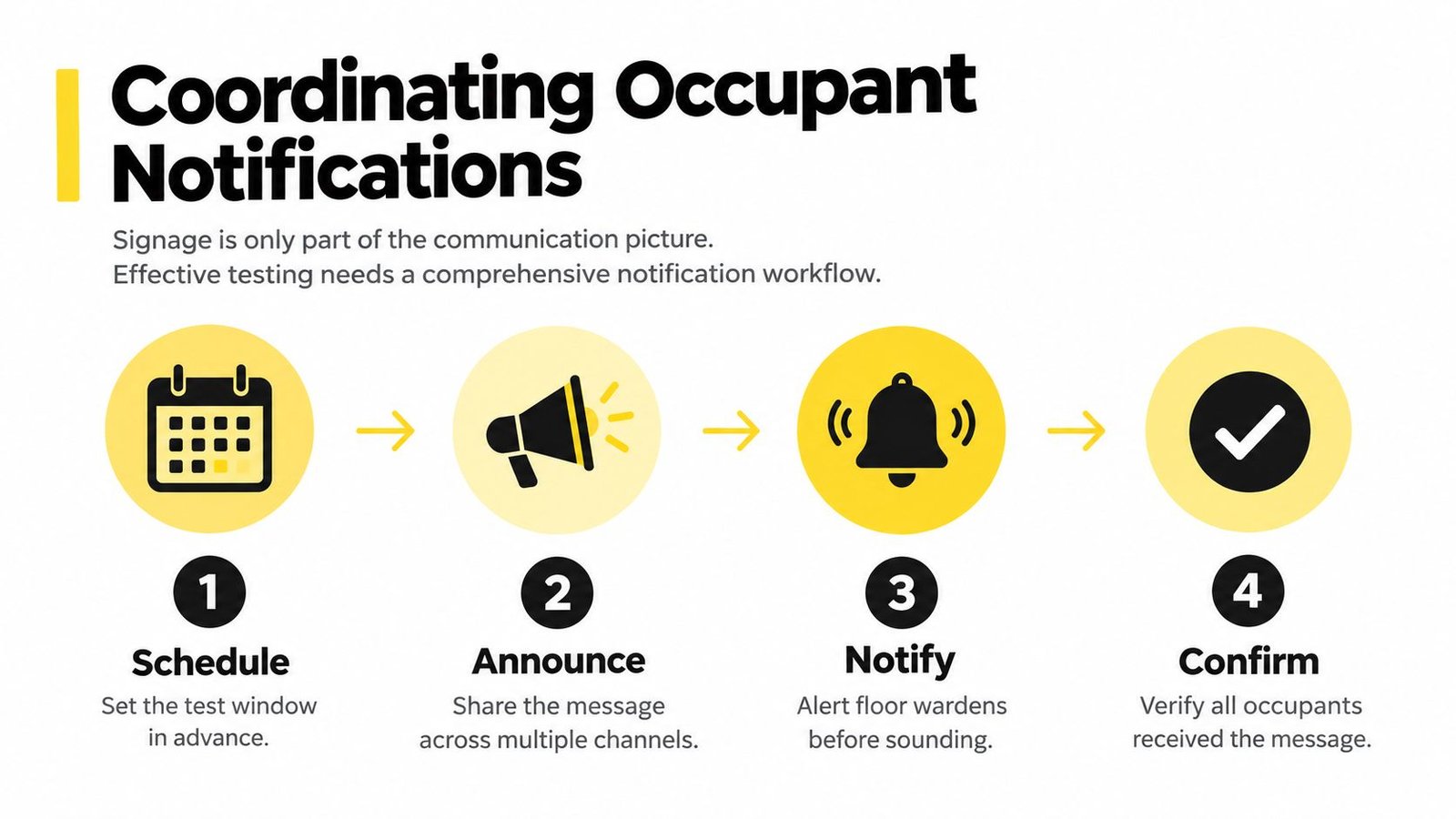
Before the test
Send one clear message with:
- The date and time window: Avoid vague wording such as “soon” or “during the morning”.
- The affected areas: Identify buildings, floors, units, common areas, or external zones.
- The expected activity: Explain that sounders or visual warning devices may operate.
- The action required: Tell people not to evacuate solely because of the announced test, while stating that an unexpected alarm still requires evacuation.
- The contact route: Name the responsible person, reception contact, or contractor.
- Accessibility arrangements: Provide translated, large-print, easy-read, audio, or direct briefings where needed.
Use more than one channel. Tenant emails, SMS messages, reception briefings, contractor inductions, noticeboards, and an accessible unified employee app explained can work together when the audience is distributed across different teams and shifts. The channel should supplement, not replace, physical signage.
During the test
Tell floor wardens, reception staff, security officers, and contractors immediately before the alarm is activated. They should know the test boundary, the person leading it, the emergency contact, and the action to take if the alarm continues beyond the agreed window. In a noisy warehouse, use radio communication or a face-to-face briefing rather than assuming a wall notice has been read.
Don't ask occupants to disregard an alarm without a precise limit. “Testing all day” creates alarm fatigue and makes the distinction between planned and genuine signals harder to maintain.
After the test
The engineer or responsible person should confirm that the test is complete, the panel has been reset, normal status is restored, any ARC notification has been completed, and the result is recorded. Remove temporary notices, send a completion message, and tell occupants about any unresolved restriction or follow-up work.
If the site uses sounders in separate areas, explain the affected zones before work begins. The fire alarm sounder guidance can help teams understand why audibility and occupant communication need to be considered together.
Practical Tips and Common Mistakes
After repeated installations and maintenance visits, the same failures appear. The sign is present, but it doesn't identify the responsible company. A temporary notice is placed at the panel, but nobody tells the night shift. A contractor completes the test, yet an obsolete “system under test” notice remains beside the entrance for weeks.
The strongest process treats signage as one control within a short sequence:
- Agree the test window and responsible person.
- Check the panel, faults, zones, interfaces, and ARC arrangements.
- Notify occupants and contractors through the channels they use.
- Display temporary notices in affected areas.
- Conduct the test using the planned device and controlled procedure.
- Restore the system, confirm normal status, and record the outcome.
- Remove obsolete notices and issue the completion message.
The mistakes that create avoidable confusion
| Weak practice | Why it fails | Better approach |
|---|---|---|
| “Testing in progress” with no contact | Nobody knows who controls the work | Name the responsible person and telephone contact |
| “Ignore the alarm” | It can discourage evacuation during a real event | Refer only to the announced test window |
| Notice at the panel only | Visitors, contractors, and shift workers may never see it | Add temporary notices at entrances and affected zones |
| Permanent paper notice | It becomes damaged or outdated | Use durable fixed signage and replaceable temporary notices |
| Leaving signs in place | People may assume testing is continuous | Remove them after reinstatement |
| Testing a monitored system without control | It can create an unwanted transmission | Follow the ARC and isolation procedure |
| Signage used as evidence | A poster doesn't prove the test occurred | Record date, device or zone, result, faults, and action |
Hot works, kitchen activity, loading bays, and refurbishment deserve special attention. Temporary conditions can increase the chance of unwanted activation, but a sign isn't permission to disable protection casually. The responsible person must coordinate isolation, alternative controls, contractor access, and reinstatement.
At servicing visits, competent inspection goes beyond panel lamps. The relevant fire alarm servicing guidance describes inspection of detectors, call points, sounders, cables, batteries, interfaces, faults, and false alarms, with service documentation and log-book records. Signage should point people towards that disciplined process, never pretend to replace it.
Building Your Testing Signage System
Build the system around the risk assessment and the way people use the premises. Start by listing every audience that needs to understand testing, including employees, residents, visitors, cleaners, security staff, engineers, delivery drivers, and contractors. Note which groups need translated, large-print, easy-read, audio, or face-to-face communication.
Then create two layers of signage:
- Permanent information: A durable panel notice naming the maintenance company, telephone number, responsible role, and basic test instructions.
- Temporary information: Removable notices showing the current test window, affected areas, expected alarm activity, and the emergency distinction.
Choose materials for the environment. A clean office may suit a professionally printed notice, while a warehouse, plant room, or exposed loading area needs a more durable board. For temporary site communication, Correx Signs can be considered where a lightweight, replaceable board is appropriate, subject to correct fixing and the conditions at the premises.
Review the system, not just the sign
Check the signs during weekly user routines and engineer visits. Confirm that contact details remain current, wording hasn't been obscured, temporary notices are removed, and tenants or contractors still understand the process. During refurbishment, revise placement when hoardings, partitions, temporary entrances, or access restrictions change the normal routes.
Troubleshooting should be specific. If residents miss written notices, add direct briefings and translated versions. If neurodiverse occupants find an unexpected sound particularly distressing, provide advance information about timing, location, duration, and what the sound means, without weakening the evacuation instruction. If visual impairment affects access to notices, use direct notification, audio communication, tactile wayfinding where appropriate, and a named contact.
The final check is traceability. The log book should show who tested the system, when, which device or zone was used, what operated, whether faults appeared, and what corrective action followed. If the site can't connect the sign, the procedure, the test, and the record, it doesn't have a signage system. It has isolated pieces of paper.
Wisenet Security Ltd provides fire alarm design, installation, monitoring, maintenance, and integrated safety support across South Wales and the South West. Visit Wisenet Security Ltd to arrange a practical review of your testing procedure, signage placement, occupant communications, and fire alarm documentation.