

Is 4K CCTV Worth It? the 2026 UK Guide
Most advice on is 4K CCTV worth it starts and ends with pixel count. That's the wrong test. A 4K camera can give you more detail, but it can also consume far more storage, place greater demands on your network, and produce disappointing footage if the lens, lighting, angle, or recording settings are wrong.
For South Wales homeowners, retailers, landlords, and industrial operators, the better question is simple: where do you need forensic detail, and can the whole system preserve it? A 4K camera pointed at a nearby front door may offer little practical improvement over 2K. The same camera covering a wide car park, industrial boundary, driveway, or forecourt can be a sensible investment.
| Resolution | Best use | Main advantage | Main drawback |
|---|---|---|---|
| 1080p | Basic overview and compact areas | Lower data demand | Limited crop and distance detail |
| 2K | Doors, paths, small rooms, short driveways | Strong balance of detail and efficiency | Less useful across wide scenes |
| 4K | Wide areas, long approaches, car parks, industrial sites | Greater forensic detail and crop room | Higher storage, bandwidth, and system design demands |
Table of Contents
- The Resolution Trap and Forensic Reality
- Image Quality and Night Vision Performance
- Storage Bandwidth and Total Cost of Ownership
- Strategic Placement and Crime Prevention Impact
- UK Privacy Regulations and Proportionality
- Professional Installation and System Integration
- Tailored Recommendations for South Wales Properties
The Resolution Trap and Forensic Reality
A live image that shows a person is not necessarily an image that identifies that person. That distinction is where many 4K CCTV purchases go wrong. Detection means you can see movement. Recognition means you can describe someone with reasonable confidence. Identification means the recording contains usable detail for an investigation, subject to the quality of the footage and the circumstances.
Resolution only helps when enough pixels fall on the important subject. A wide-angle 4K camera may spread its pixels across an entire driveway, pavement, wall, and road. A well-positioned 2K camera aimed tightly at a doorway may place more useful detail on a visitor's face. The camera's label matters less than the target's size, distance, movement, lighting, focus, and angle.
That's why the popular claim that higher resolution is always better is incomplete. UK guidance from the Surveillance Camera Code of Practice stresses that surveillance should be proportionate to its purpose and collect only the image quality needed for that purpose. A camera system should support a defined security objective, not maximise specifications.
What 4K adds
4K becomes valuable when you need to inspect a subject that occupies a relatively small part of a broad scene. It gives you more information to work with during playback, particularly when an operator needs to crop into a vehicle, face, delivery area, or distant approach.
That benefit has a cost. A UK storage benchmark estimates that four 4K cameras recording continuously with H.265 at about 8 Mbps per camera need roughly 10 TB of storage, while a comparable motion-based setup can reduce that requirement to about 5.2 TB. The UK CCTV storage and NVR guide identifies 10 TB as sensible minimum headroom for four-camera 4K continuous recording.
Practical rule: Buy 4K for a forensic job, not because the box has a larger number on it.
You may also want to understand how resolution is prepared and displayed across different screens. A useful resource on preparing images for 4K displays helps explain why source quality and display capability both affect the final result. The same principle applies to CCTV. A high-resolution camera cannot compensate for poor capture conditions or an undersized recorder.
Image Quality and Night Vision Performance
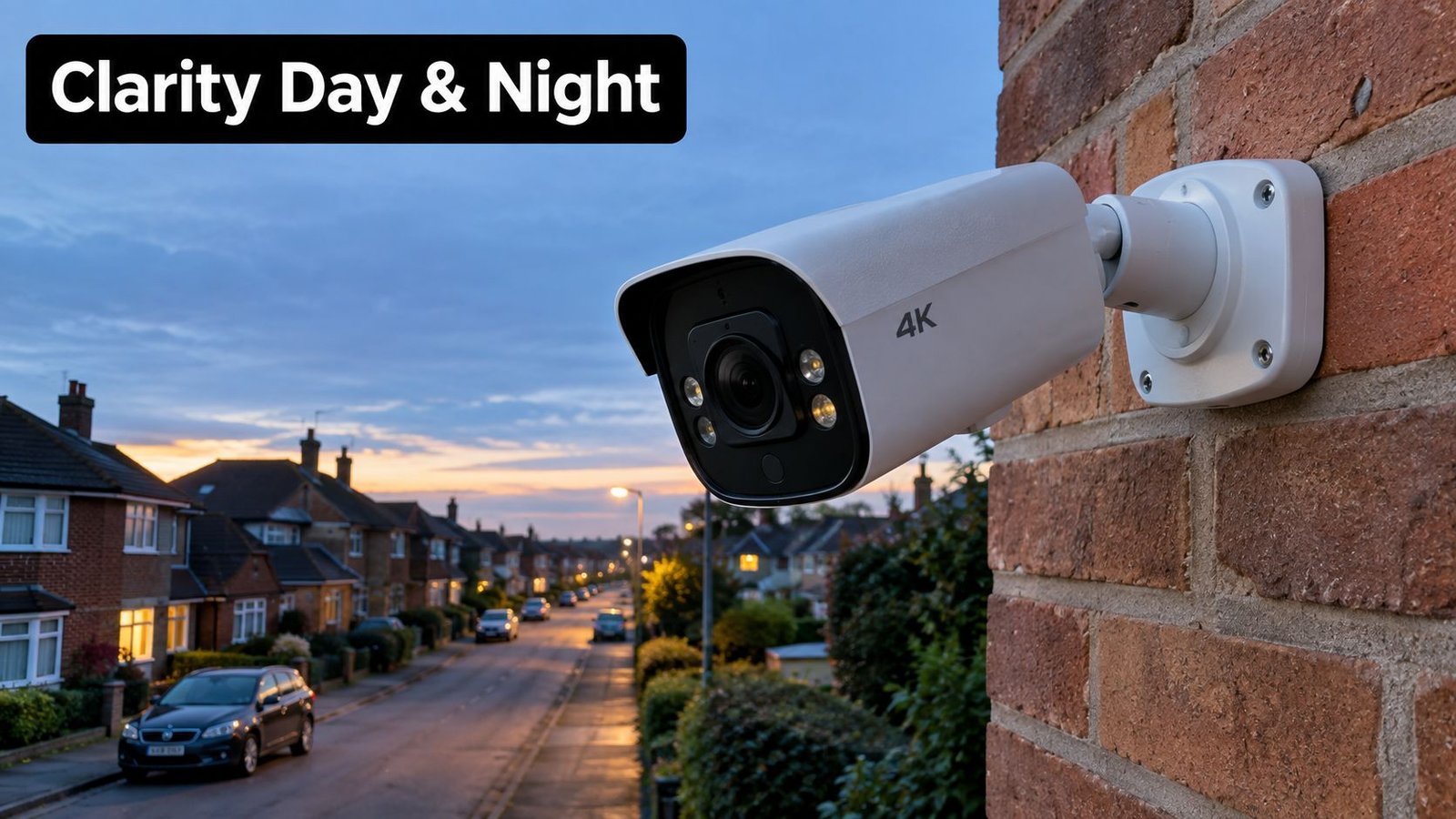
4K's clearest advantage is extra detail across a wide field of view. It can let one camera monitor a broad driveway, warehouse floor, car park entrance, or forecourt while retaining more usable information for later review. That doesn't mean one camera should replace every other camera. It means a carefully selected 4K view may cover a larger scene without making distant subjects completely unusable.
A 4K camera is commonly associated with an 8-megapixel image, but the number of pixels alone doesn't determine evidential quality. The lens must resolve detail, the camera must maintain focus, the recorder must preserve an appropriate bitrate, and the installer must avoid placing the subject against strong backlight. A distant face moving through rain at night can remain difficult to identify even when the recording is technically 4K.
Distance changes the calculation
For a typical South Wales semi-detached property, a camera watching a front door from a short distance may not need 4K. A good 2K camera with a controlled view can produce more useful facial detail than a 4K unit mounted too high or aimed across the entire front garden. The case for 4K grows when the important subject sits farther away, when a driveway is wide, or when the camera must cover a substantial side or rear approach.
One UK-focused comparison describes 4K as more valuable for coverage beyond 15 metres, wide driveways, and footage intended to support police or insurance evidence, while noting that many normal domestic viewing distances offer only a marginal improvement over 2K. The UK guide to home night-vision CCTV is also useful when assessing the separate factors that affect nighttime performance.
Night vision is an optical problem
4K doesn't automatically improve night vision. In low light, the sensor needs enough light to produce a clean image and a short enough exposure to limit motion blur. Infrared illumination, visible-light deterrence, lens aperture, sensor sensitivity, image processing, and the position of nearby walls all influence the result.
Higher resolution can introduce a trade-off when a sensor uses smaller individual pixels. Unless the camera has suitable sensor technology, optics, and processing, a lower-resolution camera with stronger low-light behaviour may produce a cleaner moving subject. Infrared glare from reflective surfaces, wet paving, vehicle paint, and nearby walls can also overwhelm an otherwise capable camera.
Use 4K at night when the camera has a clear low-light specification and the scene has been tested after installation. Don't judge only from a daytime demo. Ask the installer to show recorded footage from the actual mounting position, including a person walking through the critical area and a vehicle approaching from the relevant direction.
A visual demonstration can help you understand how image quality changes during evening conditions:
Storage Bandwidth and Total Cost of Ownership
The hidden cost of 4K CCTV is rarely the camera itself. It's the recorder, surveillance-grade hard drives, network capacity, remote access, retention period, and future maintenance. If you install high-resolution cameras but configure the NVR for a short recording history, you may lose the footage before anyone realises an incident has occurred.
A UK storage guide gives a useful working benchmark. Four 4K cameras, each running at about 8 Mbps with H.265, need approximately 10 TB for continuous recording. Motion-based recording can reduce the same four-camera requirement to roughly 5.2 TB, although the result depends on scene activity and configuration. The figures aren't a universal promise, but they're a useful warning against buying an NVR with a nominal capacity that leaves no practical headroom.
A working comparison
The table below uses the available UK 4K benchmark and qualitative comparison for lower-resolution systems. The source doesn't provide a like-for-like bitrate and retention calculation for 1080p, so those cells aren't filled with invented figures.
| Resolution | Bitrate per Camera | Daily Storage, 4 Cameras | 30-Day Retention, 4 Cameras |
|---|---|---|---|
| 4K, continuous H.265 benchmark | About 8 Mbps | Roughly 0.33 TB per day | Roughly 10 TB |
| 4K, motion-based benchmark | Configuration dependent | Roughly 0.17 TB per day | Roughly 5.2 TB |
| 1080p | Configuration dependent | Lower than comparable 4K | Lower than comparable 4K |
The UK storage benchmark is based on continuous and motion-based recording assumptions, so your actual usage will change with bitrate, frame rate, scene movement, compression, and retention settings. It's still enough to make the commercial point: 4K requires storage planning before installation, not after the first hard drive fills.
Compression and remote viewing
H.265 is important because it can reduce the data burden compared with less efficient encoding, but compression doesn't remove the need for capacity. Motion recording can help, although it must be configured carefully. A driveway camera with poor motion zones may record passing traffic, tree movement, rain, or changing shadows and consume storage without improving security.
Remote viewing creates another constraint. Multiple 4K streams can place significant demands on the site's upload connection, especially when a homeowner, manager, or security operator views several cameras at once. Rural and semi-rural parts of South Wales can have very different connectivity from one property to the next, so test the actual service rather than assuming a package name guarantees performance.
Cloud retention changes the cost model rather than eliminating it. Before choosing hosted recording, compare retention, stream quality, event handling, user access, export options, and ongoing charges. The CCTV cloud storage guide provides useful context for that decision.
Strategic Placement and Crime Prevention Impact
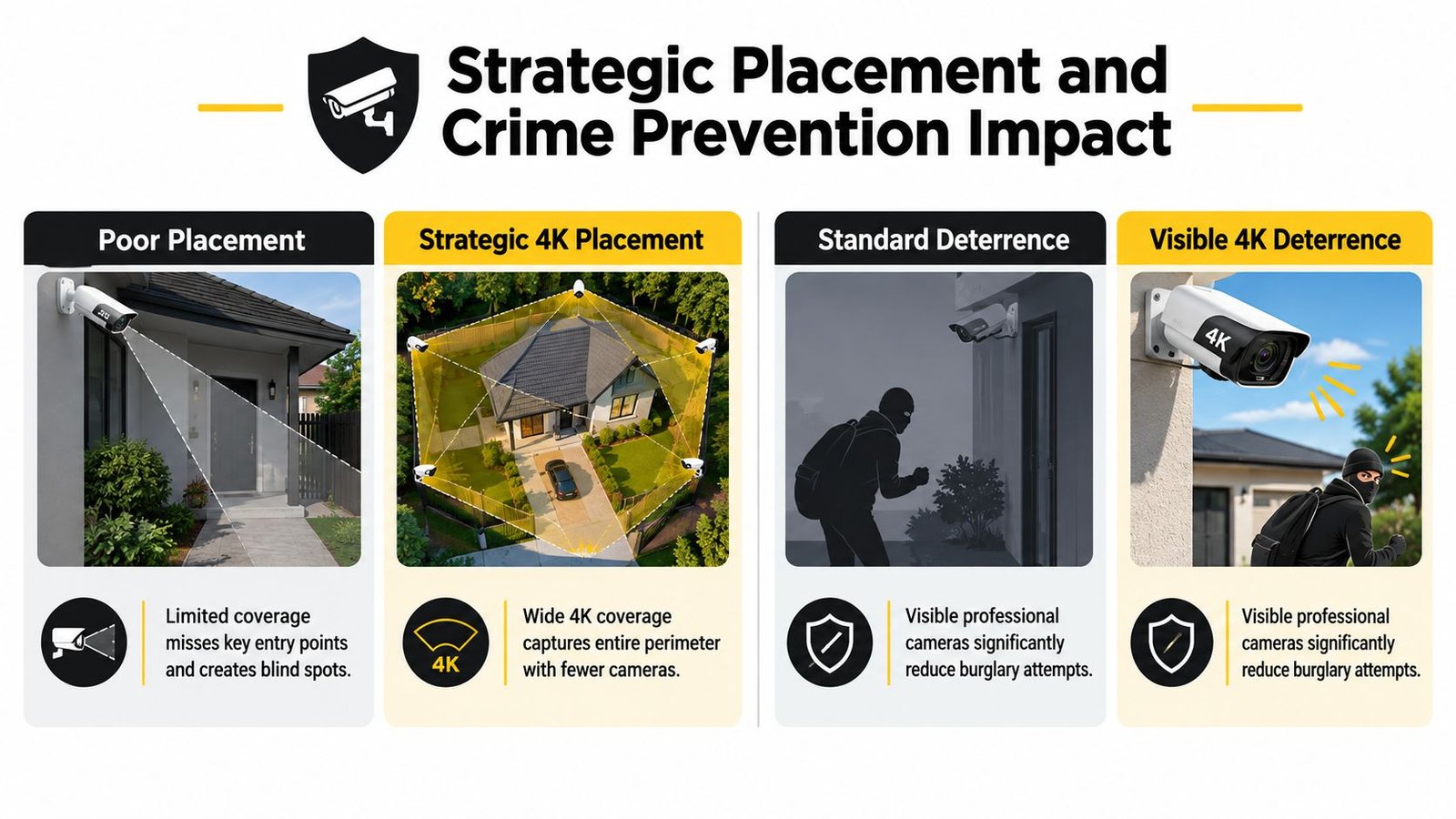
A well-placed 2K camera can outperform a badly placed 4K camera. That's not a contradiction. It reflects how surveillance works in real properties. The camera must watch the route a person or vehicle is likely to use, keep the subject within a useful part of the image, and operate with enough light and contrast to preserve detail.
UK crime-prevention evidence supports a placement-first approach. A College of Policing review found a 13% overall reduction in crime in places with CCTV compared with similar places without it, as reported in the UK CCTV crime-prevention evidence. The effect wasn't uniform across every setting. Car parks performed particularly strongly, with targeted schemes associated with reductions of roughly 51% in car park crime.
That matters to a South Wales property owner deciding where to spend the budget. A 4K camera overlooking a car park exit, loading yard, retail forecourt, or industrial gate may deliver more forensic value than upgrading every internal corridor.
Match resolution to the scene
A camera at a front door has a defined job. It should capture visitors approaching the entrance, not spend most of its pixels monitoring the pavement and neighbouring windows. A driveway camera may need a wider view, particularly if vehicles approach from more than one direction. An industrial perimeter may need several overlapping views, with 4K reserved for gates, vehicle routes, and areas where a person could approach unseen.
Use a mixed-resolution design when it makes sense:
- Entrances and gates: Choose 4K when you need to crop into faces, vehicle details, or access events at distance.
- Car parks and forecourts: Prioritise wide 4K coverage where vehicles and pedestrians remain relatively small in the frame.
- Small internal rooms: Use 2K where the camera has a short, controlled viewing distance.
- Low-risk overview zones: Select a lower resolution if the purpose is general awareness rather than identification.
Deterrence still depends on design
Visible cameras, adequate lighting, warning signage, controlled access, and an organised response process work together. Resolution doesn't make a camera deterrent by itself. Nor should a 4K camera be used as an excuse to cover a property with excessive views that create privacy and storage problems.
Place the highest-detail cameras at the points where an incident must be reconstructed. Put general-monitoring cameras elsewhere. That approach treats CCTV as a security system rather than a collection of expensive specifications.
UK Privacy Regulations and Proportionality
High-resolution footage can create a stronger privacy obligation. The ICO and the UK Surveillance Camera Code of Practice both emphasise that surveillance should be necessary, proportionate, and limited to its stated purpose. A camera installed to protect a driveway shouldn't be configured to capture unnecessary detail of a neighbour's garden, bedroom window, or more public space than the security risk requires.
Start with the purpose in writing. For example, the purpose might be monitoring a private entrance, protecting a loading area, or recording vehicle access. Then set the camera's angle, lens, resolution, retention, and access permissions around that purpose. The UK CCTV and GDPR guidance for businesses provides practical context for organisations handling recorded images.
A proportionate setup process
- Define the protected area. Mark the doors, gates, paths, assets, or vehicle routes that require coverage.
- Narrow the field of view. Avoid pointing a wide lens across neighbouring land or unnecessary public space.
- Use privacy masking. Configure fixed privacy zones where parts of the image don't serve the security purpose.
- Set retention deliberately. Keep footage for a reason, not because the hard drive allows it.
- Restrict access. Give recordings only to authorised users and protect exported footage.
- Review the system. Recheck angles after landscaping, building work, lighting changes, or boundary alterations.
4K isn't automatically unlawful, but unnecessary detail can weaken the proportionality argument. If a lower resolution provides the image quality needed for the defined purpose, choosing 4K without a clear reason may be difficult to justify. Conversely, a 4K camera can be defensible when a wide area or longer distance requires additional forensic detail.
Professional Installation and System Integration
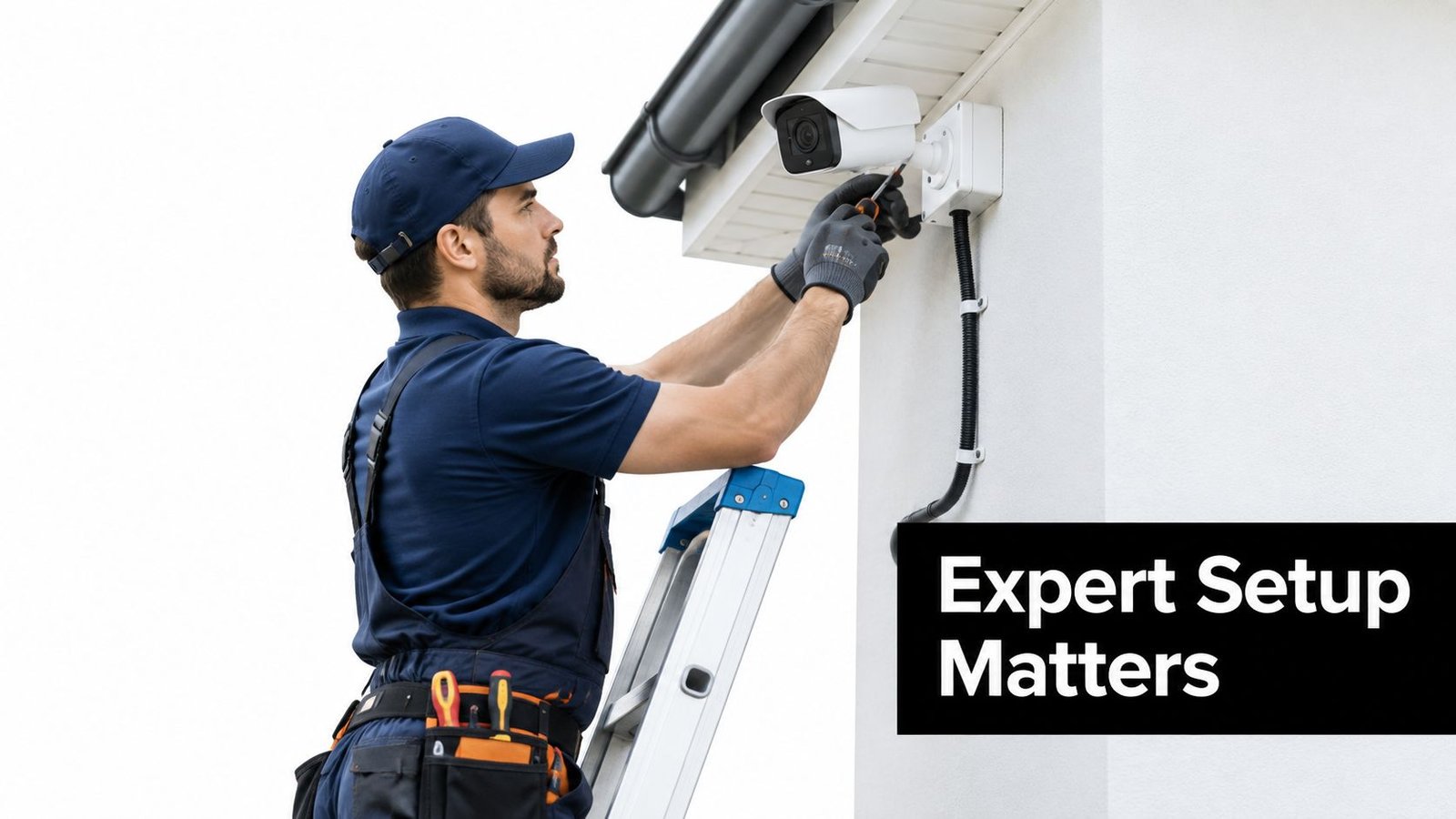
A 4K CCTV system needs more than a camera and a cable. The installer must design the view, calculate the network load, size the recorder, choose suitable storage, protect the equipment, and test the footage under real conditions. A cheap kit can appear straightforward until the cameras are mounted too high, the night image blooms with infrared glare, or the NVR overwrites important footage sooner than expected.
High-bandwidth Power over Ethernet runs need proper planning. Cable routes may pass through lofts, external walls, plant areas, suspended ceilings, or exposed sections of a warehouse. The installer must account for distance, weather protection, termination quality, switch capacity, and access for future maintenance.
Installation details that affect evidence
Camera placement often determines whether 4K delivers anything useful. A professional should check:
- Backlight and glare: Windows, security lighting, vehicle headlights, and reflective surfaces can destroy facial or plate detail.
- Mounting height: A camera mounted too high may record the top of a head instead of a useful face.
- Lens selection: A wide lens may cover more ground but spread detail more thinly across the image.
- Weather exposure: Rain, condensation, salt, dust, and unstable mounting surfaces all affect reliability.
- Recording configuration: The camera's saved stream must match the evidential purpose, not merely its advertised maximum.
South Wales properties also vary sharply. Cardiff terraces, Newport homes, Swansea retail units, rural driveways, coastal sites, and industrial buildings around the M4 corridor can require different mounting methods and cable routes. A generic online kit won't know whether a wall faces low winter sun, whether a gate needs a narrow vehicle view, or whether a remote outbuilding needs a separate network solution.
Integration adds practical value
CCTV can work alongside intruder alarms, access control, intercoms, gates, and monitored response. An access event can direct an operator to the relevant camera. An alarm can trigger a recording marker or notification. A gate camera can help verify a vehicle before access is granted.
Wisenet Security Ltd offers domestic and commercial CCTV designs with HD and 4K camera options, alongside intruder alarms, access control, fire systems, intercoms, and gate automation. The important point isn't buying the highest resolution everywhere. It's designing the complete system so the cameras, recorder, network, lighting, privacy controls, and response process work together.
Tailored Recommendations for South Wales Properties
The right answer depends on the scene, not the postcode. A homeowner in Cardiff, a retailer in Newport, a warehouse near Swansea, and a landlord managing a multi-tenant car park may all need different resolutions and recording strategies.
For most residential properties, I'd use 4K selectively. Put it on a wide driveway, long rear approach, or side access where a person remains small in the image. Use a tighter 2K view for a nearby front door or compact garden path if it provides the required detail. A standard semi-detached home often benefits more from correct height, lighting, privacy masking, and overlapping coverage than from making every camera 4K.
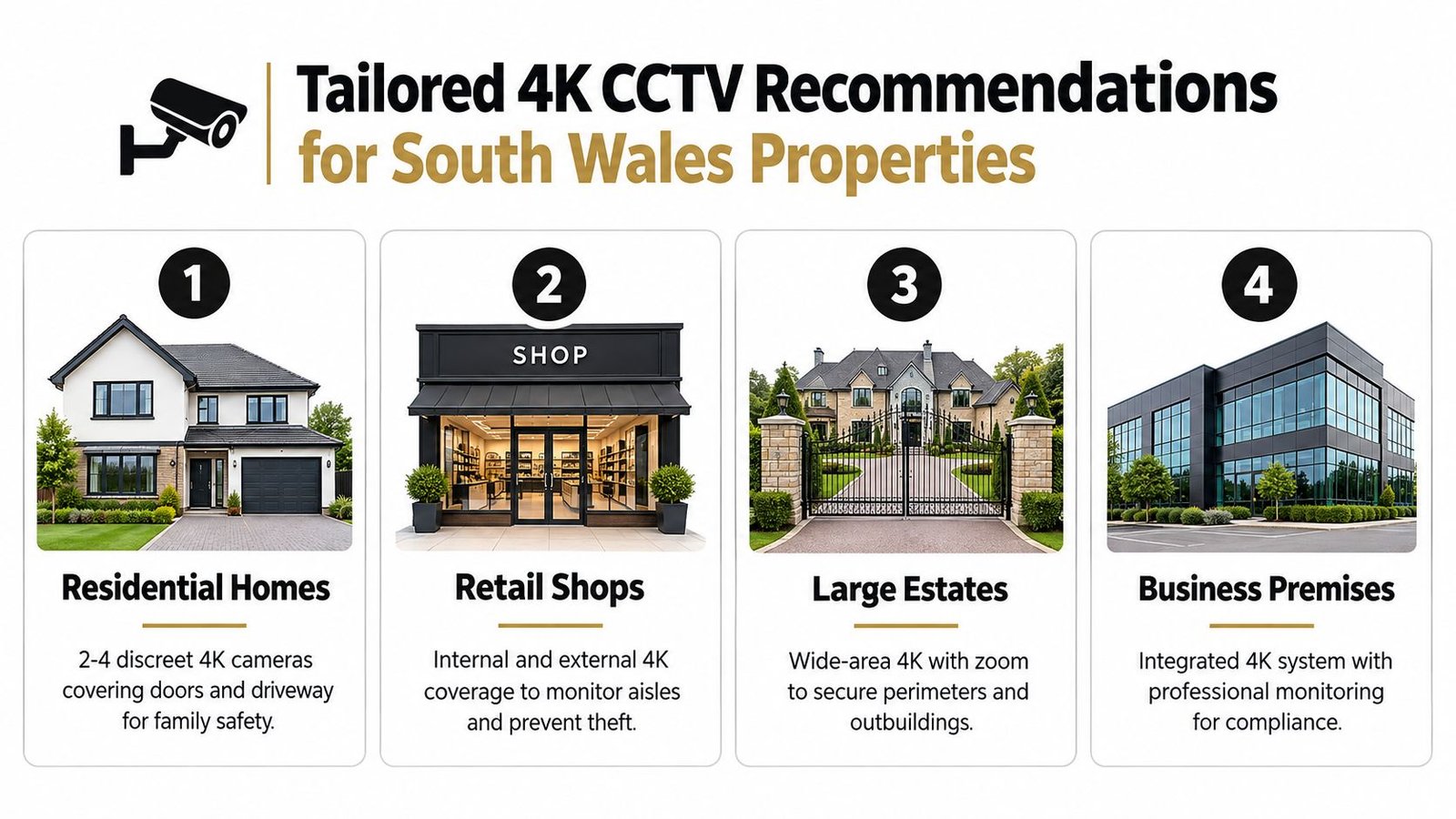
Four practical property decisions
Residential homes in Cardiff or Newport
Choose 4K for wide driveways, vehicle approaches, and longer garden boundaries. Keep the camera view tight around doors and avoid using resolution as a reason to capture neighbouring property.
Retail shops and forecourts
Prioritise 4K at entrances, tills, high-value displays, and external approaches where identification matters. Use more economical cameras for compact back rooms or areas where subjects remain close.
Warehouses and industrial estates
4K is usually worth serious consideration at gates, loading bays, yards, and perimeter routes. Large scenes demand careful lens selection, lighting design, network planning, and enough retention to review incidents discovered later.
Landlords and multi-tenant car parks
Use 4K where vehicles enter, leave, park, or pass through controlled access points. Combine it with clear signage, suitable lighting, privacy controls, and a recording policy that defines who can access footage.
The strongest design is often mixed. Spend the 4K budget on the locations where evidence matters most, then use 2K or another suitable resolution for supporting views. If you need long-distance identification across a broad area, don't accept a basic wide-angle camera without testing the farthest point in the image.
My verdict is direct. 4K CCTV is worth it for car parks, industrial sites, wide driveways, gates, forecourts, and other scenes where subjects are distant or need cropping. It isn't automatically worth it for every room, doorway, or small garden. Storage, bandwidth, lighting, lens choice, and placement decide whether the extra pixels become useful evidence.
If you're planning CCTV in Cardiff, Newport, Swansea, Bristol, or the surrounding South Wales and South West areas, contact Wisenet Security Ltd for a free consultation and a system design matched to your property, storage needs, privacy requirements, and critical viewing distances. Ask for a clear recommendation on where 4K earns its place and where a lower-resolution camera will do the job properly.