Tod Security Abergavenny: Local Protection Explained
You're probably in the position I see all the time with local owners in South Wales. The alarm's installed, the CCTV still records, the fire panel still beeps during tests, and yet one nagging question keeps coming back, who turns up if something fails on a wet Tuesday night, and will the same people still support the system after an ownership change?
That's the right question to ask about Tod Security Abergavenny. The name carries local history, but buyers need more than history. They need to know who answers the phone, who honours warranties, and whether the engineer who fitted the system is still the person who maintains it.
Table of Contents
- Why Local Security Matters in Abergavenny
- Core Security Services and What They Protect
- Monitored Alarms Versus Bell-Only Systems
- Why Accreditations and Engineer Vetting Matter
- Understanding Ownership Changes and Service Continuity
- Choosing the Right Security Package for Your Property
- Next Steps and Getting a Free Consultation
Why Local Security Matters in Abergavenny
A shop owner in Abergavenny needs a provider who can get to site, clear faults fast, and keep disruption out of trading hours. Local security only works if the engineer can reach you, understands the building type, and knows the roads, estates, and commercial routes across Monmouthshire and wider South Wales. A call centre miles away cannot restore a failed system, replace a damaged contact, or judge how quickly a repair needs attention.
Tod Security's background matters because it shows continuity, not just branding. The business says it was formed in 1987 in Abergavenny by Samantha and David Tod, then moved into a 1,000 m² purpose-built premises in 2019 after growing from a family start-up into a regional specialist. That history does not prove every service call will be perfect, but it does show long experience with local properties, local faults, and the practical realities of keeping systems alive after ownership changes. The company's own about page lays out that timeline clearly.
What local buyers should care about
Local buyers should care about response time, engineer coverage, and who owns the responsibility after a sale or handover. If a camera fails, a door contact breaks, or a fire panel needs attention, a nearby team should be able to handle commissioning, maintenance, and follow-up without the delay that comes from a provider based far away. That matters even more for older retail units, mixed-use buildings, and South Wales retrofits, where the original wiring, access routes, and alarm layout rarely match a neat standard package.
Practical rule: if a provider cannot explain how it covers your area, do not assume the website listing means anything.
Service continuity also matters after ownership changes. Buyers want to know whether warranties still stand, whether the same engineers will attend, and whether support numbers now route through a different back office. Ask those questions before you sign. If the answers are vague, service quality usually becomes vague too.
Search behaviour says a lot about whether a firm is local. A data-first approach helps separate real coverage from empty claims, and DigiVisi's data-first SEO approach is a useful lens for checking whether a company is present in a place or just stuffing a page with location keywords.
The issue is accountability. A business rooted in the Monmouthshire market should be easier to verify, easier to reach, and easier to hold responsible than a faceless national chain. If you want protection that supports trading, school runs, late openings, and delivery schedules, local service is the point.
Core Security Services and What They Protect
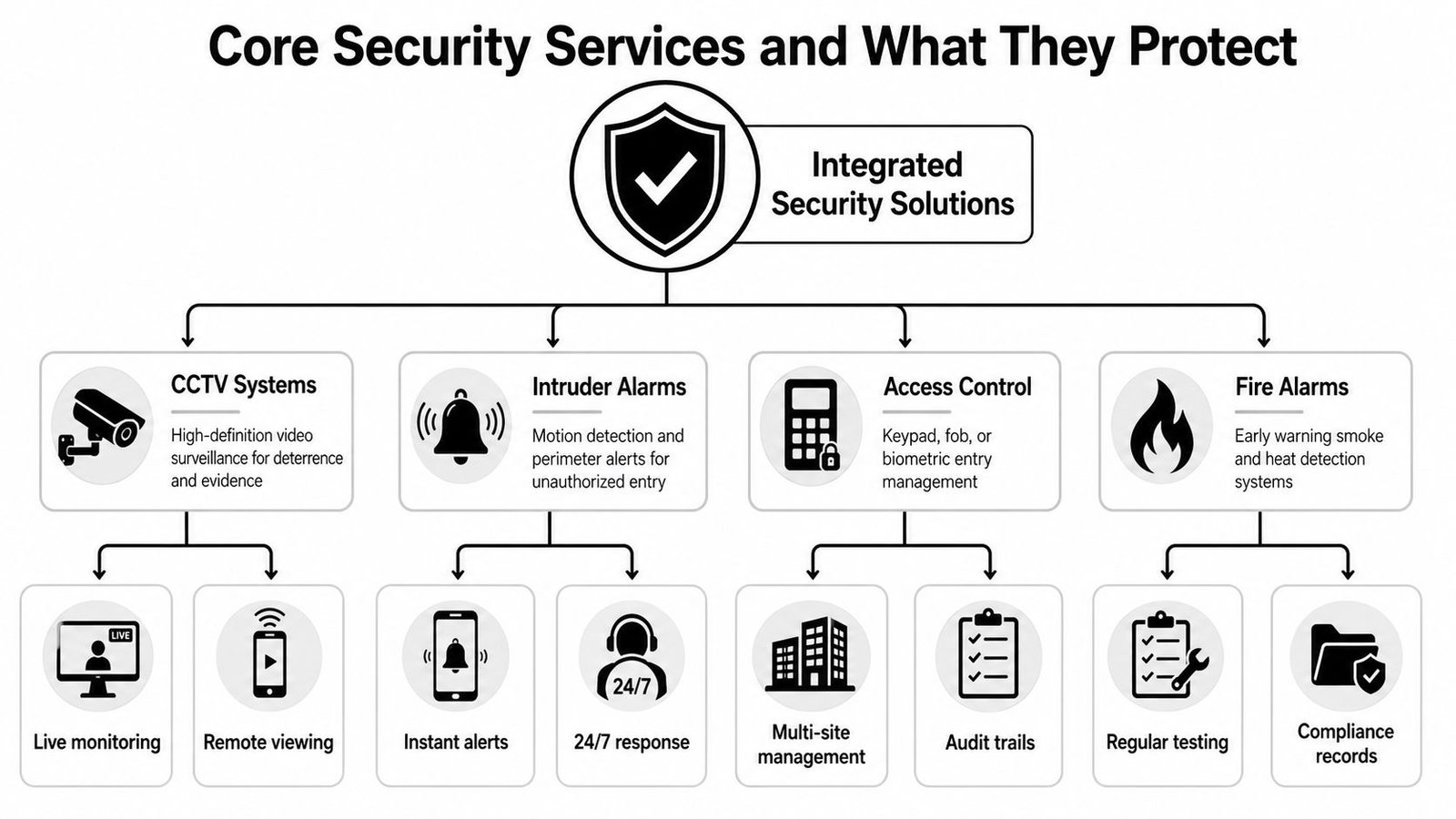
Tod Security's value sits in the combination of systems, not in any single box on a wall. CCTV, intruder alarms, access control, and fire alarms solve different problems, and the wrong mix leaves gaps. A retail counter needs visibility. A warehouse needs perimeter discipline. A shared office needs controlled entry. A care setting or small industrial unit needs the lot working together.
CCTV and intruder alarms do different jobs
CCTV is about deterrence, incident review, and evidence. It doesn't stop every offence, but it changes behaviour and gives you something usable after an event. Intruder alarms are about immediate notification and making the site noisy enough to push an offender into a quicker exit. For a shop, that can mean a visible deterrent at the front and a fast alert when someone gets in after hours.
Tod's own service mix includes CCTV, intruder and burglar alarms, access control, and fire alarm systems. That matters because most businesses don't have one vulnerability, they have several. A side door that's rarely used, a stockroom nobody monitors, and a front entrance that opens to the public are very different risk points, and each needs a different layer of protection.
Access control and fire alarm systems protect people as much as property
Access control is the cleanest way to decide who gets in, when they get in, and what trail is left behind. Keypads, fobs, cards, and biometric readers aren't luxury extras for many sites, they're the difference between traceable movement and unmanaged keys. For landlords and multi-tenant buildings, that audit trail matters when access questions turn into disputes.
Fire alarms are about life safety and continuity. A conventional system suits simpler layouts, while an addressable system gives more precise location information, which helps larger or more complex premises act faster. Wisenet Security Ltd offers both conventional and addressable fire alarm systems, along with maintenance and monitoring, so if you're comparing local providers, ask which type fits your floor plan rather than accepting a generic quote.
A system that only looks secure on paper is wasted money. You need the kit to match the way people actually move through the building.
The kit should fit the site, not the sales pitch
Tod Security's broader credentials suggest a company built for integrated work rather than one-off installs, and that's the right model for South Wales businesses that want one contractor to cover several weak points. The right package usually combines deterrence, control, and response, not just cameras for show.
Monitored Alarms Versus Bell-Only Systems
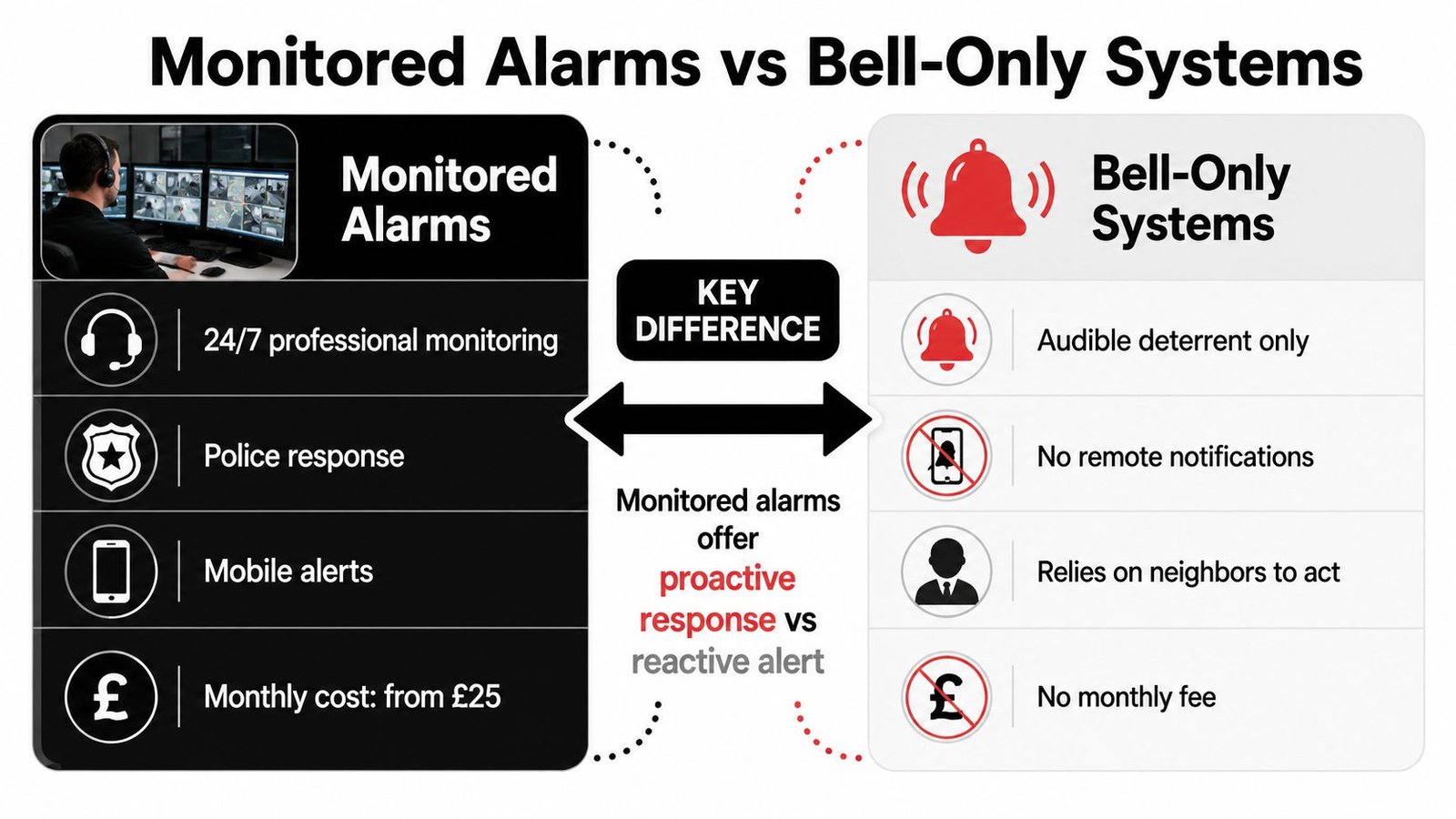
Too many buyers get lazy. They ask whether they want an alarm, then stop thinking. The decision is whether you want a system that only makes noise or one that actively pushes information to a monitoring point and mobile device.
A monitored alarm is the stronger option for commercial premises, higher-value homes, and sites that sit empty overnight. A bell-only system can still work for lower-risk properties where the main goal is deterrence and the owner is close enough to act quickly. The difference is simple, one is proactive, the other is reactive.
For a practical overview of how monitoring works, the guide on what a monitored alarm system is is worth a look before you sign anything. If you're comparing options, don't let a salesman blur the line between audible deterrence and monitored response.
Where monitored alarms earn their keep
Monitored alarms suit businesses that can't rely on a neighbour hearing the siren. A warehouse, a retail unit with stock on site, or a building with sensitive areas benefits from someone outside the premises being notified quickly. That's the point, the system doesn't just shout, it tells someone who can act.
Bell-only alarms still have a place. They're simpler, usually cheaper to run, and fine where the owner is likely to receive the alert and attend promptly. But they depend heavily on the right people noticing and reacting. If nobody nearby hears it, the system has done only half the job.
Why false alarms and outages matter
Power cuts, battery issues, and poor maintenance expose weak alarm setups very quickly. A monitored system gives you a second layer of oversight, while a bell-only system leaves the burden on whoever gets the phone notification. That doesn't make bell-only useless, it just means you need to be honest about the risk profile.
If you manage a site with stock, staff, or public access, I'd push you toward monitoring unless there's a good reason not to. If you only want a simple deterrent for a low-risk property, bell-only can be acceptable, but only if the owner can respond fast.
Why Accreditations and Engineer Vetting Matter
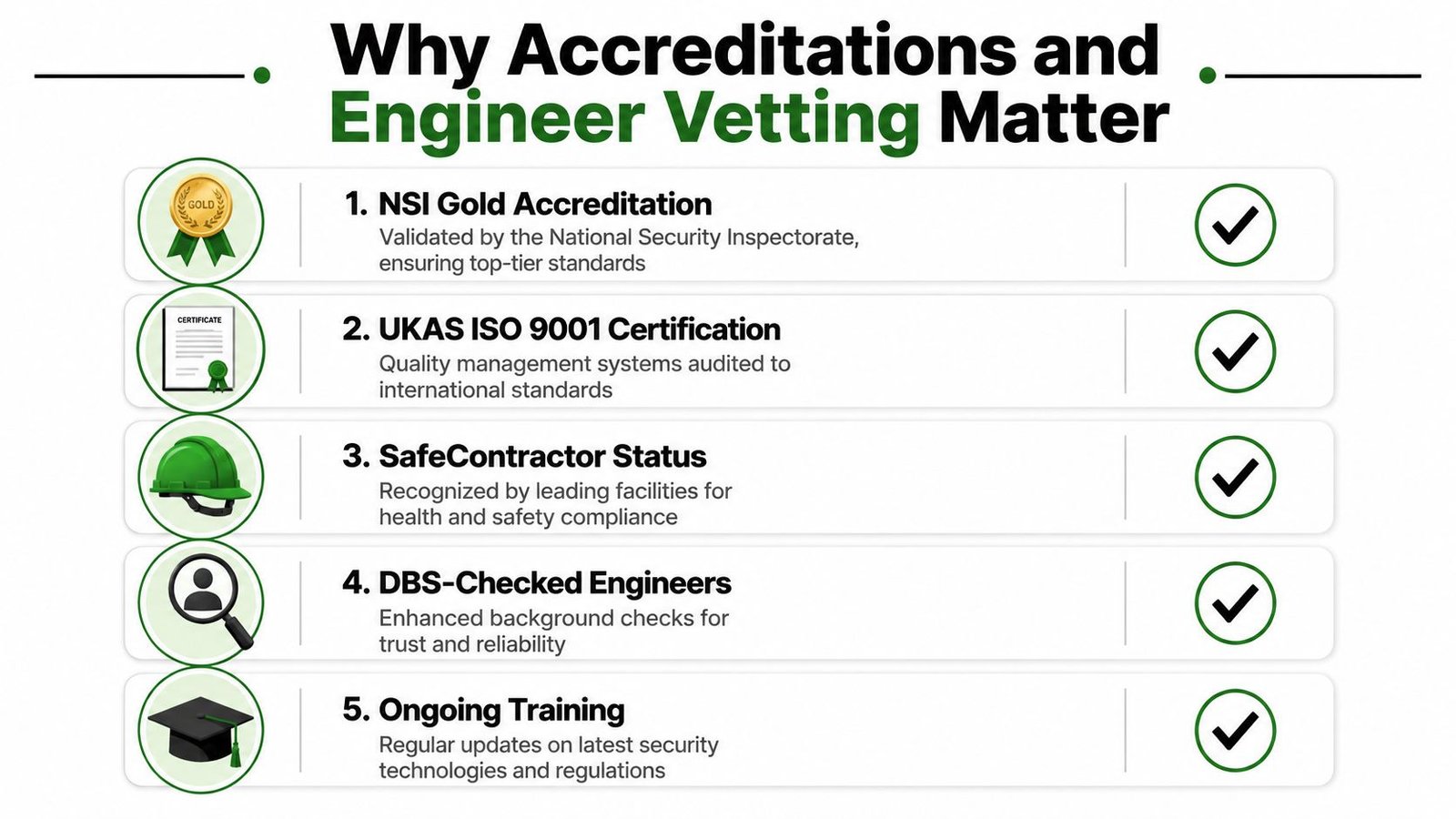
A company can talk up its service all day. What matters is whether its work has been checked against outside standards, and whether the people entering your property have been properly vetted. Tod Security presents NSI Gold Accreditation and UKAS 9001 as part of its long-term profile, and those markers are worth checking because they point to formal oversight rather than sales copy. The company history page is the place to verify how that timeline is presented.
What the labels mean
NSI Gold Accreditation tells you the installer has been assessed against external security standards, not just its own internal claims. UKAS 9001 points to quality management that is audited, which matters when you want repairs, maintenance, and paperwork handled properly after the first install. If a provider also references SafeContractor status and DBS-checked engineers, that gives you a clearer picture of who is allowed onto your site and how seriously the firm treats workplace safety.
For a practical checklist on what to ask an installer, use this security systems inspection board resource. It helps you ask the right questions about installation standards, ongoing maintenance, and the records you should expect to keep.
Vetting matters because engineers get access
Security engineers often need keys, codes, communication access, and time alone in sensitive rooms. In a house, that may mean bedrooms, utility areas, and garages. In a business, it can mean stockrooms, cash handling areas, and server cupboards. That is why DBS checks and ongoing training matter more than a smart-looking van or a polished sales pitch.
If an installer cannot explain who has site access and how engineer competence is maintained, walk away.
Wisenet Security Ltd says its engineers are DBS-checked, it holds SafeContractor accreditation, and it works with manufacturers including Hikvision, Paxton, Pyronix, and Fike. That does not make it the only option worth considering, but it does show the kind of evidence you should ask for before you let any contractor onto your premises.
The questions worth asking
Ask who signs off the work. Ask who handles servicing. Ask what happens if the original engineer leaves. Ask whether maintenance records stay with you or disappear into a support portal you cannot access. A proper installer will answer those questions clearly, because those answers decide whether you have control, compliance, and continuity, or a mess to untangle later.
Understanding Ownership Changes and Service Continuity
Tod Security's acquisition question isn't a side issue, it's the main issue. Public records show Tod Security Systems Limited was incorporated on 15 January 2003, and the filing history shows a registered office move on 14 November 2023, another update on 18 November 2024, and a director change on 31 October 2023 when David Patrick Cosgrove was appointed and Samantha Jane Tod ceased as director. Those filings sit alongside the company's long-running marketing claim that the business dates back to 1987, which means customers need to separate heritage from current operational control. Companies House filing history gives the dated record.
Ownership changes affect the questions you should ask
The practical issue after an acquisition is not the headline, it's continuity. Who owns your warranty obligations? Who services legacy panels and controllers? Who holds the service logs? If the trading brand changes, the customer still needs a named party to carry support, especially for old installs that were built under a different management structure.
A recent industry profile says the trading brand is now Tod Security & Fire, references South Wales locations in Pontpontool and Cardiff, and reports that the business was acquired by Walker Fire in 2023. That matters because buyers often keep using the old brand name in their heads while the service reality changes behind the scenes. The PSI Magazine profile is useful precisely because it surfaces that transition.
Don't assume continuity, verify it
Here's the blunt truth. A new owner can preserve service quality, improve it, or make it messier. You don't know which until you ask direct questions about warranties, response times, engineer coverage, and maintenance responsibility for legacy systems.
I'd want four answers before I renewed anything:
- Warranty ownership: who is legally responsible for the equipment you already paid for?
- Legacy support: who services older alarms, cameras, and fire systems if the original product line has changed?
- Local coverage: which engineers cover South Wales, and how often are they in Abergavenny, Pontypool, or Cardiff?
- Escalation route: who do you call if the installer, distributor, and manufacturer all point at each other?
That checklist matters because customers buy continuity, not just equipment. If a firm has changed hands, the old website copy may still look reassuring while the back-office setup has moved on. You need current answers, in writing.
Choosing the Right Security Package for Your Property
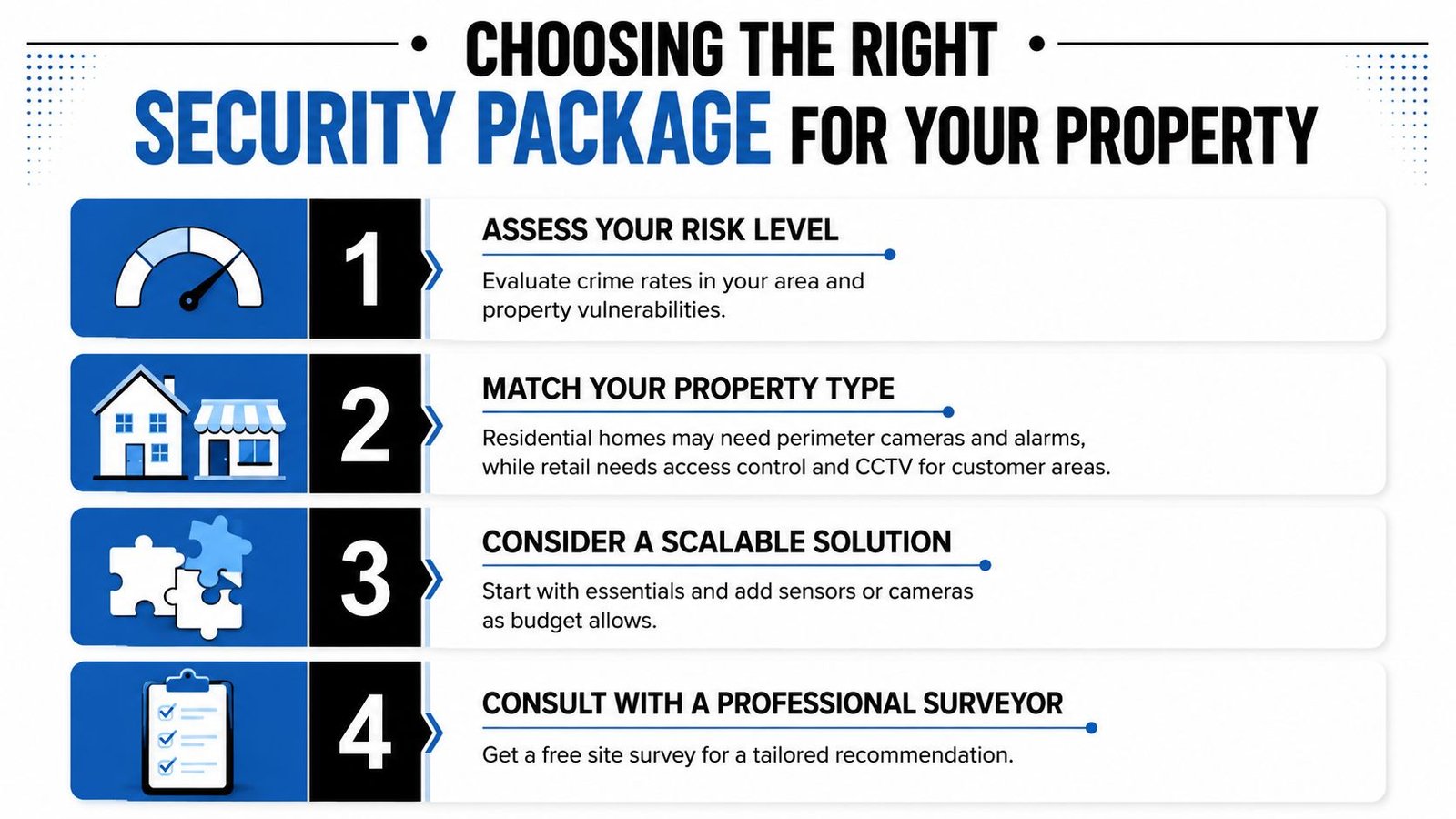
A good security package starts with a risk assessment, not a catalogue. A house, a high-street shop, a warehouse, and a multi-tenant block all need different layers because they lose different things. Privacy, stock, cash, access control, fire compliance, and staff safety are not interchangeable problems.
Start with the property type
A home usually needs perimeter visibility, intrusion detection, and straightforward app access. A retail unit needs customer-facing deterrence, stock protection, and a clean alarm response path. A warehouse or yard needs stronger external coverage, controlled entry, and a way to track after-hours movement. A block of flats needs access control that won't create key chaos.
For South Wales buyers, a sensible route is to shortlist one provider that can design the whole package rather than stitching together four subcontractors. If you want a broader comparison tool for that process, finding the right smart security for you is a useful starting point before any surveyor steps through the door.
Spend where the risk is real
Don't waste budget on features that look impressive but don't reduce your actual exposure. If the back door is the weak point, deal with the back door. If staff hand keys around too freely, move to access control. If nobody can tell where an alarm triggered, don't buy prettier cameras, fix the response logic.
Rule of thumb: buy the system that closes the biggest gap first, then add extras later.
That approach is also where a company like Wisenet Security Ltd fits naturally, because it offers CCTV, intruder alarms, access control, fire alarm systems, and free consultations for a design. Use that kind of consultation to pressure-test the proposal, not to sit through a sales script.
Ask for the right evidence
Ask for a site survey, a maintenance plan, and a clear explanation of what happens after installation. Ask which parts are scalable if your business grows. Ask what support looks like if an engineer has to revisit the site a month later. That's how you separate a proper recommendation from an upsell.
Next Steps and Getting a Free Consultation
If you're comparing Tod Security Abergavenny with other installers, don't get distracted by the oldest logo or the slickest flyer. Focus on three things, who owns the contract now, who services the system later, and how quickly someone can get to your site when something fails. That's the difference between protection and paperwork.
Bring photos of the building, a list of problem areas, and any old maintenance records to your consultation. Ask for written confirmation of warranty handling, engineer coverage, and whether the proposal covers CCTV, alarms, access control, and fire safety as a joined-up package. If the answers stay vague, keep looking.
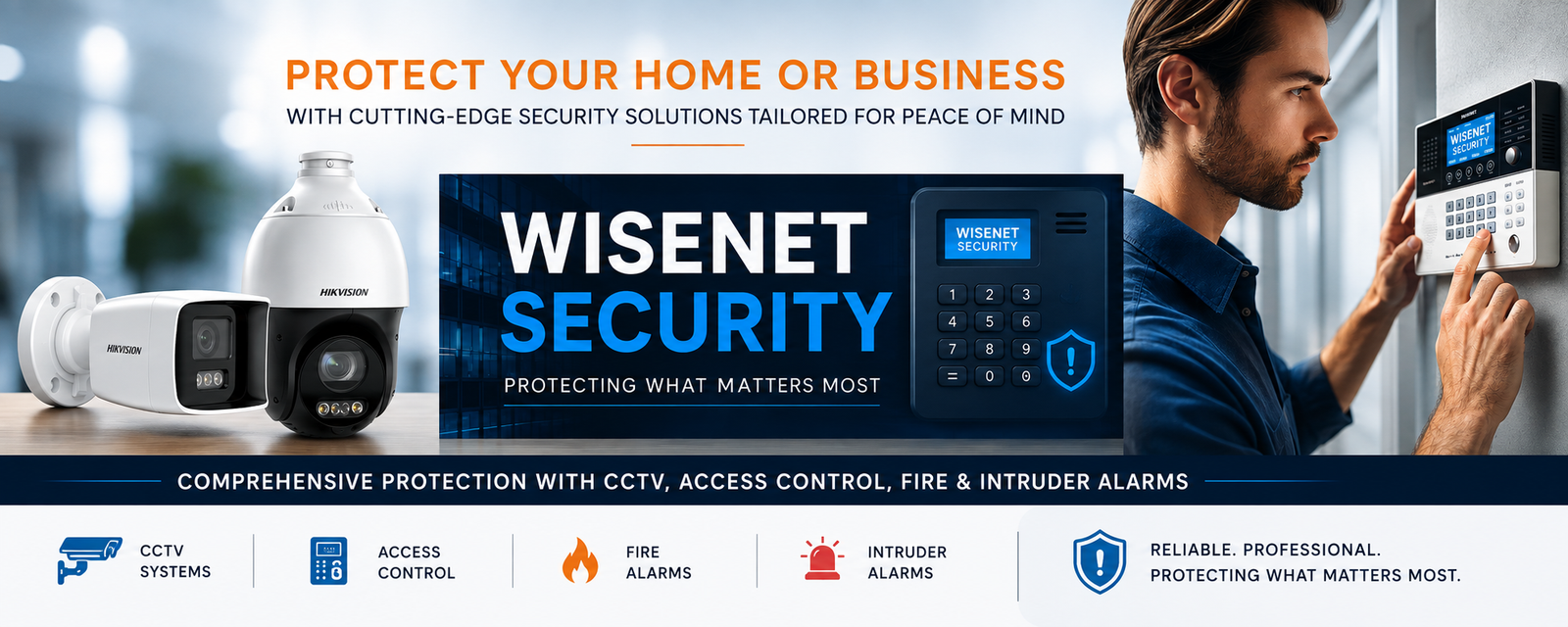
Wisenet Security Ltd designs, installs, and maintains CCTV, intruder alarms, access control, and fire alarm systems for homes and businesses across South Wales and the South West. If you want a straightforward consultation that focuses on the risks that matter, visit Wisenet Security Ltd and compare what they propose against your current setup.