Alarm System Maintenance: UK Guide 2026
You lock the door, set the alarm, and head off to work or away for the weekend. Then the thought creeps in halfway down the road. Did the system arm properly? Would it trigger if a door contact failed, a battery weakened, or a detector stopped seeing movement the way it should?
That uncertainty is exactly why alarm system maintenance matters. Alarms are typically thought about at installation time. Engineers think about what happens after installation, when dust builds up in detectors, standby batteries age, monitoring paths drift, and nobody writes down the small fault that later becomes the reason the system didn't perform when it was needed.
If you own a home, manage a shop, run a warehouse, or look after a multi-tenant building in South Wales or the South West, it helps to stop treating intruder alarms and fire alarms as two separate worlds. They have different rules, different risks, and different service needs, but the practical question is the same. Is the system working today, and could you prove it if an insurer, fire officer, or loss adjuster asked?
Table of Contents
- Why Your Alarm System Needs Regular Maintenance
- Understanding UK Alarm System Regulations and Standards
- Recommended Maintenance Frequencies For Your System
- Your Step-by-Step Guide to Basic User Checks
- When to Call a Qualified Engineer What Pros Look For
- The Value of Professional Service Agreements
- Your Actionable Alarm System Maintenance Checklist
Why Your Alarm System Needs Regular Maintenance
It is 2am. A shop front in Cardiff takes a hit, or a smoke detector in a Bristol HMO should be raising the alarm, and the system that looked fine all year does not respond as expected. That is the core maintenance problem. Alarm systems usually fail at the point you need proof, not at the point you happen to be looking at the keypad.
Regular maintenance closes that gap between “installed” and “dependable”. Intruder alarms, fire alarms, and the signalling paths connected to them all contain parts that age, collect dust, drift out of tolerance, lose battery capacity, or develop faults that only appear during a proper test. An alarm is a bit like a spare tyre. It can sit there for months looking ready, then let you down the first time it carries any load.
Property owners often split fire and intruder maintenance into two separate mental boxes. On site, that is rarely how risk behaves. The same building, the same staff, and the same missing records can undermine both systems. One contractor tests devices but leaves poor paperwork. Another changes a panel battery but no one updates the logbook. Months later, you have an accountability problem as much as a technical one.
That point matters across South Wales and the South West, where many homeowners, landlords, and small businesses inherit older systems with patchy service history. A professional maintainer does more than tighten terminals and trigger detectors. They create a clear trail of what was checked, what failed, what was replaced, and what still needs action. If you are unsure how intruder systems are assessed, this guide to EN 50131 alarm grading and system requirements gives useful background.
What maintenance protects you from
A good maintenance routine helps stop the failures owners often miss:
- Backup power loss: Batteries can weaken long before a panel shows an obvious warning.
- Detector contamination or drift: Smoke detectors, PIRs, contacts, and sounders all suffer from age, dust, wear, or environmental conditions.
- Signalling faults: A monitored system may arm locally but fail to pass a signal reliably because of path, communicator, or programming issues.
- User error and assumptions: Staff changes, forgotten codes, isolated zones, and ignored fault messages are common causes of poor performance.
- Documentation gaps: If there is no clear service record, it becomes much harder to prove the system was maintained, especially after an incident or insurer query.
The last point is the one many owners underestimate.
A working alarm is hardware plus evidence. For a homeowner, that means confidence that the system will respond properly. For a business, school, rental property, or office, it also means showing who serviced it, what was tested, and what was recommended. That is one reason professional standards and competent trade practice matter, as highlighted in the Growth 4 Trades licensing guide.
The practical benefit is simple. Regular maintenance reduces false alarms, catches wear before failure, keeps batteries and detectors within serviceable condition, and gives you records that stand up to scrutiny. If something goes wrong after a break-in, fault, or fire event, the question is rarely whether an alarm was fitted at some point. The question is whether it was looked after properly.
Understanding UK Alarm System Regulations and Standards
The first point that confuses people is this. Fire alarms and intruder alarms don't sit under the same framework, even though both are alarm systems and both need regular attention.
Fire alarms and intruder alarms are not governed the same way
For commercial fire alarms, the maintenance position is much firmer. Under the framework described in BS 5839 and the Regulatory Reform (Fire Safety) Order 2005, systems must be kept in efficient working order and in good repair, with structured servicing and record retention. Non-compliance can lead to unlimited fines for organisations and up to two years of imprisonment for individuals, as explained in this guide to UK fire alarm servicing and maintenance duties.
The same source also explains that records matter for years, not days. Monthly inspection reports need to be retained for at least 5 years in healthcare settings, annual maintenance certificates for the system's lifetime plus 6 years, and fault reports for at least 10 years. Even if your premises aren't a healthcare site, that gives you a strong benchmark for how seriously documented maintenance is treated.
Intruder alarms are different. For many premises, the service frequency isn't set by a single statute in the same way. Instead, compliance often sits around BS EN 50131, insurer requirements, police response conditions, and the practical needs of monitored systems. If you want a plain-English breakdown of that standard, this page on BS EN 50131 requirements for alarm systems is useful.
A lot of owners also mix up “standard” with “law”. They're not always the same thing, but standards often become the benchmark your insurer, monitoring provider, or auditor expects you to follow. That's why they carry real consequences in practice.
What competent person means in practice
A competent person isn't just someone with a screwdriver and confidence. In alarm work, it means someone who understands the system type, the relevant British Standard, the manufacturer's instructions, and the testing method needed to prove the system is still performing correctly.
For landlords, property managers, and small firms using outside contractors, it helps to think more broadly about competence and documentation. A trade business that wants to tighten up its compliance processes may also find a practical parallel in this Growth 4 Trades licensing guide, because it explains why formal credentials, records, and responsibility lines matter when work affects safety and liability.
Fire alarm maintenance is a legal and evidential issue, not just a technical one.
If you remember one distinction, make it this:
| System type | Main driver | Why records matter |
|---|---|---|
| Fire alarm | Legal duty and life safety obligations | You may need to prove the system was maintained in line with accepted standards |
| Intruder alarm | Insurance, monitoring, and security performance | You may need to prove continuity of service and competent maintenance |
That difference catches people out. They service one system carefully, then let the other drift because nobody has explained where responsibility sits.
Recommended Maintenance Frequencies For Your System
Owners often ask for one universal service interval. In reality, the right timetable depends on system type, whether it's monitored, and what the site risk looks like.
A simple way to think about the timetable
For fire alarms, the benchmark most businesses recognise is regular user checks plus periodic professional inspections. Under BS 5839-1, commercial fire alarm systems should have a professional inspection every six months, alongside weekly user checks that include testing a different manual call point and checking the fire alarm control panel for faults, as outlined in this guide to commercial fire alarm legal responsibilities.
For commercial intruder alarms, annual servicing is the minimum many people think of. But if the system is connected to an Alarm Receiving Centre or police-approved monitoring, it generally needs servicing every six months to stay aligned with BS EN 50131 expectations, according to Clearway's guide to alarm servicing intervals.
Why those intervals matter technically
Those schedules aren't arbitrary. They exist because alarm components age in predictable ways.
Clearway notes that battery degradation, sensor drift, and firmware outdatedness can build up within 6 to 9 months, which is why the six-month engineer visit matters for monitored intruder systems. The same source says this maintenance rhythm can reduce false alarm rates by up to 40% and extend system lifespan by 3 to 5 years.
For fire systems, standby power also matters. The Quartz Empire guide states that standby batteries can lose 20 to 30% capacity within 6 months, which is why battery checks are taken seriously in life-safety systems.
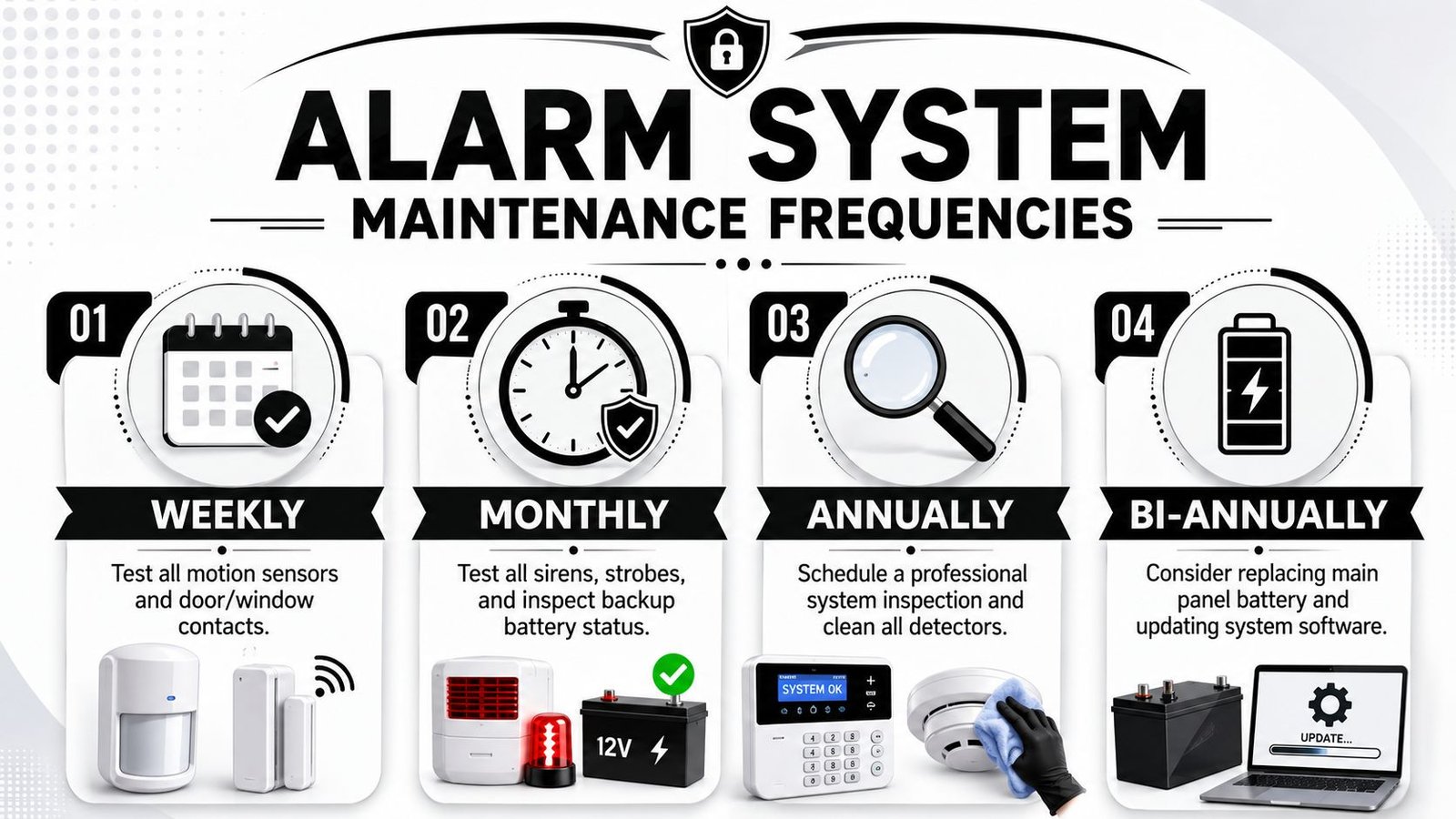
Here's the practical version most owners can follow:
- Weekly: For fire alarm users, carry out the routine user test and confirm the panel shows no fault.
- Monthly: Check visible devices, warning lights, power indicators, and your logbook entries.
- Every six months: Book a professional service for commercial fire alarms and for monitored intruder alarms.
- Annually: Arrange a deeper review of the whole system, especially on mixed sites with fire, CCTV, access control, and intrusion working together.
If you want a more detailed explanation of testing rhythm on the fire side, this guide on how often fire alarms should be tested gives a useful overview.
The easiest schedule to maintain is the one already written into your diary, your service plan, and your site logbook.
Your Step-by-Step Guide to Basic User Checks
You don't need to be an engineer to spot early warning signs. In fact, the best maintained systems usually have engaged users who notice small issues between service visits.
Checks you can do without tools
Start with the control panel. Look for any fault light, tamper indication, low battery warning, loss of mains, or communication alert. If the display is showing a message you don't understand, write it down exactly as it appears instead of guessing.
Then walk the site.
Check detectors and contacts visually
Look at PIRs, magnetic door contacts, break glass units, sounders, and external boxes. If something is loose, cracked, blocked, painted over, dusty, or hanging by a cable, it needs attention.Run a simple functional test
On an intruder system, put the panel into test mode if your instructions allow it, then trigger a sensor one at a time. Open the protected door. Walk across the PIR's field of view. Confirm the panel registers the zone you expected.Verify alerts go where they should
If your system sends notifications to an app or monitoring service, confirm the signal arrives. A siren that sounds locally is only part of the picture on a monitored setup.Listen for weak sounders
A bell, siren, or internal sounder that seems unusually quiet can point to a power issue, a failing component, or damage.
If you're also managing other life-safety devices in the building, it helps to understand adjacent fault-finding too. For example, false activations on CO devices confuse many owners, and this guide to carbon monoxide alarm troubleshooting gives a straightforward explanation of common causes and what to check.
What to record after each check
Many sites fail to document their actions properly. They test something, find no issue, and record nothing. Later, they can't prove the check happened.
Keep a simple log with:
- Date and time: When the check took place.
- Area or device tested: Front door contact, warehouse PIR, panel battery indicator, rear exit sounder.
- Result: Pass, fault observed, engineer required.
- Action taken: Cleaned detector face, notified monitoring centre, booked service.
A check that isn't written down is very hard to rely on later.
For a homeowner, that record can be a notebook or digital file. For a business, it should sit with your wider health and safety or facilities records. It doesn't need to be fancy. It needs to be consistent.
When to Call a Qualified Engineer What Pros Look For
There's a clear line between sensible user checks and work that should be left to a qualified engineer. The trick is knowing where that line is before a small fault turns into a recurring one.
Faults that should not wait
Call a professional if any of these happen:
- Recurring false alarms: One false activation may be accidental. Repeated activations usually point to a device, power, environmental, or programming issue.
- A fault message that won't clear: If the panel keeps showing the same error after basic checks, it needs diagnosis.
- Physical damage: Cracked detectors, water ingress, damaged bell boxes, cut cables, or signs of tampering all need expert inspection.
- Problems after a power outage: Some systems recover cleanly. Others come back with battery, communication, or configuration faults.
- Changes to the building: New partitions, stock racking, roller shutters, heat sources, or office layout changes can all affect detector coverage.
A common mistake is resetting the panel repeatedly and assuming the problem has gone away. If the fault returns, the system is telling you something useful. It needs investigation, not just silence.
What a proper maintenance visit includes
A professional visit should go well beyond wiping a detector and pressing a test button. On a thorough service, an engineer will usually review the panel history, inspect devices, confirm signalling paths, check standby power condition, clean contamination from equipment where appropriate, and verify that detection and notification are still suitable for the space as it exists now.
On intruder systems, that may include checking door contacts, shock sensors, PIR positioning, bell operation, user codes, and communication to the receiving centre. On fire systems, it may include detector tests, call point checks, panel functions, battery condition, and confirmation that fault indications and alarms display correctly.
A good engineer also looks for the things users don't spot easily:
| Issue | What the user sees | What the engineer checks |
|---|---|---|
| False alarms | Random activations | Device condition, siting, sensitivity, logs, environment |
| Low battery faults | Warning on panel | Voltage under load, charger performance, age of battery |
| Missed signals | App alert not received | Path integrity, communicator status, signalling setup |
| Poor coverage | “It should still catch someone” | Detector angle, blind spots, room changes, masking |
The final piece is documentation. A proper visit should leave a service record, notes on faults found, action taken, and any recommendations. Without that, you've had activity, but not much evidence.
The Value of Professional Service Agreements
Monday morning, you open up and find a fault light still showing on the fire panel. At the same time, your intruder alarm app logged a warning over the weekend, but nobody wrote down who saw it, what it meant, or whether anyone acted on it. The systems may still be operating, but you already have a problem. No clear trail, no clear ownership, and no easy way to prove the site has been looked after properly.
Why paperwork matters as much as the hardware
A professional service agreement gives you more than booked visits. It creates a reliable record. For homeowners, that means less guesswork if recurring faults keep appearing. For small businesses, it means you can show who attended, what was tested, what defects were found, and what still needs action.
That matters most after a problem.
If an insurer, landlord, facilities manager, or enforcing authority asks for evidence, "we thought it was serviced" is not enough. A proper agreement turns maintenance into a dated chain of records. Engineer visits, findings, recommendations, remedial work, and outstanding faults all sit in one place instead of across emails, diary notes, and someone's memory.
This is why a professional service agreement matters.
Property owners often split fire alarms and intruder alarms into separate boxes in their mind. In practice, both systems need the same discipline. Planned attendance, competent inspection, clear records, and someone accountable for closing faults. If one system is maintained well and the other is not, you still carry risk.
Mixed premises bring another layer. A shop, office, school annex, HMO, or warehouse may have fire detection, intruder detection, CCTV, and access control all looked after by different firms. That can leave gaps in dates, standards, and paperwork. Using one professional provider, or at least one agreement structure that keeps records aligned, gives you a complete view of site security and life safety, especially across South Wales and the South West where many owners manage several small sites rather than one large building.
What a service agreement should give you
Useful agreements are practical, not padded with promises. They should set out what will happen, when it will happen, and what evidence you will receive afterwards.
Look for points like these:
- Planned service dates: Visits are scheduled in advance, so checks do not depend on memory or staff turnover.
- Clear service records: You receive written notes on tests carried out, faults found, actions taken, and items that still need repair.
- Defined responsibilities: The provider handles servicing and reporting. The user knows what daily, weekly, or monthly checks still sit with the site.
- Fault response arrangements: If a panel shows a fault or a signalling path drops out, you know who to call and what response to expect.
- Joined-up system oversight: Fire and intruder maintenance records are easier to track together, which helps close the common accountability gap.
- Better support for claims and audits: If someone asks for evidence, you are not rebuilding the story from scraps.
The same principle applies to other security systems. If you also rely on cameras, regular CCTV system maintenance support helps keep recording, playback, and fault reporting properly documented as well.
This short video gives a helpful visual sense of how professional security system support fits into wider site protection.
For owners in Cardiff, Newport, Swansea, Bristol, and nearby areas, the benefit is straightforward. Systems are less likely to drift into a "mostly working" condition because someone independent is expected to inspect, record, and report on a set schedule.
If you want your own internal checks to match that standard, a simple record sheet helps. Jolt Electric's free electrical template is not alarm-specific, but it is a useful format for keeping dated maintenance notes in one place between engineer visits.
Your Actionable Alarm System Maintenance Checklist
If you want one page to work from, keep it simple and repeatable. The best checklist is the one you'll use.
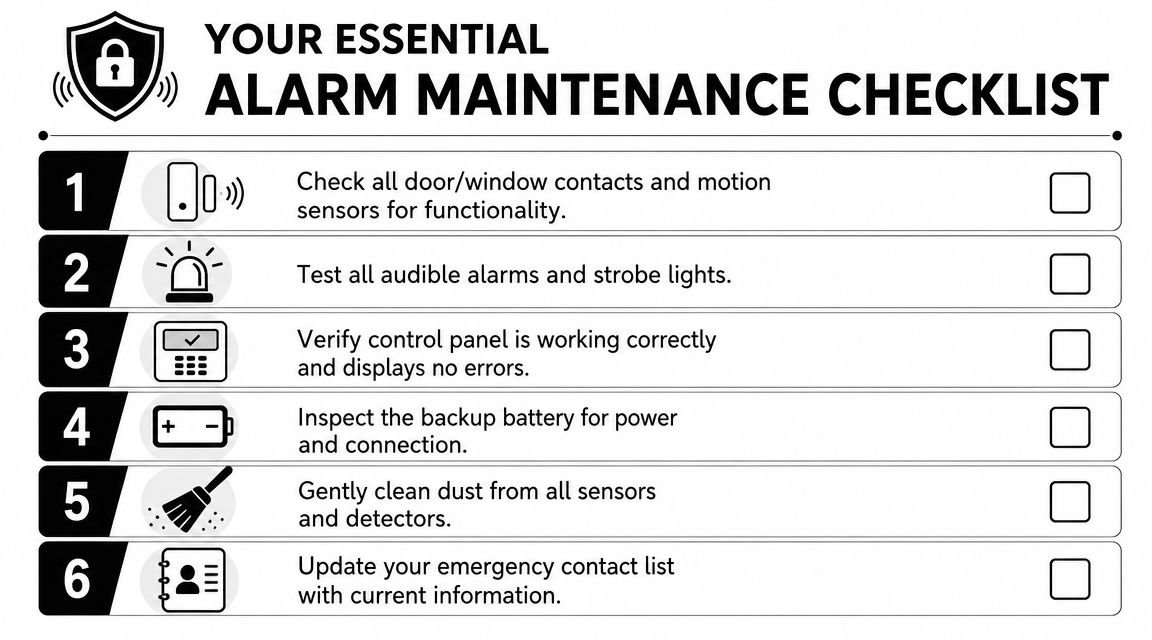
Weekly and monthly user routine
- Weekly fire alarm check: Test the scheduled call point or follow your site routine. Confirm the panel returns to normal.
- Panel glance check: Look for faults, tampers, low battery warnings, or power issues.
- Walk vulnerable areas: Check detectors, contacts, call points, sounders, and external boxes for dirt, obstruction, or damage.
- Monthly notification check: Confirm monitored alerts, mobile notifications, or internal reporting still reach the right person.
- Keep the log updated: Record the date, result, and any action taken.
A printable maintenance format can help if you want to formalise your routine. This Jolt Electric preventive maintenance schedule template is aimed at electrical upkeep, but the layout is useful for building a clear alarm checking record too.
Professional servicing and provider changes
- Book six-month servicing where required: This is especially important for monitored intruder alarms and commercial fire alarms.
- Arrange annual review: Use it to check the system still suits the building as used today.
- Fix repeat faults properly: Don't rely on resets as a maintenance strategy.
- Store all records together: Service sheets, certificates, fault notes, and user log entries should be easy to find.
- Review linked systems: If your site also relies on cameras, include CCTV maintenance planning in the same review cycle so nothing falls between contractors.
A question I hear often is whether you can switch alarm maintenance providers without causing insurance trouble. In principle, BS EN 50131 allows provider switching if the new company is a competent person, but insurers often want continuous service records, so the handover needs to be documented carefully. That means service history, open faults, monitoring details, and responsibility transfer should all be recorded cleanly.
If you change provider, don't just change phone numbers. Transfer the maintenance history as well.
The aim isn't perfection. It's control. If you know your alarm status, your test rhythm, and where your records are, you're in a far stronger position than the owner who only thinks about the system after it fails.
If you want help putting a clear maintenance plan in place for your home, shop, warehouse, or multi-site property, Wisenet Security Ltd provides local support across South Wales and the South West for intruder alarms, fire alarms, CCTV, and integrated security systems. Their DBS-checked engineers, SafeContractor accreditation, and long experience in maintenance and compliance make them a practical choice when you want reliable servicing and proper documentation, not guesswork.