CCTV and Security Systems: Your 2026 Guide
You might be reading this after a poor night's sleep because a van was checked on the drive, a side gate was found open, or a shop alarm went off and nobody could tell whether it was a real break-in or another false trigger. In South Wales and the South West, that sort of uncertainty is what prompts many individuals to start looking seriously at CCTV and security systems. Not because they want gadgets, but because they want clarity. They want to know what happened, who was there, and whether the property is protected when they're not on site.
I see the same pattern with homeowners in Swansea and Bristol, landlords managing shared buildings, and business owners around Cardiff and Newport. They don't usually begin with a neat specification. They begin with a concern. A rear lane that feels exposed. Staff locking up alone. Deliveries left in plain view. A warehouse yard that's too dark in the wrong places. The practical question isn't “Which camera is best?” It's “What actually works for this property, and how do all the parts fit together?”
That concern is widely shared. In 2024, the UK information security products and services market was forecast to exceed £16.5 billion, up 37.5% since 2021, and over 60% of UK homes were reported to have at least one security camera, up from below 45% in 2020, according to Statista's UK security and surveillance market overview. That tells you something important. Security systems are no longer a niche purchase. They've become part of normal property management for homes and businesses alike.
Table of Contents
- Protecting Your Property in an Uncertain World
- Beyond the Camera Understanding Integrated Security
- Choosing Your System Core Components
- Custom Security Solutions for Your Property
- Navigating UK Security Rules and Regulations
- Professional Installation and System Maintenance
- Making a Smart Investment in Your Security
Protecting Your Property in an Uncertain World
A family in a Swansea semi usually notices the issue in the evening. The side path is dark, the parcel has gone missing once already, and the back door can't be seen from the street. A business owner in Bristol faces a different version of the same problem. Staff leave at closing time, shutters come down, but the blind spot by the service entrance still bothers them. In both cases, the pressure comes from uncertainty rather than a single dramatic event.
Why the concern is justified
Security has become a normal part of property planning across the UK. The market growth mentioned earlier shows that households and businesses are acting on the same concern, not overreacting to it. People want systems that prevent problems where possible and give reliable evidence when something does happen.
That shift matters in practical terms. It means a good system today isn't just a recorder bolted to the wall. It's expected to support remote viewing, sensible alerts, and day-to-day confidence that doors, entrances, stock areas, driveways, and shared spaces are covered properly.
Practical rule: The right system should reduce uncertainty. If it leaves you checking clips manually, guessing why an alert fired, or wondering whether anyone could identify a face or vehicle, it hasn't solved the real problem.
What people usually want from a system
Most clients don't ask for technology first. They ask for outcomes:
- Clear evidence: If there's an incident, they want footage that's usable.
- Fewer false alarms: Nobody wants repeated late-night call-outs for wind, headlights, or wildlife.
- Simple control: Opening the app, checking a live view, or arming a system should feel straightforward.
- Coverage that fits the site: A terraced house, a retail unit, and a warehouse yard all need different thinking.
A common mistake is treating security as a single purchase instead of a joined-up design decision. One camera over the front door might be useful. It won't tell you who opened a side gate, whether a rear fire exit was used after hours, or which member of staff entered a restricted area.
That's why serious planning always comes back to the same question. Are you buying a camera, or are you building protection?
Beyond the Camera Understanding Integrated Security
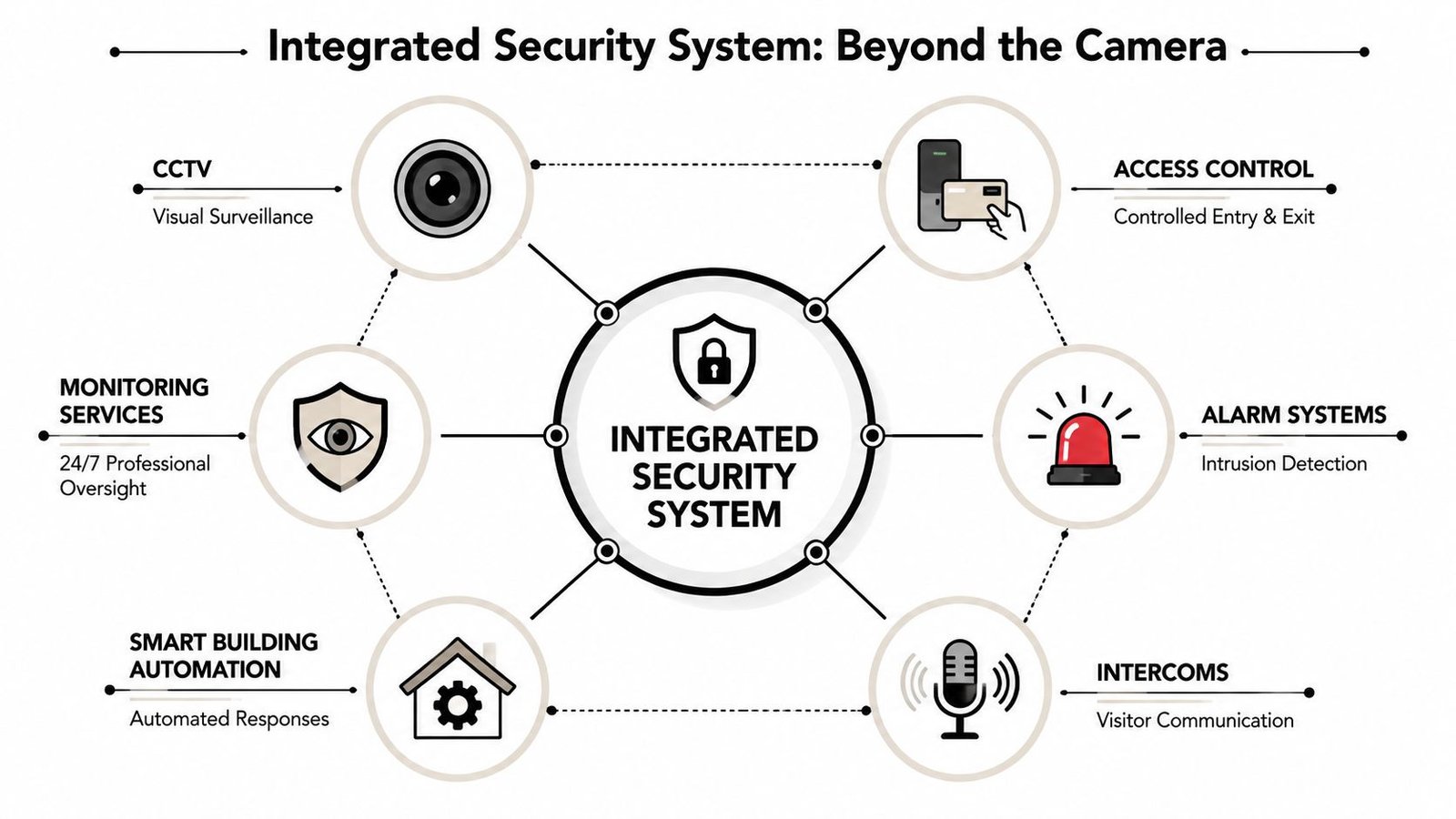
A standalone camera is like putting one lookout on a castle wall and expecting that to protect the whole site. Real security works in layers. The gate controls who gets in. The sentries raise the alarm when something's wrong. The watchtower records what happened. Modern CCTV and security systems follow that same logic.
Why standalone cameras fall short
A single camera can show movement. It often can't tell you enough on its own. If someone enters a building after hours, video is far more useful when it's tied to a door event, an alarm zone, or an intercom call. That's the difference between footage and context.
This is where integrated design changes the result. A door reader can confirm who presented a fob. An intruder alarm can flag unauthorised movement in an armed area. CCTV can show exactly what happened before and after that event. Intercoms add another layer by allowing staff or residents to verify visitors before granting access.
For vehicle security, the same principle applies. A camera helps, but layered protection matters more. If you're also thinking about protecting vans or cars on site, this guide to Top car alarm systems is useful because it shows how deterrence, detection, and immobilisation work better together than any single device alone.
How the layers work together
When security systems are planned as one setup, each part supports the others:
- CCTV records and verifies: It gives visual confirmation and evidential footage.
- Access control governs movement: It decides who can enter, where, and when.
- Intruder alarms trigger fast alerts: They react when protected areas are breached.
- Intercoms manage visitors: They reduce the need to open doors without visual confirmation.
- Automation improves response: Gates, lights, locks, and notifications can act together.
- Monitoring adds oversight: Someone is accountable for reviewing events and escalating when needed.
A system is strongest when one event creates several useful actions. A door opens, the linked camera records, the user is logged, and the right person gets notified.
For a small office, that might mean a staff fob opens the front door during working hours, while after-hours entry generates a linked camera clip and a manager alert. For a block-managed building, it could mean residents use an intercom and access credentials, while communal areas remain covered by CCTV and alarm protection.
An integrated setup also scales better. If you start with cameras and later add door entry, monitored alarms, or gate automation, the design should support that from the beginning. That's the reason many clients look for integrated security solutions instead of assembling disconnected products over time.
Choosing Your System Core Components
Most properties need a combination of three core elements: CCTV, intruder alarms, and access control. They don't do the same job, and problems start when people expect one system to cover everything.
CCTV for visibility and evidence
CCTV's role is to show what happened. In modern UK installations, the most effective setups use IP cameras connected to an NVR and PoE infrastructure, which carry power and data over a single cable, simplify expansion, and support features such as people and vehicle classification that lower false alarms compared with basic motion detection, as outlined in this guide to modern CCTV system architecture.
In plain terms, that means cleaner cabling, easier upgrades, and smarter alerting. It also means the system is far easier to manage properly than a mix of consumer cameras and separate power supplies.
Intruder alarms for immediate response
An intruder alarm doesn't care what a person looks like. Its job is to react when a protected door opens, a detector triggers, or a perimeter is breached while the system is set. That makes it the fastest way to signal a problem.
For homes, that often means door contacts, hallway coverage, and pet-tolerant sensors where needed. For business premises, it can include separate areas with different arming schedules, so staff can work in one part of the building while stock rooms or upper floors remain protected.
On site, the simplest test is this: if someone tried to get in tonight, which part of the system would detect them first?
Access control for managing movement
Access control is less dramatic than CCTV or alarms, but on many commercial sites it solves the most expensive day-to-day problem. It replaces uncertainty about keys, shared codes, and who entered which area. Card readers, fobs, keypads, and biometric options all serve the same purpose. They make entry manageable and auditable.
This matters in offices, warehouses, schools, medical settings, and multi-tenant buildings. It also matters in smaller shops with stock rooms, rear doors, or staff-only zones.
Security system components at a glance
| System Type | Primary Function | Best For |
|---|---|---|
| CCTV | Visual surveillance and evidence | Entrances, car parks, yards, till areas, communal spaces |
| Intruder Alarm | Detecting unauthorised entry or movement | Homes, shops, offices, out-of-hours protection |
| Access Control | Managing and recording entry permissions | Staff doors, shared buildings, restricted rooms, gates |
A good design uses each component for what it does best. CCTV verifies. Alarms react. Access control manages movement. Trying to make one pillar carry the whole job usually leads to weak coverage, unnecessary cost, or both.
Custom Security Solutions for Your Property
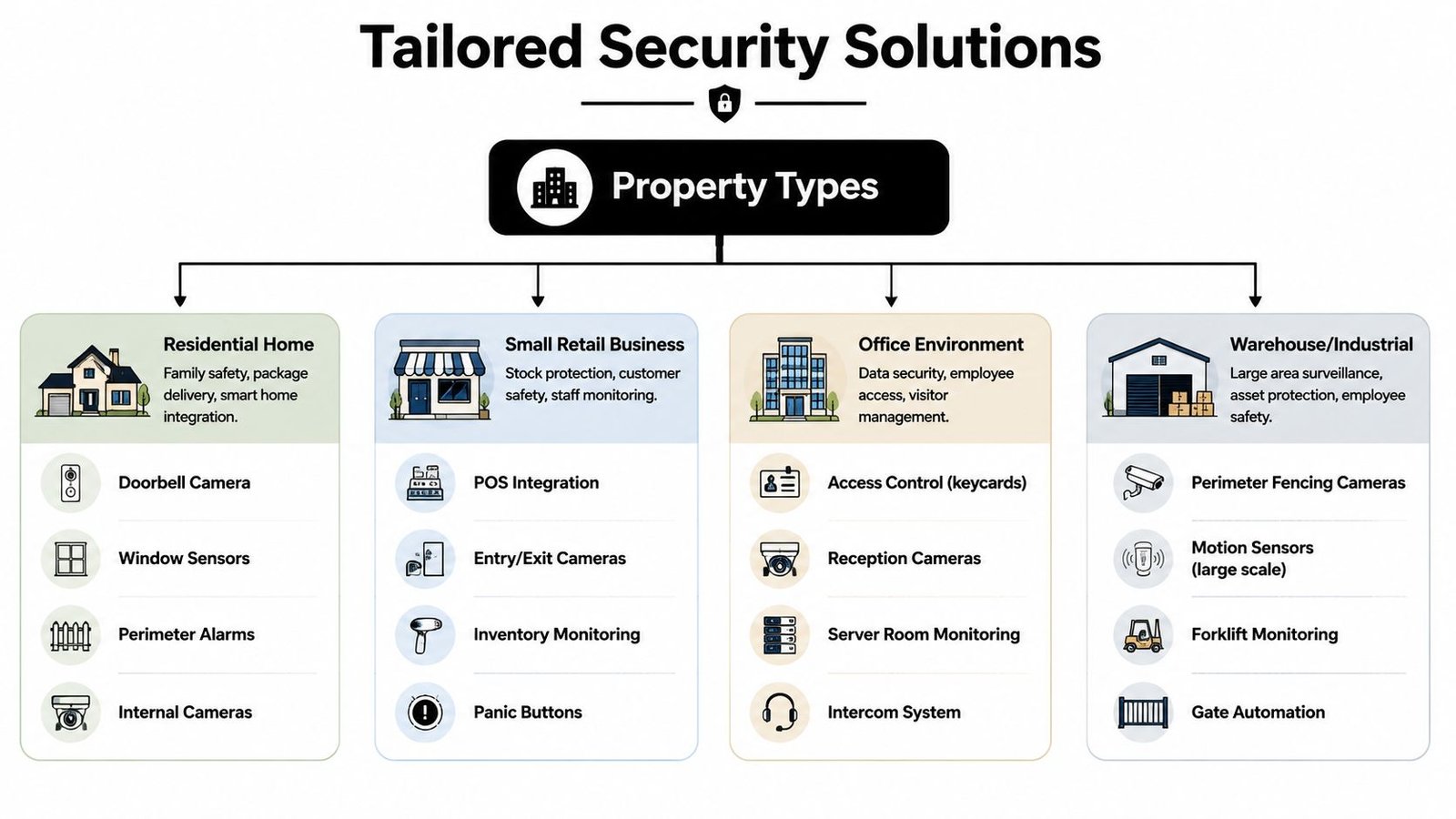
No serious installer should offer the same package to a detached house in Newport, a corner shop in Cardiff, and an industrial unit outside Bristol. The layout, risks, and daily routine are different. The best CCTV and security systems reflect that.
Here's a useful overview of how requirements change by property type.
What suits a home or small premises
A home usually needs coverage of approach routes rather than every square metre. Front entrance, driveway, side access, rear doors, and any detached garage are the usual priorities. Many homeowners also want app access, doorbell visibility, and discreet camera positions that don't make the property look commercial.
For a small retail business, the brief changes quickly. Now you need till coverage, entry and exit views, stock protection, and often a panic response arrangement for staff. Internal cameras matter more, and so does event clarity around incidents involving customers, deliveries, or cash handling.
For both settings, image detail matters more than raw camera count. UK guidance consistently points to 1080p, 4MP, and 4K as the key tiers for deciding whether you're looking at general monitoring or footage suitable for identifying faces or number plates, as explained in this CCTV image detail guide.
A short video can help visualise how those choices affect real sites.
What larger and shared sites need
Warehouses and industrial sites demand a different standard. Long distances, loading areas, gates, pallet zones, and external yards all put pressure on camera selection and placement. If the requirement includes vehicle evidence at an entrance, a general-purpose overview camera won't be enough. You need the right lens, the right height, and enough image detail at the target point.
Multi-tenant car parks and managed buildings bring another challenge. The goal isn't just seeing activity. It's linking events to entrances, barriers, intercom calls, and user movement. In those environments, integrated systems earn their keep because they reduce disputes and shorten investigations.
Typical choices by property type often look like this:
- Residential home: Doorbell camera, external IP cameras, perimeter lighting, intruder alarm, mobile alerts.
- Small retail unit: Entry cameras, till view, stock room alarm protection, staff panic provision, controlled rear access.
- Warehouse: Perimeter coverage, gate or yard cameras, access-controlled staff entrances, alarm partitioning, monitored zones.
- Multi-tenant car park: ANPR-style thinking where appropriate, barrier or gate control, intercoms, communal CCTV, clear audit trail for access.
One provider that handles this broader mix is Wisenet Security Ltd, which installs integrated CCTV, intruder alarms, access control, intercoms, fire systems, and gate automation for sites across South Wales and the South West. That sort of multi-system capability matters because property protection is usually weakest at the points where separate systems don't talk to each other.
Navigating UK Security Rules and Regulations
A security system only helps if it's lawful, insurable, and maintained properly. In the UK, the rules aren't there to make life difficult. They're there to make sure the system is fair to others, reliable in use, and defensible if something goes wrong.
CCTV and data protection duties
For homes, the legal picture is often simpler, but not always. If your cameras only cover your own land, the compliance burden is lighter. If they capture a public footpath, neighbour's boundary, shared access road, or communal entrance, data protection duties can come into play.
For businesses, landlords, and managing agents, CCTV should be treated as a data protection issue from day one. That means having a clear reason for using it, placing cameras proportionately, storing footage securely, controlling who can access recordings, and keeping signage clear and visible. Staff areas need particular care. Break rooms, welfare spaces, and private areas should be approached cautiously.
If you run a business or manage a site with shared access, this guide on CCTV and GDPR in the UK gives a useful practical breakdown of what those duties look like.
If you can't explain why each camera is there, who can view the footage, and how long recordings are kept, the system needs tightening up.
Alarm and fire compliance in practice
Intruder alarm compliance matters for a different reason. In the UK, systems are often expected to meet BS EN 50131 where insurance conditions or response expectations apply. For a property owner, that standard matters because it affects confidence in the equipment, installation method, and ongoing service.
Fire safety has its own obligations. If your premises require a fire alarm, the key issue isn't just having sounders on the wall. The category of system, detector placement, call points, maintenance routine, and integration with emergency lighting or remote signalling all have to suit the building and its use.
A few practical rules help keep things clear:
- Use the system for a defined purpose: Don't install cameras or detectors without a documented reason.
- Keep records: Maintenance visits, user permissions, and any policy around footage access should be written down.
- Train the people who use it: Many compliance failures come from poor handover, not bad hardware.
- Review changes to the site: A new partition wall, tenant, gate, or workflow can alter what's compliant and what isn't.
Professional Installation and System Maintenance
A good installation should feel organised from the first visit. Not rushed, not vague, and not built around a stock package that ignores how the property functions.
What a proper installation process looks like
The process usually starts with a site survey. That's where the real design decisions are made. Camera positions, cable routes, lighting conditions, entry points, network requirements, alarm setting routines, and user permissions all need to be looked at in person.
After that, the design should be translated into a system that suits the building and the people using it. In practice, that means asking sensible questions. Who opens up first? Who locks up last? Are deliveries expected before staff arrive? Is there a shared rear access? Does a landlord need one level of control and tenants another?
A tidy installation matters more than many buyers expect. Reliable terminations, protected cabling, sensible recorder placement, labelled equipment, and neat containment all make future service easier. So does proper handover. If the system is fitted but nobody knows how to retrieve footage, add a user, or set the alarm correctly, the job isn't finished.
Why maintenance matters after handover
Security systems don't usually fail all at once. A camera drifts out of focus. A hard drive develops faults. A detector starts to false trigger. An app setting gets changed. A door closer stops pulling shut properly and access control events become unreliable.
That's why maintenance is part of the system, not an optional extra. Routine servicing helps catch small faults before they turn into blind spots or false confidence. It also keeps firmware, storage, logs, and battery-backed devices in proper order.
A useful maintenance arrangement typically includes:
- Health checks: Cameras, recorders, detectors, readers, and power supplies are tested methodically.
- Software and firmware attention: Systems are kept stable and secure rather than left untouched for years.
- Priority fault response: Problems are dealt with promptly, especially on business-critical sites.
- User support: Staff changes, access updates, and retrieval questions can be handled without guesswork.
For properties where reliability matters, a structured CCTV system maintenance plan is often the difference between a system that operates reliably and one that only gets attention after an incident.
A security system should be treated like any other important building service. If it protects people, access, or evidence, it needs planned care.
Making a Smart Investment in Your Security
Cheap quotes attract attention because security can look simple on paper. A camera is a camera. An alarm is an alarm. Until the first incident exposes what was missed.
Why the cheapest quote often costs more later
The UK market is busy. By 2026, the UK video surveillance industry is projected to reach £14.5 billion, with over 16,500 active businesses, according to IBISWorld's industry outlook. That level of choice is useful, but it also means buyers need to separate competent system design from low-entry, box-shifting sales.
The cheapest quote often cuts cost in places that don't show up until later. Poor camera positions. Weak night performance. No thought given to access events. Consumer-grade hardware where commercial equipment was needed. No maintenance route. Limited support after handover.
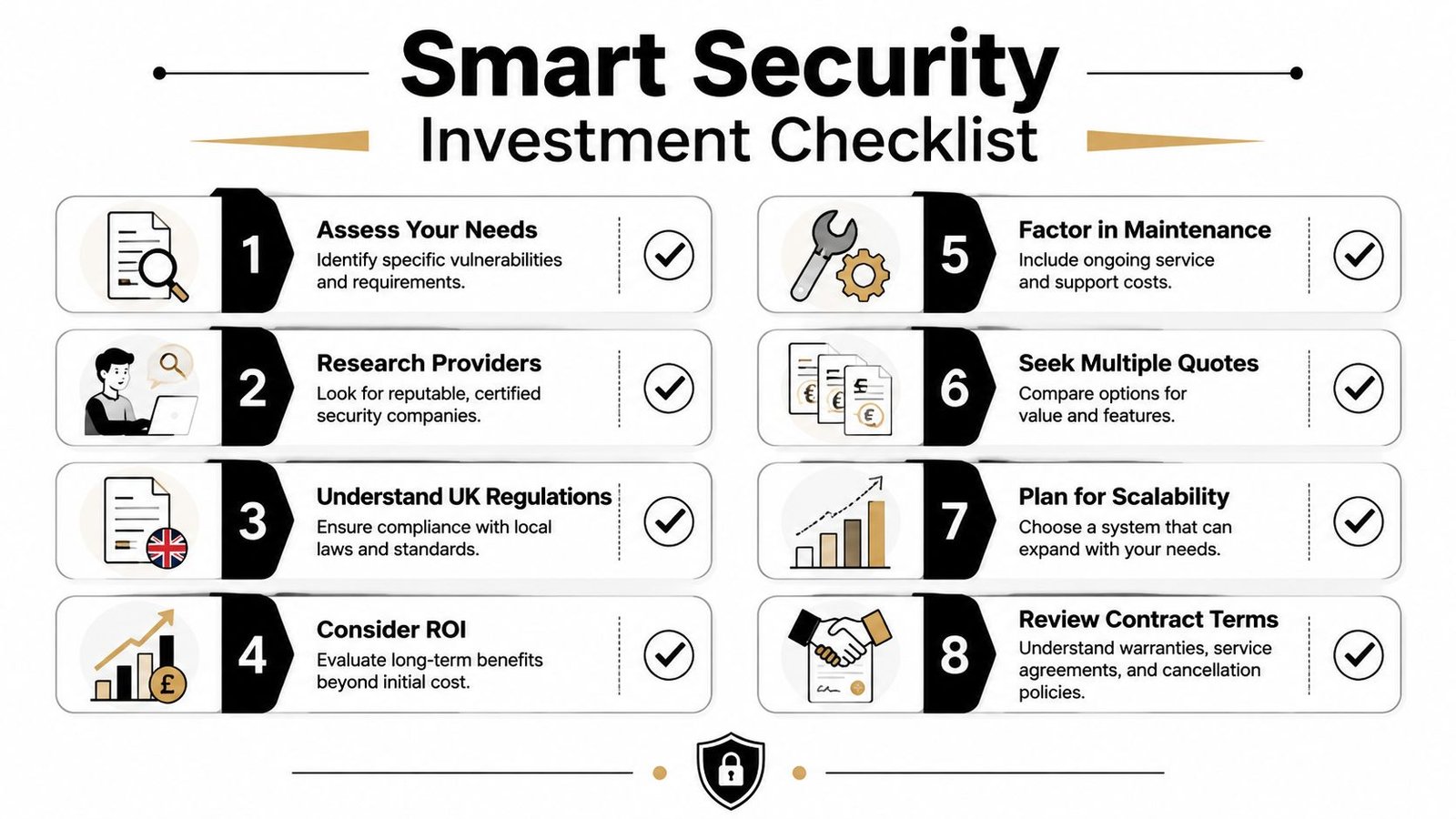
A better way to judge value is to ask whether the system will still suit you when the property changes. Can it expand? Can footage be retrieved easily? Can permissions be updated without replacing half the setup? Can an alarm, door system, or gate be integrated later?
Questions worth asking before you appoint anyone
Before you choose an installer, ask questions that reveal how they work:
- What standards do you install to? Alarm compliance, documentation, and maintenance arrangements should be clear.
- Who will design the layout? A proper survey matters more than a quick remote estimate.
- What brands are being specified and why? Hikvision, Paxton, Pyronix, and Fike all have different roles depending on the job.
- How will the systems integrate? Cameras, alarms, access control, intercoms, and gates shouldn't be planned in isolation.
- What support exists after installation? Fault response, maintenance visits, and user changes need a clear path.
- Are the engineers vetted and insured? That matters in occupied homes, schools, businesses, and managed sites.
- What happens if the property grows? Expansion should be possible without starting again.
The right choice usually isn't the lowest figure or the most features on a sales sheet. It's the installer who can explain, in plain English, what the system will do on your property, what it won't do, and how it will be supported over time.
If you want a practical conversation about CCTV and security systems for a home, shop, warehouse, shared building, or car park, Wisenet Security Ltd offers consultations across South Wales and the South West. A proper survey can clarify the risks on your site, the legal points you need to consider, and which integrated measures make sense before you spend money on the wrong setup.