Warehouse Security Camera Systems: A Complete 2026 Guide
A lot of warehouse managers start looking at cameras after something awkward rather than dramatic. A pallet goes missing. A delivery arrives short. A member of staff reports a near miss in the yard, but nobody can say exactly what happened because the only footage is grainy, badly positioned, or overwritten. By the time someone tries to investigate, the useful evidence is gone.
That's why warehouse security camera systems need to be treated as part of operations, not just as a box-ticking security measure. A good system helps with theft deterrence, incident review, vehicle disputes, staff safety, access control verification, and the small daily questions that chew up management time. It also has to fit the physical building. Ceiling height, aisle layout, loading activity, external lighting, network capacity, and retention expectations all shape what works.
In practice, cameras work best when they sit alongside physical measures. If you're tightening up internal compartments, staff-only areas, or self-storage style partitions, this storage locker doors guide is useful context because visibility and physical separation work together. The camera catches the event. The door and access arrangement help prevent it in the first place. For a broader view of operational advantages, Wisenet's own overview of the benefits of CCTV surveillance is also a sensible starting point.
Table of Contents
- Why Your Warehouse Needs a Modern Security Camera System
- Planning Your Warehouse Coverage Strategy
- Choosing the Right Cameras and Specifications
- Using VMS and Analytics to Get More from Your System
- Managing Storage and Ensuring Legal Compliance
- Integration Maintenance and Future-Proofing Your Investment
- A Supplier Checklist for South Wales and the South West
Why Your Warehouse Needs a Modern Security Camera System
At 06:15, the first wagon is backing onto a bay, agency staff are coming through a side entrance, and the yard is still fighting low light and headlight glare. If a pallet turns up short at 10:00 or a driver disputes damage at 14:00, the answer depends on whether the camera system captured the handover clearly enough to stand up to scrutiny.
That defines the need for a modern system. Warehouses need cameras that support day-to-day operations, incident review, and evidence gathering under real working conditions, not just footage that proves someone passed through a doorway. Managers need quick answers to practical questions. Which vehicle used bay three? Who opened the gate out of hours? Was shrink-wrap already torn before unloading? Did a contractor enter a restricted area? A useful system answers those questions without guesswork.
In most sites I survey, the problem is not a total lack of cameras. It is that the existing system was installed as a deterrent years ago and never updated for how the warehouse now runs.
What changed from old CCTV
Older CCTV systems often recorded continuously with limited image quality, weak low-light performance, and slow search tools. They helped after an incident, but only if the footage was clear enough and someone had time to dig for it. In a busy warehouse, that usually means delays, arguments, and no firm conclusion.
Modern systems do more than record. They support investigations, help supervisors verify events, and give managers a better record of what happened at loading points, access routes, and disputed stock movements. The practical benefits of CCTV in business settings are wider than loss prevention alone, especially where goods, vehicles, visitors, and shift-based staff overlap. Wisenet covers that in its guide to the benefits of CCTV surveillance.
The standard is higher now. Footage needs to be usable.
What “usable” means in a warehouse
A camera over a yard entrance may only need to show approach and direction of travel. A camera at goods-in is different. There, you may need to see pallet condition, driver actions, forklift contact, and timestamped handover activity. Those are not the same job, and they should not be treated as one.
That is where old systems often fail. They give broad coverage but poor detail at decision points.
A warehouse camera system earns its keep when it helps with:
- Disputed deliveries and returns. Clear footage shortens arguments over damage, shortages, and timing.
- Internal theft and stock loss. Missing goods are easier to investigate when movement routes and handover points are visible.
- Health and safety review. Near misses at crossings, loading bays, and pedestrian routes are easier to examine properly.
- Access control checks. Side doors, contractor entrances, and out-of-hours movement need a visual record, not just an access log.
- Insurance and claims. Better footage improves the chances of resolving an issue quickly and with less ambiguity.
One missed camera can undo the rest of the system. I see this regularly at side gates, caged storage areas, temporary overflow space, and older outbuildings that were added to the operation later.
Why local warehouse conditions matter
Generic advice misses regional reality. Warehouses in South Wales and the South West often deal with exposed yards, driving rain, coastal air in some locations, mixed old and new buildings, and sites that have grown in stages rather than from a single master plan. Those factors affect camera placement, lens choice, housings, lighting, and maintenance access.
A local installer should understand those conditions before specifying anything. A neat drawing is not enough if the west-facing loading bays are washed out every afternoon or the yard columns block sight lines from the only sensible mounting points.
The same applies inside. Facilities with staff lockers, contractor welfare areas, or secure issue points need careful positioning around privacy expectations and access routes. If your operation includes those spaces, this storage locker doors guide is a useful reference for thinking about physical security points that often sit just outside the main warehouse floor but still need to be considered in the wider system design.
A modern warehouse security camera system is not a nice extra. It is part of how the site proves what happened, protects staff, and controls loss without relying on memory or assumption.
Planning Your Warehouse Coverage Strategy
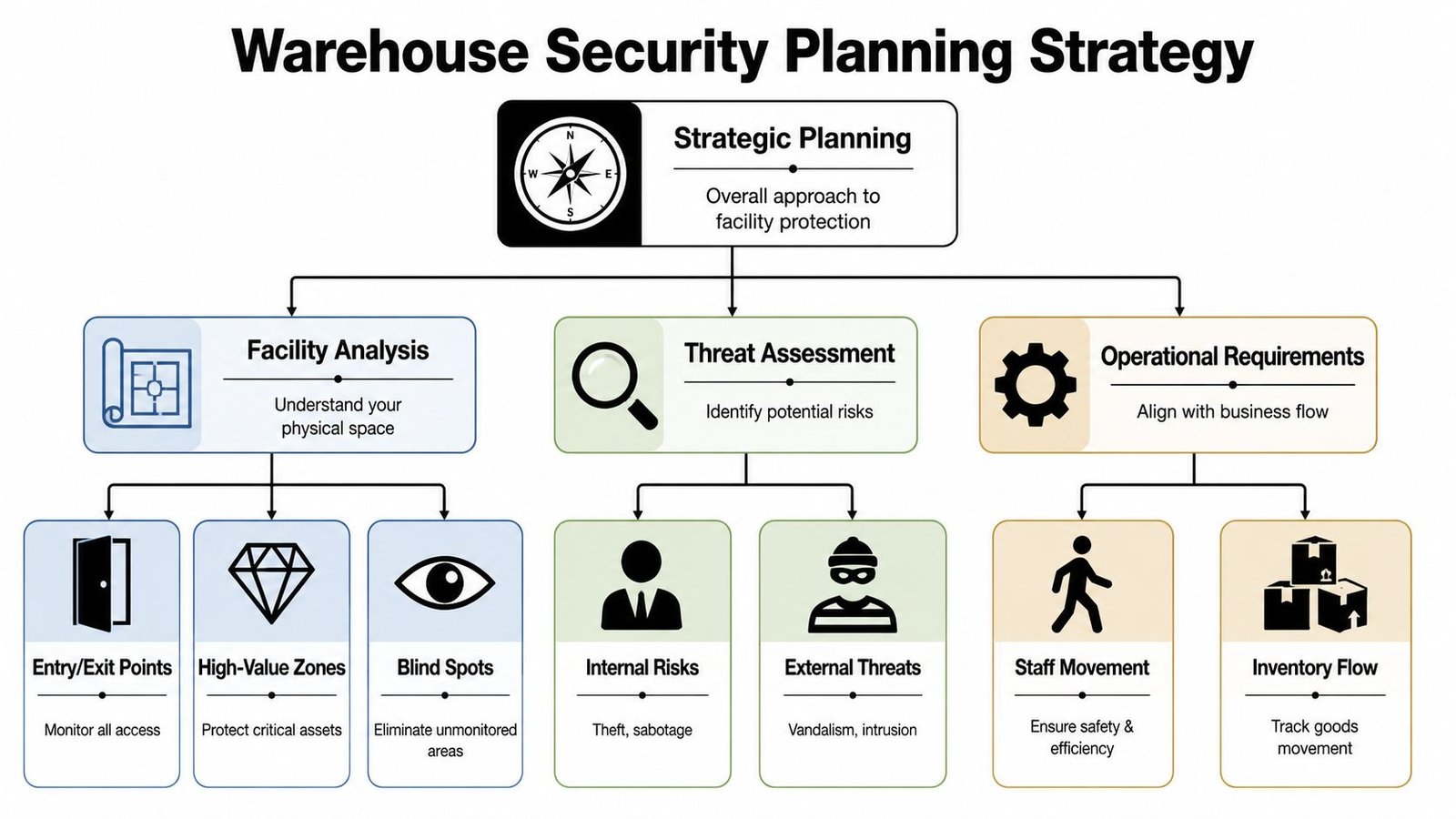
The strongest layouts are planned like a security web. Each camera supports another camera's field of view, and movement through the site becomes easier to track from approach to exit. That's more effective than scattering cameras around the building and hoping the combined coverage fills the gaps.
Start outside and work in
Begin with the perimeter and yard. A lot of warehouse losses, confrontations, and safety incidents begin before anyone enters the main building. Vehicle approach routes, pedestrian gates, fence lines, trailer parking, and external compounds all deserve attention first.
Then move to the building envelope:
Main vehicle gates and yard approaches
These show who arrived, when they arrived, and which route they used.Loading bays and shutters
These are high-friction points where goods, vehicles, agency staff, drivers, and paperwork meet.Staff entrances and side doors
These often get less attention than the main reception but can create the biggest audit gaps.Internal movement routes
Main aisles, cross-aisles, pick faces, cage areas, returns zones, and dispatch staging points all need proportionate coverage.Restricted or high-value storage
These areas need stronger evidential coverage, not just an overview.
Independent guidance for warehouse design suggests a practical benchmark of one camera per 3,000 square feet, with additional cameras at each entry, loading dock, and high-value area. It also notes that sub-1080p footage can fail to capture readable plates or facial features, which is why sparse, low-resolution layouts usually disappoint when an incident needs investigating (warehouse camera density and image quality benchmark).
Build a security web not a line of sight list
A proper site survey doesn't stop at “can I see this area?” The better question is “what happens when someone moves through it?” Warehouses are dynamic spaces. Forklifts block views. Pallet stacks change shape. Seasonal stock creates temporary blind corners. Open shutters flood bays with light while leaving internal detail in shadow.
Useful survey notes usually include:
- Choke points: Corridors, gates, bay entrances, caged stores, and mezzanine stairs where everyone has to pass.
- Obstructions: Racking uprights, stacked goods, dock levellers, roller shutters, and parked trailers.
- Lighting extremes: Dark aisles, sodium yard lighting, bright roller doors, and sun-facing entrances.
- Workflow conflicts: Areas where pedestrian and vehicle movement overlap.
- Temporary risk zones: Returns areas, quarantine stock, overflow storage, and contractor workspaces.
A camera above a loading bay door often proves a vehicle arrived. A camera angled to show the trailer, threshold, operator area, and handover point usually proves what happened.
For external compounds, temporary storage, or container-based working areas, mounting becomes part of the planning exercise. In those cases, practical accessories such as container utility poles can help create stable positions for lights and CCTV without compromising the container structure.
A simple site survey checklist
Use this during a walk-round with operations, facilities, and security staff:
- Follow the goods: Trace stock from arrival to storage to pick to dispatch.
- Follow the people: Map staff entry, visitor routes, and contractor access.
- Follow the disputes: Identify where disagreements usually arise, including shortages, damage, and unauthorised access.
- Follow the night shift: What looks visible by day may be poor at night.
- Follow the exception path: Returns, rejected goods, and manual overrides often expose weak coverage.
That process usually reveals the same truth. The expensive part isn't adding one more camera. It's installing the wrong cameras in the wrong places and finding out after a loss.
Choosing the Right Cameras and Specifications
At 6:15 on a winter morning, a wagon reverses onto a bay, a shutter lifts, and two forklifts cross through the same doorway within seconds. If the camera over that bay cannot handle headlight glare, shadow under the canopy, and fast movement, you end up with footage that shows activity without proving what happened. That is why camera choice starts with the operational question, not the product range.
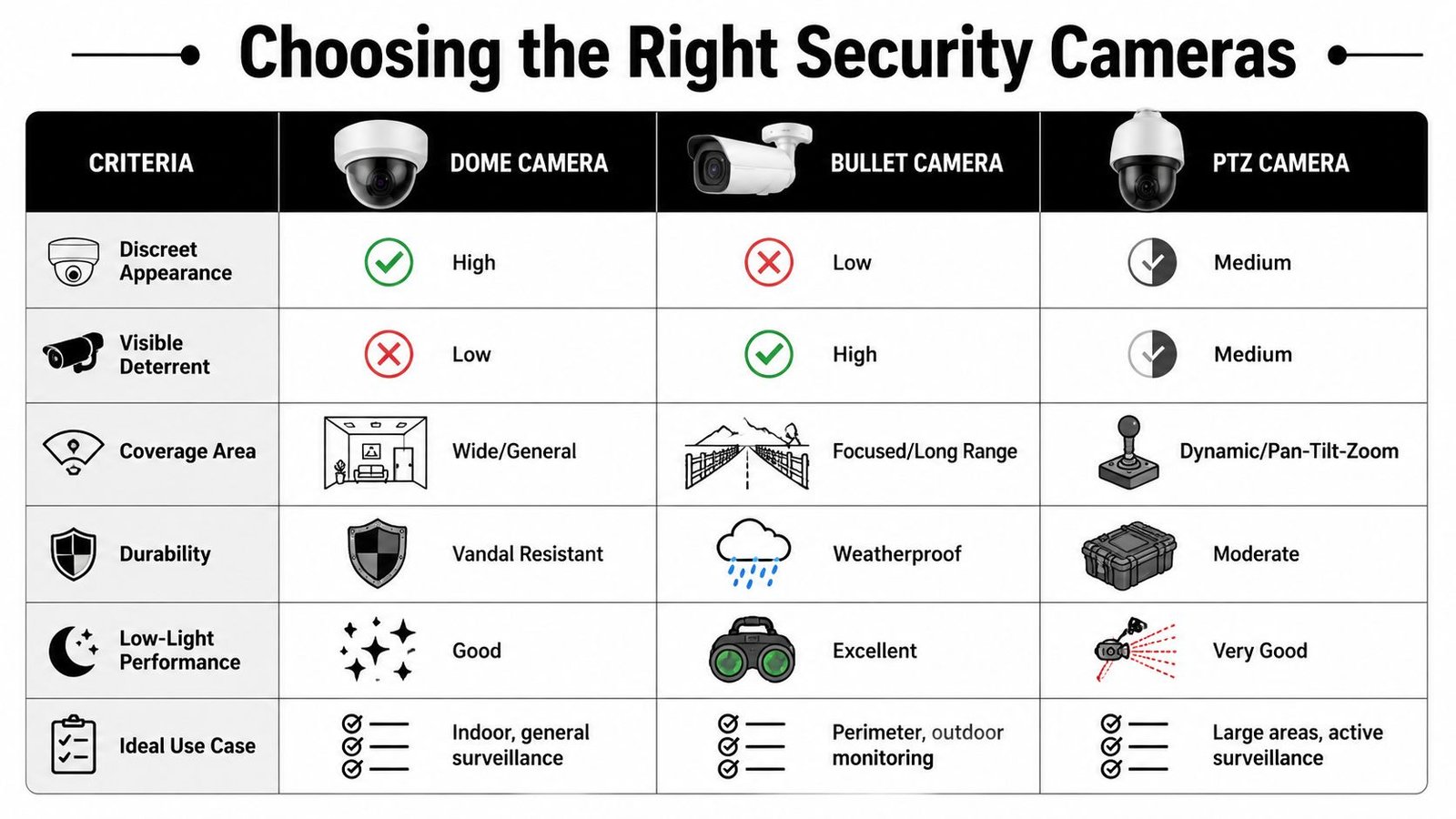
A warehouse needs different camera types for different jobs. Long external approaches, internal pick faces, dispatch desks, freezer doors, and cage stores place very different demands on lenses, housings, and mounting positions. In South Wales and the South West, that also means planning for wind-driven rain in yards, salt air on some coastal sites, and early darkness through winter trading periods.
Match the camera to the job
The simplest way to avoid overspending or under-specifying is to assign each camera a clear purpose before choosing the model.
| Camera type | Where it fits | What it does well | Where it falls short |
|---|---|---|---|
| Bullet camera | Perimeter, yards, gates, long vehicle approaches, loading areas | Strong visible deterrent, longer-range viewing, outdoor housings | More exposed to impact, less discreet inside offices or welfare areas |
| Dome camera | Internal aisles, pick zones, offices, receptions, packing benches | Clean appearance, good general coverage, often better under lower ceilings | Less effective for long-distance outdoor scenes |
| PTZ camera | Large yards, high-roof spaces, sites with active monitoring | Lets operators inspect detail across a wide area | Only records the direction it is facing at that moment |
PTZ cameras are useful, but they do not replace fixed coverage. A PTZ aimed at a fence line cannot also watch a pedestrian gate or a trailer door. Fixed cameras carry the evidential load. PTZs add flexibility for live response.
The platform matters as well. Sites upgrading older coax systems often ask whether to expand what is already in place or move to networked cameras. The answer depends on cable routes, image requirements, and how much you want the system to do beyond recording. This guide to the difference between IP cameras and HD analog CCTV explains the trade-offs in practical terms.
The specifications that matter
Spec sheets list dozens of features. On a warehouse survey, I focus on the settings that affect evidence quality, storage use, and reliability in day-to-day operation.
Resolution
Higher resolution helps when the subject is only a small part of the frame, which is common in yards, aisles, and bay approaches. For general warehouse work, 1080p is often the minimum sensible starting point, with 4K used where you need to identify faces, read labels, or review vehicle movements over a wider scene. The trade-off is straightforward. More pixels usually mean more storage, more bandwidth, and tighter demands on recording hardware.
Lens and scene width
This aspect often proves problematic for many systems. A wide shot can cover a whole loading area, but it may leave people and pallets too small for identification. A tighter lens gives better detail, but covers less ground. Overview cameras and evidence cameras often need to be separate because one view rarely does both jobs well.
Frame rate
Forklifts, pump trucks, and reversing vehicles create motion blur if frame rate is set too low. Higher frame rates improve clarity in busy zones, but they push up storage demand. Dispatch lanes, vehicle gates, and handover points usually justify a higher setting than a quiet stock aisle.
Low-light performance and infrared
Poor lighting exposes weak cameras quickly. That applies to night shifts, covered loading bays, side yards, and external doors used before sunrise. Infrared can help, but it is not a cure-all. Reflective hi-vis clothing, shiny trailer sides, dust, and steam can all affect the image. On some sites, white light gives better usable footage than relying on infrared alone.
Wide Dynamic Range
WDR matters anywhere bright and dark parts of the scene appear together. Loading doors are the obvious example. Without it, the outside can blow out while the person inside the threshold turns into a silhouette.
Ingress protection and housing choice
External cameras in Cardiff, Newport, Bristol, or along the South West coast need housings that cope with rain, dirt, and temperature swings. On food, logistics, and manufacturing sites, cleaning routines and airborne dust matter too. The camera may survive on paper and still fail early if the housing is wrong for the environment.
Buy enough detail to answer the incident question. Extra megapixels do not fix poor angle, bad light, or the wrong lens.
A practical placement mix
A workable warehouse design usually combines camera roles rather than repeating the same model across the whole site.
- Perimeter and vehicle approach routes: Bullet cameras for gates, fence lines, yard entrances, and corners where you need range and clear direction of travel.
- Loading bays and shutter doors: Fixed cameras with good WDR and strong low-light performance. One view should cover the approach, another should cover the handover area.
- Internal operations: Dome cameras for aisles, pick areas, packing zones, and staff circulation routes where broad coverage and vandal resistance matter.
- Large yards or compounds: PTZ cameras where someone will use the live view to inspect alarms, check trailer positions, or verify activity out of hours.
- High-value or dispute-prone points: Dedicated tighter views over cage stores, despatch benches, returns counters, or goods-in checks.
For businesses in South Wales and the South West, local site conditions should shape those choices. Older industrial units around the Valleys and parts of Avon often have awkward cable routes and mixed lighting. Coastal and exposed sites need more attention to weather protection and maintenance access. Multi-unit estates can also create problems with shared access roads, blind corners, and lighting spill from neighbouring units. Those details affect camera choice more than brochure features do.
One option in the market for integrated deployments is Wisenet Security Ltd, which installs and maintains CCTV systems alongside access control, intruder alarms, and related systems for sites in South Wales and the South West. The useful point here is practical rather than promotional. Warehouses benefit when the installer understands local stock profiles, building types, and service response expectations, because those factors influence specification and support.
What usually doesn't work
The same mistakes appear on warehouse reviews again and again:
- Too few cameras mounted too high: broad scene coverage, weak identification.
- One camera expected to provide overview and evidence: neither result is strong enough.
- Ignoring aisle geometry: racking, shrink wrap glare, and cross-aisle breaks create blind sections.
- Specifying for daytime handover only: the image falls apart on night shift or in winter afternoons.
- Choosing by megapixels alone: angle, lens, light, and mounting height still decide whether the footage is usable.
Good specification is site-specific. A bay camera should answer bay questions. A yard camera should answer yard questions. That sounds obvious, but it is the difference between footage that helps after an incident and footage that only proves the camera was switched on.
Using VMS and Analytics to Get More from Your System
A warehouse incident rarely starts and ends in one camera view. A pallet goes missing from dispatch, a side door opens out of hours, or a near miss with a forklift gets reported after the shift has changed. The cameras may have captured it all, but without the right software layer, someone still has to piece the story together by hand.
That is where systems lose value in day-to-day use. Recording alone is passive. A well-configured VMS helps staff find footage quickly, control who can access it, and act on alerts while the issue is still live.
Why the software layer matters
A Video Management System (VMS) is the operating layer behind the cameras. It handles live view layouts, playback, permissions, alarm handling, exports, and remote login. In practical terms, it cuts the time between "something happened" and "here is the footage."
That matters more in warehouses than in many other buildings because incidents often cross several zones. A supervisor may need to check the loading bay, follow a vehicle through the yard, confirm who entered a pedestrian door, and review an internal aisle camera to see where goods ended up. If the VMS is poorly set up, that review takes too long and staff stop using it unless there is a serious loss or claim.
Useful VMS functions for a warehouse include:
- Logical camera groups: separate goods-in, dispatch, yard, perimeter, freezer areas, and high-value stock rooms
- Role-based permissions: give team leaders, managers, and security staff the access they need without exposing every camera to every user
- Fast search tools: filter by time, camera, alarm event, or bookmarked incident
- Remote access with controls: useful for call-outs and multi-site operators, provided access is secured and logged
- Audit trails: show who viewed, exported, or changed footage settings
In South Wales and the South West, this often matters for multi-building estates and shared industrial sites where one manager may oversee more than one warehouse or travel between units. A local installer should account for that during setup, not treat remote access and user permissions as add-ons after handover.
Which analytics are worth paying for
Analytics only help if they reflect how the warehouse operates. I have seen systems with every detection option switched on, only for the client to ignore them within a week because normal forklift traffic triggered constant alerts.
Start with exception reporting. The system should flag activity that is unusual for that zone and that time of day.
The analytics that usually earn their keep are:
- Line crossing rules: good for fence lines, gate thresholds, fire exits, and internal doors that should not be used for routine movement
- Intrusion zones: useful in yards, caged stock areas, mezzanines, and out-of-hours internal spaces
- Loitering alerts: suited to side entrances, external roller shutters, and high-value goods locations
- Vehicle recognition workflows: practical where you need to confirm expected deliveries, contractor arrivals, or repeat vehicle movements
- People counting or occupancy tools: useful in selected areas, especially where pedestrian flow affects safety or operations
The trade-off is simple. More analytics create more events. More events mean more setup time, more testing, and more operator discipline. If nobody is assigned to review or respond to alerts, the analytics become background noise.
A short manufacturer demonstration can help teams visualise what the software layer adds in day-to-day use:
What good setup looks like on a live warehouse site
Good analytics are tuned around normal behaviour. That sounds obvious, but it is where many projects go wrong.
Forklifts have predictable routes. Staff doors have busy periods. Yard lighting changes the image after rain, in winter afternoons, and during night loading. A rule that works at 11am may be unusable at 7pm unless somebody tests it properly. For sites around Newport, Cardiff, Bristol, Exeter, and the wider South West, weather and exposed yard conditions add another layer. Wind-blown debris, reflective puddles, and headlight flare can all increase false alerts if the scene has not been configured carefully.
A practical commissioning checklist looks like this:
- Define what normal activity looks like in each zone.
- Create alerts for exceptions, not routine traffic.
- Test rules on day shift, night shift, and during vehicle movements.
- Adjust sensitivity, target size, and detection zones before handover.
- Check that alerts go to someone who can act on them.
- Review permissions, audit logs, and privacy settings as part of the same process.
Legal handling matters as well. Remote access, user permissions, exports, and staff monitoring all need clear rules. This guide to CCTV and GDPR requirements for UK businesses is a useful reference when deciding who can view footage, how clips are shared, and how to document system use. The wider compliance point is not unique to CCTV either. Good practice around video access sits alongside the same principles discussed in protecting DFW business data.
When the VMS and analytics are configured around the way the warehouse works, the cameras become easier to manage and more useful after an incident. That is the difference between a system that records problems and one that helps staff deal with them.
Managing Storage and Ensuring Legal Compliance
Storage problems usually show up after the system is live.
A warehouse asks for sharper images, wider coverage, and a longer retention period. The recorder was sized for lighter traffic, fewer high-detail cameras, or shorter archives. At that point, the choice is rarely pleasant. Reduce image quality, cut retention, or pay to expand storage sooner than planned.
Storage is a design decision, not an afterthought
In a warehouse, storage demand is driven by what the camera sees and how the camera is set up. A quiet internal aisle places a very different load on the system than a loading bay with forklifts, reversing wagons, pedestrians, and changing light through open shutters.
The practical trade-off is straightforward. Higher resolution improves identification. Higher frame rates make movement easier to follow. Longer retention gives you more time to investigate stock loss, damage disputes, or H&S incidents reported days later. Each of those decisions increases storage demand.
For most sites, the right answer is not to set every camera to the highest possible specification. That approach fills disks quickly and often gives poor value. A better design gives the detail to the views that need evidence grade images, then uses lower-demand settings for general oversight.
A simple planning formula helps during a survey:
Per-camera storage need = resolution + frame rate + scene activity + recording schedule + retention target
Compression matters too, but it does not remove the trade-off. Busy scenes produce larger files. So do cameras exposed to glare, shadows, weather, and constant vehicle movement.
Here is a practical planning table for early specification:
| Resolution | Compression | Estimated Storage (30 Days) |
|---|---|---|
| 1080p | Standard efficient compression | Lower than 4K, often suitable for general internal coverage |
| 1080p | Less efficient compression | Higher than the row above, useful where compatibility limits options |
| 4K | Standard efficient compression | Higher storage demand, often justified for yards, bays, and evidential views |
| 4K | Less efficient compression | Highest demand, usually worth reserving for selected cameras rather than every view |
On South Wales and South West sites, I would add one more check. Ask how long footage may need to be kept when weather, shift patterns, agency staffing, or shared yard access make incidents harder to investigate quickly. Warehouses around Cardiff, Newport, Bristol, Swindon, Exeter, and the wider region often have a mix of internal handling areas and exposed external space. That usually means not every camera should be treated the same at the storage stage.
Treat video as business data. Once you do, retention, access rights, export control, backup, and disk resilience become operating requirements, not optional extras.
That same discipline applies outside CCTV. The wider point in protecting DFW business data is useful here too. Footage creates governance and risk responsibilities as well as hardware costs.
Compliance needs clear operating rules
For UK warehouses, legal compliance starts with purpose and control. Be clear about why cameras are installed, what areas are covered, who can view recordings, and how long footage is kept. If your team needs a practical reference point, this guide to CCTV and GDPR requirements for UK businesses sets out the basics in plain terms.
The paperwork matters, but day-to-day handling matters more. I see more risk from loose user permissions and unmanaged exports than from a missing policy document. If supervisors can download clips to personal devices, if passwords are shared, or if no one can explain the retention period, the system is exposed even if the cameras themselves are well specified.
A workable compliance checklist usually includes:
- Lawful basis: Record the business reason for using CCTV in each area.
- Clear signage: Inform staff, visitors, contractors, and drivers that recording is in use.
- Access control: Limit live and recorded footage to authorised roles.
- Retention policy: Keep footage for a defined operational reason, not by habit.
- Export procedure: Control how clips are saved, shared, and logged.
- Subject access readiness: Make sure someone internally knows how requests will be reviewed and answered.
- Audit trail: Check that user activity, exports, and admin changes can be reviewed later.
The strongest sites are usually the ones where design, storage policy, and daily practice line up. That is what keeps footage usable when an insurer asks for evidence, a manager investigates stock loss, or a member of staff challenges how the system has been used.
Integration Maintenance and Future-Proofing Your Investment
A standalone camera system can record a problem. An integrated system can help trigger the right response while the problem is still manageable. That difference matters in warehouses, where delays often turn a small security event into stock loss, operational disruption, or a safety issue.
Integration closes the gap between seeing and acting
CCTV works harder when it's tied to intruder alarms, access control, and sometimes intercoms or gate automation. The link between systems creates context. A forced door event can call up the nearest camera. An out-of-hours access event can be paired with a recorded clip. A vehicle gate opening can be checked visually rather than accepted blindly.
In practical terms, integration helps with situations like these:
- Restricted area access: A card event is logged, and the relevant camera confirms who entered.
- Alarm verification: Staff can check whether an alarm is a real breach or a false trigger.
- Gate and yard control: Operators can confirm vehicle identity before opening access.
- Incident reconstruction: Footage and access events can be reviewed together.
That joined-up view is especially useful where warehouses have multiple user groups. Staff, agency workers, drivers, cleaners, engineers, and contractors often share the same site but not the same permissions.
Maintenance keeps evidence usable
Most CCTV failures aren't dramatic. They're gradual. Lenses drift out of position. Dirt builds up on housings. Infrared reflects off cobwebs. Time settings go out. Hard drives age. Firmware is never reviewed. Then an incident happens, and the footage is technically present but practically useless.
A maintenance plan should cover more than whether the recorder powers on.
A sensible service routine checks:
- Camera views: Has stock movement, racking, or signage blocked the shot?
- Image quality: Is glare, blur, or low-light noise affecting evidential use?
- Recording integrity: Are cameras recording consistently and retaining footage as intended?
- Time and event sync: Do camera times align with access or alarm events?
- Physical condition: Are housings, brackets, cable routes, and seals still sound?
- User access: Do the right people still have the right permissions?
The costliest camera fault is the one nobody notices because the picture still looks “mostly fine”.
Future-proofing without overspending
Future-proofing doesn't mean buying every advanced feature now. It means choosing a platform that can expand cleanly if the operation changes.
Look for systems that can handle:
- Additional cameras when storage or dispatch areas expand
- New analytics if risk changes at the perimeter or yard
- Integration options for later access control or alarm upgrades
- Remote administration across multiple buildings or depots
- Maintenance support over the full equipment life, not just at install
Warehouses rarely stay static. Layouts change. Products change. Staff patterns change. The right investment is one that can move with those changes without forcing a full rip-and-replace decision too early.
A Supplier Checklist for South Wales and the South West
A poor supplier choice usually shows up after handover. The cameras record, the quote looked sensible, but a fault takes days to attend, a yard camera is blinded by low winter sun, or nobody can explain why a loading bay was left with a blind spot. That risk is higher in warehouse projects because camera performance depends on daily operations, building shape, lighting, and response support, not just the equipment list.
For warehouses in Cardiff, Newport, Swansea, Bristol, and the wider South Wales and South West, local coverage matters for practical reasons. Coastal weather can shorten the life of external housings and joints. Older industrial units often hide awkward cable routes and patchy network infrastructure. Rural or edge-of-estate locations can also turn a "same-day response" promise into a much longer wait if the installer is based too far away.
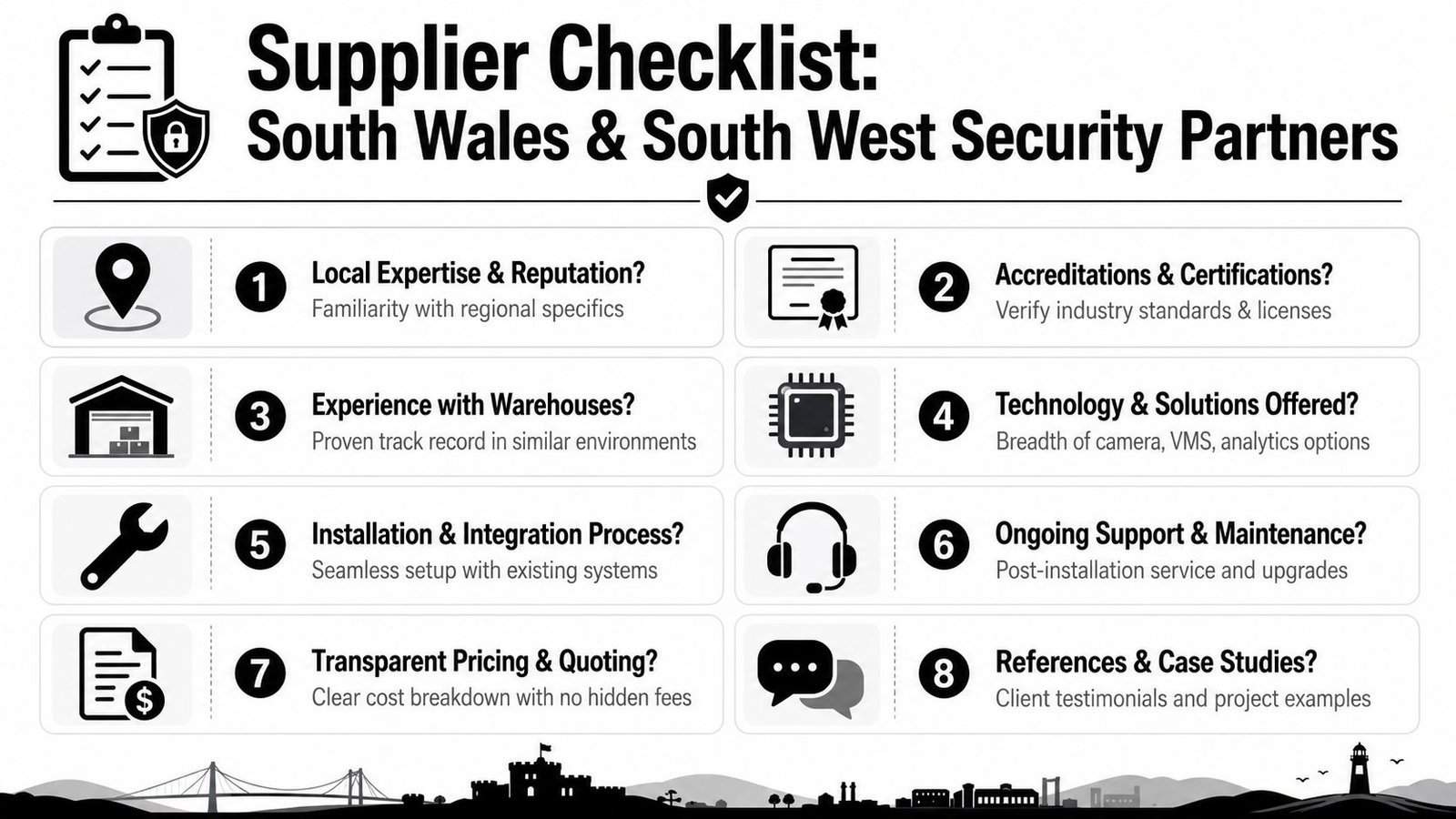
Questions worth asking before you sign
Use this checklist during a site survey, not just at quote stage.
Do they understand warehouse workflows
Ask how they would cover goods-in, dispatch, yard vehicle movement, side doors, waste areas, and any cage or pallet zones holding high-value stock. A supplier with warehouse experience will talk about how people and vehicles move through the building, where disputes usually start, and which views need identification quality rather than general overview.Can they design beyond stand-alone CCTV
Many warehouse losses involve doors, gates, alarm events, or out-of-hours access. The supplier should be able to explain how CCTV will work with intruder alarms, access control, intercoms, or automated gates where the risk justifies it.What support do they provide after installation
Ask who handles faults, firmware updates, recorder issues, user access changes, camera re-aiming after layout changes, and ongoing maintenance. If support is subcontracted or vague, expect slower resolution when the site is busy and a camera drops out.How do they handle compliance
They should explain signage, retention periods, footage access, subject access request handling, and who in your business should have admin rights. A supplier who treats GDPR and evidential handling as box-ticking is likely to leave operational gaps.Who will attend your site
Engineer vetting, insurance cover, working-at-height procedures, and method statements matter in active warehouses. This is especially important on occupied sites with forklift traffic, loading bays, and live dispatch schedules.Can they justify each camera position in plain language
Good answers sound specific. This camera covers driver and vehicle interaction at dispatch. That one confirms who opened the pedestrian gate. If the explanation stays general, the design probably has not been thought through properly.
Why local support matters in this region
South Wales and the South West include everything from modern logistics parks to older converted industrial buildings. The difference matters. A clean new-build unit in Bristol has very different constraints from a split-level site in Swansea or an older estate in Newport with mixed lighting and limited containment routes.
A local installer should already understand some of the region-specific issues that affect system design and support:
| What to ask | Why it matters locally |
|---|---|
| How quickly can you attend site? | Travel time affects fault response, especially for remote sites, multi-unit estates, and urgent recorder failures |
| Have you worked on similar buildings nearby? | Similar units often have the same yard layout, lighting spill, roof access limits, and cable route problems |
| Can you handle phased upgrades? | Many warehouses in the region expand in stages, adding cameras as operations grow or insurers raise requirements |
| Do you maintain what you install? | Long-term support matters more than the opening quote, particularly where weather exposure and heavy use increase wear on external equipment |
The best supplier is usually the one who will walk the site properly, challenge weak assumptions, and explain trade-offs before installation starts. In this region, that often means choosing a firm close enough to support the system over time, not just install it.
For businesses across South Wales and the South West, Wisenet Security Ltd fits that local-specialist role with fully insured installation, DBS-checked engineers, integrated system capability, and ongoing maintenance for commercial sites.
If you're reviewing warehouse security camera systems for a site in South Wales or the South West, Wisenet Security Ltd can help assess the building, identify coverage gaps, and design a CCTV layout that fits your operation, compliance needs, and future integration plans.