Electric Gates Cardiff: 2026 Guide to Planning & Installers
You're probably at the stage where the front boundary no longer feels good enough. Maybe you're tired of walking out in bad weather to open manual gates. Maybe deliveries, visitors, and unknown vehicles keep turning up at the entrance. Or maybe you've realised that on a Cardiff property, access control, safety, and kerb appeal all meet at the same point: the gate.
That's where most online advice falls short. It shows styles and motors, but skips the awkward parts that decide whether a gate will work on your site. Cardiff has plenty of awkward sites. Short driveways, sloping approaches, shared access lanes, exposed frontages, coastal wind, pavement line issues, and older properties where nothing is perfectly square. A gate that looks right on paper can become a poor choice once you measure vehicle turning space and opening arcs.
Table of Contents
- Securing Your Cardiff Property with Electric Gates
- Choosing Your Gate Type for Cardiff Properties
- The Real Cost of Electric Gates in Cardiff
- Navigating Cardiff Planning Permission and Safety Law
- The Installation Process from Survey to Switch-On
- Integrating Gates with Your Wider Cardiff Security
- Choosing Your Installer and Long-Term Maintenance
Securing Your Cardiff Property with Electric Gates
For most clients, electric gates aren't about showing off. They're about controlling who gets in, making daily access easier, and putting a proper boundary at the front of the property. In Cardiff, that applies just as much to a family home as it does to a depot, office yard, or shared car park.
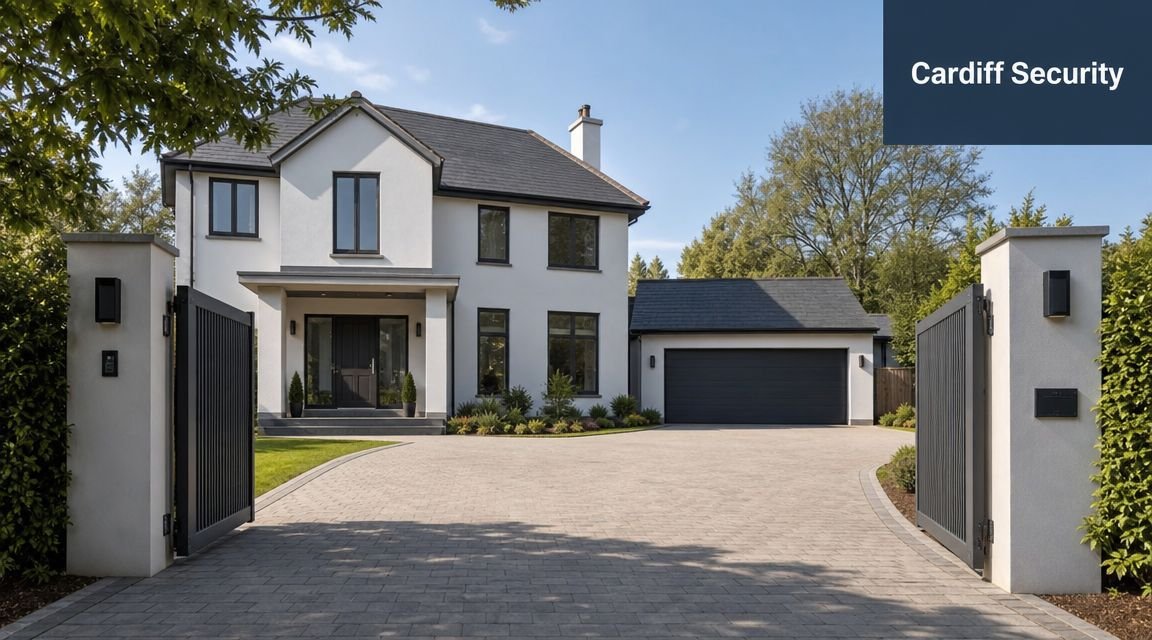
The first question isn't usually “which gate looks best?” It's “what will work on this entrance without causing problems later?” A terraced house in Roath, a detached drive in Lisvane, and a commercial yard near a main road all need different answers. The right design depends on space, road position, fall on the driveway, wind exposure, traffic frequency, and how you want visitors to enter.
Practical rule: Start with the site, not the catalogue. Gate failures often begin with a layout problem that nobody solved at survey stage.
A good electric gate setup should do four things well:
- Control access clearly: Residents, staff, deliveries, and visitors need a straightforward way in.
- Operate safely: The system must protect users, pedestrians, vehicles, and anyone near the entrance.
- Suit the property layout: The opening method has to match the available space and approach.
- Hold up in daily use: Motors, hinges, posts, and controls need to match the workload and environment.
That's what makes Electric Gates Cardiff projects so site-specific. The product matters, but the survey matters more.
Choosing Your Gate Type for Cardiff Properties
Some gate types are forgiving. Others aren't. If the opening method doesn't match the driveway, you'll notice it every day.
What suits a typical Cardiff driveway
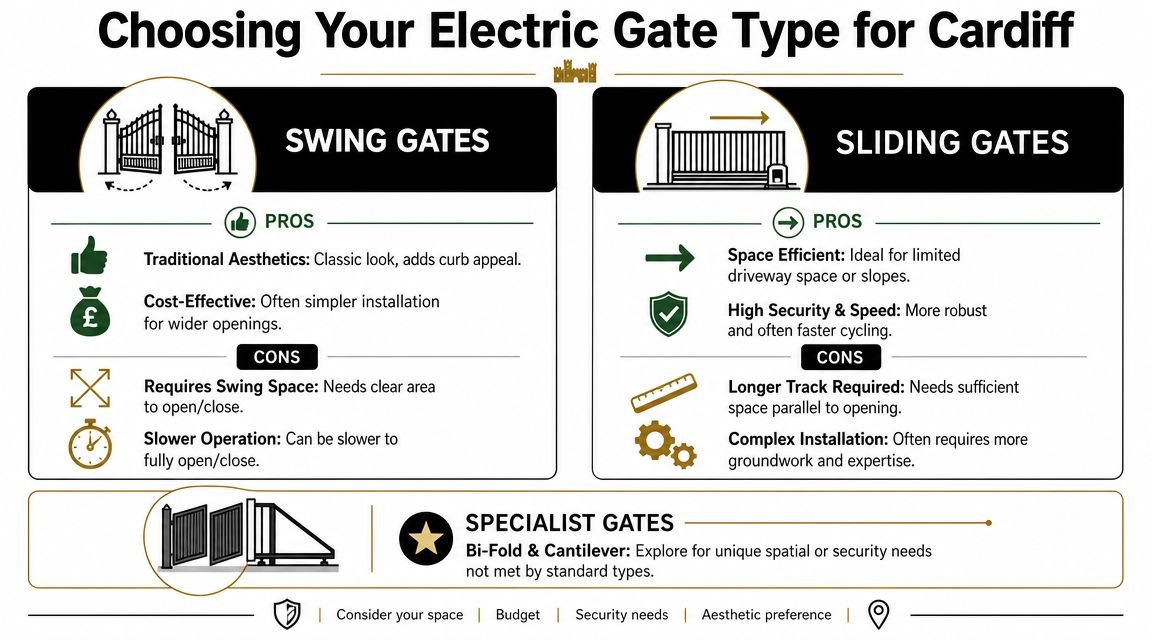
Swing gates are still the most common option for homes. They suit wider entrances and properties with enough clear space behind the gate line for the leaves to open fully. On a level driveway with decent depth, they're straightforward and visually traditional.
They become awkward when the driveway rises sharply behind the gates, when cars stop too close to the entrance, or when the opening arc conflicts with walls, parked vehicles, or pedestrian paths. On tighter plots, that's where problems begin.
Sliding gates make more sense where driveway depth is limited or where a swing arc won't work. They also suit sites where you want a strong perimeter line and a more controlled movement path. For terraced or urban properties in Cardiff, sliding can be the cleaner answer if there's room for the gate to run back along the fence or wall line.
Here's the trade-off in simple terms:
| Gate type | Usually works well for | Common limitation |
|---|---|---|
| Swing gates | Wider residential entrances, traditional frontage styles, level driveways | Need internal swing space |
| Sliding gates | Short driveways, sloping approaches, tighter urban plots | Need run-back space beside the opening |
| Bi-fold or specialist gates | Entrances where standard swing or sliding won't fit well | More complex layout and hardware choices |
Some Cardiff entrances need specialist gates, especially where the driveway is short and the boundary sits close to the pavement or road. Bi-fold arrangements can reduce the opening footprint. Cantilever or other specialist sliding layouts can help on sites where a standard tracked slider would be a poor fit.
A useful outside comparison of layout thinking appears in this guide to automatic driveway gates in Ottawa. The climate differs, but the practical point is the same. Good gate design starts with driveway geometry, not marketing terms.
Operator choice matters more than most buyers expect
Motor selection gets oversimplified all the time. People compare gate width and assume that tells them everything. It doesn't.
For Cardiff sites with frequent use, heavy leaves, or exposure to wind, the operator should be chosen around duty cycle and gate mass, not just opening width. South Wales gate automation specialists note that both 230V and 24V electro-mechanical or hydraulic systems are used across domestic and commercial settings, with commercial ranges selected for full safety and compliance, as outlined by ESA Systems' gate automation guidance.
In practice, that means:
- 24V systems are often the better fit where the gate cycles regularly, where softer start and stop control matters, or where battery backup integration is useful.
- Hydraulic or heavy-duty electro-mechanical operators are better suited to larger gate leaves and tougher loading conditions.
- Wind exposure changes the calculation: On exposed Cardiff sites, wind adds dynamic load. If the torque margin is too low, the gate may nuisance trip, reverse unexpectedly, or wear components prematurely.
A gate that's only just powerful enough on a calm day often becomes unreliable once wind, misalignment, and real-world use are added.
Material choice matters too. Timber can look excellent but adds weight and can move over time. Steel is strong but needs the structure and posts designed properly. Aluminium reduces weight, which can help motor performance and hinge life on some residential installations. There isn't one universal winner. There's only a right match for the entrance.
The Real Cost of Electric Gates in Cardiff
Price matters, but the headline figure never tells the full story. Two projects can both be called “electric gates” and still be completely different in complexity.
Typical starting costs
For residential work, Checkatrade's 2026 cost guide says the average residential electric gate setup costs around £3,000, with labour usually £35 to £65 per hour. The same guide says swing automatic driveway gates start from £2,000, sliding automatic driveway gates from £2,600, bifold automatic driveway gates from £5,000, and adding an intercom typically costs £500 to £1,500, according to Checkatrade's electric gate installation prices guide.
For larger business, warehouse, and industrial sites, the budget changes sharply. An industrial cost guide focused on Cardiff states that industrial electric gates typically range from £6,000 to £20,000 or more, depending on size, material, and automation features, as noted in this Cardiff industrial electric gates guide.
Here's a simple benchmark table.
Estimated Costs for Electric Gate Installation in Cardiff (2026)
| Project Type | Typical Starting Cost Range |
|---|---|
| Residential swing gates | From £2,000 |
| Residential sliding gates | From £2,600 |
| Residential bifold gates | From £5,000 |
| Residential setup average | Around £3,000 overall |
| Intercom addition | £500 to £1,500 |
| Commercial and industrial systems | £6,000 to £20,000 or more |
What changes the final quotation
The gate leaf is only part of the cost. A realistic quotation usually reflects several layers of work.
- Structure and material: A lightweight aluminium gate and a heavy steel infill gate create very different demands on posts, hinges, and motors.
- Ground conditions: If the entrance needs excavation, new foundations, drainage adjustment, or cable routes under finished paving, labour rises quickly.
- Access control: Keypads, audio intercoms, video entry, fobs, GSM control, and vehicle detection all add hardware and programming time.
- Safety equipment: Proper safety edges, photocells, control logic, and testing aren't optional extras. They're part of a compliant system.
- Usage pattern: A private home with light traffic and a business entrance with repeated daily operation shouldn't be priced or specified the same way.
One of the most common mistakes is comparing gate quotes as if every installer is pricing the same scope. They often aren't. One quote may include proper civils, safety devices, cabling, and commissioning. Another may only cover the visible hardware.
If you want a meaningful figure, ask for a site-based quotation rather than a generic package price.
Navigating Cardiff Planning Permission and Safety Law
This is the part too many gate guides avoid. On Cardiff sites, layout and legality can block a project long before the motor choice matters.
Layout comes before motor choice
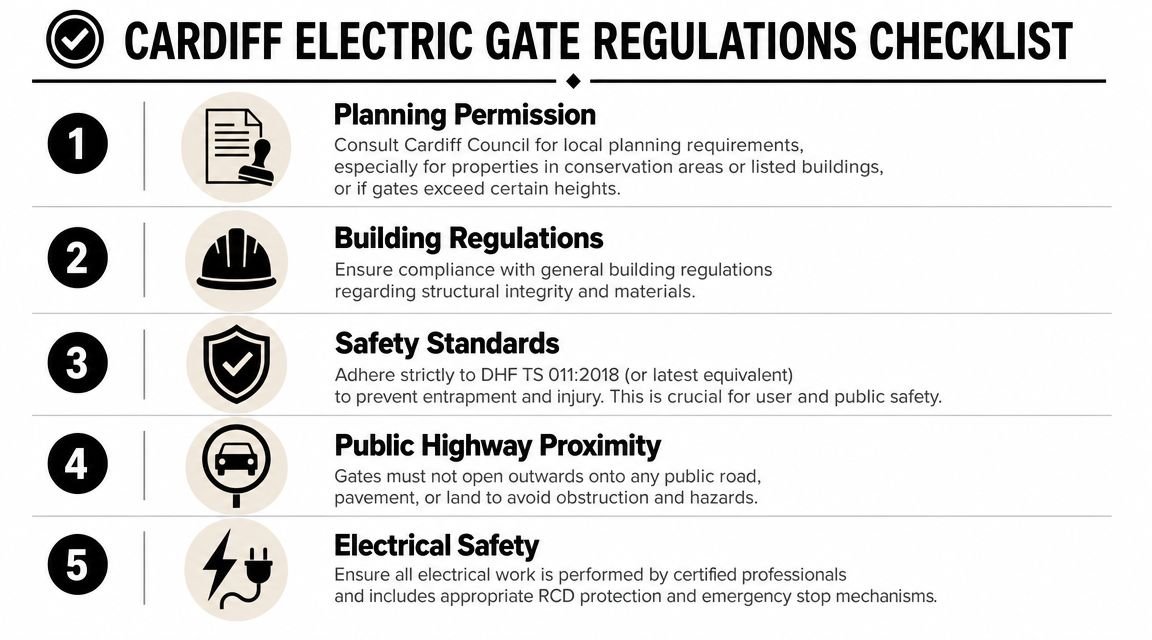
A common issue with electric gate projects in Cardiff is working out whether the gate needs to sit back from the highway, whether an outward-opening design is acceptable, and how to deal with constrained entrances, sloping approaches, or shared access. UK fire and highway safety guidance makes gate layout a compliance issue rather than a styling decision, as discussed in this guidance on gate setbacks, highway safety, and emergency access.
In practical terms, that means checking things such as:
- Road and pavement relationship: A gate shouldn't create an obstruction or force vehicles to wait in an unsafe position.
- Opening direction: If a gate swings into public space, that's usually a problem.
- Vehicle stacking space: Cars need room to stop clear of the highway while the gate opens.
- Shared entrances: You need to think about rights of access, turning movements, and who controls entry.
- Manual release access: In a fault or emergency, the gate must still be capable of safe release.
The neatest gate design on a drawing is useless if the first car has to stop on the road to use it.
Planning permission depends on the property and the proposal. Older properties, prominent front boundaries, conservation constraints, and unusual heights or layouts can all trigger extra checks. That's why surveying the boundary position and the road relationship early saves time.
Safety compliance is part of the installation
Automated gates are machines. They move with force, so safety has to be designed into the system from the start.
A proper installation should consider:
- Entrapment protection at hinge, leading edge, and closing areas.
- Detection devices such as photocells and safety edges in the right positions.
- Force limitation and setup so the operator reacts correctly to obstruction.
- Emergency operation including safe manual release.
- Electrical safety with appropriate isolation, protection, and testing.
Clients sometimes focus on finish and access method first. Engineers look at pinch points, crushing zones, leaf travel, and how someone could misuse the entrance. That's the correct order. A lawful, safe installation isn't a paperwork exercise. It's the difference between a gate that behaves predictably and one that creates avoidable risk.
The Installation Process from Survey to Switch-On
A proper gate installation is a sequence of decisions and trade-offs. It isn't a one-day bolt-on unless the site is unusually simple.
Survey and design
The first step is always the survey. That means measuring the clear opening, checking levels, confirming post positions, and looking at approach angles for cars and vans. It also means inspecting where power can be taken from and how cabling will reach the entrance without creating future faults.
After the survey, the design can be fixed properly. The installer should confirm the opening method, gate dimensions, hinge or track arrangement, operator type, safety devices, and access method. If you're comparing systems such as residential gates, commercial gates, barriers, or bollards, it helps to review options in one place through a specialist gates and barriers service like Wisenet Security's gates and barriers solutions.
A sensible quotation should then reflect the actual site, not a generic package.
Groundworks, fitting, and commissioning
The physical work usually starts with the entrance itself. Posts or support structures need to be set correctly. Cable routes need protecting. If the gate is sliding, the running area has to be true. If it's swing, the hinge geometry has to be right. Small errors here cause big reliability problems later.
Typical installation stages include:
- Civil works first: Foundations, posts, ducting, and any required track or threshold preparation.
- Gate hanging or mounting: The leaves or sliding frame are fitted and aligned so movement is mechanically correct before automation is set up.
- Operator installation: Rams, underground motors, articulated arms, or sliding motors are fitted to suit the design.
- Safety hardware and controls: Photocells, edges, intercoms, keypads, loops, and control panels are installed and wired.
- Commissioning: Opening and closing forces are adjusted, safety responses are tested, access methods are programmed, and the user is shown how to operate and release the system safely.
Good gate automation starts with mechanics. If the gate doesn't move freely by hand, no motor will fix that for long.
The handover matters as much as the install. The client should know what normal operation looks like, what to do during a power issue, and when servicing is due.
Integrating Gates with Your Wider Cardiff Security
A gate works best when it isn't treated as a standalone product. On most sites, the entrance is just one point in a wider security chain.
Access at the gate should match how you use the site
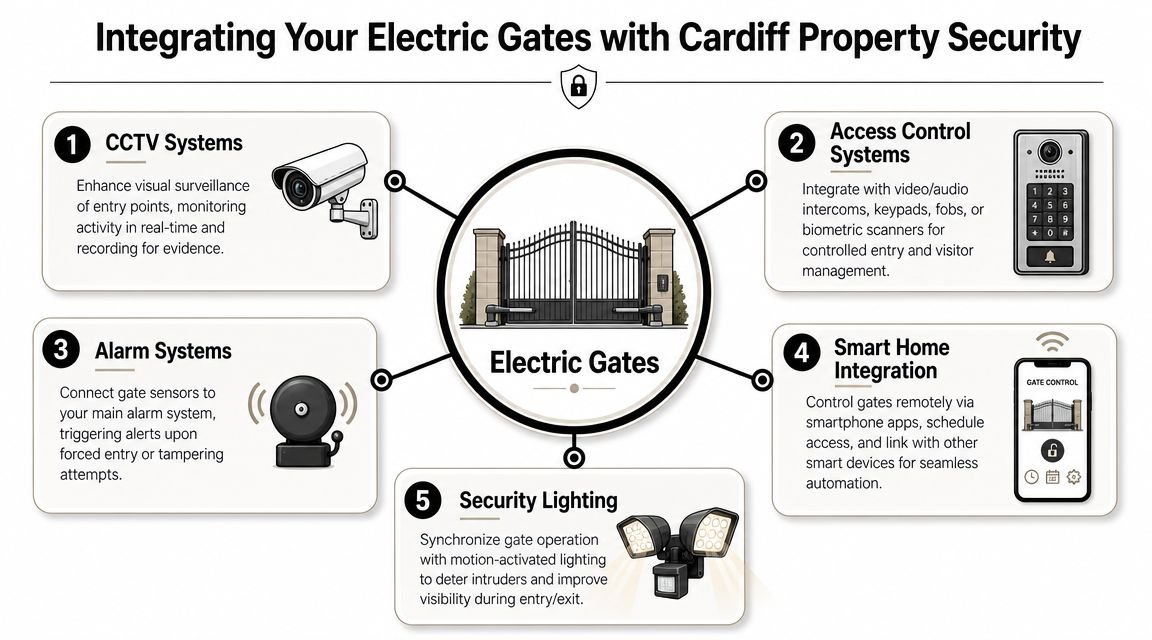
For a home, that may be as simple as remote controls, a keypad, or a video intercom that lets you answer from your phone. For a business, it often means different access methods for staff, deliveries, and visitors.
Common combinations include:
- Video intercom at the entrance: Useful where you want to see and speak to visitors before opening.
- Keypads or fob readers: Practical for regular users who need repeat access without a call-in process.
- Timed access permissions: Helpful on managed sites where contractors or cleaners need limited entry windows.
- Vehicle-based access methods: Better for busy sites where stopping every vehicle at an intercom would slow operations.
The gate should reflect how people arrive, not how the brochure says they ought to.
A gate works better as part of one system
When the entrance is integrated with wider security, you get clearer control and fewer blind spots. A gate can trigger recording on CCTV, work alongside access control permissions, and tie into site lighting or alarms so entry activity is visible and logged.
For example, if you're planning visitor entry, staff credentials, intercoms, or managed permissions, it makes sense to look at a broader access control and door entry setup rather than specifying the gate in isolation.
That joined-up approach improves day-to-day use in practical ways:
- CCTV confirms what happened at the entrance when there's a dispute, delivery issue, or unwanted access attempt.
- Access logs show who entered and when on business premises or shared developments.
- Lighting improves visibility for arrivals and departures outside daylight hours.
- Alarm integration helps flag tampering or forced access if the gate or cabinet is interfered with.
A lot of gate faults blamed on automation are control issues caused by poor integration. If the intercom, lock logic, access permissions, and safety devices are planned together, the whole entrance behaves more predictably.
Choosing Your Installer and Long-Term Maintenance
The installer you choose will affect the gate long after the fitting day. A smart-looking gate with poor alignment, weak safety setup, or no support plan becomes expensive and frustrating.
What to ask before you appoint anyone
Ask direct questions. A serious installer should answer them clearly.
- Insurance and responsibility: Are they fully insured for this type of work, including automation and electrical elements?
- Engineer standards: Are the engineers trained, vetted, and used to working on occupied residential and commercial sites?
- Local experience: Have they dealt with Cardiff access constraints, sloping drives, roadside boundaries, and exposed sites before?
- Scope clarity: Does the quotation spell out civils, cabling, safety devices, controls, and commissioning?
- Aftercare: Who handles faults, servicing, and future upgrades?
If you're comparing providers, it also helps to look at firms that specialise in controlled entry systems more broadly, such as established access control installers in South Wales, because gate performance often depends on how well access hardware and automation have been specified together.
Why maintenance matters after handover
Gates move, vibrate, and sit outside year-round. Hinges settle. Tracks collect debris. Safety devices go out of alignment. Batteries age. That's normal.
Servicing keeps the system safe and reliable. It also catches wear before it becomes a breakdown. On domestic gates, that usually means preserving smooth operation and checking safety responses. On commercial systems, it also means reducing disruption when access has to work every day.
Choose the installer as if you'll still be dealing with them years from now. In gate automation, that's usually what happens.
If you're planning electric gates in Cardiff and want a site-based opinion before choosing a design, Wisenet Security Ltd can arrange a practical consultation around your entrance layout, access needs, and compliance considerations.