
Security Alarm for Door Protection in the UK
A smart doorbell isn't a security plan. Neither is a small magnetic contact stuck to a frame without checking whether the lock, hinges, closer and surrounding structure can withstand an attack. A security alarm for door protection should detect an unwanted opening quickly, but it can't stop an entrance that gives way before the alarm has time to matter.
That distinction matters in South Wales and the South West, where a Victorian terrace, a modern flat entrance, a shopfront, a farm outbuilding and a warehouse loading door all present different risks. The right design starts with the door as a physical barrier, then adds detection, notification, lighting, cameras and response procedures around it.
Table of Contents
- Why Door Alarms Fail Without Physical Security
- Understanding Door Contact Sensors and UK Standards
- Residential Homes Versus Commercial Premises
- Designing Entry Routes to Prevent False Alarms
- Integrating Door Alarms with CCTV and Access Control
- Legal and Compliance Rules for Rented Properties
- Planning Your Professional Security Installation
Why Door Alarms Fail Without Physical Security
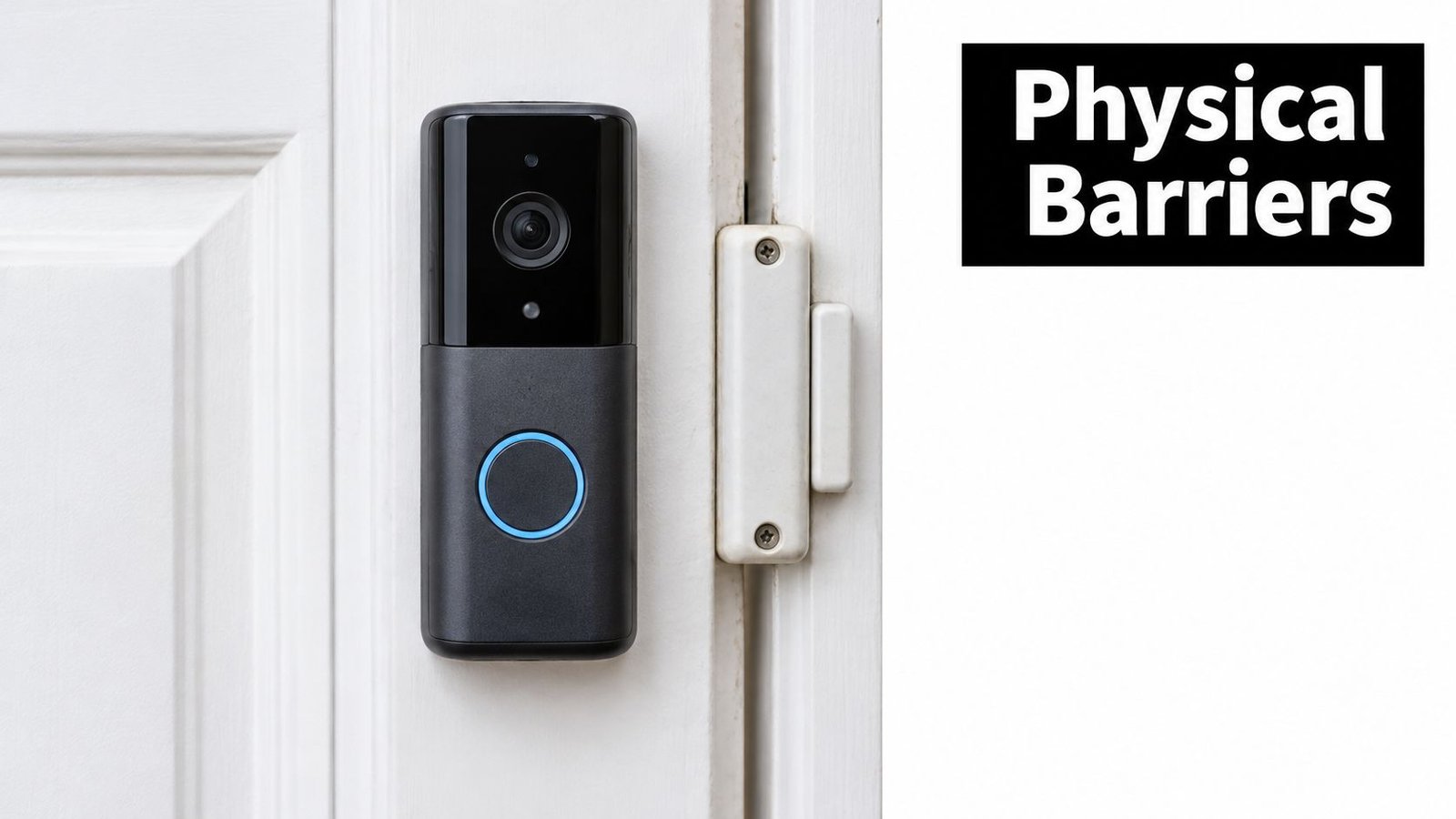
The most popular advice often starts with a gadget. Fit a smart doorbell, receive an alert on your phone and assume the entrance is protected. That approach confuses awareness with prevention. A camera may show someone approaching, while a basic contact may report that a door has opened, but neither device strengthens a weak lock or prevents a poorly secured leaf from being forced.
Historically, doors were the main route into homes in England and Wales. The Office for National Statistics overview of burglary found that, where an offender entered a dwelling, approximately 70% of entries were through a door, compared with around 30% through a window. That makes door protection a primary security task, not an optional improvement after windows and perimeter devices have been considered.
The physical failures that sensors can't repair
A contact sensor normally reports position. If the magnet separates, the control panel may record an open door. It doesn't reinforce a strike plate, stop a frame from splitting or correct a latch that never fully engages.
Check the entire entrance, not just the alarm device:
- Lock and cylinder: Confirm that the lock engages properly and that the cylinder, escutcheon and fixing points aren't exposed to avoidable attack.
- Frame and keep: A strong lock fitted into weak timber still leaves a vulnerable assembly. Look for movement, splitting and loose fixings around the keep.
- Hinges: External or poorly protected hinges can create a physical weakness, particularly on doors opening in an exposed direction.
- Closer and alignment: A door that drifts open, bounces off its latch or needs to be lifted into position can create both a security gap and false alarms.
- Glazing and letter plates: A contact won't address an adjacent pane or hardware that allows someone to reach the internal handle.
- User behaviour: Tailgating, propped doors and routinely opening the door during deliveries can defeat a carefully specified system.
An ONS-linked discussion reports that about one in four UK burglaries involves an open door or window (Locksure's summary of UK burglary statistics). The practical lesson is simple. A door alarm can identify an opening, but it can't turn an open entrance into a secure one.
Practical rule: Treat the alarm as the detection layer. Treat the door, frame, lock and hinges as the barrier that buys you time.
Why the entrance design still matters
Architectural choices affect security before an installer arrives. Slim profiles, glazed panels and double-door arrangements need careful consideration because the meeting stile, multipoint locking and frame construction can behave differently from a conventional single door. If a project involves a new entrance, a useful design reference is this overview of slim-frame double doors for architects, particularly when appearance and access width must be balanced against effective locking and sensor placement.
For an existing property, start with a physical inspection in daylight and repeat it after the door has been locked. Try the handle, inspect the frame for movement and check whether the door closes consistently without being pushed. On a commercial entrance, observe the door during deliveries and staff changes. The busiest part of the day often reveals the weakness that a night-time alarm test misses.
A layered system then makes sense. A lock and reinforced frame resist entry. A contact detects opening. A shock or vibration device may identify an attack before the door opens. An internal detector confirms movement, while a camera can preserve evidence and a monitored signal can notify an appropriate response service. Each layer has a different job, and none should be asked to compensate for a failed layer beneath it.
Understanding Door Contact Sensors and UK Standards
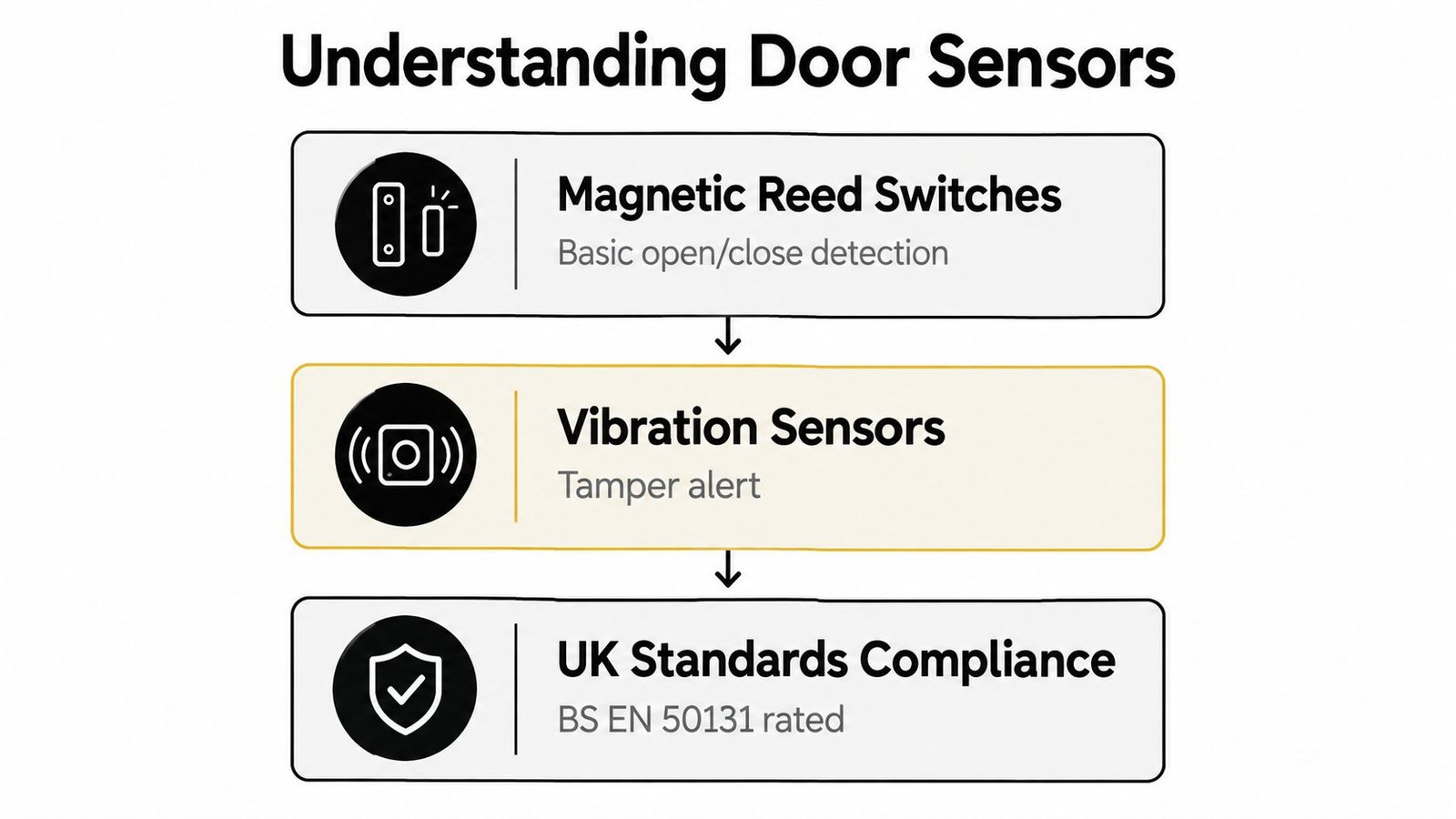
A door sensor isn't automatically suitable because it uses a magnet. Basic reed switches provide open and close detection. They can work well on a straightforward internal or residential entrance when the door, frame and operating conditions are stable. They become less adequate when the risk assessment requires lock-state information, tamper supervision, reliable environmental performance or integration with a graded alarm system.
The distinction matters because a door can appear closed while remaining unsecured. A standard contact may report a secure-looking position even though the latch or lock hasn't engaged. A lock-state contact can monitor the door position, the lock status or both, giving the control panel more useful information about what has happened.
Selecting the contact for the entrance
BS EN 50131-2-10 covers magnetic lock-state contacts for Grades 1 to 4 and addresses contacts used on doors or frames to monitor lock status, door position or both. The BSI series information for BS EN 50131 provides the relevant standards context. The grade should follow the risk assessment and the wider alarm design, rather than being chosen because a product listing uses the word “professional”.
Environmental class is just as important. A contact on an internal office door faces a different environment from one on a coastal entrance, an unheated warehouse, a farm building or a semi-external gatehouse. Moisture, dust, temperature variation and condensation can affect alignment, enclosure performance and long-term reliability.
Specify the following before choosing a device:
- What must be detected? Opening alone may be enough for a low-risk door. A restricted commercial entrance may need door position and lock-state reporting.
- Where will it sit? Confirm the environmental class for the location, not just the nominal indoor or outdoor description.
- How will it communicate? Wired and wireless routes need suitable supervision where the risk assessment requires it.
- How will it be installed? The magnet and sensor must remain within the manufacturer's alignment tolerance as the door moves, settles and closes.
- How will the panel treat it? Confirm grade compatibility, tamper arrangements, event logging and signalling behaviour.
Open detection is not forced-entry detection
A contact tells you that the door has moved. It may not tell you that someone is attacking the frame, striking the lock or applying force without creating the expected separation. A vibration or shock detector can add an earlier warning, but it needs careful adjustment because normal building movement, slamming and nearby traffic can create unwanted activations.
For many premises, the practical architecture uses more than one input. A contact records opening, a lock-state device records abnormal opening, an internal detector confirms movement and a camera supplies context. You can explore how door and window devices are commonly applied in an integrated system through Wisenet Security UK's door and window sensors guide.
Don't specify a sensor from a photograph alone. Give the installer the door material, opening direction, frame detail, exposure, locking arrangement and required alarm grade. Good detection begins with matching the component to the door's real behaviour.
Residential Homes Versus Commercial Premises
A family home in Cardiff and a warehouse entrance in Bristol may both need a door alarm, but they don't need the same alarm architecture. The home has predictable occupants, occasional visitors and a relatively simple set and unset routine. The warehouse may have deliveries, staff shifts, contractors, forklifts, multiple access points and doors that must remain secure while other areas are active.
A residential system often prioritises simple operation. A contact on the front or rear door can provide an entry trigger, while mobile alerts, an external sounder and pet-friendly internal detection support day-to-day use. The system must be easy for every household member to operate. If arming it feels inconvenient, people will bypass the protection.
Commercial premises need more control over identity and timing. A fob, card, keypad or other credential can associate an authorised opening with a person or role. Access schedules can limit entry outside working periods, while event history can distinguish a valid opening from a forced door or a door held open too long.
Door Alarm Requirements by Property Type
| Feature | Residential Homes | Commercial Premises |
|---|---|---|
| Main objective | Detect unauthorised entry while keeping daily operation simple | Control, verify and record access across different users and zones |
| Typical entrance pattern | Household members, visitors and deliveries | Staff, contractors, customers, deliveries and service access |
| Detection choice | Door contact, internal movement detection and optional camera verification | Door contact or lock-state contact, internal detection, access-control events and CCTV verification |
| User management | Small group of known users | Individual credentials, role-based permissions and time-based rules |
| Alerting | Mobile notification, bell-only alarm or monitored service | Confirmed signalling, management notifications, response procedures and event review |
| Operational concern | Entry delay, pets, forgotten arming and convenient disarming | Tailgating, propped doors, shift changes, loading activity and audit requirements |
| Record keeping | Useful event history for household review | Auditable records for incidents, authorisation checks and property management |
The design trade-off
A bell-only home alarm can suit an owner who wants local deterrence and an alert on a phone. It won't provide the same response pathway as a professionally monitored system, and a phone notification depends on the user noticing and acting on it. Conversely, a complex access-control system can be excessive for a small home if nobody needs individual permissions or a formal entry record.
For a shop, the front door might need a delayed entry route for staff, a separate immediate alarm for a rear door and a camera trigger when the contact changes state. A warehouse may need different treatment for office doors, pedestrian entrances and loading bays. The system should reflect how people use each opening, not apply one setting across the building.
UK business data shows why adoption figures don't provide a complete design answer. The 2013 Commercial Victimisation Survey recorded burglar alarms at 83% of recreation-sector premises and 32% of agriculture, forestry and fishing premises. It also recorded 475 burglary incidents per 1,000 agricultural, forestry and fishing premises with alarms, compared with 187 per 1,000 without alarms. Those figures don't show that alarms cause burglary. Higher-risk premises are more likely to install them, so exposure and selection affect the result.
The sensible conclusion is not to copy another property's equipment list. Assess the entrance, occupancy, working pattern, valuables, response arrangements and failure consequences first.
Designing Entry Routes to Prevent False Alarms
A badly designed entry route causes as many problems as a bad detector. If the lock sticks, the door drops on its hinges, or staff have to rush to a keypad before the timer expires, the system will generate avoidable alarms and people will start working around it. Good alarm design starts with the route through the door, the frame, the hardware and the way the building is used.
Police Crime Prevention Initiatives reported that annual calls to police for false alarms or faulty equipment fell from 1,188,386 in 1995 to 85,146 in 2020, while the number of registered alarm systems almost doubled (PCPI's executive summary). That improvement came from better confirmation, better setup and better maintenance, not from treating every single door opening as a police matter.
Build the route around how people enter
Set the route to match the user, not the other way round. A front entrance used by staff each morning needs a different sequence from a side door that should never open while the system is set. In rented flats, HMOs, shared offices and small commercial units, this matters even more because one person's normal access can be another person's nuisance activation if permissions and timings are poorly defined.
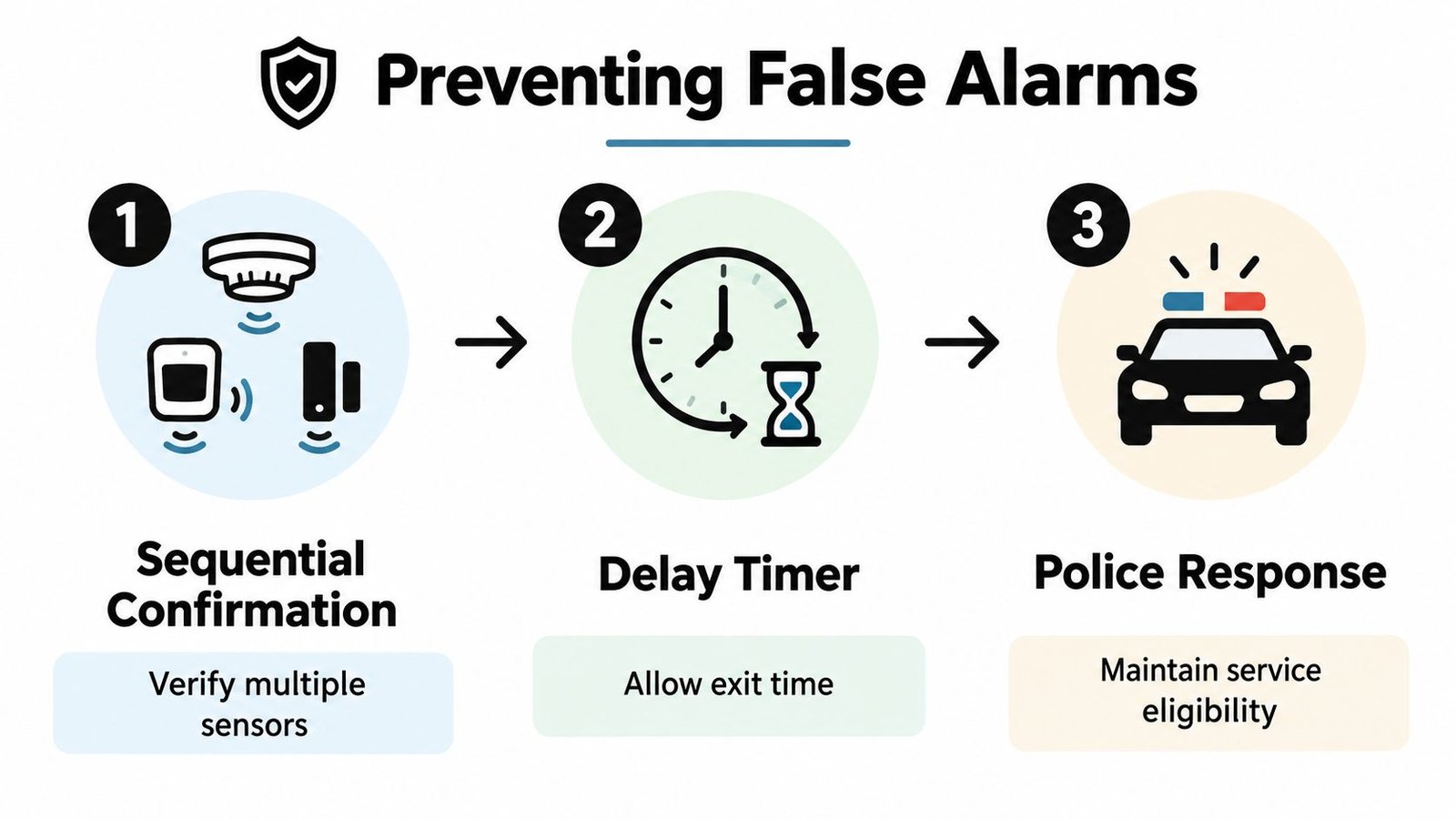
The basic sequence should be clear. The contact operates when the door opens. The authorised user then reaches the keypad, fob reader or other control point within the entry time. Internal detection should support that route, not contradict it on the first few steps inside.
Use separate zones where the layout allows it:
- Entry door zone: Set the main authorised entrance to start the correct entry timer instead of triggering an instant alarm.
- Internal confirmation zone: Use a second condition to confirm movement after the door event, based on the route an intruder or authorised user would take.
- Immediate zones: Keep rear doors, side doors and restricted access points on instant response where entry is not expected during the set period.
- User identification: Use individual codes or credentials where you need to know who entered and when.
- Event review: Check the log after faults, repeat activations or openings that do not fit the normal pattern.
For the internal detector, placement matters as much as technology. A PIR pointed at a draughty lobby, a glazed entrance in direct sun, or a route used by pets or shifting stock will create noise, not confirmation. This guide to how motion detection works is a useful reference when pairing movement detection with a door contact. The two devices should answer different questions.
A door contact shows that the door moved. Confirmation shows whether the movement fits a real entry pattern.
Understand the police response conditions
UK alarm response practice uses sequential confirmation, where an alarm-receiving centre gets two or more alarm-related conditions within a defined period before requesting police attendance. The same PCPI summary explains that an alarm with a police Unique Reference Number receives Level 1 response until three false calls occur in a rolling 12-month period, and that urgent remedial action is advised after two false calls.
That puts real weight on the entry timer. Set it too short and users panic, mistype and trigger avoidable activations. Set it too long and someone forcing entry may get further into the building before the alarm is confirmed. On site, the right answer usually comes from walking the route, opening the door normally, closing it properly and timing how long a genuine user takes.
Remove mechanical causes
A surprising number of false door alarms begin with poor mechanics. The magnet and reed may only line up when the door is pushed hard. The closer may pull the leaf away from the contact before the latch settles. Hinges may have dropped. Multipoint locks may not throw cleanly unless the handle is lifted fully. If the door hardware is wrong, no amount of app control will make the alarm reliable.
Wireless devices need the same discipline. Check batteries, signal supervision and how the contact behaves with the door fully shut, partly latched and held against the stop. On timber doors in older South Wales and South West properties, seasonal movement can be enough to create intermittent faults.
For commercial premises, record who tests the route and what happens after a failed test. For homes and shared properties, make sure every authorised user follows the same entry sequence and does not prop the door open while the system is armed. A reliable system depends on correct setup, sound door hardware and people using it consistently.
Integrating Door Alarms with CCTV and Access Control
A standalone contact gives you a useful event, but integration turns that event into evidence and context. When a protected door opens unexpectedly, the alarm platform can request a camera recording, notify a responsible person and create an event that can be compared with access-control activity.
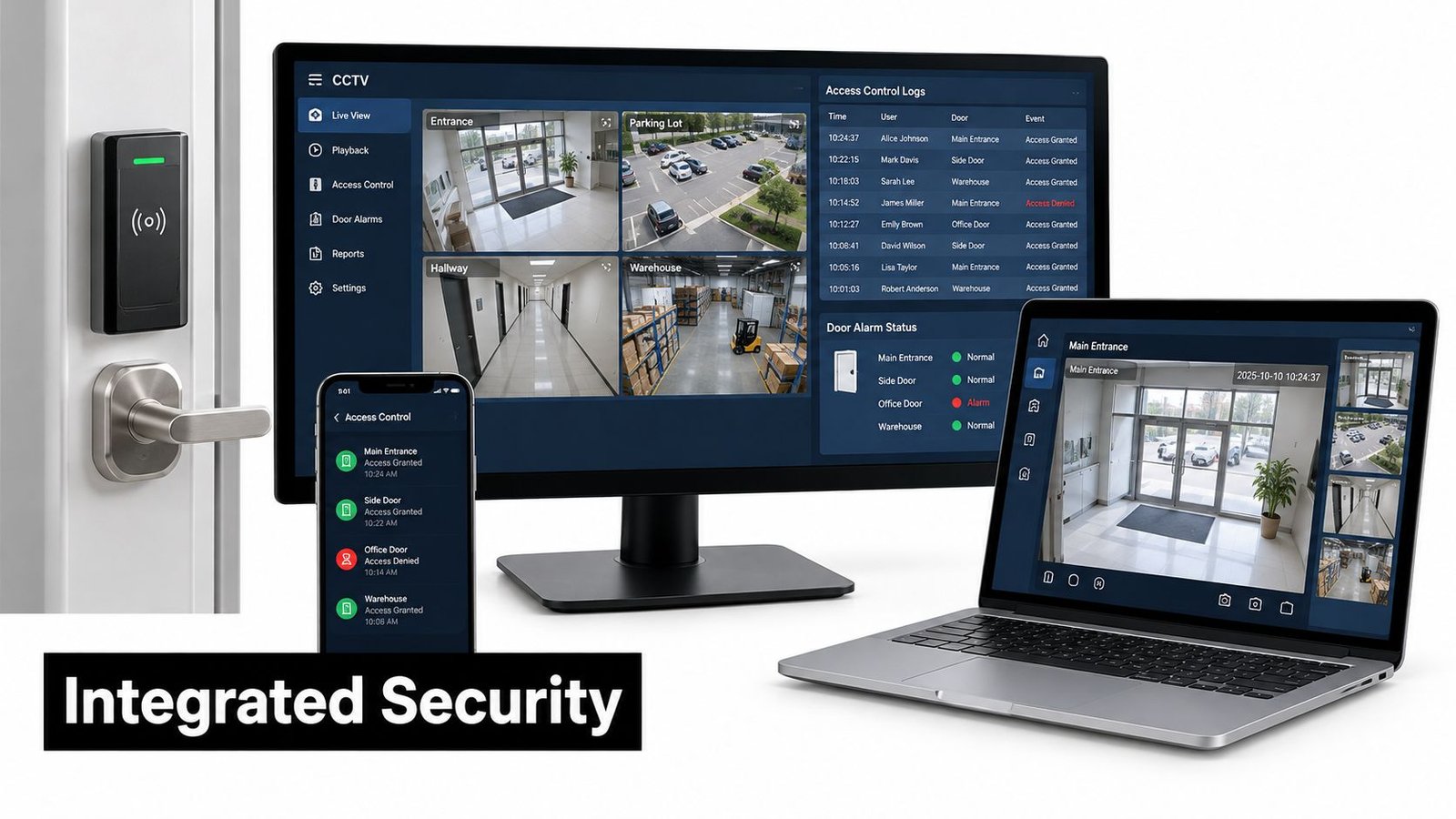
Consider a rear shop door that opens outside trading hours. The contact supplies the trigger. CCTV can capture the approach and the surrounding area. A monitored alarm can pass the event through the agreed response process. If the premises uses access control, the log can show whether a valid credential was used, whether the door was forced or whether the door opened without a corresponding authorisation.
Make each system answer a different question
Integration fails when systems are connected without deciding what the event should mean.
- Door contact: Did the door move?
- Lock-state contact: Was the door secured or unsecured at the relevant point?
- Access control: Was a recognised person authorised to enter?
- CCTV: What happened immediately before and after the event?
- Alarm signalling: Who must be notified, and what action follows?
- Intercom: Can a resident, receptionist or manager verify a visitor before release?
A warehouse manager may need a camera preset aimed at a pedestrian entrance, while a landlord may need a video intercom for visitors and a separate alarm for the communal plant room. The programming should avoid unnecessary recordings and alerts. Capture enough context to investigate, but don't turn every routine access event into a security incident.
For landlords and agents, privacy should be considered at the design stage. Practical guidance on surveillance rules for landlords can help frame questions about shared spaces, signage and access to recordings. A camera facing a private entrance is different from one covering a communal corridor, pavement or neighbouring property.
Event logs are operational tools
An auditable record helps resolve disputes and identify patterns. If a door was reported forced but the log shows a valid credential, the investigation starts from a different point. If the access record shows no valid opening and the contact changed state, the system can flag a possible forced or propped door event.
Use a documented integration plan. The Wisenet Security information on security system integration provides relevant context for combining intrusion detection, CCTV and access-control functions. During commissioning, test the full chain rather than testing each device in isolation. Open the door, check the alarm event, confirm the camera recording, inspect the notification and verify that the event history is understandable to the person who will review it.
Integration should also respect resilience. A network interruption, power failure or failed camera shouldn't remove the primary door alarm function without notice. The installer should explain which parts continue locally, which require connectivity and how faults appear to the user.
Legal and Compliance Rules for Rented Properties
A tenant can't always install a door alarm or smart doorbell because the device is inexpensive. Permission, maintenance, privacy and removal all need to be agreed before the hardware is fixed to a door or connected to a shared building system.
Housing guidance indicates that tenants generally need landlord permission before adding security measures. Landlords must repair security equipment they already provide, but they're not normally required to add new alarms unless the tenancy agreement or a separate arrangement says otherwise. The written agreement should identify the equipment, the responsible party and the process for reporting faults.
Shared entrances create a privacy boundary
A camera aimed at a house entrance may capture a small area of private approach. A camera on a flat, HMO or commercial unit may also record neighbours, visitors, staff and people using a communal corridor. Audio can be particularly intrusive, so the system owner should consider whether it needs to be enabled at all.
The ICO guidance on commercial smart doorbells says organisations should complete a Data Protection Impact Assessment covering the purpose, lawful basis and effects on people whose data is captured. That isn't a substitute for a complete privacy process, but it gives property managers a practical starting point.
Document these decisions before installation:
- Purpose: State whether the camera detects intrusion, verifies visitors, protects staff or monitors a shared entrance.
- Control: Identify who controls the recordings and who can view, export or delete them.
- Retention: Set a justified retention approach rather than keeping footage indefinitely.
- Audio: Disable recording if the purpose doesn't require it.
- Transparency: Provide suitable signage and explain how people can raise a data request.
- Access: Restrict viewing rights to people with a genuine operational need.
- Tenancy end: Decide how accounts, credentials, recordings and connected devices are transferred or removed.
Put responsibilities in writing
A landlord may own a fixed alarm while the tenant controls daily arming and user permissions. A managing agent may arrange maintenance, but a resident or shop operator may still need to report a low battery, damaged contact or failed internet connection. If nobody owns the task, faults remain unresolved.
The same principle applies to private entrances within a larger property. Before advising whether you can rent out a condo, property managers should consider whether the proposed security equipment belongs to the individual occupier, the building owner or the management company, and whether it affects communal areas.
Consent should also cover physical alterations. Drilling into a fire door, replacing a lock, routing cable through a communal frame or fitting a camera to a rendered facade can create building, fire-safety or reinstatement issues. The approval should describe the exact device, location, power source, connectivity, maintenance arrangement and removal condition.
Professional design is especially valuable in flats, HMOs and multi-tenant commercial buildings because one poorly positioned camera or incorrectly configured door release can affect people who never agreed to the installation.
Planning Your Professional Security Installation
Start with the door, not the product catalogue. Walk around the property and list every external entrance, side access, rear door, garage, loading point and shared doorway. Note which doors are used at night, which are propped open during deliveries and which must remain available for emergency escape.
Complete a practical pre-survey
Before requesting quotations, record the basics:
- Physical condition: Check the leaf, frame, hinges, closer, locking points, glazing and surrounding wall for movement or damage.
- Usage: Write down who uses each door, at what times and for what purpose.
- Risk: Identify valuables, restricted rooms, vulnerable occupants, remote locations and periods when the property is empty.
- Existing equipment: Note the alarm panel, CCTV, access-control readers, intercoms, lighting and network limitations.
- Response: Decide who should receive an alert and what that person can realistically do.
Take photographs for the survey, but don't assume an installer can specify the system from images alone. Door construction, frame depth, lock type and cable routes often determine whether a contact, lock-state device, shock sensor or access-control interface is appropriate.
Ask the installer better questions
A professional site survey should explain why each component is proposed. Ask which BS EN 50131 grade applies, which environmental class suits each contact, how tamper protection works and what happens if communication or mains power fails. Request a zone schedule showing entry delays, immediate zones, internal confirmation, access-control events and camera triggers.
Check the installer's insurance, engineer screening, maintenance arrangements and relevant accreditation. SafeContractor accreditation can provide evidence of a structured contractor assessment process, while NSI Gold is relevant to companies working within recognised security-installation and monitoring frameworks. Accreditation doesn't replace your own questions, but it helps distinguish documented professional practice from a quick gadget fitting.
The handover should include user instructions, codes or credentials managed securely, zone descriptions, test records, maintenance recommendations and contact details for faults. For a rented or shared property, add the privacy documentation, recording policy and responsibility matrix.
Plan for maintenance from day one
A door system changes as the building changes. Hinges settle, closers weaken, magnets move, batteries discharge and staff or tenants change. Arrange periodic inspection appropriate to the system and risk, and investigate repeated activations instead of repeatedly silencing them.
Wisenet Security Ltd designs, installs and maintains integrated intruder alarms, CCTV, access control and intercom systems for homes, businesses and multi-tenant premises across South Wales and the South West. Its door protection work can combine door contacts with BS EN 50131 alarm systems, mobile alerts, CCTV and access-control functions, with maintenance and handover included as part of an installation built around your needs.
Review the system after a refurbishment, change of tenant, new loading routine or alteration to the entrance. The most dependable security alarm for door protection is the one that still matches the physical door and the people using it months after installation.
Visit Wisenet Security Ltd to arrange a consultation covering the door, frame, lock, alarm grade, CCTV and access-control requirements at your property. The team serves Cardiff, Bristol, Newport, Swansea and surrounding areas, and can design, install and maintain a layered system for a home, business or shared building.