Addressable Fire Alarm Panel: UK Guide
A 2 am alarm in a Cardiff warehouse is a test of more than the fire alarm itself. Someone has to interpret the panel, find the affected area, check whether the signal is genuine, and make safe decisions while staff, residents, or security personnel wait for instructions. If the display only reports “Zone 3”, the response team may have to search a substantial part of the building before they reach the triggering device.
An addressable fire alarm panel changes that first response. Instead of reporting only a broad zone, it identifies the individual detector, call point, or other device that has activated. That precision matters in warehouses, HMOs, mixed-use buildings, offices, and other South Wales premises where a slow search can create confusion, disruption, and avoidable risk.
Table of Contents
- How Device-Level Detection Changes First Response
- How Addressable Loops and Device Codes Work
- Addressable vs Conventional Fire Alarm Systems
- Tackling the UK False Alarm Epidemic
- Navigating BS 5839-1 and UK Compliance Standards
- Sizing Loops and Budgeting for South Wales Sites
- Maintenance Protocols and Choosing a Local Installer
How Device-Level Detection Changes First Response
An overnight alarm at a South Wales commercial property creates an immediate operational problem. A conventional panel may show only that an alarm has originated somewhere within a defined zone. That can work in a small, simple building, but a zone covering several rooms, storage aisles, flats, corridors, or tenant areas leaves the responder with a broad search.
An addressable system narrows the starting point. Each detector or manual call point has its own address, allowing the panel to display the device and its programmed location. The response team may be directed to a particular room, corridor, plant area, or warehouse section rather than being told only that a zone has changed state.
That information saves time, but it also affects how false alarms are handled. Dust, steam, unsuitable detector selection, cooking activity, aerosol products, building work, and careless use of manual call points can all produce unwanted signals. A precise location helps staff investigate the cause quickly. It does not confirm that a fire exists, and it does not remove the need for clear procedures, competent decisions, and reliable maintenance.
Addressable systems emerged in the 1980s and became more widely used as the technology matured. Their defining change was assigning a unique address code to each detector on a loop, allowing the panel to identify an individual device rather than only a zone, as described in this history of UK addressable fire alarm technology.
Poor maintenance can undermine that advantage. A dirty detector, inaccurate device description, unresolved fault, or poorly controlled building activity can send staff to the wrong conclusion or create repeated call-outs. In multi-occupancy premises, the panel may identify a tenant kitchen, shared escape route, service riser, or unoccupied commercial unit, but the responsible person still needs an agreed process for investigation, evacuation, escalation, and reset.
Practical rule: Choose addressable technology for better information and control. Do not assume the panel alone will prevent false alarms.
The wider standards environment now places greater emphasis on digitally managed life-safety systems. For non-domestic premises, BS 5839-1:2025 came into force on 30 April 2025, with stronger expectations around cybersecurity for connected panels, revised battery-backup calculations, and stricter documentation requirements. The overview of the Notifier Inspire addressable system provides relevant system context, but compliance still depends on the design, configuration, records, and maintenance of the installed system.
How Addressable Loops and Device Codes Work
Think of an addressable loop as a managed communications route rather than a collection of anonymous alarm circuits. The control panel communicates with detectors and other field devices connected around the loop, and each device has a unique digital identity. A smoke detector, heat detector, manual call point, sounder, or interface module can therefore report its own status.
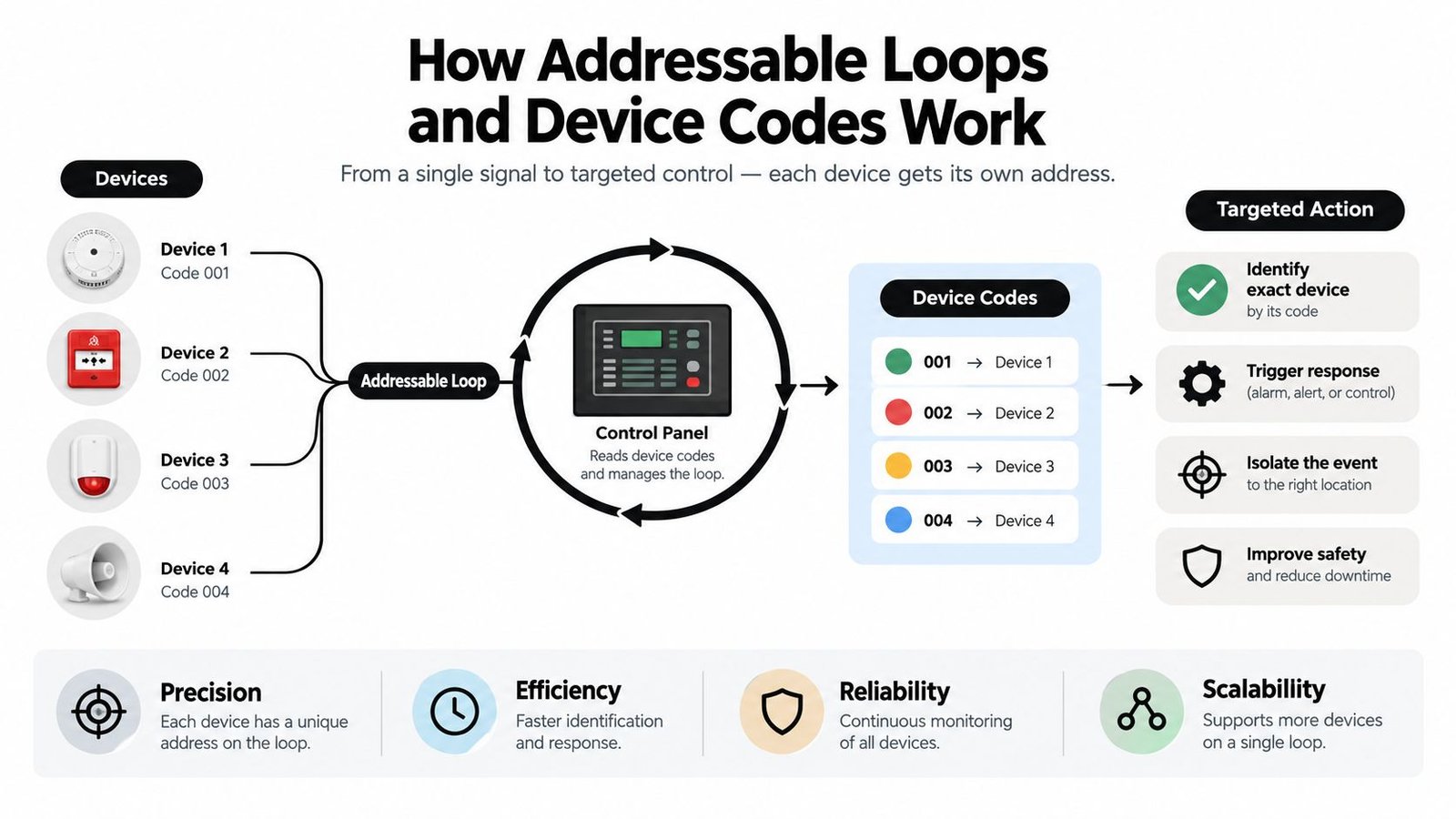
The postal-system analogy is useful. A conventional circuit tells the panel that something has happened within a broad delivery area. An addressable loop gives every device its own delivery address, so the panel can send messages to, and receive information from, a specific item.
What the panel is checking
In normal operation, the panel monitors the devices connected to the loop and interprets their reported condition. Depending on the device and system protocol, the panel may distinguish between an alarm condition, a fault, a communication problem, or a maintenance issue. The engineer then sees more than a generic circuit indication.
That difference affects everyday management:
- Alarm location: The panel can identify the device and its programmed location, helping the response team investigate the right area.
- Fault-finding: A single detector issue can be separated from a genuine alarm event, reducing the need to search every device on a large circuit.
- Cause and effect: The system can be programmed to control outputs and responses for more complex buildings, such as activating selected sounders, releasing doors, or sending signals to connected equipment where the design requires it.
- Maintenance information: A recurring issue at one device can point to contamination, an unsuitable environment, damage, or a developing fault.
A UK addressable fire alarm panel uses individually addressed devices on one or more loops. This allows the panel to identify the exact device and location that activated, supports more detailed fault diagnosis and incident response, and enables more complex cause-and-effect programming for larger or multi-zone buildings. UK installations are also expected to align with BS 5839-1 and relevant EN 54-2/4 requirements, as explained in this UK guide to fire alarm panel selection.
Loop design is more than connecting cable
The installer must consider the building's layout, device type, cable route, isolator positions, sounder requirements, interfaces, and the consequences of a cable fault. A loop may serve several areas, but that doesn't mean devices can be placed without thought. Poorly planned device descriptions are also a problem. “Detector 14” tells an operator much less than a clear, maintained location description.
Commissioning matters just as much as installation. Every device should be labelled in a way that matches the panel's text, drawings, zone plan, cause-and-effect schedule, and handover information. If a detector is moved during refurbishment but the panel description isn't updated, the technical precision of the system becomes misleading.
For a property manager, the useful question is not just whether a panel is addressable. Ask whether the loop layout, device labels, drawings, programming, and maintenance records will remain accurate after tenants change, rooms are subdivided, or plant is relocated.
Addressable vs Conventional Fire Alarm Systems
The choice between systems shouldn't be reduced to “basic” versus “smart”. A conventional system may be entirely appropriate for a small property with a straightforward layout and limited expansion plans. An addressable system is usually more compelling where the building has multiple floors, many occupants, complex plant, several tenants, or a realistic prospect of alteration.
The cost comparison also needs care. Conventional equipment can appear cheaper at the purchase stage, while addressable equipment involves intelligent field devices, programming, commissioning, and more detailed design work. On a complex site, however, the value of quicker fault identification and better information may outweigh the attraction of a lower initial specification.
| Feature | Conventional System | Addressable System |
|---|---|---|
| Alarm indication | Reports the affected zone | Identifies the programmed device and location |
| Wiring approach | Devices are grouped into zone circuits | Devices communicate on one or more monitored loops |
| Fault diagnosis | The engineer may need to investigate a wider area | The panel can identify an individual device or communication issue |
| Programming | Generally simpler cause-and-effect arrangements | More detailed cause-and-effect options for complex sites |
| Expansion | May require careful zone planning or additional equipment | Can offer more flexible expansion, subject to panel, protocol, and loop limits |
| Best fit | Smaller, uncomplicated premises | Larger, multi-zone, multi-occupancy, or changing premises |
| Maintenance skill | Straightforward for competent engineers familiar with the equipment | Requires suitable training, software, programming knowledge, and manufacturer support |
Where conventional still makes sense
A small shop, compact office, or simple low-complexity property may not gain enough operational value from an addressable panel to justify the additional design and programming requirements. The fire risk assessment, building layout, occupancy, escape arrangements, and future plans should determine the system category and architecture.
Conventional systems also have a practical advantage where the local team needs a simple interface and the installation contains few circuits. Simplicity can reduce confusion, but only if the zone plan remains accurate and the response procedure explains how the area should be searched.
Property managers comparing fire alarm work with wider electrical infrastructure may find it useful to review what a commercial electrical panel project typically involves. Fire alarm power supplies, interfaces, and containment should still be designed as life-safety systems, not treated as an ordinary extension of general electrical work.
Where addressable earns its place
An addressable panel is more suitable when the response team needs to know precisely which device has operated, when a building has several occupiers, or when the system must interact with other life-safety functions. It can also make refurbishment planning easier, provided the chosen protocol and panel have sufficient capacity and the installer documents every change.
The hidden trade-off is competence. An addressable system isn't automatically easier to maintain. Engineers need access to the correct programming tools, manufacturer information, device compatibility details, and reliable records. A poorly commissioned addressable system can create confusing descriptions, nuisance faults, and dependence on one installer.
For background on the limitations and typical use of zone-based equipment, see this guide to conventional fire alarm systems. Use it as part of a site-specific decision, not as a substitute for a fire risk assessment.
Tackling the UK False Alarm Epidemic
An addressable panel can tell you exactly which detector generated an unwanted alarm. It can't clean a contaminated detector, correct a poor choice of sensor, stop steam entering a detection chamber, or teach staff how to use a manual call point responsibly.
The scale of the operational problem is clear in official data for England. Fire and rescue services attended 250,341 fire false alarms in the year ending June 2025, including 169,717 caused by apparatus and 75,941 due to good intent, according to the UK fire and rescue incident statistics. Those figures describe England rather than South Wales, but they show why false-alarm control belongs in the buying conversation.
London Fire Brigade also stresses that most automatic fire alarm signals aren't actual fires in its guidance for business premises. Better pinpointing can make investigation more efficient, but it doesn't make an unsuitable or neglected detection system quiet.

Start with the cause, not the panel
A good false-alarm review examines the environment around the device. A detector near a loading bay may face dust or vehicle fumes. A kitchen-adjacent detector may respond to normal cooking activity. A sensor in a bathroom corridor may be affected by steam. Building work can introduce contamination that remains after contractors leave.
The remedy might involve a different detector type, repositioning, better ventilation, revised protection, clearer staff procedures, or more disciplined cleaning. Depending on the risk assessment, a multi-sensor device may be more appropriate than a single optical detector, but the installer should justify that choice against the environment and required performance.
Make the panel part of a management process
Use the event history to identify patterns rather than repeatedly resetting the same device. Record the location, time, activity in the area, weather or process conditions where relevant, and any action taken. A recurring alarm from one device needs investigation, not a permanent instruction to ignore it.
Property managers should also make sure occupants know what the alarm means and what they must do. Training should cover cooking, aerosols, dust-producing work, manual call points, isolation procedures, contractor control, and escalation. Any temporary isolation needs authorisation, a defined duration, compensating measures where necessary, and a clear return-to-service check.
A panel that pinpoints every nuisance alarm can improve accountability. It can also expose a maintenance and management problem that a vague zone indication allowed people to overlook.
Ask prospective installers how they will measure success. The answer shouldn't be “the panel is addressable”. It should cover detector selection, device placement, investigation records, cleaning, staff behaviour, contractor activity, and the process for reviewing repeat events.
Navigating BS 5839-1 and UK Compliance Standards
A panel specification cannot compensate for a weak fire risk assessment. For a commercial property in South Wales, the assessment should define the hazards, occupancy profile, escape strategy, protected areas, alarm audibility or visibility, required interfaces, and system category. The addressable panel must then support that design and provide usable information for operation, testing, servicing, and future inspection.
For non-domestic premises, the current edition is BS 5839-1:2025, which came into force on 30 April 2025. The update sets expectations around connected-panel cybersecurity, battery-backup calculations, and documentation. These requirements should be checked against the standard itself and the responsible person's design brief, with practical commentary available in this summary of the 2025 fire alarm standard changes. A vendor summary can help explain the subject, but it should not replace the applicable standard or competent design advice.
Connected systems need a security conversation
Network connectivity can support remote monitoring, management information, and links to other building systems. It also adds failure points and access requirements that do not arise in the same way with a standalone panel. The design team should document who can access the system, how programming changes are authorised, which devices or services connect to it, and how communication faults are reported.
Ask for the connection boundary, user permissions, update responsibilities, event-logging arrangements, and handover information. “It connects to the network” is not a sufficient specification. A life-safety system must continue to provide clear local indications and dependable operation if a connected service is unavailable. Convenience features must not obscure the source of an alarm or make fault investigation harder.
Documentation is part of the installation
The handover should give the responsible person a working record of the installed system, rather than a collection of disconnected certificates. Depending on the project, it should include:
- System description: The areas protected, operating principles, and devices or interfaces included in the design.
- Drawings and zone plan: Accurate device locations, references, panel positions, interfaces, and protected areas.
- Cause-and-effect schedule: The response to each relevant alarm, fault, or input.
- Battery calculations: Evidence that the power arrangement matches the design and applicable requirements.
- Configuration records: Panel programming, device descriptions, software information, and authorised changes.
- Maintenance information: Test arrangements, servicing requirements, fault reporting, and responsible-person instructions.
EN 54-2/4 considerations apply to equipment and control-panel selection for UK systems, alongside the design and application requirements of BS 5839-1. Ask the installer to identify relevant product approvals and explain how the complete installed system meets the agreed design brief.
A detailed event history only helps if it remains accurate and is reviewed. Tenant alterations, device replacements, and changes to cause and effect must be reflected in the records. Otherwise, the panel may identify an event precisely while directing staff to information that no longer matches the building.
Sizing Loops and Budgeting for South Wales Sites
Loop capacity is where a seemingly sensible quotation can become a poor long-term decision. A panel may support a certain number of devices in the manufacturer's specification, but the design also has to account for sounders, interfaces, isolators, cable conditions, environmental factors, alarm loads, and the expansion a property manager expects after refurbishment.
UK specification information for addressable panels commonly includes up to 200 devices per loop and 24 hours of standby plus 30 minutes of alarm battery backup, with programmable sounder and output circuits, as shown in this Notifier Pearl addressable fire system specification. Those are useful benchmarks, not permission to fill every loop to its published limit.
Leave room for the building's next phase
Engineers should generally keep loop loading below 80% of capacity to preserve expansion headroom and support reliable communications, according to the same specification source. A warehouse that is fully loaded on day one may have no practical room for new detection, additional sounders, interface modules, or a revised layout when racking and partitions change.
For a South Wales property manager, the calculation should reflect the actual estate:
- A compact office may need a modest single-loop arrangement if the risk assessment and building layout support it.
- An HMO or mixed-use property may need more careful separation of occupier areas, shared routes, and interfaces.
- A logistics or industrial site may need several loops, staged expansion, and a panel network strategy rather than one crowded loop.
Panel pricing varies widely. Current UK market listings show single-loop and multi-loop panels ranging from approximately £367 to £5,780, as recorded in the available UK fire alarm installation cost guide. Those figures describe equipment listings, not a complete installed project. Labour, cabling, containment, devices, batteries, commissioning, certification, monitoring, access equipment, and remedial building work can all affect the final budget.
Price the lifecycle, not just the cabinet
Ask for separate costs for the panel, field devices, loop cabling, sounders, interfaces, power supplies, programming, commissioning, documentation, training, monitoring, and future alterations. Check whether replacement devices will remain available and whether another competent engineer can access the system if the original installer is unavailable.
The cheapest quotation can become expensive when the panel lacks expansion capacity, the protocol restricts device choice, or the documentation is too poor to support future work. A slightly more capable design may be easier to adapt, but it still needs to be justified by the risk assessment and property plans.
Maintenance Protocols and Choosing a Local Installer
An addressable fire alarm panel is a managed safety system, not a fit-and-forget appliance. The responsible person needs a written routine for user checks, fault reporting, contractor control, alarm investigation, record keeping, and planned servicing. The exact testing and servicing arrangements should follow the applicable design, standards, manufacturer instructions, risk assessment, and advice from a competent fire alarm professional.
Routine checks should confirm that the panel is healthy, access hasn't been obstructed, indicators are understood, and any isolated or disabled point has been authorised and recorded. Servicing should examine the panel, power supply, batteries, devices, loop communications, alarm outputs, interfaces, event history, cause and effect, and the physical condition of equipment. A clean certificate without meaningful remedial advice isn't enough.

Questions to ask before appointing an installer
A local company should be able to explain the proposed design in plain language and show how it relates to the building's risks. Ask for evidence of:
- Relevant experience: Similar warehouses, HMOs, offices, retail units, or mixed-use premises, not just domestic alarm work.
- Manufacturer competence: Familiarity with the proposed panel, device protocol, programming software, commissioning process, and replacement parts.
- Documentation quality: Clear drawings, device descriptions, cause-and-effect information, battery calculations, certificates, and user guidance.
- Engineer checks: Appropriate identity checks and site procedures for engineers entering occupied properties, with DBS-checked personnel where the project requires it.
- Contractor assurance: Accreditations such as SafeContractor can form part of your due diligence, alongside insurance, references, and evidence of competent work.
- Aftercare: A defined fault response process, planned maintenance, support for alterations, and a route to update records after changes.
A practical downloadable fire safety checklist can help organise a site walkaround, but it shouldn't replace a professional fire risk assessment or a standards-based inspection. For monitored premises, discuss how the panel will connect to a 24/7 Alarm Receiving Centre, how signals will be verified, who receives alerts, and what happens if the communication path or power supply fails.
Wisenet Security Ltd is one South Wales and South West option for conventional and addressable fire alarm design, installation, monitoring, and maintenance, with services covering areas including Cardiff, Newport, Swansea, Bristol, and surrounding locations. The right supplier is the one that can design for the actual building, document the system accurately, and remain involved when false alarms, refurbishments, faults, or tenant changes test the installation.
If you manage a commercial property, HMO, warehouse, or mixed-use site in South Wales, ask Wisenet Security Ltd for a site-specific review of your addressable fire alarm panel requirements, loop capacity, false-alarm risks, and maintenance arrangements. Visit Wisenet Security Ltd to discuss a compliant design and ongoing support for your building.