Pet Friendly Burglar Alarms: How They Actually Work
A sensor that ignores a 25 kg dog on the floor can still be triggered by that same dog climbing onto a sofa, so the actual fix is placement and system layout, not the “pet-friendly” label alone. Pet-friendly burglar alarms reduce avoidable activations by filtering animal-sized movement, but they can't promise a pet-proof home or zero false alarms.
You know the problem if you've been woken by a siren in the early hours, found your cat staring innocently from the landing, and then wondered whether the alarm can tell the difference between an animal and an intruder. In the UK, Which? surveyed 2,083 people in February 2019 and found that 21% said a pet had triggered their burglar alarm, while a further 9% reported a false alarm caused by an animal outside the home. UK security guidance summarises those findings and the false-alarm challenge.
That frustration has an engineering cause. A motion detector doesn't understand “dog”, “cat”, or “burglar” as categories. It detects changes in heat and movement within defined zones, then applies rules about the size and pattern of the detected object. The detector can ignore a pet walking where the manufacturer expects it to walk, but stairs, furniture, sunlight, radiators, and unusual behaviour can move the animal into a part of the detection field where the filter no longer helps.
Table of Contents
- Why Pet Owners Need a Different Kind of Alarm
- The Sensor Technologies That Actually Ignore Pets
- Placement and Mounting That Prevents False Triggers
- Bell-Only, App Alerts and Monitored Systems Compared
- UK Standards and Police Response You Should Know
- Costs, Maintenance and Long-Term Reliability
- Common Myths About Pet Friendly Burglar Alarms
- Working With a Local Installer for a Pet Safe Setup
Why Pet Owners Need a Different Kind of Alarm
At three in the morning, the alarm gives you one message: movement has been detected. It doesn't know that your dog has left its bed to drink, or that your cat has crossed the hall. A standard passive infrared, or PIR, sensor sees a changing infrared signature across several zones. A warm moving animal can therefore look sufficiently similar to a person to activate the alarm.
The important question isn't whether a detector has a pet-friendly badge. Ask which movement it has been designed to ignore, in which part of the room, and under what installation conditions. A detector may use lens design, signal processing, and object-size filtering to disregard a smaller heat source near the floor. That design assumes the pet remains below the detector's effective masked zone and doesn't use nearby furniture as a launch point.
What the detector is actually measuring
A PIR sensor is passive because it doesn't transmit energy into the room. It receives infrared radiation and looks for changes as a warm object moves between detection zones. A person crossing those zones creates a changing pattern, while a small animal moving low across the floor may produce a smaller pattern that the detector is programmed to reject.
The difficulty is that weight isn't directly measured like a bathroom scale reading. The detector responds to the thermal image and movement pattern presented to its lens. A 25 kg dog walking low may be ignored under a standardised design condition, yet the same dog standing on a sofa can occupy a taller, more human-like section of the field.
Why the UK threshold needs context
Pet immunity is commonly discussed alongside BS EN 50131-2-2, the standard for passive infrared detectors used in intruder alarm systems. Practical guidance describes a typical design target of up to 25 kg, provided the animal stays below the masked detection zone. The test method uses a 25 kg dog-shaped thermal mass, so a product that passes is designed not to alarm under that defined condition. The detector-siting guidance explains the standardised approach and its installation limits.
That doesn't make every room safe for every animal. A cat climbing a bookcase, a dog running up an open staircase, or a pet resting in a warm patch beside a radiator changes the conditions. Treat the rating as a design reference, not permission to install the sensor anywhere.
Practical rule: Pet immunity describes what the detector is designed to ignore. It doesn't describe every route your pet can take through the house.
The Sensor Technologies That Actually Ignore Pets
Most residential pet-friendly burglar alarms begin with a pet-immune PIR. Installer guidance commonly describes practical immunity thresholds around 20 kg to 25 kg, but it also stresses that mounting height, room geometry, furniture, stairs, and animal behaviour affect the result. This UK guidance explains how those variables influence PIR performance.
The technology matters, but the room decides whether the technology succeeds.
Comparing the main sensor families
| Sensor type | How it detects | Pet immunity rating | Typical use |
|---|---|---|---|
| Pet-immune PIR | Detects changing infrared patterns and filters smaller, lower movement | Good when the pet stays below the masked zone | Main rooms, halls, and circulation areas with controlled layouts |
| Dual-technology sensor | Combines PIR with another detection method and requires a compatible confirmation pattern | Better tolerance in difficult rooms, but not unlimited | Rooms with environmental movement or a higher false-alarm risk |
| Microwave sensor | Detects movement through microwave changes | Poor as a standalone choice around pets because it doesn't reliably classify animal size | Specialist applications, usually with another technology |
| Photoelectric beam | Detects interruption across a defined line | Strong where pets remain outside the beam path | Perimeters, corridors, gates, and restricted routes |
| Door or window contact | Detects opening of a protected door or window | Very strong because it doesn't monitor room movement | External doors, accessible windows, and pet-limited rooms |
A pet-immune PIR is usually the sensible starting point. Lens masking can remove lower zones, while signal processing helps distinguish small movement from a person. The weaknesses appear when the animal climbs, jumps, or travels across stairs. A cat on a worktop isn't behaving like a floor-level pet, even if it weighs very little.
A dual-technology detector can reduce unwanted activations by requiring compatible signals from two sensing methods. That can help in rooms with challenging heat or movement patterns, although it adds equipment cost and doesn't remove the need for careful siting. A standalone microwave detector is generally a poor fit for a home with free-roaming animals because movement, rather than animal size, remains its central input.
Contacts and beams often produce the cleanest solution for households where pets occupy predictable spaces. Protect the doors and windows, then use selected internal detection only where the pet can't reach the active zones. Wisenet's guide to door and window sensors is useful when planning that perimeter-first arrangement.
Placement and Mounting That Prevents False Triggers
A pet-immune detector works by controlling what it can see. For many pet-friendly PIR installations, guidance places the unit around 1.8 to 2.4 metres above the floor, with the final height and angle set by the manufacturer's instructions and the room. The placement infographic below illustrates the practical principles.
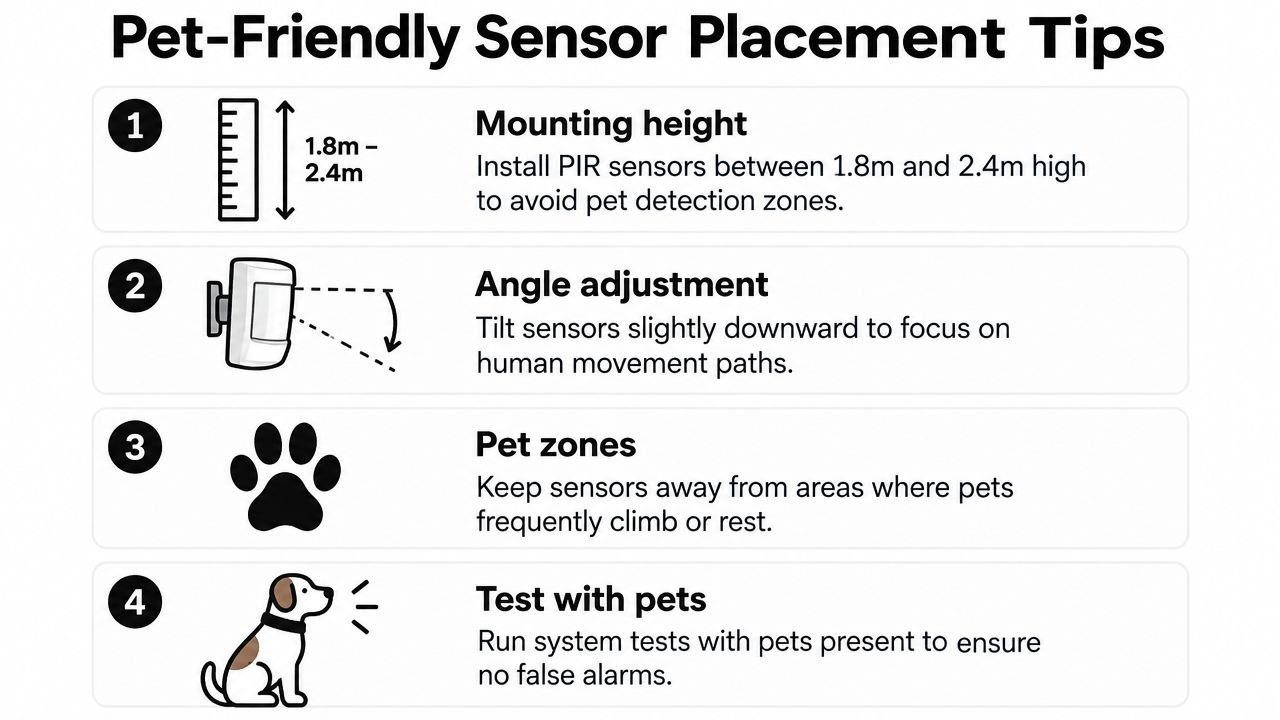
Mounting height alone won't fix a bad field of view. A sensor aimed across a staircase may see a cat climb directly through multiple detection zones. A detector facing a sofa may see the dog jump onto the cushions and suddenly present a taller heat signature than the system was configured to ignore.
Mask the routes, not just the sensor
Many pet-immune PIRs use lens shutters or masking sections. These physical covers block selected detection zones, allowing an installer to remove the areas that overlap a sofa, stair run, cat flap, or other pet route. Masking must follow the product instructions. Randomly covering part of a lens can create gaps that an intruder can exploit.
Consider a downstairs hallway where a cat uses the stairs. A detector facing the staircase may activate whenever the cat climbs, even if the detector performs correctly on floor-level movement. Repositioning it to look across the likely human approach route, then masking the lower zones that intersect the stairs, can restore a more predictable detection pattern.
Environmental details matter just as much:
- Sunlight: Direct rays through a window can create a hot patch that changes as the sun moves.
- Radiators: Warm surfaces can alter the background temperature in one corner.
- Curtains: Moving fabric can cross the detector's view and produce changing infrared patterns.
- Stairwells: Open stairs give pets access to higher parts of the room and several detection zones.
- Furniture: Sofas, shelving, and worktops create climbing platforms that defeat a floor-level assumption.
Before blaming the detector, check the geometry. If your vehicle alarm is also creating nuisance activations, the troubleshooting principles in this guide to stop your car alarm from going off offer a useful reminder that placement, environment, and maintenance can matter as much as the alarm device.
The system should be tested while pets move normally through the home, not only while a person walks past the sensor. A good installation makes the pet's usual route irrelevant to the active zone and preserves a clear human approach path.
Bell-Only, App Alerts and Monitored Systems Compared
Pet-friendly detection determines whether an alarm activates. Signalling determines what happens next. A bell-only system sounds locally, an app-based system contacts you, and a monitored system sends an event to an Alarm Receiving Centre, or ARC, where an agreed response process begins.
| Signalling type | Response path | Best for pet homes | Weakness for pet homes | Typical ongoing cost |
|---|---|---|---|---|
| Bell-only | External sounder and local deterrence | Owners who want a straightforward system without a monitoring service | No independent verification or remote response | No monitoring fee, with servicing still required |
| App alerts | Push notification to the owner | People who can check alerts quickly and contact a keyholder | Depends on connectivity, phone access, and the owner's availability | Service and connectivity costs vary |
| Professionally monitored | ARC contacts keyholders and follows the agreed escalation route | Households needing a structured response when nobody is available | More demanding installation, maintenance, and response procedures | Contracted monitoring charge varies |
A bell-only system can be perfectly reasonable for a small home with attentive neighbours and a clear plan. Its limitation is simple: if a cat triggers it while you're away, the bell can't explain the event or decide whether the sound represents an intrusion.
App alerts give you more information and control. They also transfer the responsibility to you. If you're driving, asleep, abroad, or dealing with a poor mobile connection, the notification may not produce a useful response.
A monitored system adds an ARC and nominated keyholders. Depending on the arrangement and police requirements, the ARC may provide keyholder-only handling or work within a police response process involving a Unique Reference Number, confirmed or unconfirmed alarm status, and verification requirements. Occasional pet-related activations still matter because repeated false alarms can undermine confidence in the system and affect response arrangements.
For a fuller explanation of the ARC process and monitoring roles, see this guide to what a monitored alarm system does. Choose the signalling path after deciding how your pets move through the property, not before. A response service can't compensate for a sensor that watches the wrong part of the room.
UK Standards and Police Response You Should Know
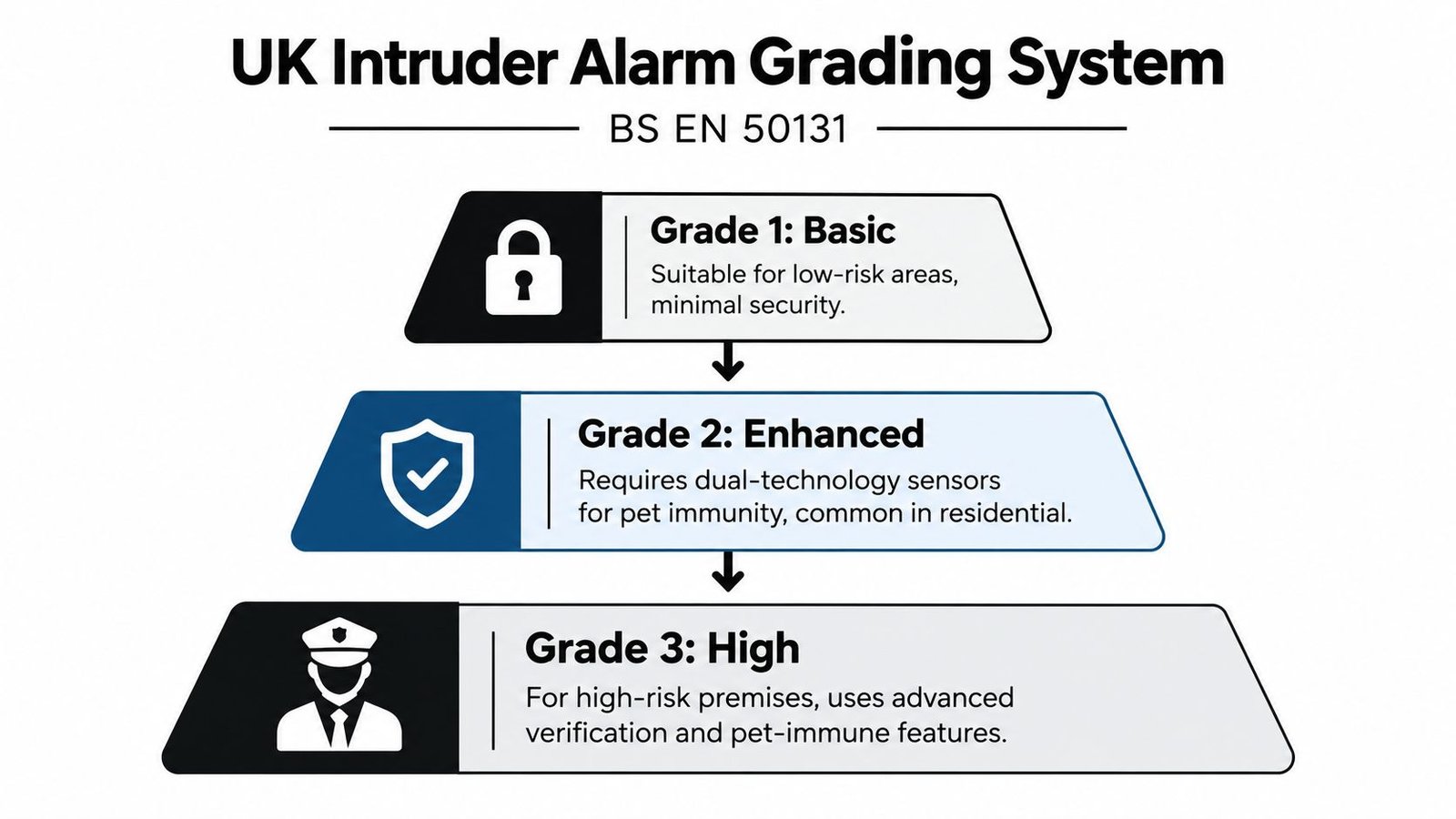
Pet immunity sits inside a wider UK alarm specification. BS EN 50131 covers the performance and grading of intruder alarm equipment, while installers also work to relevant installation and maintenance requirements. Pet-friendly design therefore involves more than choosing a detector with a suitable product description.
The passive infrared detector standard, BS EN 50131-2-2, gives pet immunity a measurable engineering context. The practical target often described in guidance is up to 25 kg, under defined conditions and with the animal below the masked detection area. The guidance on PIR siting sets out why compliance still depends on mounting and layout.
Why grading changes the conversation
Lower-risk domestic installations may use different equipment and signalling arrangements from higher-risk premises. A professional survey considers the property, the likely threat, entry points, communications path, and whether police response eligibility is required. The installer should specify a compatible panel, detectors, sounders, signalling equipment, and maintenance schedule as one system.
Police response is administered through the UK policy framework associated with the National Police Chiefs' Council, formerly ACPO. A system seeking police response generally needs the appropriate registration and a URN, together with procedures for managing false alarms and confirming events where required. Repeated nuisance activations, including those caused by poor pet planning, can lead to withdrawal of response.
That makes correct masking and commissioning more than technical housekeeping. If the installer ignores the manufacturer's instructions, leaves a stairwell in the active field, or fails to test the system with pets present, the household may experience both nuisance alarms and compliance problems.
Costs, Maintenance and Long-Term Reliability
There are no honest universal price bands for pet-friendly burglar alarms without surveying the property. A small wireless installation with carefully selected contacts is a different job from a larger wired system with several motion detectors, difficult cable routes, dual-technology devices, or monitored signalling.
A quote normally separates equipment, labour, commissioning, and any recurring monitoring service. The main cost drivers are:
- Property layout: More rooms and entrances require more protection points.
- Pet behaviour: A free-roaming cat may need a different design from a dog that stays in one room.
- Sensor mix: Contacts and beams can reduce reliance on internal motion detection, while difficult rooms may need dual-technology sensors.
- Installation route: Concealed cable runs, access between floors, and building construction affect labour.
- Required grade: Equipment and documentation can change when the system must meet a specific security grade or police-response arrangement.
- Service arrangement: Monitoring, call handling, and scheduled maintenance add ongoing commitments.
The relevant comparison is not the cheapest detector against the most expensive detector. It is the total cost of a reliable design against the disruption caused by repeated activations. Which? reported that 74% of households had experienced a false alarm overall, and reported that one in ten false burglar alarms were triggered by a pet. Its consumer reporting shows why nuisance alarms deserve attention beyond the product label.
| System tier | Hardware and installation | Monthly monitoring | Key maintenance tasks | Pet-home suitability |
|---|---|---|---|---|
| Bell-only arrangement | Varies with property size, wiring, and sensor mix | None | Battery, detector, sounder, and walk testing | Suitable where local response is practical |
| Wireless pet-immune kit | Varies with device selection, wireless coverage, and commissioning | Optional | Battery checks, firmware review, and pet walk tests | Useful for suitable layouts and less disruptive installation |
| Monitored system | Varies with grade, signalling, installation, and ARC requirements | Contract-dependent | Scheduled servicing, communications checks, and false-alarm review | Appropriate when a structured remote response is needed |
Maintenance prevents problems that pet immunity can't solve. Dust on PIR lenses, spider webs near sensors, weak backup batteries, temperature changes, and outdated smart-panel software can all create unreliable behaviour. UK false-alarm guidance also identifies insects and maintenance-related issues as part of the wider problem, rather than treating pets as the only cause. This facilities guidance discusses common triggers and prevention measures.
Carry out user walk tests as part of routine care, inspect sensors when furniture changes, and arrange professional servicing through a competent contractor at the interval specified for the equipment and system. Don't wait for a nuisance activation to reveal that the cat tree has moved into the detector's view.
Common Myths About Pet Friendly Burglar Alarms
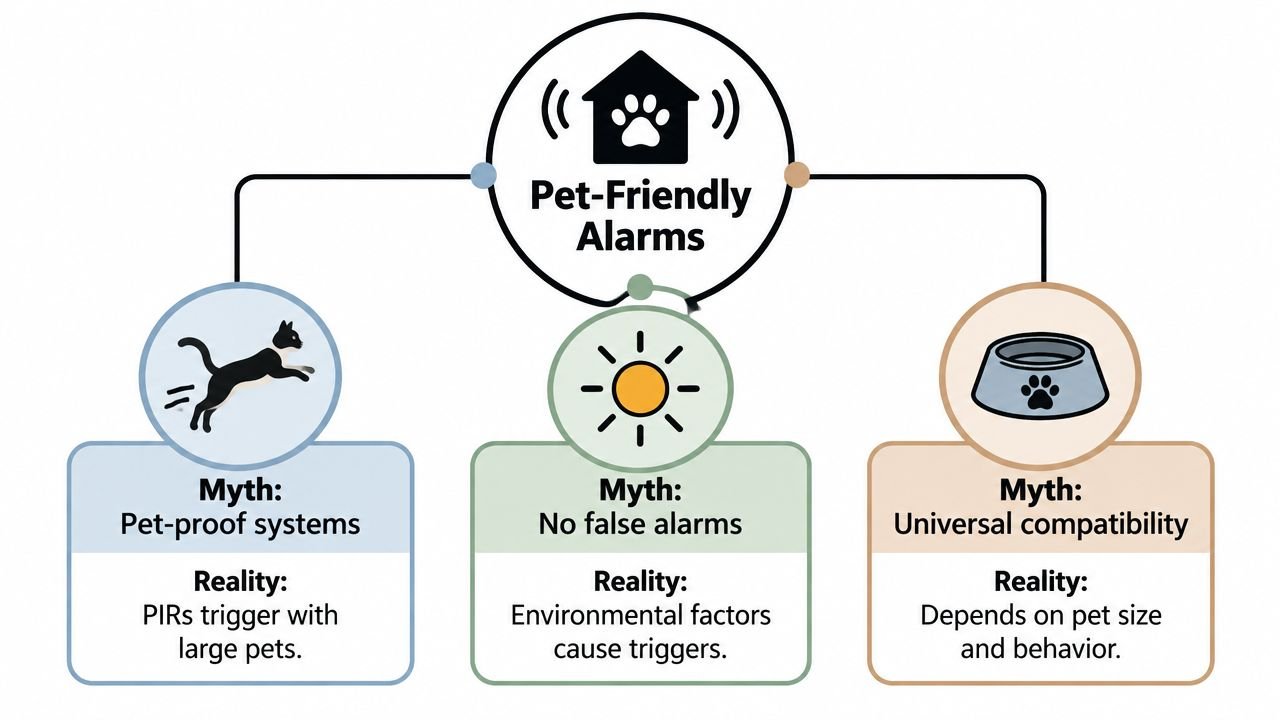
Marketing language often compresses a complicated design into two words. The safest way to evaluate pet-friendly burglar alarms is to test the claim against the animal's actual behaviour and the detector's field of view.
Myth one, pet-friendly means pet-proof
It doesn't. The detector may reject a pet moving below its masked detection zone, but the pet can still activate it after climbing onto a sofa, worktop, shelving unit, or stairs. A “pet-friendly” specification is conditional on the installation and the movement pattern.
Myth two, one detector covers every animal
A small cat and a large dog don't occupy the same thermal or physical space. One may stay low on the floor while the other reaches the upper detection zones when it jumps or climbs. The correct design may use different sensor types, selective masking, contacts, or part-setting for separate areas.
Myth three, higher sensitivity is safer
More sensitivity isn't automatically more security. Raising the detector's response can make it react more readily to the same heat changes, moving curtains, sunlight, or animal movement that caused nuisance activations in the first place. The safer approach is a suitable detection method with a deliberate field of view, not maximum gain everywhere.
Wireless pet collars don't tell an intruder detector what to ignore, and a sound-only alarm doesn't solve poor sensor placement. A reliable system layers perimeter protection with carefully chosen internal detection, then tests the arrangement under normal household conditions.
The honest question isn't “Will my alarm ignore my pet?” It is “Can my pet reach an active detection zone in a way that resembles an intruder?”
Working With a Local Installer for a Pet Safe Setup
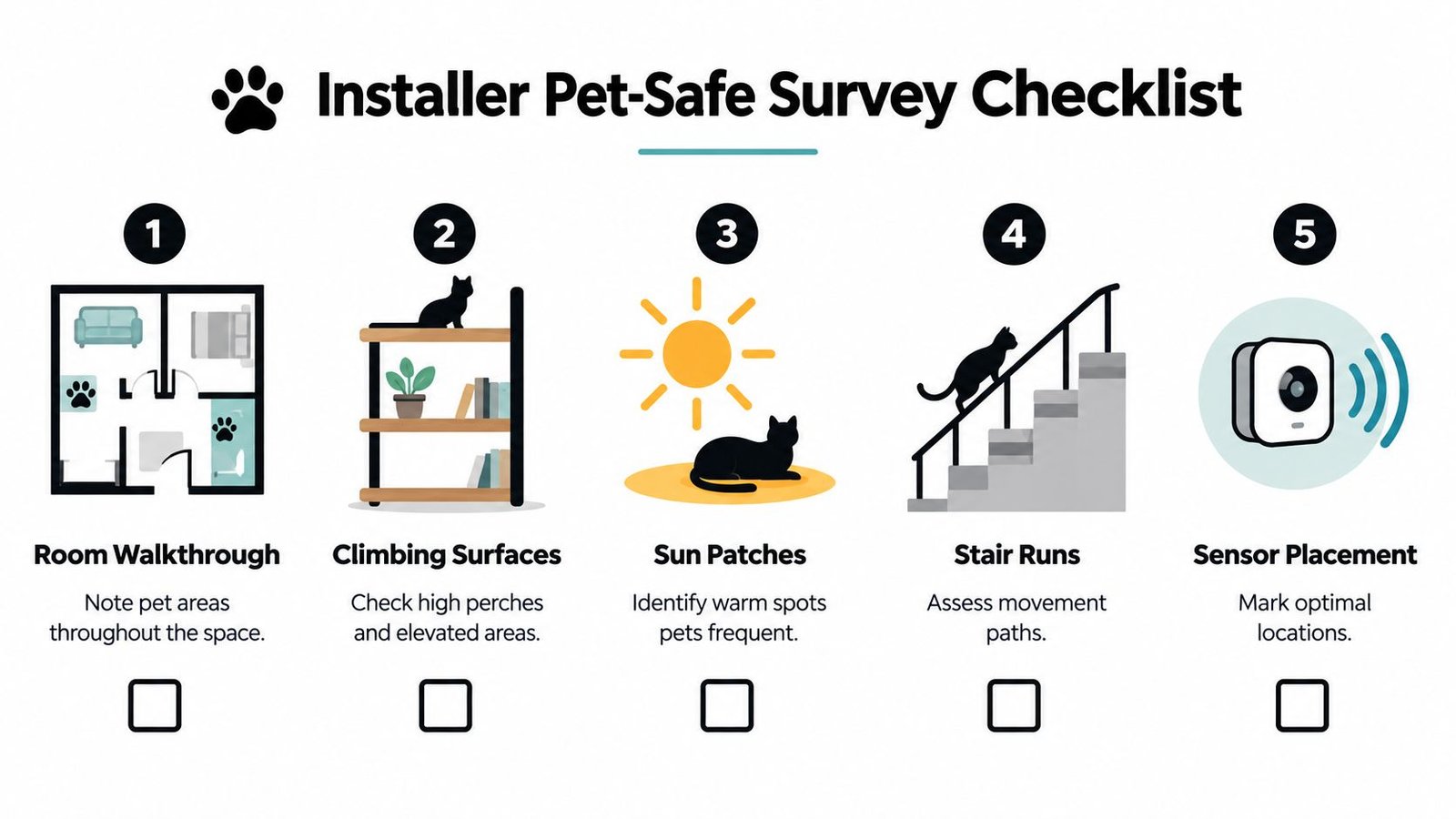
A competent installer should survey the home as a map of pet movement, not just count doors and windows. Walk through each room together and identify where the dog sleeps, where the cat climbs, how the animals use the stairs, which windows create sunny patches, and whether furniture is likely to move.
Ask the installer to explain the proposed sensor for each room. One room may suit a pet-immune PIR, another may need a dual-technology detector, and a third may be better protected with door and window contacts because the pet has unrestricted access to the floor area.
Use this survey checklist
- Walk every room: Mark normal pet routes, sleeping areas, feeding points, and access between rooms.
- Inspect climbing surfaces: Include sofas, shelves, worktops, cat trees, and stair landings.
- Check environmental conditions: Note sunlight, radiators, open fires, moving curtains, and ventilation.
- Design entry and exit behaviour: Set delays that allow the slowest household member and the pets to leave safely without rushing.
- Choose the sensor mix: Combine PIR, dual-technology, contacts, beams, and part-setting where the layout demands it.
- Commission with animals present: Walk-test the system while pets move naturally, including their evening and overnight routines.
- Complete the handover: Record user codes, demonstrate the app or keypad, explain part-setting, and document the maintenance plan.
- Review early performance: Arrange a follow-up discussion after the household has used the system and can report any unexpected movement or alerts.
Ask whether the contractor is NSI or SSAIB accredited if police response, documented procedures, or higher-grade installation is important to you. Accreditation doesn't replace a thoughtful survey, but it can help you assess whether the company works within recognised installation and maintenance frameworks.
The handover should leave you able to explain which sensors are active when pets are home, how to part-set the property, what an app alert means, and whom to contact after an activation. If the installer can't explain why a detector faces a particular route, ask for the design to be revised before accepting it.
Wisenet Security Ltd designs, installs, and maintains BS EN 50131 intruder alarm systems with pet-friendly sensors, bell-only options, mobile alerts, and monitored arrangements across South Wales and the South West. For a property-specific survey that accounts for stairs, furniture, pet routines, and entry points, visit Wisenet Security Ltd to request a consultation.