24/7 Security Monitoring: Your Complete Guide
If you run a shop, manage a warehouse, or own a home in South Wales, you already know the weak point. The building looks secure at 9pm, then something happens at 2am, nobody sees it straight away, and you find out after the damage is done. That's the test of 24/7 security monitoring. It's not about having cameras on a wall, it's about whether somebody can detect, verify, and escalate an incident while it's still unfolding.
Table of Contents
- What 24/7 Security Monitoring Actually Means
- How Different Monitoring Models Work
- Benefits for Homes and Businesses
- Technical Standards and Regulatory Requirements
- What Happens When Power or Connectivity Fails
- How to Evaluate and Choose a Monitoring Provider
- Next Steps for Protecting Your Property
What 24/7 Security Monitoring Actually Means
A Cardiff retailer comes in at opening time and finds a smashed door, stock missing, and a mess on the floor. The footage is there, but nobody watched the live feed, nobody verified the alarm, and nobody called for help until the owner arrived. That's passive recording, and it's too late to stop the crime.
24/7 security monitoring is different. It means cameras, sensors, and signalling paths are watched continuously, so an event can be detected, checked, and escalated in real time. In a professional setup, the system doesn't just store evidence, it creates a response chain.
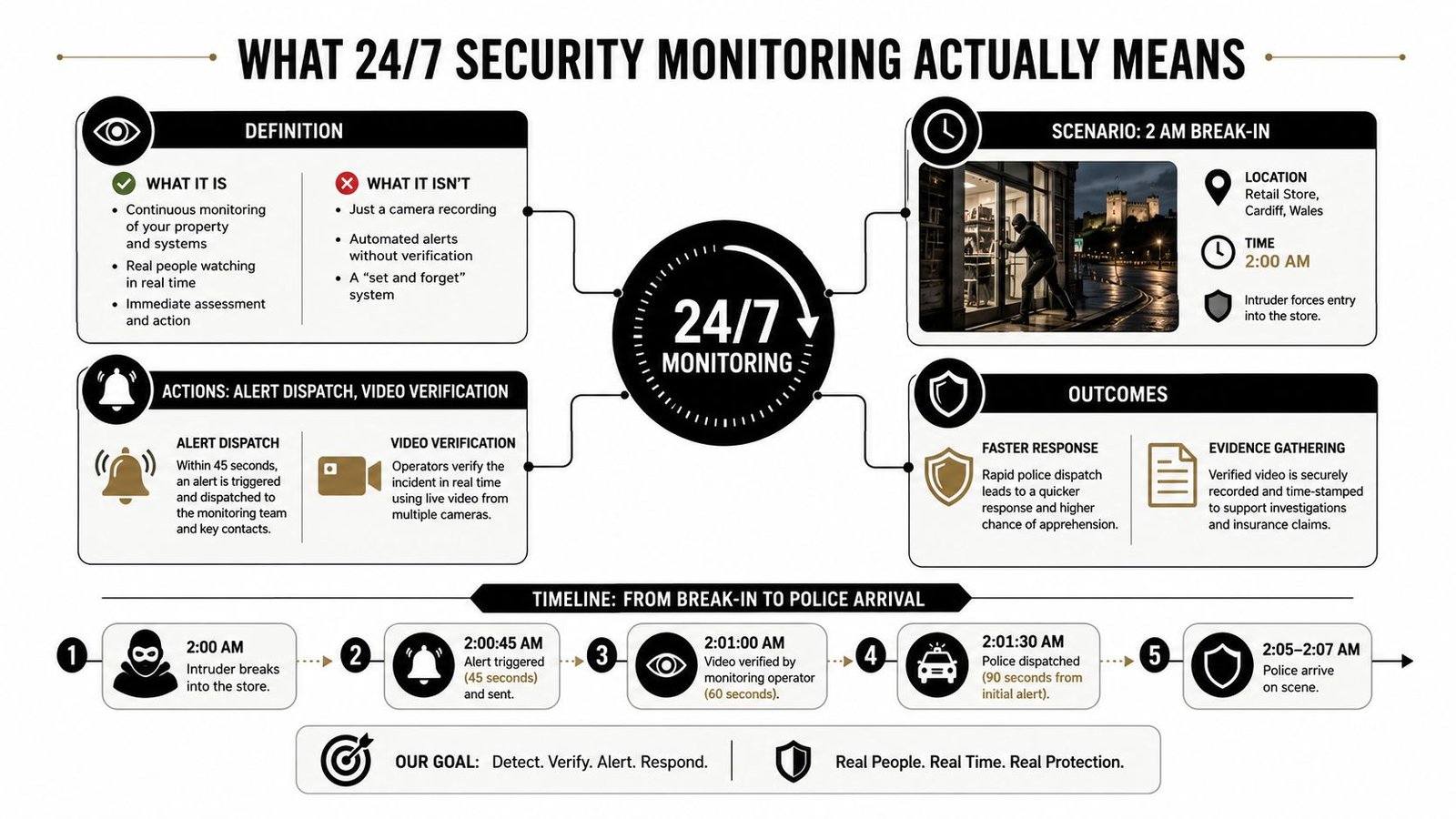
A proper monitored system usually includes cameras, intruder sensors, a communication path to an Alarm Receiving Centre, and a defined escalation process. If the site needs a deeper technical overview of the control room side, the 24/7 security operations center resource is useful because it shows how live monitoring is organised around alert handling and response discipline.
Practical rule: if no one is watching, verifying, and acting, you've got recording, not monitoring.
The difference matters because the value is in the sequence. A sensor trips, the alarm reaches the monitoring centre, an operator checks the event, and the right response follows. That could mean a phone call, a guard dispatch, or a police escalation where the system and the evidence meet the required standard.
For property owners, this is a response model, not a gadget purchase. The camera is only one part of it. The outcome depends on who sees the alert, how fast they see it, and whether the system can prove the event clearly enough to justify action.
How Different Monitoring Models Work
Not every monitored site needs the same setup, and that's where people waste money. A warehouse in Newport, a shop in Bristol, a Swansea car park, and a multi-tenant block all have different risk profiles, different operating hours, and different tolerance for false activations. If you buy the wrong model, you'll either overpay or leave gaps.
Active CCTV monitoring
Active CCTV monitoring means someone watches live video, either continuously or on triggered events. A warehouse in Newport might use this when yard activity, loading bays, and out-of-hours movement all need attention. The trigger is usually motion, alarm linkage, or an operator's visual review of unusual behaviour.
This model works best where human judgement matters. If a person is trespassing, tailgating, or loitering near a vehicle fleet, a trained operator can decide whether it's a real issue before it becomes one. That reduces noise and speeds up escalation.
Alarm signalling to an ARC
Alarm signalling is more straightforward. A retail shop in Bristol arms the system, a door contact or PIR trips, and the alarm panel sends the event to the monitoring centre. The ARC checks the signal and follows the agreed response path.
This is the right fit for sites that need solid after-hours coverage without live video review all day. It's common in shops, offices, and smaller premises where the main aim is fast escalation when a genuine intrusion happens.
Video verification and remote guarding
A Swansea car park is a better use case for video verification. The alarm or camera system flags an event, then the operator checks the clip or live feed before deciding whether it's real. That matters because car parks produce a lot of harmless movement, and unverified alarms burn time.
Remote guarding goes a step further. A site, such as a multi-tenant building, can use live operators to watch entrances, call out intruders, and coordinate response before anyone gets inside. That's more active, more expensive, and more useful on sites with repeated nuisance activity.
| Model | Trigger | Verification | Response Speed | Best For |
|---|---|---|---|---|
| Active CCTV monitoring | Motion, alarm link, operator review | Human live review | Fast | Yards, depots, high-risk estates |
| Alarm signalling to an ARC | Panel activation | Operator checks signal | Fast | Shops, offices, smaller premises |
| Video verification | Alarm plus image or clip review | Visual confirmation | Fast | Car parks, mixed-use sites |
| Remote guarding | Live feed and proactive patrol | Live operator judgement | Very fast | Multi-tenant buildings, vulnerable sites |
For a plain explanation of the alarm side, Wisenet's monitored alarm system guide is worth reading alongside this table. It helps you separate signalling from full video-led monitoring before you buy.
Benefits for Homes and Businesses
The main benefit is simple. A monitored system turns a silent event into a managed incident, and that matters whether you're protecting a family house or a commercial yard. The value shows up in deterrence, evidence quality, remote oversight, and fewer wasted callouts.
For homes, the obvious win is reassurance, but the stronger point is verification. If a Cardiff homeowner gets a real alert on a phone rather than a stream of false notifications, they can act quickly and avoid the guesswork that comes with a noise heard in the night. That's where monitored systems feel different from basic kits.
For businesses, the gains are operational. A logistics hub in Newport doesn't want staff driving across town for a false alarm if the issue is a faulty contact or a loose panel cover. A good monitoring setup reduces the number of pointless responses because someone checks the signal before anyone mobilises.
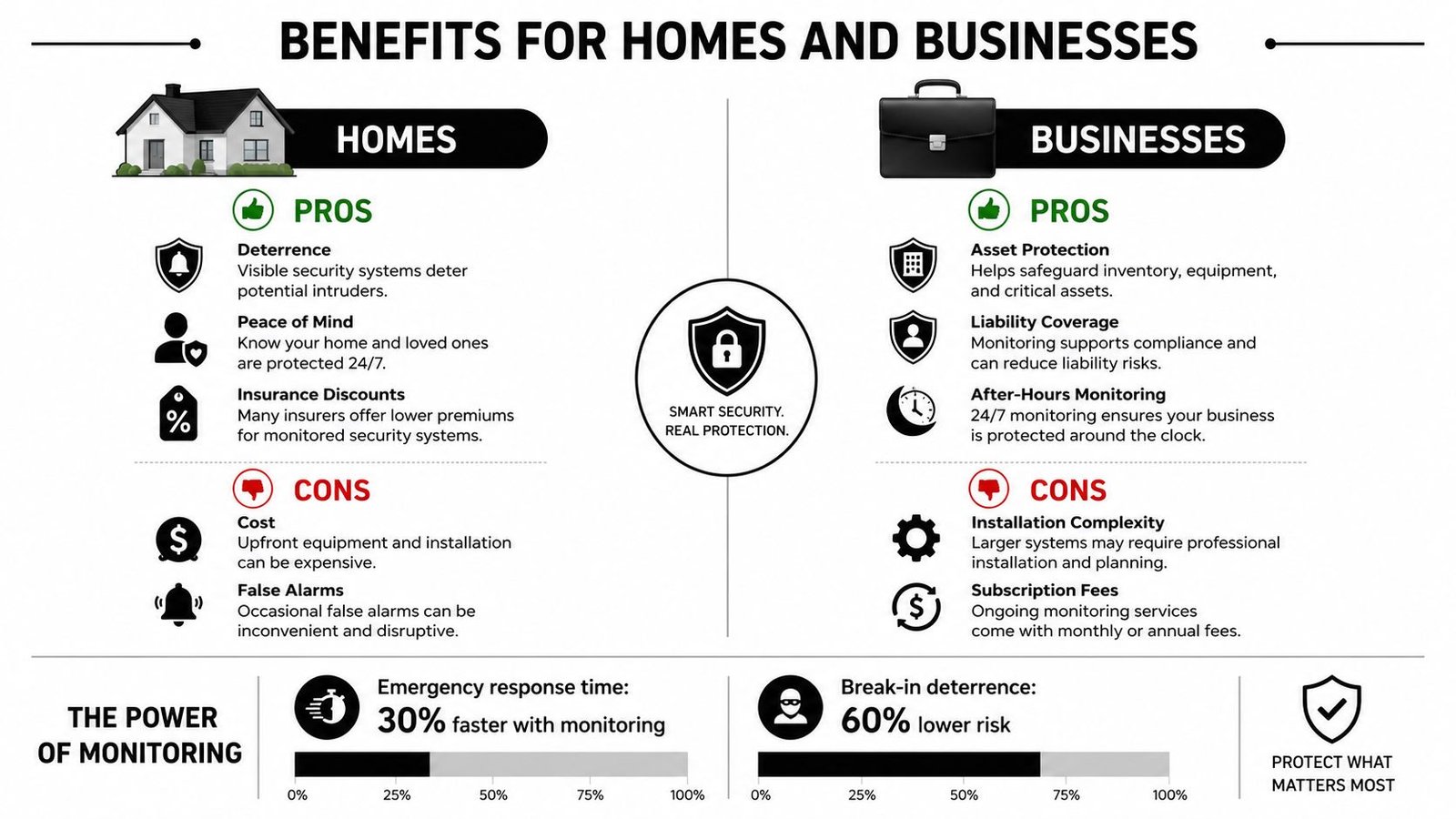
The financial logic is often ignored. Industry reporting cited the UK alarm-monitoring market at £520 million by 2025 (Zipdo), which shows how much money sits behind round-the-clock protection. That doesn't mean every site needs the same package, but it does show businesses are paying for resilience, not just hardware.
A monitored system is worth paying for when it prevents one ugly mistake, not when it looks impressive on a quote.
For property managers, remote access is another major advantage. You can check activity, hand over evidence, and keep records without driving to site for every incident. For insurers, better footage and faster verification can make a claim cleaner, because the evidence trail is clearer and less disputed.
If you want the operational idea behind monitored home systems, the embedded video below gives a useful visual overview.
Technical Standards and Regulatory Requirements
A lot of buyers ask the wrong question. They ask whether the system has cameras, alarms, and an app. The key question is whether the installation, signalling, and evidence handling are built to stand up when something goes wrong.
For intruder alarms, BS EN 50131 is the key reference point. In practice, that means the system isn't just fitted neatly, it's installed to a standard that supports proper grading, maintenance, and monitored signalling. A bell-only system can make noise, but that's not the same thing as a monitored installation with a clear response path.
CCTV brings a different layer of obligations. If footage is used for security, you still need to think about data handling, access, retention, and lawful use under GDPR and the Data Protection Act. That matters most on sites with shared entrances, staff areas, or public-facing coverage.
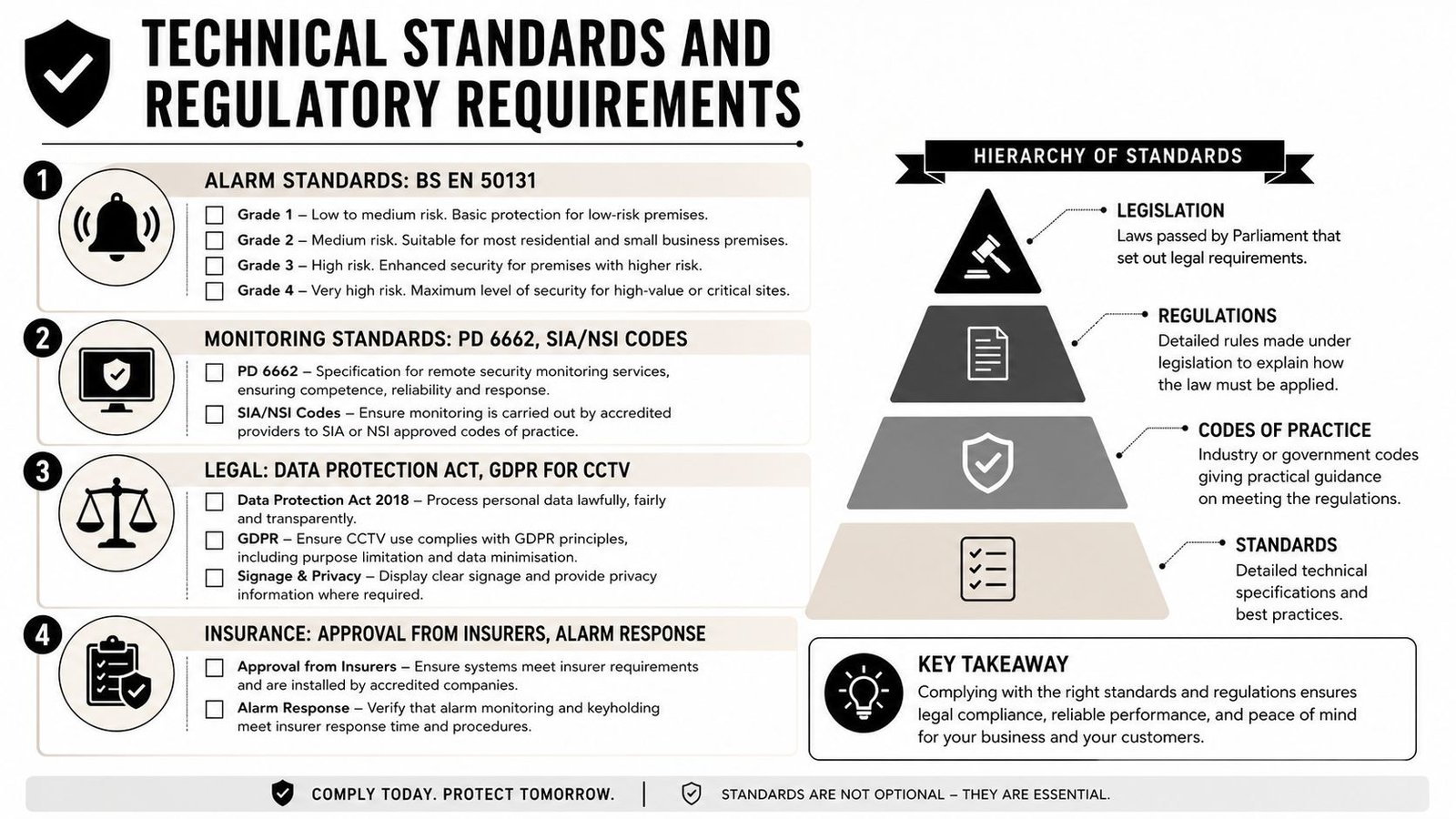
Insurance is the other pressure point. Some policies ask for monitored signalling, documented maintenance, and a system that meets the insurer's expectations for alarm response. If you skip those details, you can end up with a system that feels secure but doesn't satisfy the paperwork after a loss.
A sensible provider should be able to show you certifications, maintenance logs, and commissioning paperwork without drama. Wisenet's security systems and alarms inspection board is a useful example of the kind of documentation trail you should expect from a serious installer.
If the provider can't explain how the system is certified, maintained, and supported, keep looking.
The short version is this. Technical compliance isn't decoration, it's what makes the monitoring defensible. If you want police response eligibility, cleaner insurance conversations, and fewer disputes over whether the system was installed properly, the paperwork has to be right from day one.
What Happens When Power or Connectivity Fails
Most sales talk falls apart here. A system can look excellent on paper, then fail exactly when a power cut, broadband issue, or mobile outage knocks it offline. In South Wales, that's not a theoretical edge case, it's a planning issue.
You need to ask how the system behaves when the primary route drops. Does it use dual-path signalling. Does it have cellular backup. Does it keep recording locally, then resend alerts when the connection returns. If the answer is vague, the setup isn't resilient enough for a warehouse, landlord, or car park that stays exposed overnight.
A small but important point is power support for the network gear itself. If your router dies, your remote access and signalling can vanish even if the cameras are still physically powered. For that reason, a guide on best router UPS options is worth checking if you're serious about continuity rather than just uptime on a brochure.
The monitoring side should also answer how long footage is buffered locally, whether alerts queue during an outage, and what proof is retained for insurers after a gap. That's not a luxury question. It decides whether you have a record of the incident or just a story about what probably happened.
Ask this directly: what still works when the ISP, SIM, or mains supply fails.
If you're already maintaining an alarm, the battery side matters too, so review Wisenet's alarm system battery replacement information alongside any resilience plan. A dead backup battery turns a nominally monitored system into a vulnerable one faster than most owners realise.
The hard truth is that “24/7” only means something if the system survives interruption. Buy the design, not the promise.
How to Evaluate and Choose a Monitoring Provider
Start with accreditation, then move to response discipline. Too many buyers compare monthly prices and forget to ask who is answering alerts, what they do with them, and how the provider proves it. That's the wrong buying method.
Look for ARC accreditation, engineer credentials, and clear escalation rules. Ask whether the provider supports video verification, can integrate with your current CCTV or alarm kit, and offers maintenance on the same contract. If you're in South Wales or the South West, local knowledge matters because a provider who knows the area understands access patterns, weather issues, and the practicalities of calling out help at unsociable hours.
Here's the shortlist I'd use in a consultation:
- Accreditation: Check the operator's monitoring credentials and ask how their alarm centre is governed.
- Response process: Ask who reviews alerts, what gets verified, and when escalation happens.
- Technology fit: Confirm they support your cameras, panels, and remote access tools.
- Contract terms: Watch for long lock-ins and vague cancellation clauses.
- Support model: Make sure maintenance, fault reporting, and aftercare are clearly defined.
- Cost clarity: Ask what's included, what isn't, and what triggers extra charges.
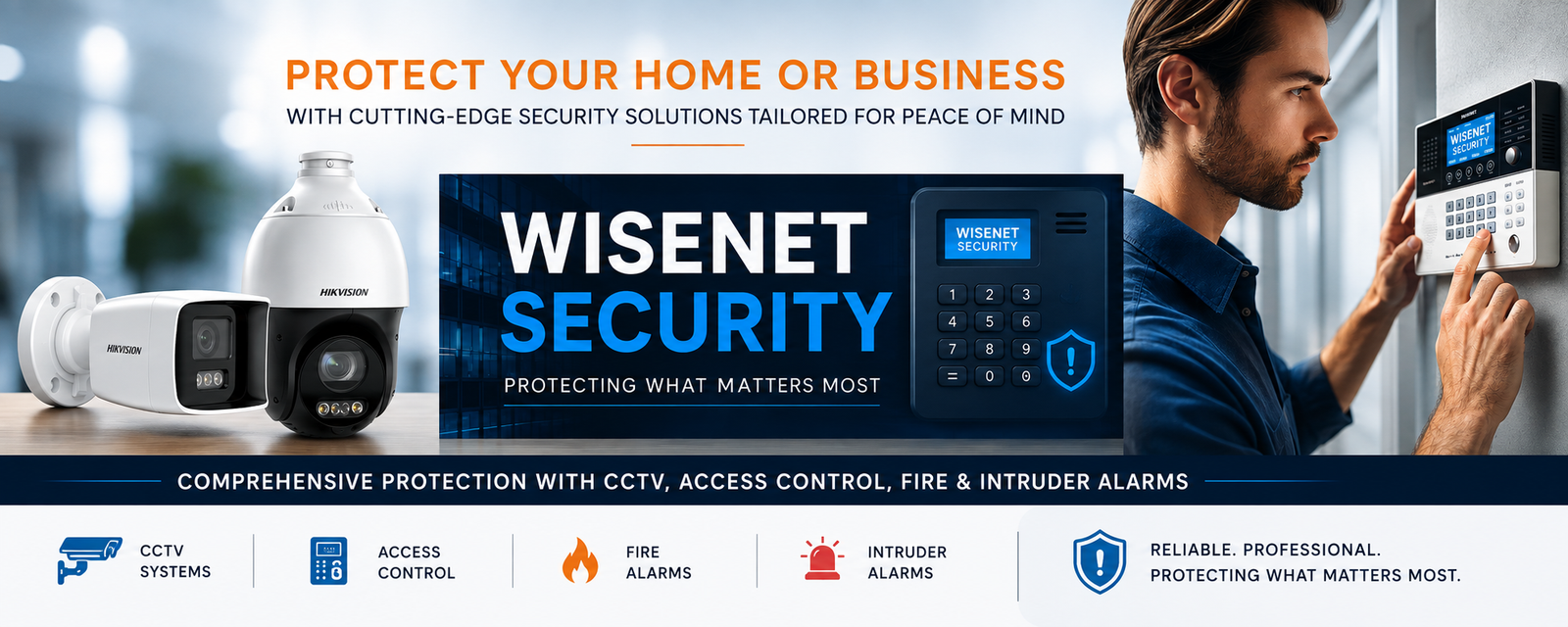
If you want one local option that fits the brief, Wisenet Security Ltd designs, installs, and maintains monitored CCTV and intruder alarm systems for homes and businesses across Cardiff, Bristol, Newport, Swansea, and surrounding areas. It's one option among several, but it's the kind of provider that should be able to explain the system, the paperwork, and the maintenance path without hand-waving.
The details matter more than the sales pitch. DBS-checked engineers, SafeContractor accreditation, and named manufacturer partnerships are all signs that the company takes the operational side seriously. If they can't answer basic questions about verification, battery backup, or integration, walk away.
Next Steps for Protecting Your Property
The right decision path is straightforward. First, match the monitoring model to the site, because a shop, a yard, and a block of flats don't need the same setup. Then make sure the system meets the right standard, keeps working during outages, and gives you a response chain that's documented.
If you're weighing false alarms, video verification, or better after-hours coverage, don't buy on price alone. Read practical security guidance too, including luxury home security advice if you want a useful reminder that good protection is about design, not just devices. The same principle applies whether you're protecting a detached house or a business unit.
If you're in Cardiff, Bristol, Newport, Swansea, or nearby and you want a straight answer on whether your site needs monitored CCTV, an ARC-linked alarm, or a resilience upgrade, book a consultation and have the current setup reviewed properly. Ask the hard questions about false alarms, outage handling, and police response before you sign anything.
Wisenet Security Ltd can assess your current setup, explain your monitoring options, and design a system that fits how your property operates, day and night. If you want a practical review for your home or business in South Wales or the South West, visit Wisenet Security Ltd and arrange a consultation.