
Security Company Swansea: Expert Protection 2026
If you're reading this after checking a camera app, locking up late, or replaying a recent incident in your head, you're in the same position as many Swansea property owners. The worry usually isn't just burglary. It's whether your current setup would help when something goes wrong, or whether it would give you noise, false alerts and unusable footage.
That's where most advice goes off track. People get told to buy a camera, fit an alarm, or add a keypad door entry system as if each piece works well on its own. In practice, standalone security often creates blind spots. A camera records but no one reacts. An alarm sounds but nobody can verify what triggered it. A door system logs access but doesn't tie into the wider picture.
Good protection comes from joining those parts up properly. For those seeking a security company in Swansea, that's the difference that matters most: not the box on the wall, but how CCTV, intruder alarms and access control work together to protect a home, office, shop or warehouse.
Table of Contents
- Finding the Right Security for Your Swansea Property
- Understanding Your Security System Options
- How to Choose the Best Swansea Security Company
- Decoding Modern Security Technology
- Costs Monitoring and Ongoing Maintenance
- An Integrated System in Action A Real World Example
- Your Next Step to Securing Your Swansea Property
- Frequently Asked Questions
Finding the Right Security for Your Swansea Property
A lot of people start looking for a security company in Swansea after something has already happened. A break-in nearby. A suspicious visitor caught too late. Staff leaving a rear door unsecured. The pressure then is to buy something quickly. That usually leads to poor decisions.
The better approach is to start with risk, not hardware. A Sketty homeowner may need strong perimeter awareness, simple app control and reliable night coverage around side access. A city centre retailer may need clear entry footage, staff access permissions and a way to confirm whether an alarm activation is real before escalating it. A small industrial site may need all of that, plus out-of-hours alerts and audit trails.
Practical rule: Buy security to solve a specific operating problem, not to tick a box.
The local market is crowded, and plenty of providers sell individual products well enough. What often gets missed is system design. A properly planned setup considers entry points, lighting conditions, daily routines, user behaviour, privacy requirements and who responds when an alert arrives.
If you want a local starting point, Wisenet's Swansea coverage area gives a clear view of the types of properties and locations typically served across the city and surrounding areas.
Understanding Your Security System Options
A Swansea shop with a stand-alone alarm can still waste half an hour on a false callout. A house with only cameras may record a problem clearly but do nothing to stop it in the moment. The system matters less than how the parts work together.
CCTV, alarms, access control and fire detection each solve a different problem. The strongest setups combine them so one event triggers useful context somewhere else. An intruder alarm activates. The relevant camera view opens straight away. A door forced out of hours creates an audit trail and a video record. That saves time, cuts guesswork and helps staff or homeowners respond properly.
CCTV provides verification, deterrence and evidence. In practical terms, that means clear coverage of entrances, side access, loading areas, tills, receptions and any route an intruder is likely to use. Good cameras also help reduce false alarms because someone can check whether the activation was a real incident, a cleaner opening early, or a delivery at the wrong door.
Intruder alarms handle fast detection. They are still the quickest way to flag a break-in attempt, especially where nobody is watching live video all day. Their weakness is context. Used on their own, they create noise as well as alerts. Connected to CCTV and monitoring, they become far more useful.
Access control deals with day-to-day control. It decides who gets in, which areas they can enter and when that permission applies. For Swansea offices, schools, apartment blocks and commercial units, this often solves more real-world problems than another camera does. Lost fobs can be removed in minutes. Staff movements can be logged. Rear doors stop being managed by copied keys and informal handovers.
Fire alarms belong to a separate compliance category, but they still need to be planned alongside the rest of the system. Doors on access control may need to release safely. Emergency routes must stay usable. For many buildings, treating fire, security and access as separate installs creates avoidable faults later.
Single-product buying usually leads to gaps.
A camera cannot control a stockroom door. An alarm cannot show whether the trigger was genuine. Access control cannot show what happened in the car park before someone reached the entrance. Integrated design fixes that by giving each system a clear job and linking events where it makes operational sense. For many properties, that approach also lowers long-term costs because faults are easier to diagnose, user error is easier to spot and unnecessary callouts drop.
If you are comparing local providers, our guide to security companies across South Wales explains what good system design should look like beyond the hardware list.
If you're assessing camera placement and practical setup points before speaking to an installer, HomeProBadge's security camera installation tips are a useful outside reference for thinking through angles, coverage and common mounting mistakes.
Security System Types Compared
| System Type | Primary Purpose | Ideal For | Wisenet Solution Example |
|---|---|---|---|
| CCTV | Visual verification, deterrence and evidence capture | Homes, shops, offices, warehouses, car parks | HD or 4K camera coverage with remote viewing |
| Intruder Alarms | Detect unauthorised entry quickly | Houses, retail units, offices, industrial spaces | BS EN 50131-compliant alarm with mobile alerts |
| Access Control | Control and log entry permissions | Offices, flats, schools, staff areas, gated sites | Keypad, card, fob or biometric managed entry |
| Fire Alarms | Life safety and regulatory compliance | Commercial premises, shared buildings, industrial units | Conventional or addressable fire alarm systems |
Good security design gives each system a clear role. Better security design links them so alerts can be checked, decisions can be made faster and the property is easier to manage day to day.
How to Choose the Best Swansea Security Company
Price matters. It just shouldn't be the first filter.
A cheap installer can fit decent hardware badly, leave dead zones, skip user training and disappear when the first fault appears. A better provider looks at behaviour on site, not just walls and cable routes. That includes who opens up, who locks down, which doors get propped open, where deliveries arrive, how staff move, and what happens when nobody responds to an out-of-hours alert.
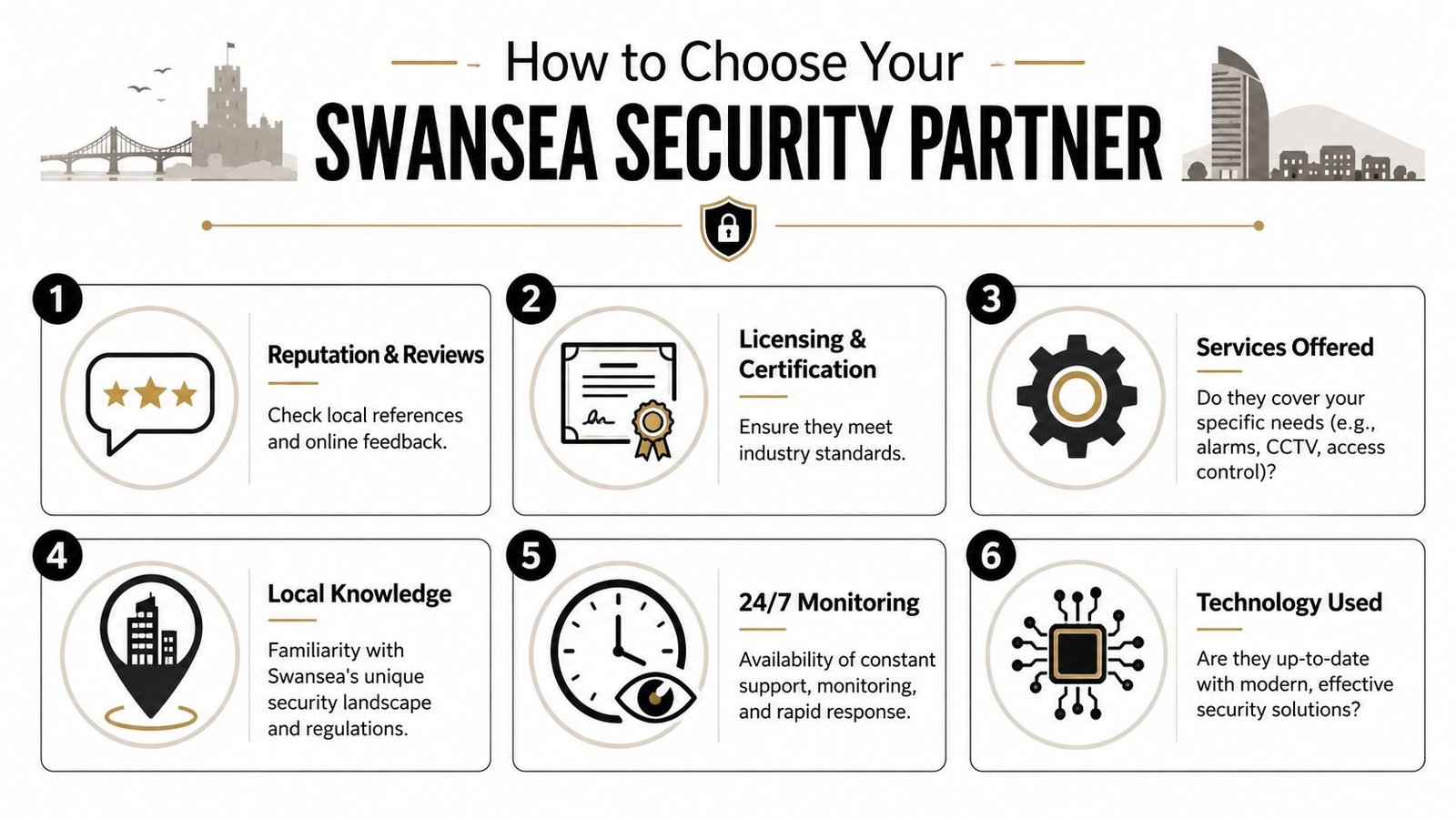
What separates an installer from a security partner
One of the clearest signs is whether they talk about integration early. That isn't a luxury add-on. It's often the point of the whole system.
PE Systems notes that up to 40% of security alarm activations at UK businesses are false positives, contributing to an estimated £1.2 billion annually in wasted resources. That's exactly why visual verification matters. If an alarm event can be checked against live or recorded footage, staff and responders can make a better decision instead of reacting blindly.
Look for these signs when comparing providers:
- Standards knowledge: They should understand BS EN 50131 alarm requirements and where those standards affect insurance expectations and monitoring arrangements.
- System thinking: They should explain how cameras, alarms and access control interact, not quote each one as if it lives in isolation.
- Local practicality: They should know the difference between securing a detached home, a seafront premises, a city centre unit and a warehouse on a mixed industrial estate.
- Aftercare: They should have a clear maintenance position, because even a good installation will drift if lenses get dirty, batteries age, sensors move or software isn't reviewed.
A broader view of regional capability also helps when judging whether a firm can support multi-site needs. This South Wales security company overview is useful for understanding what a properly resourced provider should be able to cover across the area.
Questions worth asking before you sign anything
Ask direct questions and pay attention to whether the answers are clear.
- Who designed the system? If the person quoting can't explain camera purpose, sensor logic or user flow, that's a warning sign.
- How are false activations reduced? A serious provider should talk about placement, programming, user training and visual verification.
- What happens after installation? You want to hear about testing, maintenance, updates and support, not just handover day.
If a company only talks about equipment, they're probably selling boxes. If they talk about response, workflow and verification, they understand risk.
Decoding Modern Security Technology
Specs can distract people. What matters is whether the system gives you footage and alerts you can use.
What better image quality actually changes
Many poor CCTV systems fail at the exact moment they're needed. You get glare at the entrance, a dark patch across the car park, or a face reduced to a silhouette. That's why image handling is more important than headline resolution on its own.
The Hanwha Wisenet X-series uses 150dB Wide Dynamic Range to handle harsh contrast between bright and dark areas, helping capture clear facial and number plate detail in difficult scenes, according to CCTV Direct's write-up on the Wisenet X-series AI cameras. In practical terms, that matters at shopfronts with strong daylight behind a subject, office entrances with reflective glass, and yard gates hit by vehicle headlights at night.
Some models in that range also include digital image stabilisation. That's useful on exposed buildings where wind vibration can soften footage just enough to ruin identification.
Why smart analytics matter more than extra cameras
More cameras don't automatically mean better protection. Often the smarter move is fewer cameras placed properly, with analytics set up around actual risk points.
Useful examples include:
- Virtual line crossing: Ideal for gates, service yards and restricted corridors where any crossing outside normal hours should trigger review.
- Directional detection: Helps separate normal movement from suspicious movement, such as someone approaching a rear entrance from the wrong side.
- Loitering detection: Valuable around shutters, side alleys, compounds and entrances where someone lingering is often the first sign of trouble.
The advantage is speed. Instead of scrolling through footage after the fact, the system flags the event when it happens. That gives homeowners a faster prompt and gives businesses a better basis for escalation.
A good installer will also keep the interface usable. Remote viewing, event clips and user permissions should be easy enough that staff use the system, rather than bypassing it because it feels cumbersome.
Costs Monitoring and Ongoing Maintenance
Security pricing becomes clearer once you separate installation cost from ownership cost. Most confusion comes from mixing those together.
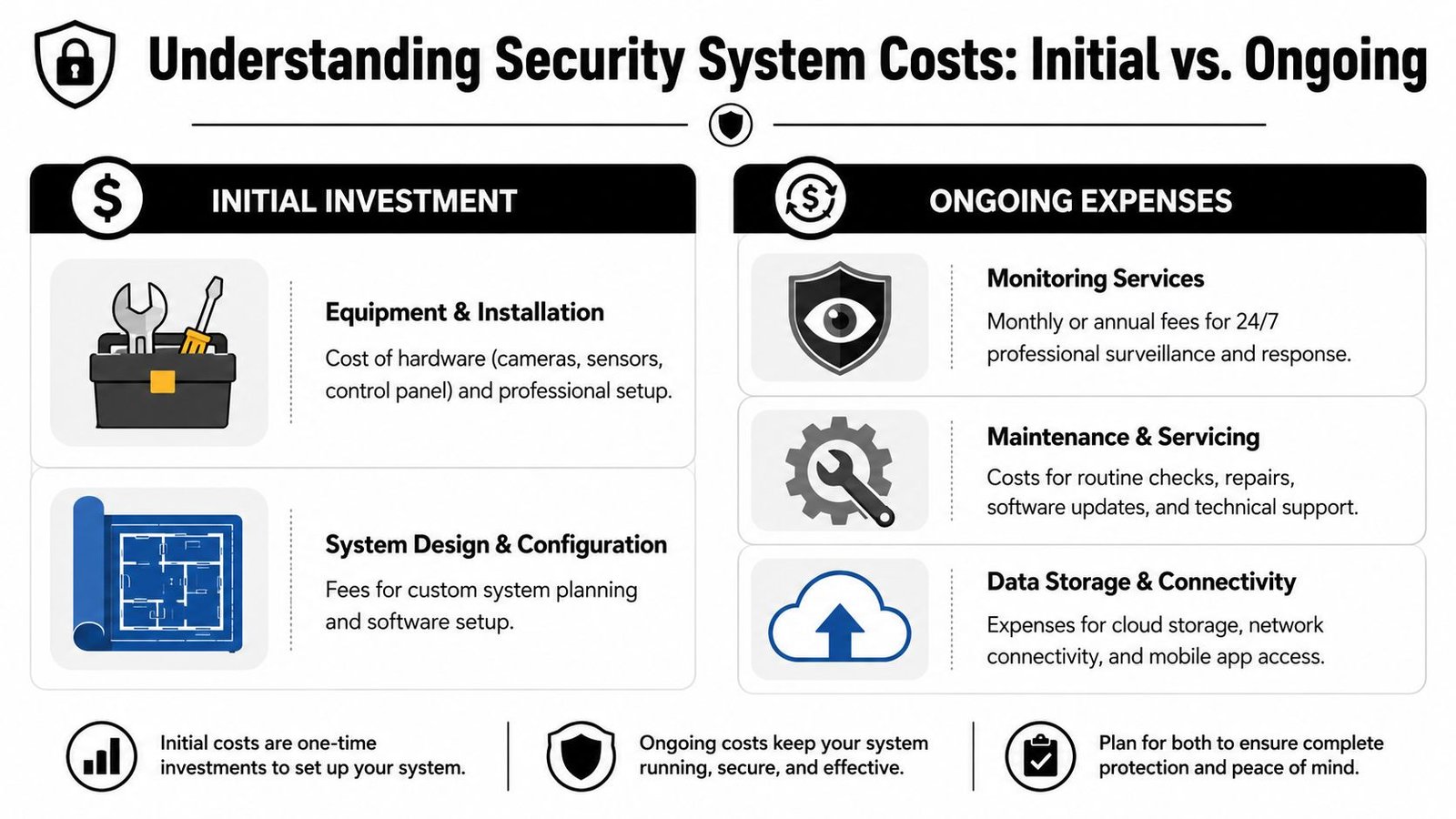
What you're really paying for
The first part is equipment and labour. Cameras, alarm devices, controllers, locking hardware, cabling, commissioning and setup all sit here. System design matters too. A well-designed scheme may cost more upfront than a basic fit, but it usually wastes less money later because it avoids duplication, poor placement and awkward upgrades.
The second part is ongoing service. That includes monitoring, maintenance, testing, call-outs, firmware review, battery checks, cleaning, storage management and support when users change or premises are reconfigured.
For businesses with public-facing spaces, privacy features deserve attention as part of that long-term value. Hanwha's Wisenet 9 platform includes Dynamic Privacy Masking, which can automatically obscure individuals in footage to support UK GDPR compliance, as described by Hanwha Vision America's Wisenet 9 platform page. That's relevant in car parks, shared access areas and entrances where you need security coverage without capturing more identifiable detail than necessary.
If you want a budgeting reference point before requesting a site survey, this guide to 2026 security system costs in the UK is a sensible place to frame the likely cost categories.
Monitoring choices compared
Different premises need different response models. There isn't one correct option for everyone.
| Monitoring Option | How it works | Best fit | Main trade-off |
|---|---|---|---|
| Bell-only alarm | Siren activates on trigger | Smaller homes, lower-risk sites | Relies on someone nearby noticing and acting |
| Self-monitored app alerts | User gets push notifications and can check footage | Homes, small businesses with engaged owners | Depends on someone being available and confident enough to assess events |
| Professionally monitored response | Alerts are handled through an external monitoring process | Higher-risk businesses, vacant sites, multi-keyholder operations | Ongoing service cost, but more structured response |
Maintenance isn't an optional extra. It's what keeps a good system from becoming an expensive wall ornament.
An Integrated System in Action A Real World Example
Theory makes sense on paper. The test is what happens at half past two in the morning when nobody should be on site.
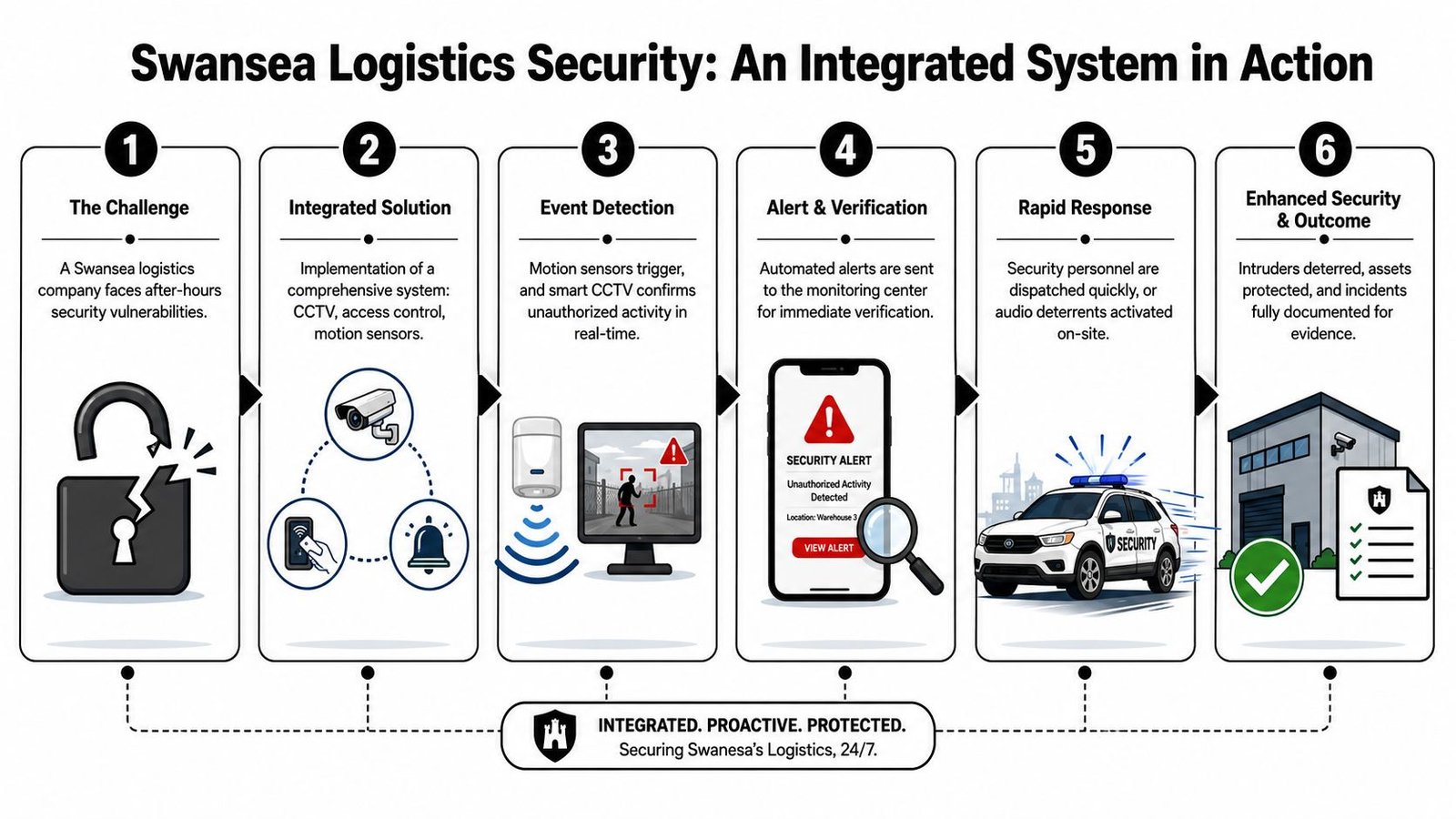
A Swansea warehouse after hours
Take a hypothetical logistics business on the outskirts of Swansea. The site has a yard, roller shutter access, a staff entrance, a fenced perimeter and regular overnight vehicle movement on nearby roads. A basic bell-only alarm would struggle here because the environment creates too much ambiguity. Staff also need occasional early access, and deliveries don't always follow a neat schedule.
In an integrated setup, the outer edge of the site is covered by CCTV analytics watching a defined boundary line. A person enters the wrong area after hours and the system flags the movement. That event pulls attention to the nearest cameras rather than waiting for someone to review footage later.
At almost the same time, the intruder alarm zone covering the side access activates. Because the camera view is linked to the event, the responsible person can verify whether this is a genuine intrusion, an authorised arrival or a harmless cause that doesn't justify a full escalation.
Why the joined-up response matters
That's where integrated security earns its keep. The event isn't just loud. It becomes understandable.
A joined-up response might look like this:
- Boundary breach detected: Analytics flag movement where none should occur.
- Alarm activation follows: The relevant zone triggers and marks the incident time clearly.
- Visual confirmation appears: Linked cameras show whether a person is present, what route they took and whether vehicles are involved.
- Access data adds context: If a valid credential was used at a nearby door, the incident may be operational rather than hostile.
- Response becomes proportionate: The right people get the right information and can act without guesswork.
That sequence reduces delay, cuts confusion and improves evidence quality if the incident has to be investigated later.
A strong system doesn't force you to choose between speed and certainty. It gives you both.
For Swansea businesses with yards, compounds or multiple entry points, that's usually the difference between a system that helps operations and one that only creates noise.
Your Next Step to Securing Your Swansea Property
The right security setup usually isn't the most complicated one. It's the one that matches the property, the people using it and the way the site operates day to day.
If you're comparing providers in the security company Swansea market, focus on a few essentials. Does the company think in systems rather than single products? Do they understand verification, user behaviour and response? Can they explain how compliance, privacy and maintenance fit into the decision, not just installation day?
For homes, that often means reliable detection around the points burglars test, with footage that's clear enough to be useful and app access that doesn't become a nuisance. For businesses, it means reducing friction as much as reducing risk. Better access management, fewer wasted call-outs, stronger evidence and clearer procedures when something happens.
The best next move is a proper site survey. Walk the property, identify the weak spots, decide who needs access, and work out how alerts should be handled before any equipment is specified.
Frequently Asked Questions
Do I need CCTV and an alarm or just one of them
Start with the risk you need to control.
If the main concern is stopping an intruder and getting an alert straight away, an intruder alarm is usually the first priority. If the priority is seeing what happened, checking activity remotely, or giving police and insurers usable evidence, CCTV often comes first.
For many Swansea homes and business premises, the better long-term answer is an integrated setup. The alarm triggers the event. The cameras confirm whether it is a real incident, a delivery at the wrong door, or user error. That cuts wasted call-outs, gives a clearer response plan, and usually costs less over time than adding disconnected systems in stages.
Will a modern security system be difficult to use
It should be simple to use every day. If it is awkward, people bypass it, leave areas unset, or share codes they should not share.
Good system design fixes that before installation. A homeowner might only need app control, alerts, and live views. A business manager may need user permissions, opening and closing records, and event footage. Staff may only need access credentials for the doors and times that matter to their role.
The test is practical. Can people use it correctly at 7am, at closing time, and when they are under pressure? If the answer is no, the setup needs work.
Can security systems help with GDPR compliance
Yes, but only if privacy is designed into the system from the start.
For CCTV, that usually means sensible camera placement, retention settings that match the purpose of recording, restricted user access, and clear procedures for reviewing and exporting footage. For integrated systems, it also means deciding who can see video, who can view access logs, and how long those records are kept.
This matters in Swansea properties that overlook pavements, shared drives, customer entrances, or neighbouring land. Features such as privacy masking and role-based permissions can reduce unnecessary recording and limit who sees personal data in day-to-day use.
Is Wisenet Security Ltd the same company as Hanwha Vision
No. They are separate companies.
Hanwha Vision is the manufacturer behind Wisenet-branded camera technology. Wisenet Security Ltd is a local UK installer and maintainer using that technology as part of wider system design. In practical terms, that means the installer specifies, fits, configures, and supports the system, while the manufacturer produces the hardware and platform.
If you want advice that starts with the property and not a product list, speak to Wisenet Security Ltd. The team designs, installs and maintains integrated CCTV, intruder alarm and access control systems across South Wales, with practical guidance on what will work for your site, your budget and your day-to-day use.