Secure Your UK Home: Night Vision CCTV Cameras 2026
You check an alert on your phone at half past one in the morning. Something moved across the drive, or someone tried the side gate, or a van stopped outside the shop for a little too long. You open the clip and get the same result people have been getting for years: a grey blur, a blown-out face, or a patch of darkness where the detail should be.
That's why people upgrade to night vision CCTV cameras. It isn't because “night vision” sounds advanced. It's because most sites are at their weakest when the light drops, and poor footage is no use when you need to identify a person, a vehicle, or the direction they came from.
The UK has had widespread CCTV for a long time. An estimate published in CCTV Image magazine put the number of private and local-government CCTV cameras in the UK at 1.85 million in 2011, or roughly 1 camera for every 32 people, showing how dense the installed base already was before modern low-light upgrades became common, according to the UK CCTV overview on Wikipedia. The gap was never just camera presence. The gap was whether the system could still produce usable evidence after dark.
In South Wales and the South West, that matters even more. Damp air, fog-prone routes, reflective wet ground, street lighting in some places and almost none in others. On paper, many cameras look similar. On site, they don't behave the same at all.
Table of Contents
- Why Your Property Needs to See in the Dark
- How Night Vision CCTV Technology Works
- Comparing Night Vision Technologies
- Key Specifications to Evaluate Before You Buy
- Recommended Camera Setups for Common UK Scenarios
- Installation and Positioning for Optimal Night Vision
- UK Legal Considerations and System Integration
Why Your Property Needs to See in the Dark
Most domestic and business camera failures happen at the same time. Not when the system is offline, but when it's technically recording and still not capturing anything useful.
A front door camera might show that someone approached the house, but not their face. A rear alley camera might catch movement, but only as a bright ghostly outline. A shopfront unit might record a vehicle stopping outside, then lose the registration in headlight glare and wet-road reflection. The owner still gets an alert, but the footage doesn't answer the question they have: who was there?
That's where proper night coverage changes the value of the whole system. A camera that works only in daylight is mostly a visual deterrent. A camera that works in darkness becomes part deterrent, part evidence tool, and part operational tool for reviewing incidents the next morning.
What usually goes wrong at night
Some issues come up again and again on real properties:
- Too much dependence on one camera: One wide camera covers the area, but nobody can identify a person once they move past the edge of the porch light.
- Bad lighting balance: The scene has a bright lamp in one corner and deep shadow everywhere else.
- Poor placement: The lens points into reflective paving, a road, or a glazed door panel.
- Wrong expectation: The buyer thinks “night vision” means cinema-quality colour in total darkness.
A camera that only proves that “something happened” isn't enough when you need to act on the footage.
For homeowners, the weak points are usually the driveway, side access, rear garden path, and front door approach. For businesses, it's shutter lines, delivery doors, bin stores, side alleys, external stairwells, and car parks after trading hours.
Night vision CCTV cameras solve a specific problem. They reduce the gap between motion being detected and a person being identifiable. That sounds simple, but it's the difference between reviewing footage once and being done, or spending half an hour trying to work out whether you're looking at a person in a dark jacket or just a patch of shadow.
How Night Vision CCTV Technology Works
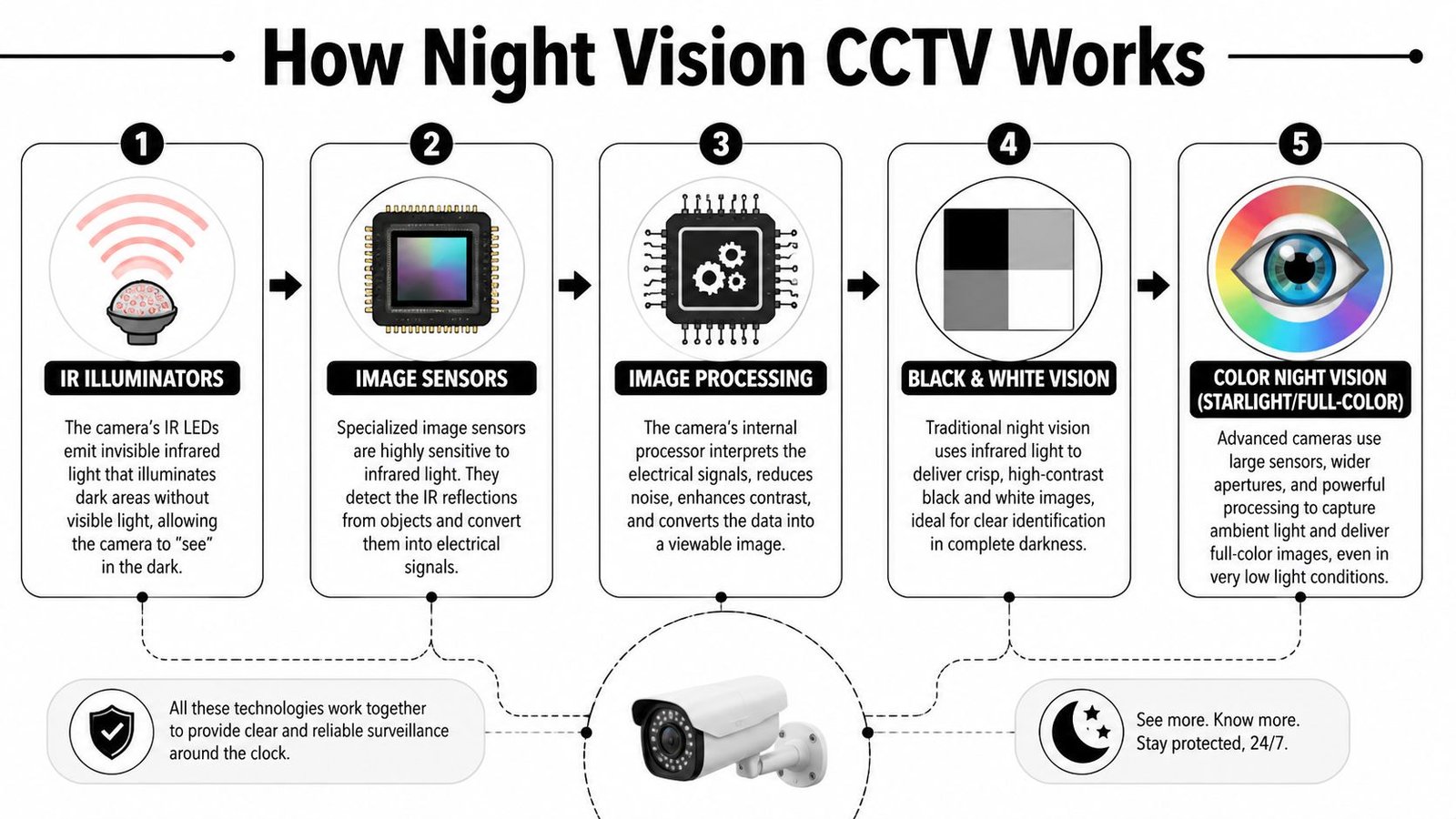
A night camera works a bit like an owl's eye plus a torch you can't see. It either gathers far more of the available light than a standard camera can, or it adds invisible illumination so the sensor has something to work with.
That sounds straightforward, but the result depends on several parts doing their job together. If one is weak, the whole night image suffers.
The three parts that matter most
The sensor is the first part. This is what captures light. Better low-light performance usually comes from a sensor that can make more of very limited ambient light without filling the image with noise.
The lens is the second part. A wider aperture lets more light reach the sensor. That's one reason some low-light colour cameras can keep detail longer into the evening while cheaper units fall into mushy black-and-white much sooner.
The illuminator is the third part. In many cameras, that means infrared LEDs. They throw out light that people can't see, but the camera can. That's why traditional IR night vision tends to produce monochrome footage. It's not capturing visible colour information. It's building an image from infrared illumination.
A modern system also relies on image processing. The camera has to decide how to expose the scene, reduce noise, manage highlights, and switch between day and night modes without constantly hunting. That's one reason good cameras look stable at night while poor ones flicker, smear movement, or blow out faces near the lens.
To see how this sits inside a broader modern surveillance setup, it helps to look at how AI CCTV systems improve security, especially when alerts, search, and playback are part of the same system.
Why digital systems changed night recording
Night footage improved massively once CCTV moved beyond old tape-based recording. According to Ajax Systems' overview of security camera development, recording evolved from VTR/VCR systems in the 1970s and 1980s to DVRs and NVRs in the 1990s–2000s, with 4K security cameras appearing in the early 2010s. That change made higher-quality night footage practical because digital systems could handle better sensors, cleaner recording, and remote review without the limitations of older analogue workflows.
Most buyers also need to keep expectations realistic about range. Independent industry material cited in the verified data notes that many consumer night-vision cameras typically cover about 30 to 50 feet, while higher-end PTZ models can reach 150 feet or more, depending on the camera and the application.
A quick visual example helps if you want to see the basics in action:
Practical rule: Don't judge a night camera by the phrase “has night vision”. Judge it by what detail it can hold at the exact point where a person or vehicle matters.
Comparing Night Vision Technologies
Not all night vision CCTV cameras work the same way, and that's where many buying mistakes start. One technology may be ideal for a driveway and a front path, but the wrong choice for a retail frontage or a warehouse yard.
Night Vision Technology Comparison
| Technology | Image Type | Best For | Pros | Cons |
|---|---|---|---|---|
| Infrared | Black and white | Entrances, gardens, side paths, general perimeter coverage | Works in complete darkness, discreet, usually dependable for routine coverage | No colour detail, can suffer from glare and reflection |
| Starlight / low-light colour | Colour in very low light | Identification near street lighting, forecourts, front doors, car parks with ambient light | Better scene detail, useful for clothing and vehicle colour | Performance depends on available light and setup |
| Thermal | Heat signature image | Perimeter detection, large dark sites, early detection in open areas | Detects presence well in difficult visibility | Not suited to detailed visual identification on its own |
| White-light assisted | Colour with visible illumination | Loading bays, retail fronts, active deterrent areas | Can produce strong visible detail and deter intruders | Visible light spill, neighbour impact, compliance concerns in residential settings |
Infrared cameras
Infrared remains the workhorse option for many homes and smaller businesses. It's often the safest choice when you need reliable night coverage without visible lighting.
IR cameras perform well on rear gardens, side gates, access lanes, and entrances where there may be little or no ambient light. They also tend to be more discreet, which matters on residential streets where a bright white lamp every time the camera triggers would become unpopular quickly.
The downside is obvious. You lose colour. If the goal is to tell whether a car was dark blue or black, or whether someone wore a red hoodie or a brown jacket, monochrome footage won't help much.
Starlight and low-light colour cameras
This is where marketing often gets ahead of reality. Good low-light colour cameras can be excellent, but they aren't magic. They need either very strong sensor performance, some usable ambient light, or both.
The clearest benchmark in the verified data is this: starlight sensors can achieve colour images down to 0.0002 Lux by using large apertures such as f/1.0, and that wider aperture provides a 4-log improvement in light gathering compared with standard f/2.0 lenses, according to the technical benchmark cited in the verified data. In practice, that means colour detail like clothing or vehicle colour can remain visible in conditions where standard cameras have already dropped into rough monochrome.
That matters if your main question is identification rather than simple monitoring. A front entrance with spill light from a porch, a forecourt with nearby lamps, or a retail frontage with background lighting can all suit this type of camera well.
If colour matters to the incident review, the camera needs enough light to keep colour honestly. Otherwise you're paying for a feature the site can't support.
Thermal cameras
Thermal is a specialist option. It doesn't replace standard CCTV for most homes or small shops, but it can be valuable on larger sites.
A thermal unit sees heat contrast rather than visible scene detail. That makes it useful for detecting that a person is present in darkness, mist, or along a long perimeter where ordinary visual cameras struggle. It is not, on its own, the camera you'd usually rely on for face-level evidence.
On industrial sites, thermal often makes sense as a detection layer paired with visual cameras that handle identification.
White-light assisted cameras
These cameras use visible LEDs to light the scene and keep a colour image at night. In the right place, they work well. A loading bay, service yard, or active entrance can benefit because the camera isn't just observing. It is also lighting the target area.
The trade-off is environmental and social. On a terraced street, frequent bursts of white light can annoy neighbours, draw complaints, and create more scene contrast than you intended. In car parks, they can help one angle while creating reflections on another if the layout is poor.
For many properties, the answer isn't choosing one technology for everything. It's mixing them. Use colour where identification needs it and the site can support it. Use IR where darkness is deeper, privacy matters more, or the scene needs to stay discreet.
Key Specifications to Evaluate Before You Buy
Spec sheets can be misleading because they usually show maximum capability under controlled conditions. What matters is whether the camera will still perform in your setting, at your distance, with your lighting and your weather.
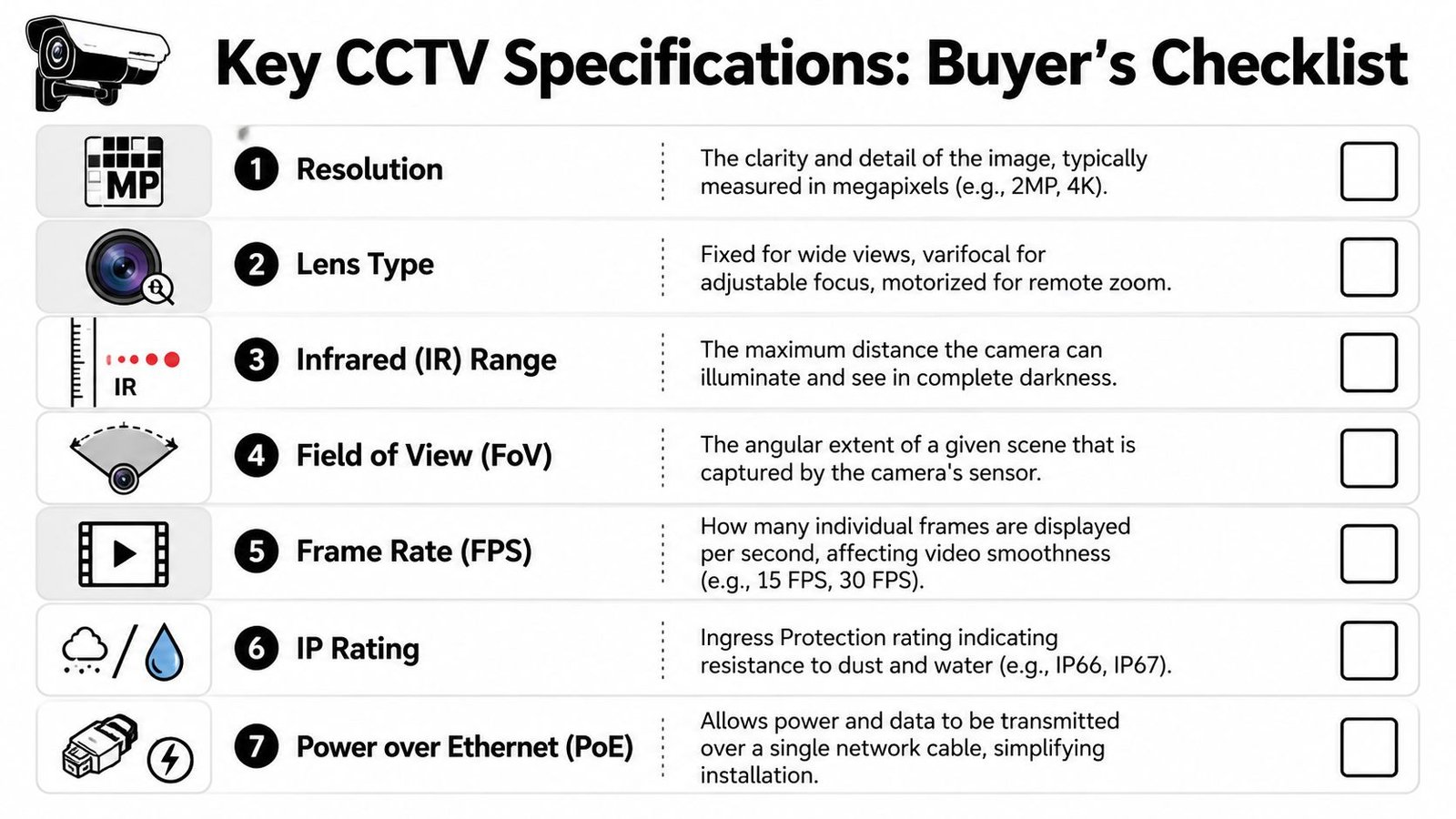
What the spec sheet should tell you
Start with resolution. Higher resolution can help, but only if the lens, sensor, and recording setup are good enough to support it at night. A sharper sensor doesn't fix bad placement or poor lighting. It just records bad footage in more detail.
Then look at lens type and field of view. A very wide view covers more ground but spreads detail thinly. For identification, a narrower, better-targeted view often beats a wide overview shot.
IR range needs careful reading. A claimed range tells you the camera can illuminate out to a certain distance under ideal conditions. It doesn't mean you'll identify a face clearly at the far end. It also doesn't tell you how the camera handles subjects close to the lens.
That's where Smart IR matters. As noted in the verified data, a camera's stated IR range is only part of the picture. Smart IR automatically adjusts LED intensity based on object distance, preventing nearby subjects from being overexposed while keeping longer-range detail usable, as described in this night vision range guide from Eufy. In practice, this is what stops a face at the doorway becoming a white oval.
The recording platform matters too. If you're comparing system types, this explanation of the difference between IP cameras and HD analog CCTV is useful because night performance isn't only about the camera body. It's also about what the recorder and network can preserve.
What to ask before you approve a system
Don't ask only “How far can it see?” Ask these instead:
- What detail do I need at night: Detection, recognition, or identification are not the same thing.
- Where will glare come from: Headlights, wet paving, signs, white walls, glazed doors, and metal shutters all change the result.
- Will the camera face traffic or pedestrians at close range: If yes, exposure control matters as much as raw range.
- How much ambient light is present: A streetlamp in the distance may help one camera and do nothing for another.
- Can the installer show a night sample from a similar site: That usually tells you more than a brochure.
If you're reviewing options for a business, this guide to top security camera solutions is a useful comparison resource because it helps frame the bigger system decision, not just the headline night feature.
Don't buy around the longest quoted range. Buy around the point on your site where evidence actually matters.
Recommended Camera Setups for Common UK Scenarios
Different properties need different night strategies. A small house in Cardiff doesn't need the same setup as a warehouse unit on an industrial estate, and a pavement-facing shop in Bristol has a very different privacy and lighting challenge from a gated car park.
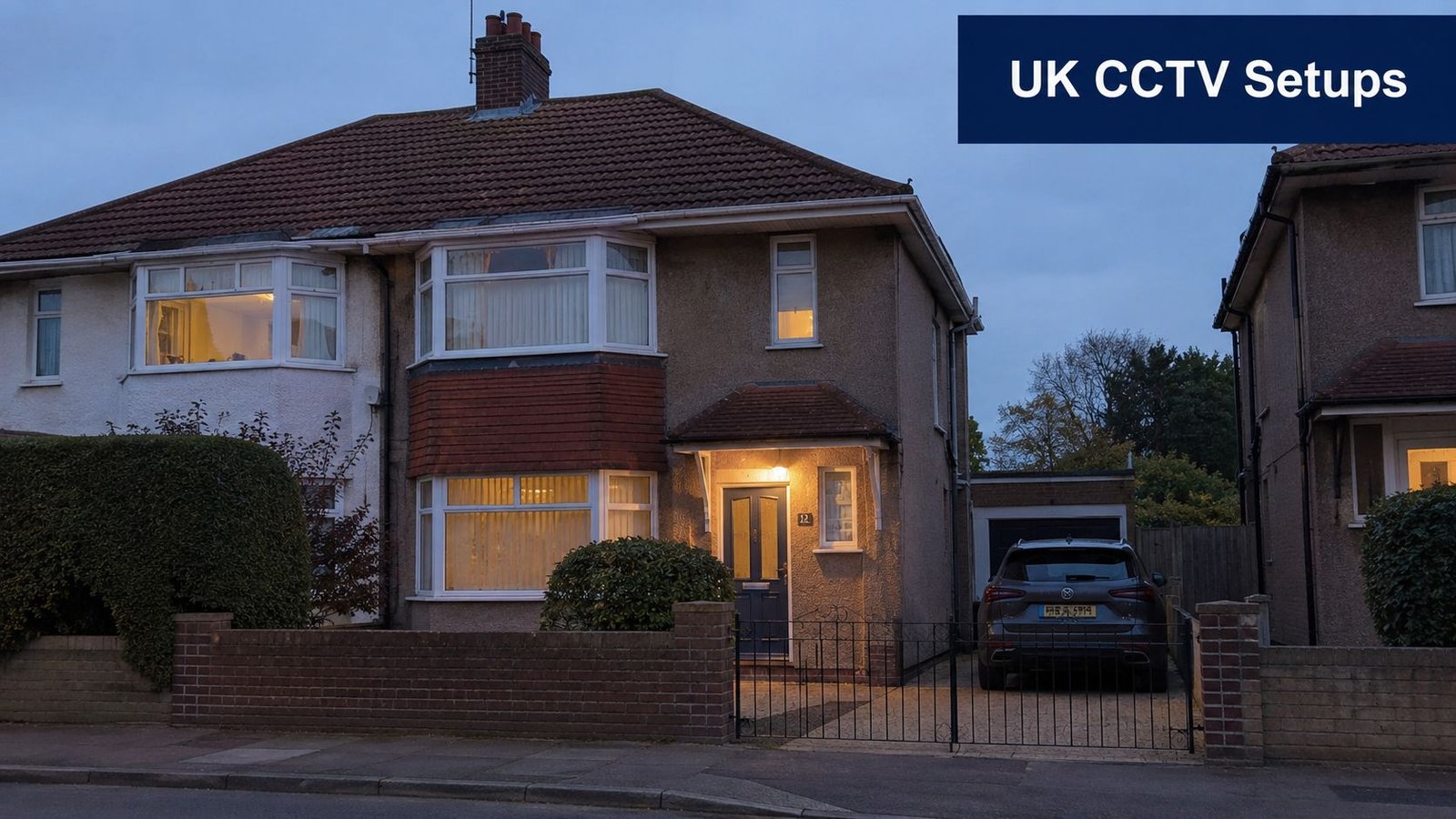
Terraced or semi-detached home
For most homes, the front door and driveway need the best identification, while the side path and rear garden need dependable coverage without creating nuisance lighting.
A sensible arrangement is usually:
- Front entrance camera: Low-light colour if there's steady ambient light from a porch or street.
- Driveway overview: A separate camera with controlled IR or balanced low-light performance.
- Side access and rear garden: Traditional IR cameras that stay discreet and don't light up neighbouring walls.
This setup works because it separates tasks. One camera handles faces near the property line or entrance. Another covers movement routes. Trying to make one wide-angle front camera do all of it usually leads to compromise.
Retail front and pavement-facing premises
Shops need a tighter approach. You want clear footage at the door, till-side entrance, and shutter line, but you also need to avoid overreaching into the public realm more than necessary.
For that reason, I'd usually prioritise a focused entrance camera for identification and a second overview camera for context. If the frontage already has signage or street lighting, low-light colour can work well. If not, a carefully tuned IR camera is often more predictable than a white-light unit blasting the pavement every time someone walks by.
The biggest mistake on these sites is over-wide coverage. It feels safer, but it often gives you lots of scene and not enough detail where incidents happen.
Commercial car park
Car parks are difficult because they combine distance, movement, reflective surfaces, and vehicle lighting. Wet tarmac makes it harder again.
A good setup usually mixes:
- Entry and exit views: Cameras aimed for vehicle approach and driver-side activity, not just a broad overhead shot.
- Pedestrian route coverage: Dedicated cameras for payment points, walkways, and door approaches.
- General overview cameras: Wider units for scene context and post-incident review.
Here, night vision CCTV cameras need to control glare well. Headlights, reflective number plates, and wet ground can all overwhelm a poorly chosen lens or bad angle. If the site uses white-light support, it needs tight control so one pool of brightness doesn't blind the next camera down the line.
Warehouse and industrial yard
Large sites often need two layers. One for detecting movement across a boundary or yard, and one for identifying people or vehicles as they approach buildings, gates, roller shutters, or loading areas.
On these jobs, a mix of long-range IR, targeted identification cameras, and sometimes thermal detection can make sense. A single camera mounted high on a corner of the building rarely solves the problem on its own, even if the quoted range looks impressive.
For a managed installation, Wisenet Security Ltd designs integrated CCTV systems for homes and businesses in South Wales and the South West, including layouts that combine night vision coverage with alarms, remote viewing, and site-specific placement decisions.
If your site has awkward lighting, coastal exposure, or shared boundaries, a survey matters more than the brochure. The right answer usually comes from walking the property after dark, not from comparing daytime screenshots.
Installation and Positioning for Optimal Night Vision
Good hardware can still produce poor footage if the camera is in the wrong place. Most night failures I see come from placement, not from the fact that the camera lacks a feature.
Placement mistakes that ruin footage
The first is pointing an IR camera through glass. The infrared reflects back and the image becomes useless. If you need coverage through a window, the camera and lighting strategy have to be chosen around that condition, not against it.
The second is mounting too high for the job. High mounting protects the camera, but it can also give you the top of a hood instead of a face. Overview coverage can sit higher. Identification points should be set at an angle that still captures useful facial detail.
The third is aiming into known glare sources. Streetlights, security lights, white render, polished vehicles, metal shutters, and reflective signs all distort night performance. A small change in angle often does more than changing the camera itself.
A practical checklist on site looks like this:
- Check near-field objects: Gutters, soffits, signs, and wall edges can reflect IR back into the lens.
- Look for wet-surface reflection points: Driveways and forecourts behave differently after rain.
- Test the approach path: Don't judge the image standing still under the camera. Walk the route an intruder or customer would take.
Working around UK weather
Weather changes performance more than most product pages admit. In the verified data, UK-facing guidance notes that standard IR range figures don't account for local weather and that the Met Office notes fog can reduce visibility to under 200 m, which can shorten effective identification range substantially, as discussed in this weather and camera range article.
That doesn't mean cameras stop working in fog or rain. It means your best-case night range won't be available every night. In damp coastal air, in valley fog, or during fine drizzle, the useful distance drops and glare increases.
Rain doesn't just darken a scene. It changes every reflective surface in it.
The fix is practical. Shorten critical identification distances. Put the camera where subjects pass through a controlled zone instead of trying to identify them across the whole site. Use supplementary lighting carefully where it helps. Keep lenses clean. Recheck night images after weather changes, not just on the evening of installation.
UK Legal Considerations and System Integration
Night performance isn't separate from compliance. The camera choice affects what you capture, how intrusive the system feels, and whether the setup stays proportionate for the site.
Privacy and proportionality at night
Colour night vision can give stronger evidential detail, but it can also create issues if that colour image depends on visible white LEDs. The verified data notes that full-colour night vision can create light spill and neighbour concerns, and that UK ICO guidance stresses CCTV must be proportionate. In some residential settings, a traditional IR camera is the more compliant choice because it balances security with data minimisation, as discussed in this night camera privacy trade-off reference.
That matters on terraced streets, shared drives, blocks of flats, and mixed-use premises. The brightest system isn't automatically the right one. Sometimes the right answer is a narrower field of view, less visible illumination, and tighter scene control.
For businesses, it's worth reviewing the practical compliance side in this guide on CCTV and GDPR in the UK, especially if cameras cover staff routes, public approaches, or shared external areas.
Joining CCTV with the rest of the security system
Night cameras work better when they're part of a full security setup. A camera alert on its own can be noisy. A camera event linked with an alarm zone, gate trigger, or remote review workflow is much more useful.
For homeowners, that often means smartphone viewing and quicker verification when an alert comes through. For businesses, it may mean tying CCTV into intruder alarms, access control, and incident review procedures so staff can act on verified footage instead of chasing false activations.
A good system doesn't just record the dark. It helps you understand what happened in it.
If you're planning a new system or trying to fix night footage that isn't delivering, Wisenet Security Ltd can assess the property, the lighting, the likely risk points, and the privacy implications before recommending a setup. That's usually the difference between a camera that looks good on paper and one that still gives you usable evidence on a wet, dark night in South Wales.