
Security and CCTV: UK Home & Business Guide 2026
You're probably reading this after a nudge of doubt. A neighbour mentioned a break-in. Staff have started opening up early and closing late. A van has been hanging about outside the unit more often than feels normal. Or you've already got cameras, but when you checked the footage, it told you less than you expected.
That's the point where the search for security and CCTV advice often begins, and the information discovered is frequently either too technical or too sales-heavy. Neither helps when you're trying to protect a family home in Cardiff, a shop in Bristol, a yard in Newport, or a small industrial unit on the edge of Swansea.
Modern security isn't just about sticking a camera above the front door and hoping for the best. The systems that work well are planned around risk, daily routines, lighting, entry points, privacy rules, and how people use the building. For homes and small businesses across South Wales and the South West, the difference between a useful system and an expensive annoyance usually comes down to design, not gadget count.
Table of Contents
- Securing Your Peace of Mind in 2026
- Beyond Cameras What Is an Integrated Security System
- Choosing Your Eyes The Core CCTV Technologies
- Building Your Digital Fortress Integration in Action
- Staying Compliant UK Legal and Privacy Rules
- From Plan to Protection Installation and Maintenance
- How to Choose a Trusted Local Security Partner
Securing Your Peace of Mind in 2026
A homeowner in Penarth hears from the street WhatsApp group that two cars were entered overnight. A café owner in Bristol notices someone testing the rear gate after closing. A landlord in Newport gets a call about anti-social behaviour in a shared entrance. Different properties, same problem. People want to feel in control again, and they want to know what will help.
The first mistake is treating security like a shopping list. Camera, tick. Alarm, tick. Light, tick. That approach often leaves blind spots, poor footage, awkward user habits, and systems that nobody checks until something goes wrong.
Good security and CCTV planning starts with three simple questions:
- What are you trying to stop: Opportunist theft, repeat trespass, package theft, staff-only access breaches, vandalism, or nuisance behaviour all need different responses.
- Where does the risk happen: Front path, side alley, roller shutter, car park, rear service yard, shared corridor, or gate line.
- What do you need afterwards: A live alert, a clear image, an access record, an audio challenge, or evidence worth handing to police or an insurer.
Practical rule: Buy for the incident you're most likely to face, not the one that looks best on a brochure.
In homes, that often means covering approach routes, not every inch of the garden. In small businesses, it usually means pairing cameras with alarm inputs, lighting, and controlled access at the places staff use. In yards and car parks, it means thinking about distance, number plates, and night conditions before you think about resolution.
Peace of mind comes from knowing the system fits the property. Not from owning the most cameras.
Beyond Cameras What Is an Integrated Security System
A proper security system behaves less like a pile of electronics and more like a building's nervous system. One part detects. Another confirms. Another reacts. Another records what happened. That's what integration means in practice.
One system instead of separate gadgets
An integrated security system connects the main protection layers so they work together:
- CCTV cameras watch and record.
- Intruder alarms detect unauthorised entry.
- Access control decides who gets in and when.
- Intercoms let you verify visitors before opening.
- Remote monitoring gives you oversight when nobody is on site.
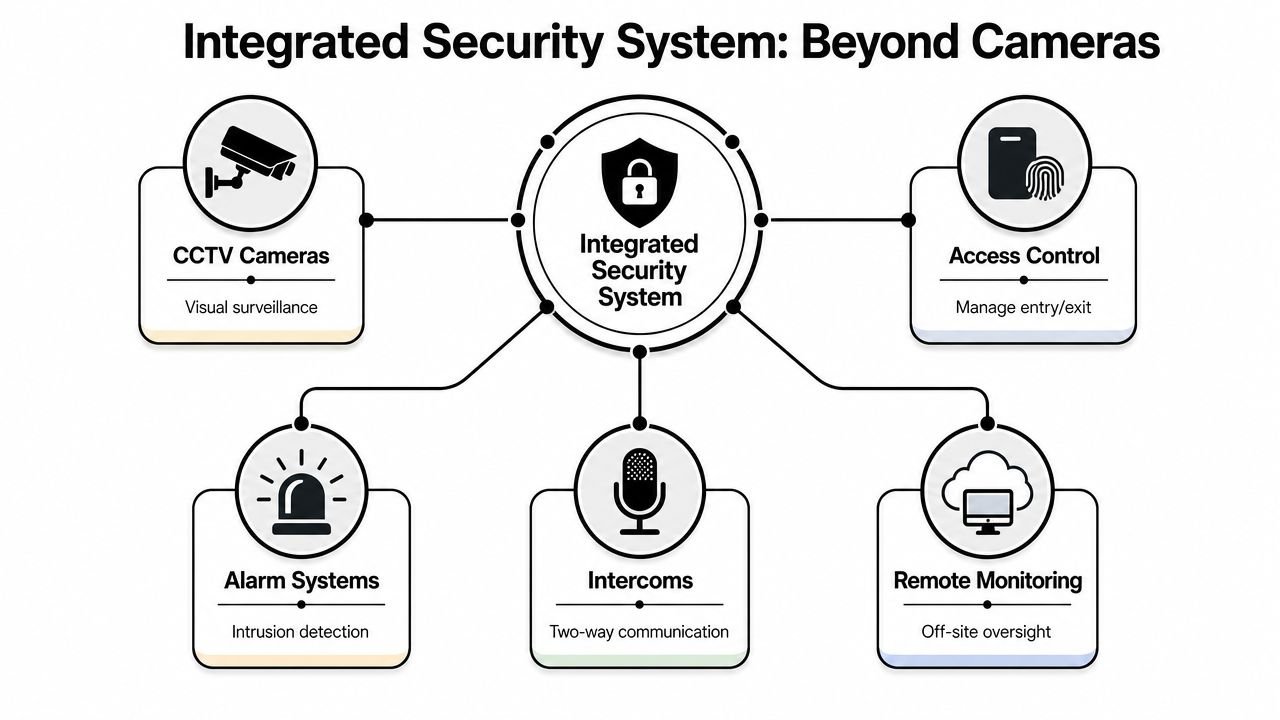
A side gate contact can trigger a nearby camera to flag that event. An intercom call at a business can show the entrance view before anyone grants access. An alarm activation can push the right camera feed to a phone instead of leaving you scrolling through multiple views under pressure.
This is also how sensible security reviews are carried out. If you want to understand where a property is vulnerable from an attacker's perspective, this comprehensive guide for pentesters is useful reading because it looks at how people test physical access, perimeters, doors, and operational weaknesses in practice.
Why integration changes the outcome
Standalone devices often create fragments of information. A camera records movement, but who opened the door? A keypad logs an entry, but what happened after that? An alarm sounds, but was it a person, a delivery, or wind on a loose door?
Integration gives context.
A practical example is a mixed-use building with a front entrance, rear service access, and internal storeroom. Rather than adding more and more cameras, a better design might join door control, event-tagged video, and mobile alerts into one setup. That's the thinking behind integrated security solutions for homes and businesses, where systems are designed to share signals instead of working in isolation.
Good systems don't just show you that something happened. They tell you where, when, and in what sequence.
For homeowners, that can mean quicker verification without standing at the window. For a shop, it means fewer gaps between a rear door opening and the footage that explains it. For a warehouse, it means staff, deliveries, gate events, and after-hours alarms all sit in the same operational picture.
Choosing Your Eyes The Core CCTV Technologies
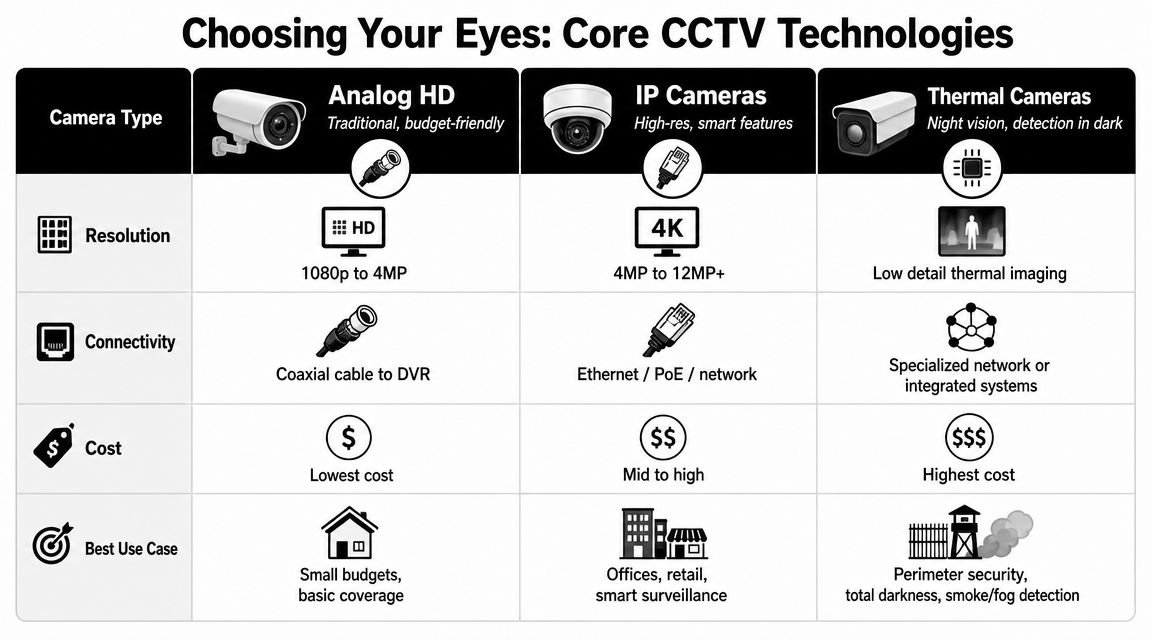
Most buyers get pushed towards headline specs. More megapixels. More channels. More zoom. The better question is simpler. What detail do you need, at what distance, in what light, and for what purpose?
Resolution that matches the job
Industry guidance notes that 1080p is typically sufficient for general surveillance, but identification of faces or number plates often requires higher resolution or closer camera placement, and in the UK the same guidance notes that IP cameras and on-board analytics can improve the chance of capturing legally usable detail under GDPR and DPA 2018 considerations, as outlined in this video surveillance systems guide.
That's the trade-off many people miss. A wide shot of a driveway or shop floor can be perfectly acceptable for general awareness. It's far less reliable if your actual aim is to identify a face at the edge of frame or read a plate in poor light.
Camera types and where they fit
A short comparison helps.
| Camera option | Strength | Limitation | Typical fit |
|---|---|---|---|
| Bullet | Visible deterrent, easy to aim | More obvious, can be visually intrusive | Perimeters, driveways, rear yards |
| Dome | Tidy appearance, good indoors | Can suffer from glare if poorly placed | Shops, receptions, shared entrances |
| Turret | Strong night image and easy servicing | Less discreet than a dome indoors | Homes, side paths, external walls |
| Thermal | Detects heat in difficult darkness | Not for facial detail alone | Perimeter detection, large dark sites |
For many homes in South Wales, a turret camera on the front approach and one on the rear access path gives better practical coverage than a random mix of bargain domes. For a small business, bullets over service doors and domes inside customer-facing space often make more sense because they suit different environments.
Buying advice: If you need identification, don't start with resolution. Start with distance and angle.
Storage and connection choices
The next decision is how footage gets stored and how cameras connect.
- HD analogue systems can still suit straightforward upgrades where existing cabling is in place and budgets are tight.
- IP cameras are more flexible for analytics, remote access, cleaner integration, and future expansion.
- Cloud-led setups can help some smaller sites, but recurring costs and internet dependence need to be understood properly.
- NVR-based local recording gives solid control, especially when paired with reliable network design and sensible retention settings.
If you're comparing technologies side by side, this guide on the difference between IP cameras and HD analogue CCTV is a useful starting point.
In practice, most serious installs now favour IP where evidential quality, mobile viewing, event search, and integration matter. Analogue still has a place, but mainly where the goal is basic coverage rather than a more connected system.
Building Your Digital Fortress Integration in Action
The value of integration shows up in small moments. A delivery arrives out of hours. A cleaner enters a staff door earlier than expected. A side gate opens while the building is set. A family member wants to see who's calling without opening the door. A disconnected setup treats each event separately. A connected one turns it into a clear chain.
How connected systems behave in real life
Consider a small trade counter with a shutter, side door, office, and yard. If the side door opens after closing time, the alarm event can trigger a notification, call up the nearest camera view, and preserve footage around that moment for quick review. Staff don't have to guess which camera matters or scrub through hours of video.
In a residential setting, a video intercom can support the front entrance while perimeter cameras cover the approach and side passage. If someone tests the gate latch, external lighting can improve visibility while the homeowner gets a prompt view on their phone. The key benefit isn't novelty. It's speed and clarity.
Security professionals often describe this as layered design. If you want a broader, non-sales explanation of that thinking, this piece on implementing multi-layered security measures is worth a read because it shows why single-point solutions leave avoidable gaps.
When another camera is the wrong answer
A key consideration is whether more cameras are always the answer. UK police guidance highlights that poor image quality and positioning often make footage unusable, and in many cases better lighting, targeted placement, and effective access control may deliver more useful evidence than adding an additional camera, especially where privacy is a concern, as discussed in this article on security camera placement and evidence quality.
That matches what installers see on site all the time. One badly placed camera looking into glare isn't fixed by adding two more badly placed cameras. The right answer may be:
- Improved lighting near a gate, path, shutter, or shared entrance
- A tighter field of view at the point where someone must pass
- Access control on a vulnerable door instead of passive recording
- Better user habits, such as arming zones properly or not sharing door codes
A camera should support a decision. If it can't show the event clearly enough to act on, it's decoration.
The best security and CCTV systems are usually the ones that replace guesswork with sequence. Sensor. Clip. Alert. Review. Response.
Staying Compliant UK Legal and Privacy Rules
Plenty of security systems are technically capable and legally careless. That's a problem. In the UK, CCTV use needs to be necessary, proportionate, and privacy-aware. Those principles matter whether you're a homeowner covering a driveway or a business recording staff entrances, customer areas, and external approaches.

The practical compliance checklist
Start with plain English.
- Define the purpose: Write down why the system exists. Theft prevention, staff safety, entry control, anti-social behaviour, or vehicle protection are clear purposes. “Just in case” is weak.
- Limit what you capture: Aim cameras at your property and the risk area. Don't casually sweep a neighbour's garden, private windows, or more public space than necessary.
- Use visible signage: People should know they're being recorded and who operates the system where that applies.
- Set retention sensibly: Keep footage for as long as your purpose reasonably requires, then overwrite or delete it.
- Control access to footage: Only authorised people should review, export, or share recordings.
Businesses need to be stricter still because they're handling recorded personal data in a more formal context. This guide to CCTV and GDPR in the UK for businesses is useful if you're working out what your policy, signage, access rules, and retention approach should look like.
Common mistakes that cause trouble
The problems usually aren't dramatic. They're ordinary.
A camera goes up too high and captures the street but not faces. A back-lane camera records neighbouring access unnecessarily. An owner keeps footage indefinitely because nobody set overwrite rules. Staff can view recordings without any clear reason. None of that improves security.
Compliance test: If someone asks why you record this area, how long you keep it, and who can view it, you should be able to answer in one minute.
Homes have more flexibility than businesses, but privacy still matters. Small firms often forget that staff areas, customer spaces, audio capture, and remote viewing all need careful thought. A lawful system isn't a burden. It's a system designed with purpose instead of habit.
From Plan to Protection Installation and Maintenance
A decent installer spends more time planning than most buyers expect. That's usually a good sign. The failures in security and CCTV rarely come from the box on the wall. They come from poor survey work, lazy cable routes, bad angles, weak lighting, and no follow-up after handover.
What a proper survey should uncover
The site survey should identify how the property is used day to day. Not just where walls and doors are, but how people move, when the site is empty, where deliveries arrive, where lighting fails, and where someone can approach unseen.
Systematic reviews show CCTV produces a small but significant reduction in crime, particularly in car parks and residential areas, and schemes with active monitoring or those combined with other measures such as better lighting perform better than passive, standalone systems, according to this systematic review and meta-analysis of CCTV and crime prevention.
That finding fits practical installation work. Car parks, shared residential entrances, side access routes, and service yards respond best when the camera is there for a specific reason. Wide, generic coverage with no monitoring plan often looks reassuring but performs weakly when tested by a real incident.
A good survey should leave you with answers to questions like these:
- Which point matters most if someone approaches on foot or by vehicle?
- Where can a face or plate realistically be captured in available light?
- Which doors need alerts rather than recording only?
- What happens if power or internet drops?
Wired or wireless and who should monitor
Wired systems usually win on reliability. They're more stable, less vulnerable to signal issues, and generally better suited to permanent business installs or homes where long-term performance matters more than quick fitting. Wireless can still make sense in selected domestic settings or awkward outbuildings, but it needs honest expectations.
Maintenance matters just as much as installation.
- Clean lenses and housings: Dirt, spider webs, and water marks can ruin night footage.
- Check time and date settings: Incorrect timestamps weaken evidence.
- Test alerts and remote access: A silent failure is common after router changes or app updates.
- Review growth: A business that added a side container, extra shutter, or staff entrance may already have outgrown the original design.
Some owners self-monitor confidently. Others need a monitored alarm response, managed maintenance, or remote health checks. Neither approach is automatically right. The right choice depends on how often the site is vacant, how fast someone can respond, and whether an alert at 2am will be acted on or ignored.
How to Choose a Trusted Local Security Partner
If you're hiring an installer, you're not just buying hardware. You're trusting someone to decide where your weak points are, how your footage is handled, and whether the system will still be working properly when you need it months from now.

What to check before you say yes
Look for a provider that can explain trade-offs without hiding behind jargon.
- Insurance and vetting: Full insurance matters. So do DBS-checked engineers where people are working in homes, schools, offices, or sensitive areas.
- Evidence of standards: Ask how they approach alarm grading, fire compliance where relevant, retention settings, and system handover.
- Integration capability: If they only want to sell cameras, they may miss better answers involving alarms, access control, intercoms, or gates.
- Maintenance support: Ask what happens after commissioning. Fault response and routine servicing tell you a lot.
One local example is Wisenet Security Ltd, which works across South Wales and the South West on CCTV, alarms, access control, fire systems, intercoms, and gate automation. That kind of mixed-system experience matters because homes and businesses rarely have just one security problem.
Why local knowledge matters
A local installer usually understands the practical realities better than a distant call-centre operation. Terraced streets in Cardiff have different privacy and cabling constraints from rural properties outside Monmouthshire. A Bristol retail unit has different access risks from a Swansea industrial yard. That local knowledge affects where cameras go, how visible they should be, and what will hold up in bad weather and daily use.
Before deciding, it's worth watching how a professional team approaches site risk, design, and installation in practice:
The right partner should be able to walk the site, challenge weak assumptions, and tell you when not to spend money. That last part matters. Honest advice often sounds like this: keep this camera, move that one, improve lighting here, add access control there, and stop recording areas you don't need.
If you're in South Wales or the South West and want a practical review of your current setup or a new integrated system designed around the way your property works, speak to Wisenet Security Ltd. A clear site survey and straightforward advice will tell you far more than another hour comparing camera specs online.