

Best Burglar Alarm Systems UK: The 2026 Buying Guide
More than 250,000 burglaries were recorded in England and Wales in the year ending December 2024, so the best burglar alarm system in the UK is one that combines professional installation, reliable detection, and a credible response process. An app-only alarm may notify you, but it doesn't automatically provide monitoring, verification, or police response.
Crime has fallen substantially over the long term, yet a security system still has a practical role. The right installation helps deter intrusion, identifies activity early, creates useful evidence, and ensures that someone can act when you're away, asleep, or unable to answer your phone.
Table of Contents
- Why Burglary Protection Remains Essential in 2026
- Understanding UK Burglar Alarm Standards and Compliance
- The Critical Gap Between App Alerts and Professional Monitoring
- Layered Security and Why Alarms Alone Are Not Enough
- Selecting the Right System for Homes and SMEs in South Wales
- Privacy and Cyber-Security in Smart Security Systems
Why Burglary Protection Remains Essential in 2026
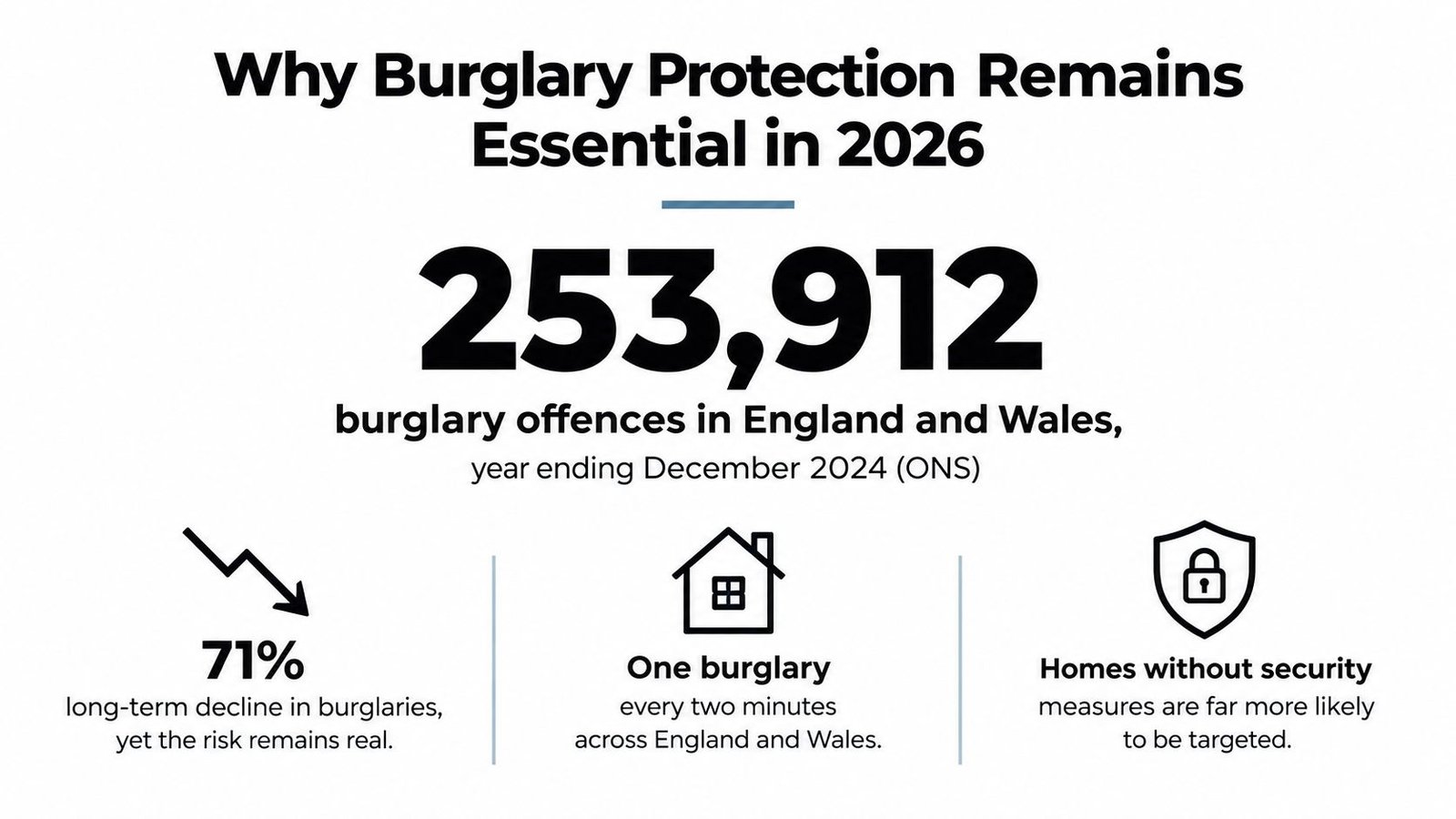
The latest official figures provide useful context. The Office for National Statistics burglary data records 253,912 burglary offences in England and Wales in the year ending December 2024. That was a 6% reduction from the previous year and a 71% reduction compared with the 890,099 offences recorded in the year ending March 2003.
Those figures don't support panic, but they do reject complacency. The ONS total includes both residential and non-residential burglary, so the risk applies to houses, shops, offices, warehouses, workshops, and other commercial premises. A lower national trend doesn't tell an individual property owner that their building is safe.
Risk management rather than fear
A homeowner in Cardiff, Swansea, or the Vale of Glamorgan may rarely think about burglary until a neighbour is affected. A retailer in Bristol, a warehouse in Newport, or a landlord managing several properties faces a different exposure, with empty periods, stock, staff access, and multiple entry points to consider.
The useful question isn't whether burglary will happen. You can't answer that with certainty. Ask instead whether the property has enough protection to:
- Discourage casual attempts: External warning devices, visible security equipment, lighting, and controlled access can make a property less attractive.
- Detect entry quickly: Door contacts, window contacts, shock sensors, and motion detection can identify activity before an intruder reaches valuable areas.
- Provide usable information: Video verification, event records, and clearly documented alarm signals can help people understand what happened.
- Trigger a defined response: Alerts should reach the right person or receiving centre, with keyholders and escalation procedures agreed in advance.
A siren that sounds after an intruder has moved through the building may be better than no alarm, but it isn't the same as a designed security workflow. A professional survey considers the building's layout, likely access routes, occupancy, pets, staff, neighbouring properties, and the consequences of a false alarm.
Why post-incident investigation isn't enough
Police outcomes also show why prevention and early notification matter. In England and Wales, the charge rate for residential burglary was 4.3% in the year ending March 2024, rising from 3.9% the previous year. The rate was 4.9% for home burglary and 2.2% for burglaries of an unconnected building, according to the official crime outcomes data.
These figures don't show that an alarm guarantees a charge, and they don't prove that one brand performs better than another. They do show why a property owner shouldn't rely entirely on identifying an offender after the event. Detection, verification, signalling, and a response plan need to work together before and during an incident.
Understanding UK Burglar Alarm Standards and Compliance
Security standards describe how equipment should behave and how the complete system should be installed, configured, maintained, and monitored. They aren't just badges attached to a control panel.
BS EN 50131 covers intruder and hold-up alarm equipment, including performance requirements and security grades. In practical terms, the grade should reflect the expected threat and the property being protected. A small occupied home, a remote outbuilding, a retail unit holding stock, and a warehouse won't necessarily need the same detector arrangement or resilience.
What the main standards mean
Think of the standards as different parts of one chain:
- BS EN 50131: Applies to the alarm equipment and its performance. It helps define how detectors, control equipment, warning devices, and related components should operate.
- BS 8243: Covers the installation and configuration of alarm systems intended for confirmed alarm arrangements. It addresses how the system should be set up to reduce false alarms and support a reliable response.
- BS EN 50518: Applies to the alarm-receiving centre, or ARC, that receives and handles monitored signals.
- PD 6662:2017: Forms part of the relevant UK requirements for remotely monitored systems installed since June 2019 in England, Wales, and Northern Ireland.
The plain-English guide to EN 50131 can help buyers understand equipment grades before they compare quotations. The grade alone, however, doesn't make an installation police-recognised. The installer, signalling route, receiving centre, configuration, and maintenance arrangements all matter.
Police response has conditions
ProtectUK states that monitored systems should conform to BS EN 50131 for equipment, BS 8243 for installation, and BS EN 50518 for the ARC. Police response also depends on compliance with the National Police Chiefs' Council security-systems policy, so a smartphone notification isn't equivalent to a police-linked alarm.
A police-compatible installation normally requires a defined process for confirming an event, contacting keyholders, and passing appropriate information through the recognised route. An audible-only activation generally won't receive police attendance unless independent evidence supports that a genuine offence is taking place.
Practical rule: Ask for written confirmation of the equipment standard, installation standard, signalling path, ARC arrangements, installer recognition, and maintenance requirements. Don't accept “police response” as a vague sales phrase.
Before signing, ask the installer:
- What grade and configuration does the risk assessment specify?
- Is the installation designed to BS 8243?
- Which ARC receives the signals, and does it meet the relevant requirements?
- What evidence confirms police-recognised compliance?
- What happens if broadband, mains power, or mobile service fails?
- What maintenance and false-alarm procedures apply?
This paperwork matters for more than police liaison. An insurer may require an approved installer, particular equipment, regular maintenance, or a defined monitoring arrangement. A cheaper self-installed product may function perfectly as a notification device while failing to satisfy a policy condition.
The Critical Gap Between App Alerts and Professional Monitoring
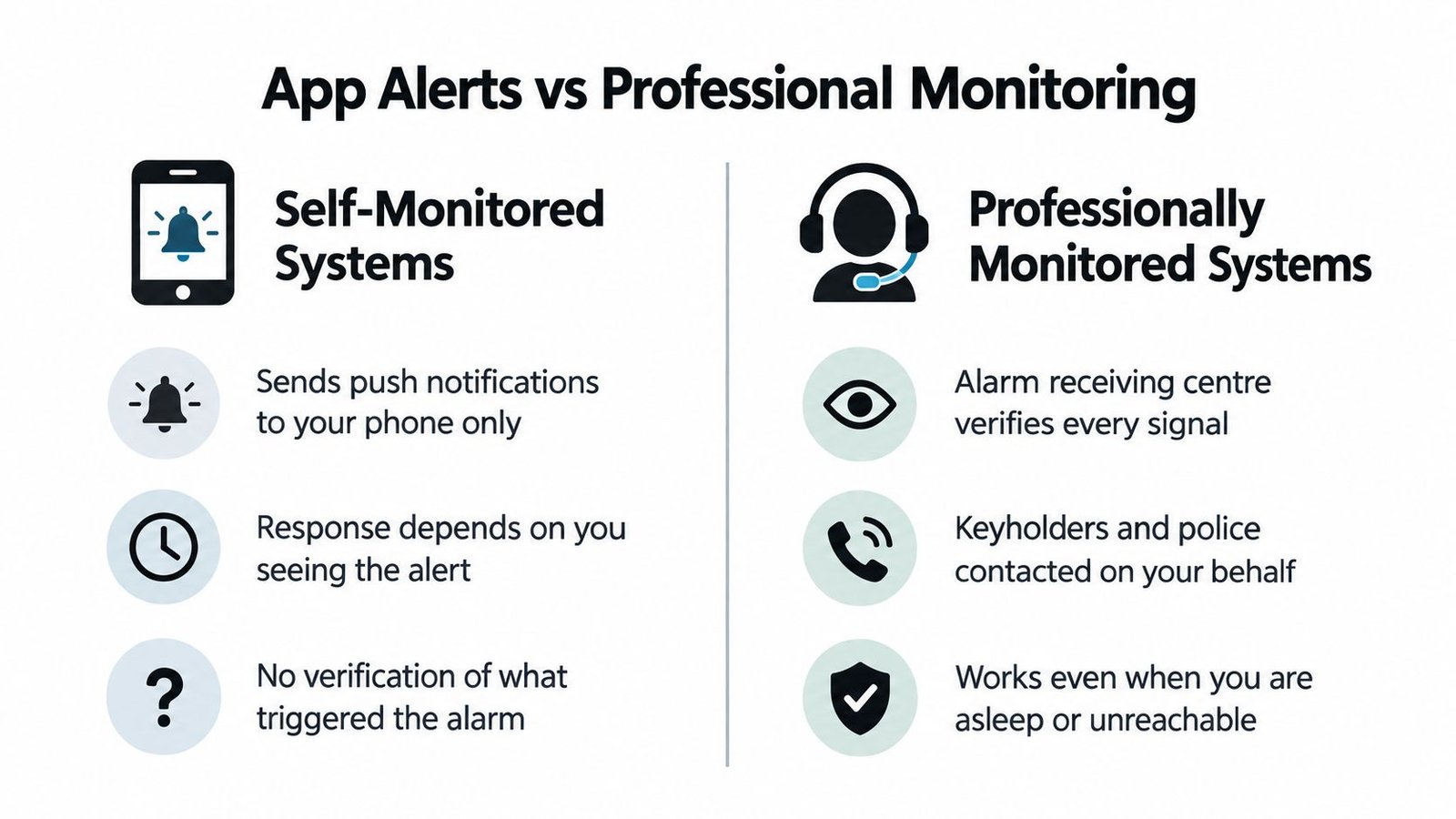
The word monitoring causes much of the confusion in the UK alarm market. A system that sends a push notification to an owner's phone is self-monitored. It depends on the owner seeing the message, understanding it, having a working phone and connection, and being available to decide what to do.
A professionally monitored system sends alarm signals to an alarm-receiving centre. The ARC follows an agreed procedure, which may involve verification, contacting keyholders, and escalating the event through the applicable route. These are different response chains, even if both systems have an app.
Compare the response, not the app
Consider two situations. In the first, a homeowner receives an alert during a meeting, assumes it was a pet, and doesn't open the app until later. In the second, a monitored signal reaches an ARC while the owner is asleep, and the agreed keyholder process starts without depending on the owner noticing a banner on a screen.
Neither arrangement is automatically right for every property. App-only notification may suit an occupied home where a trusted person can respond promptly and the owner accepts responsibility for verification. Professional monitoring becomes more valuable when the property is empty, the contents are important, staff need a formal process, or the owner can't reliably handle alerts.
The distinction also relates to alert fatigue, where repeated or poorly prioritised notifications cause people to ignore future warnings. The practical discussion in DevArmor's guide to alert fatigue is useful beyond cybersecurity because the same human problem affects physical security. If every activation becomes noise, the system loses operational value.
Police response is not automatic
For a remotely monitored system to support a police URN and potential police response in England and Wales, the installation must meet the relevant technical and police-recognised requirements. ProtectUK and NSI guidance also make clear that response is conditional. Three false alarm calls in a rolling 12-month period can lead to the withdrawal of immediate response, and keyholders remain part of the process.
That condition changes how you should evaluate equipment. A loud external sounder may attract attention, but it doesn't independently verify an event. A phone alert may be convenient, but it doesn't create an ARC record or police response route. A professionally designed system aims to reduce nuisance activations through correct detector placement, entry and exit settings, confirmation technology, commissioning, and maintenance.
The explanation of monitored alarm systems provides useful context for the difference between app connectivity and ARC-based handling. When reviewing a quotation, request a written flow diagram:
- Sensor: What detected the activity?
- Control panel: How is the event assessed and recorded?
- Signalling: How does the message reach the ARC?
- ARC: What verification and contact procedure applies?
- Keyholder: Who attends, and how quickly can they act?
- Police route: What conditions must remain satisfied?
The following video can help visualise the operational distinction between alarm equipment and a wider response process.
A reliable system isn't defined by the number of features shown in an app. It's defined by what happens after a detector activates, including when the owner is unavailable and when the first signal turns out to be a false alarm.
Layered Security and Why Alarms Alone Are Not Enough
An alarm should be one part of a security design, not the entire design. Research analysing Crime Survey for England and Wales data found that homes with standalone alarms were associated with a marginally higher burglary risk than homes without security. Related research concluded that alarms alone may increase the risk of completed or attempted burglary and may reduce the effectiveness of some security combinations.
That finding doesn't prove that alarms cause burglary. Higher-risk properties may be more likely to install alarms, owners may fail to use or maintain them, and repeated activations may be ignored. The engineering lesson is more useful than the headline. A siren without sensible detection, verification, and response can create confidence without delivering dependable protection.
Build overlapping layers
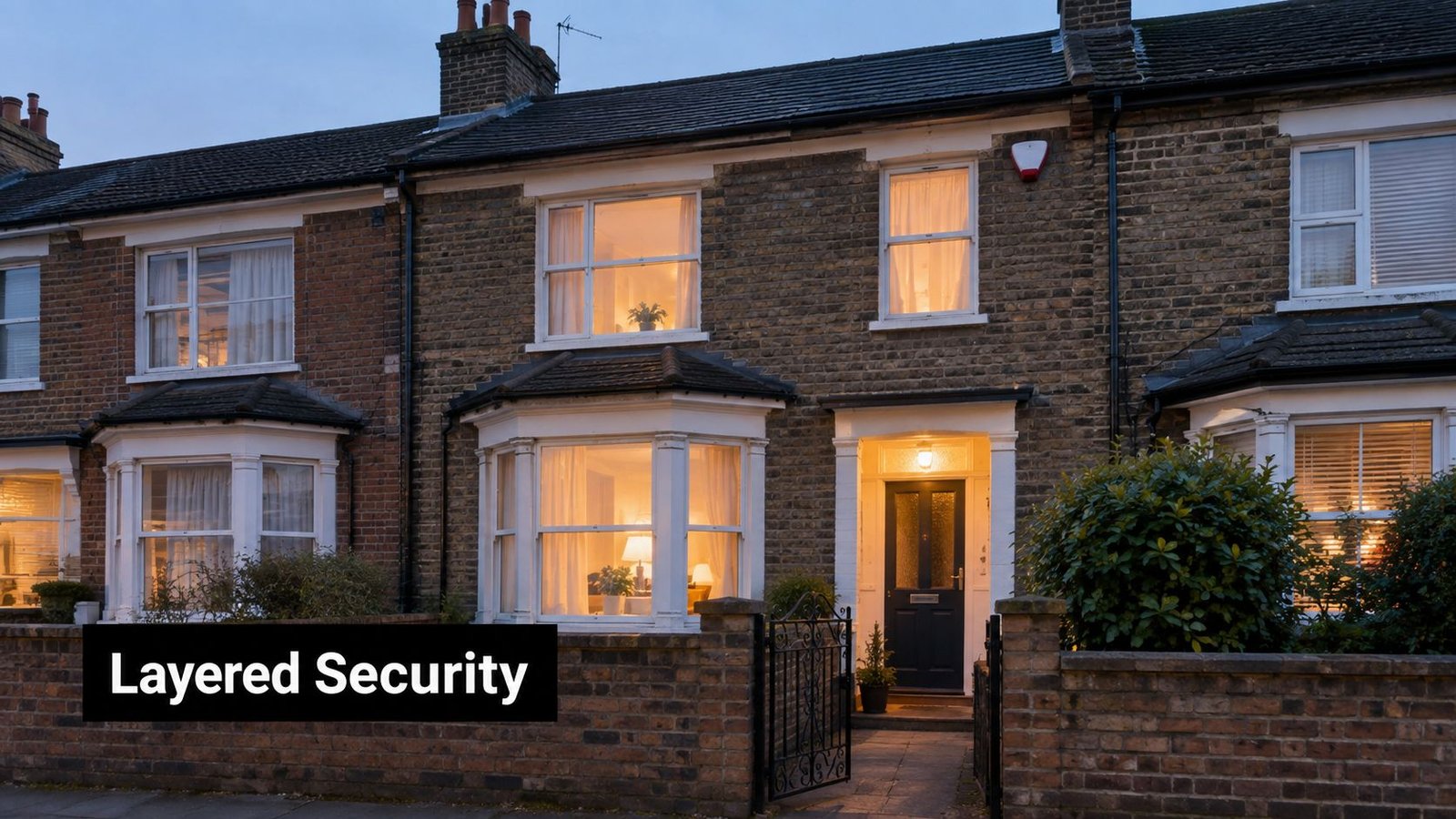
A layered installation gives each component a defined job:
- Perimeter layer: Door and window contacts identify opening, while shock sensors can detect attempted forced entry where appropriate.
- Interior layer: Motion detectors cover routes through halls, rooms, storage areas, and circulation spaces. Pet-friendly detection can reduce unwanted activations where the configuration suits the animal and room.
- Verification layer: CCTV or video verification supplies visual information that can help distinguish a genuine intrusion from a user error, environmental movement, or equipment fault.
- Response layer: Mobile alerts, keyholders, professional monitoring, and documented procedures determine who acts after the system reports an event.
- Resilience layer: Tamper detection, backup power, suitable signalling, and maintenance help the system continue operating when an intruder or fault affects one part of the installation.
A terraced house may need carefully positioned contacts and motion detection because adjoining walls, front access, rear doors, and narrow hallways create different exposure points. A commercial building may also require access control, CCTV coverage of loading areas, and separate arming zones for staff, stockrooms, and offices.
For a broader explanation of layered security for confidential sources, consider how independent controls can support one another rather than depending on one alarm event. The same principle applies to homes and businesses, although the exact devices should follow a site survey.
An integrated design can combine alarms, cameras, access control, gates, lighting, and fire systems while keeping responsibilities clear. Integrated security solutions should still be commissioned carefully, because adding devices doesn't automatically produce a coherent response.
Selecting the Right System for Homes and SMEs in South Wales
Start with the property, not a product bundle. A detached house in the Vale of Glamorgan may need protection for front and rear doors, accessible windows, garages, and outbuildings. A Bristol shop may need opening detection, staff access rules, stockroom coverage, and a process for closing time. A Newport warehouse may require separate zones, perimeter coverage, access control, and a response plan for periods when no employee is present.
Match the specification to the building
| Property Type | Key Features | Monitoring Level |
|---|---|---|
| Detached or semi-detached home | Door and window contacts, motion detection, pet-friendly options where suitable, external warning device, app control | App-only may suit an occupied property with dependable keyholders. Consider ARC monitoring if the property is frequently empty |
| Larger home or rural property | Perimeter detection, garage or outbuilding protection, CCTV verification, resilient signalling, carefully planned wireless or wired coverage | Professional monitoring is useful where travel time, isolation, or unreliable owner availability affects response |
| Retail unit or small office | Opening detection, staff user permissions, access control, panic or hold-up options where justified, CCTV at entrances and tills | ARC monitoring can provide a formal out-of-hours process and support keyholder escalation |
| Warehouse or industrial premises | Perimeter sensors, loading-door protection, zoned detection, CCTV, access control, tamper protection, backup arrangements | A professionally monitored and maintained system is generally more appropriate for vacant periods and valuable stock |
| Landlord or multi-tenant property | Separate user permissions, clear privacy controls, common-area detection, documented handover, maintenance access | Select monitoring and access arrangements that distinguish landlord, tenant, and keyholder responsibilities |
A quotation should identify the protected areas, detector types, signalling method, alarm grade, installation standard, warranty, maintenance schedule, and response model. It should also state what isn't included, such as cameras, additional keyholders, call-out work, or ongoing monitoring.
Questions that expose weak comparisons
Ask whether the price covers professional commissioning and whether the installer will provide user training. Check how the system handles temporary occupants, cleaners, contractors, staff turnover, pets, and holiday periods. A control panel with many functions isn't useful if users arm it incorrectly or silence repeated faults without investigation.
For a business, check access permissions and event records. A former employee shouldn't retain an active code or app account, and a manager should be able to identify authorised users without sharing one common credential. For a home, decide who receives alerts when you're travelling and whether a neighbour can attend without entering the premises.
Wisenet Security Ltd provides professionally installed burglar and intruder alarms across South Wales and the South West, including bell-only and monitored options, mobile alerts, pet-friendly sensors, and integration with CCTV and access control. Compare that type of proposal with other local, insured installers, and judge each quote by its documented response chain rather than its headline price.
Privacy and Cyber-Security in Smart Security Systems
A connected alarm can improve visibility while creating another account, another data stream, and another route into the household or business. Cameras may capture neighbours, visitors, employees, tenants, or public areas. Microphones and cloud applications can add further privacy considerations.
The Information Commissioner's Office consumer IoT assessment reports that privacy concerns affected 50% of consumers overall, with smart security and control among the categories where concern was highest. The same source discusses UK-focused research in which 28% of young British respondents never think about the security of their smart appliances. These figures point to an awareness problem, not proof that every connected alarm is unsafe.
Secure the account and the data
Use a unique password for the alarm account and enable multifactor authentication where the supplier supports it. Give family members, staff, tenants, and contractors their own permissions instead of sharing one administrator login.
Before installation, ask:
- Access: Who can view cameras, change settings, export clips, or add users?
- Retention: How long are recordings and event logs stored?
- Deletion: Can you remove footage and close former users' access?
- Visibility: Can cameras be positioned to avoid unnecessary views of neighbours or public space?
- Support: How long will the manufacturer provide firmware and security updates?
- Resilience: What can the system still do if broadband or mobile service fails?
Choose encrypted communications and a supplier that explains its data handling in plain English. A business should also document who may access recordings and why, particularly where footage includes staff or customers. A landlord needs a clear arrangement with tenants before installing cameras in shared or private areas.
Usability is part of security. Pet detection should match the actual animal and room, temporary access should expire, and holiday handovers should name a responsible person. Test alerts, investigate nuisance activations, and maintain the system so users don't learn to ignore it.
Wisenet Security Ltd designs, installs, and maintains integrated burglar alarms, CCTV, access control, and related security systems for homes and businesses across South Wales and the South West. Visit Wisenet Security Ltd to request a consultation and compare a system designed around your property, response requirements, and privacy needs.