Intruder Alarm Cost in 2026: UK Prices and Hidden Fees
A professionally fitted UK home intruder alarm typically costs about £400 to £1,200, and complete DIY kits cost around £150 to £220. That figure is the installation, not the bill you will still be paying in year five.
Price the response before you price the panel. A bell on the wall, a phone alert, and an alarm receiving centre are three different products, and they cost different amounts every year because they do different jobs after the sensor trips. I would not sign a quote until I know who is supposed to act, how fast, and what that action costs when the contract renews.
For a house in South Wales or the South West, or a unit holding stock overnight, intruder alarm cost is a five-year ownership decision tied to the risk that property actually faces.
Table of Contents
- Intruder Alarm Cost at a Glance
- Recurring Costs Most Quotes Leave Out
- What Pushes Your Quote Up or Down
- Five-Year Cost of Four Real Setups
- Matching Spend to Risk and Response
- Budgeting Steps for Homes and SMEs
- Book a Survey Before You Commit to a Tier
Intruder Alarm Cost at a Glance
UK security spending includes the equipment and ongoing work needed to protect properties. Government analysis of the economic and social costs of crime for 2019 to 2020 puts general security expenditure, including intruder alarms, at about £2.2 billion a year. Applying an IHS Markit estimate that intruder alarms accounted for 55% of security expenditure excluding vehicles gives an estimated £1.2 billion spent on intruder alarms across the UK each year. The analysis also records burglary-prevention security spending of about £338.5 million by individuals and £501.2 million by commercial organisations. These totals include installation, replacement, upgrades, monitoring and maintenance, so they describe more than the initial equipment price.
For homes, Quote2's 2025 cost guide gives a professionally installed burglar alarm range of £400–£1,200. The Independent's report on home-security alarm costs puts complete home-security alarm kits at around £150–£220. Older UK installation benchmarks put monitored home systems at about £800–£900 to install, according to published UK installation benchmarks. Treat these as starting prices: equipment, installation and the response service are separate parts of the decision.
| System tier | Typical installed cost | Best fit |
|---|---|---|
| DIY alarm kit | £150–£220 | Flat or small home with few entry points and no monitoring |
| Professionally installed home system (bell-only or app alert) | £400–£1,200 | Typical South Wales or South West house |
| Monitored home system (installation only) | £800–£900 | Homes wanting alarm receiving centre response |
| Small commercial, BS EN 50131 Grade 2 | £1,500–£3,000 | Small shop, office or single retail unit |
| Medium multi-zone, Grade 2/3 | £3,500–£8,000 | Multi-zone retail, warehouse or logistics unit |
| Large, high-value or Grade 3/4 | £8,000–£25,000+ | High-value industrial, multi-site or insurer-driven premises |
What sits inside the installed price
A fitted system's price should cover the control panel, detection devices, power supply and standby battery, wireless pairing or cable routes, external sounder where specified, programming, a walk test and handover notes naming each zone. Commissioning is part of the installation, not an optional extra. It checks that each device is assigned correctly, such as confirming the front-door contact is labelled to match that entrance.
Why the grade moves business prices
BS EN 50131 grades run from Grade 1 for lower-risk threats to Grade 4 for high-risk sites. Insurers commonly ask for Grade 2 or Grade 3. Indicative installed costs are £1,500–£3,000 for a small commercial Grade 2 system, £3,500–£8,000 for a medium multi-zone Grade 2/3 installation, and £8,000–£25,000 or more for larger, high-value or Grade 3/4 premises, according to commercial intruder-alarm guidance. A site survey narrows these starting ranges by accounting for the premises and required coverage. In practice, the chosen system tier and site requirements affect the quote more than the grade label alone.
Recurring Costs Most Quotes Leave Out
The quote on the front page is a one-off. The annual contract is where a tidy budget drifts, because monitoring, signalling, and call-outs keep arriving after the engineer has left.
| Cost item | Typical range | Who pays it most | What to confirm |
|---|---|---|---|
| Maintenance, audible home system | £60–£100 per year | Homeowners with bell-only systems | Visits per year and battery replacement included |
| Monitored home package (monitoring and maintenance) | £200–£300 per year | Homeowners wanting ARC response | Keyholder response and call-out fees |
| ARC monitoring, business | £300–£900 per year | Shops, warehouses and offices | Service level and response times |
| Maintenance, business | 8–15% of installed value per year | Multi-zone and graded systems | Test frequency and response times |
| Cellular or dual-path signalling (IP plus 4G) | Quoted separately | Sites where insurers specify dual-path | Subscription term and SIM replacement |
| App and cloud connectivity | Quoted separately | Homeowners wanting smartphone alerts | Whether the subscription is needed to receive alerts |
| Call-outs for false activations or repairs | Quoted per visit | All sites | Whether outside-contract visits are charged |
Home contracts
An audible home system is the cheap annual path, at about £60–£100 a year for maintenance. A monitored home package, covering monitoring and maintenance together, sits nearer £200–£300 a year. That second band is not a markup on the same job. It pays an alarm receiving centre to take the signal, try the keyholders, and follow the agreed procedure. If the contract does not say how many site visits are included, or whether a flat battery is inside the fee, the low headline is incomplete.
Charges quotes often omit
Business ARC monitoring commonly adds about £300–£900 a year, and annual maintenance is often estimated at 8–15% of the installation value. Dual-path signalling, usually IP plus 4G, is a separate hardware and subscription cost, and many insurers will not accept a single path. App and cloud alerts can be a paid subscription, and some panels will not push a notification once that subscription lapses. Call-outs for false activations, pet-triggered PIRs, or a failed battery outside the contract are charged per visit.
Practical rule: A low annual maintenance fee means little if every extra visit is billed on top, or if the contract auto-renews at a higher rate you have not modelled.
Ask each supplier, in writing, which rows above are included, how many visits a year you get, the response time, and the renewal price. A maintenance checklist is the right place to tick batteries, tamper circuits, and signalling tests before you compare those answers.
What Pushes Your Quote Up or Down
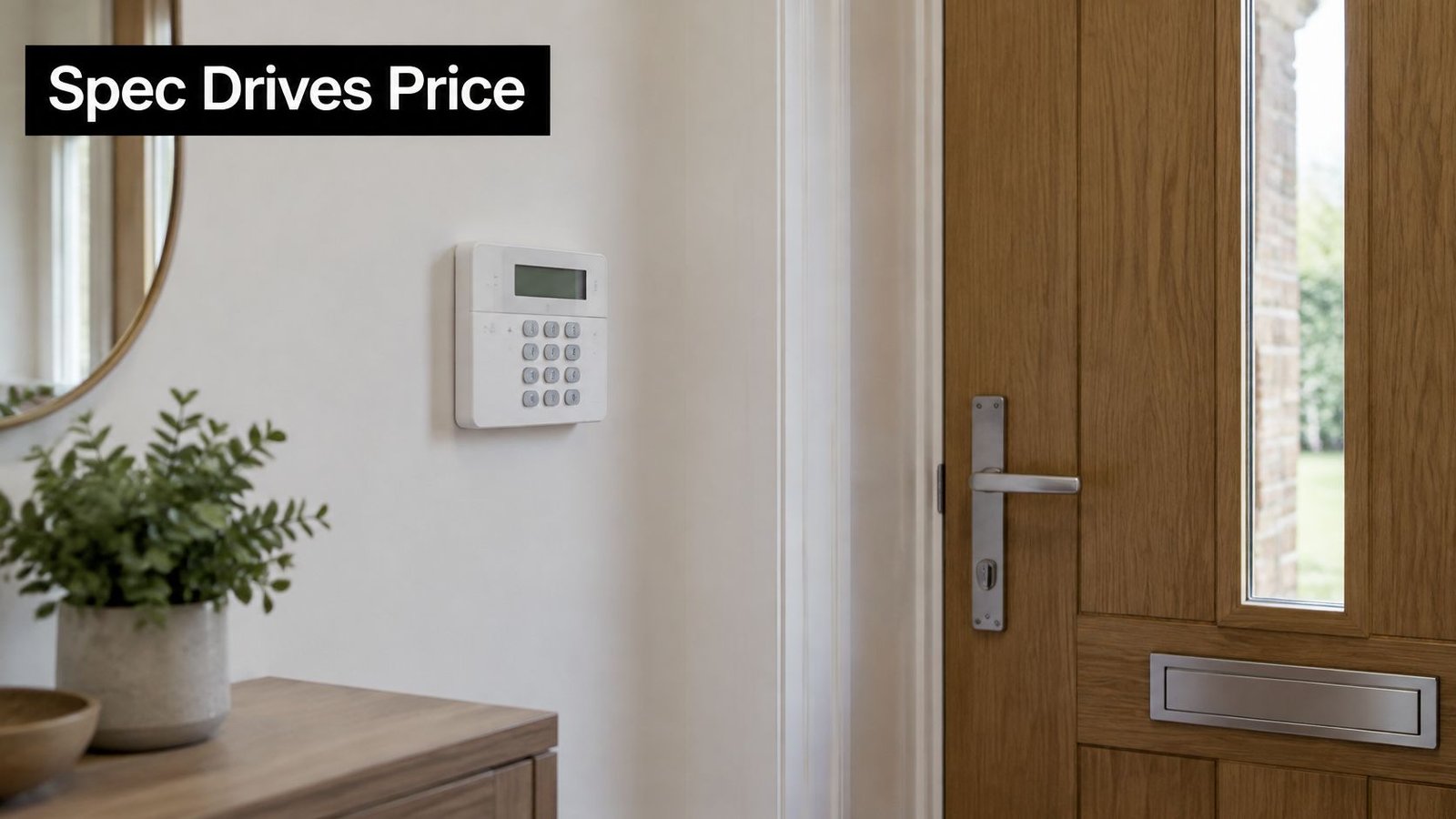
Two quotes for the same house can differ the way two cars with the same badge differ. The paint matches. The engine, the options, and the labour underneath do not. Intruder alarm cost moves with the specification, not with the logo on the keypad.
| Factor | Effect on price | Example |
|---|---|---|
| Detector count | Rises with each door, window and motion sensor | Eight contacts versus three in a semi and a flat |
| Wired versus wireless | Wired raises labour for cable routing and making good; wireless raises device cost | Wired install in an occupied home with plaster walls |
| Building access | Lofts, multiple storeys and tight voids add labour | Loft-mounted sensors in a three-storey house |
| Zoning | More zones need more panel capacity and commissioning time | Separate zones for ground floor, first floor and stock room |
| External signalling | Adds a bell box and fixings | Audible external bell on a shop frontage |
| EN 50131 grade | Higher grades need more detection layers and certified installation | Grade 2 shop versus Grade 3 jewellery unit |
| Signalling path | Dual-path (IP plus 4G) adds hardware and subscription | Insurer-specified dual-path on a warehouse |
| ARC service level | Faster verification and response costs more per year | Keyholder response versus police-response eligibility |
| Premises size and contents value | Larger sites need more sensors and higher grades | Multi-unit logistics hub with high-value stock |
Same street, different labour
Take a three-bedroom semi with eight door and window contacts, two pet-tolerant PIRs, and a loft PIR. Then take a two-bedroom flat with three contacts, one PIR, and no loft. The panels can be the same model. The semi needs more devices, more programming, and often a second visit because loft boards, furniture, and occupied rooms slow the route. Wired work in an occupied home costs more in labour because cable has to be fished and plaster made good. Wireless devices cost more per point, and they still need a signal test in every room, including the ones with thick stone or foil-backed plasterboard.
Grade and signalling on commercial sites
On a shop or warehouse, grade and path do more to the price than the panel brand. More zones mean more commissioning time. Insurer-driven dual-path signalling adds a communicator and a SIM subscription. A higher ARC service level, especially one aimed at police-response eligibility, costs more per year than a keyholder-only package. Police response is not automatic. It normally needs a certified install, confirmed activations, and a Unique Reference Number.
The main intruder alarm types are worth naming in the specification so a bell-only quote is not set beside a dual-path monitored one.
A cheap quote usually fails four questions. How many contacts, PIRs, and tampers are listed? Which EN 50131 grade is certified? Which signalling paths are live on day one? What does the ARC do, and in what time?
Five-Year Cost of Four Real Setups
Five-year cost here is the installed price plus five years of running cost. It excludes inflation and it excludes a mid-life panel or battery replacement, so it is a floor, not a ceiling. On that basis a monitored home costs more than double a bell-only install at the bottom of each band, and the extra money only pays off if someone will act.
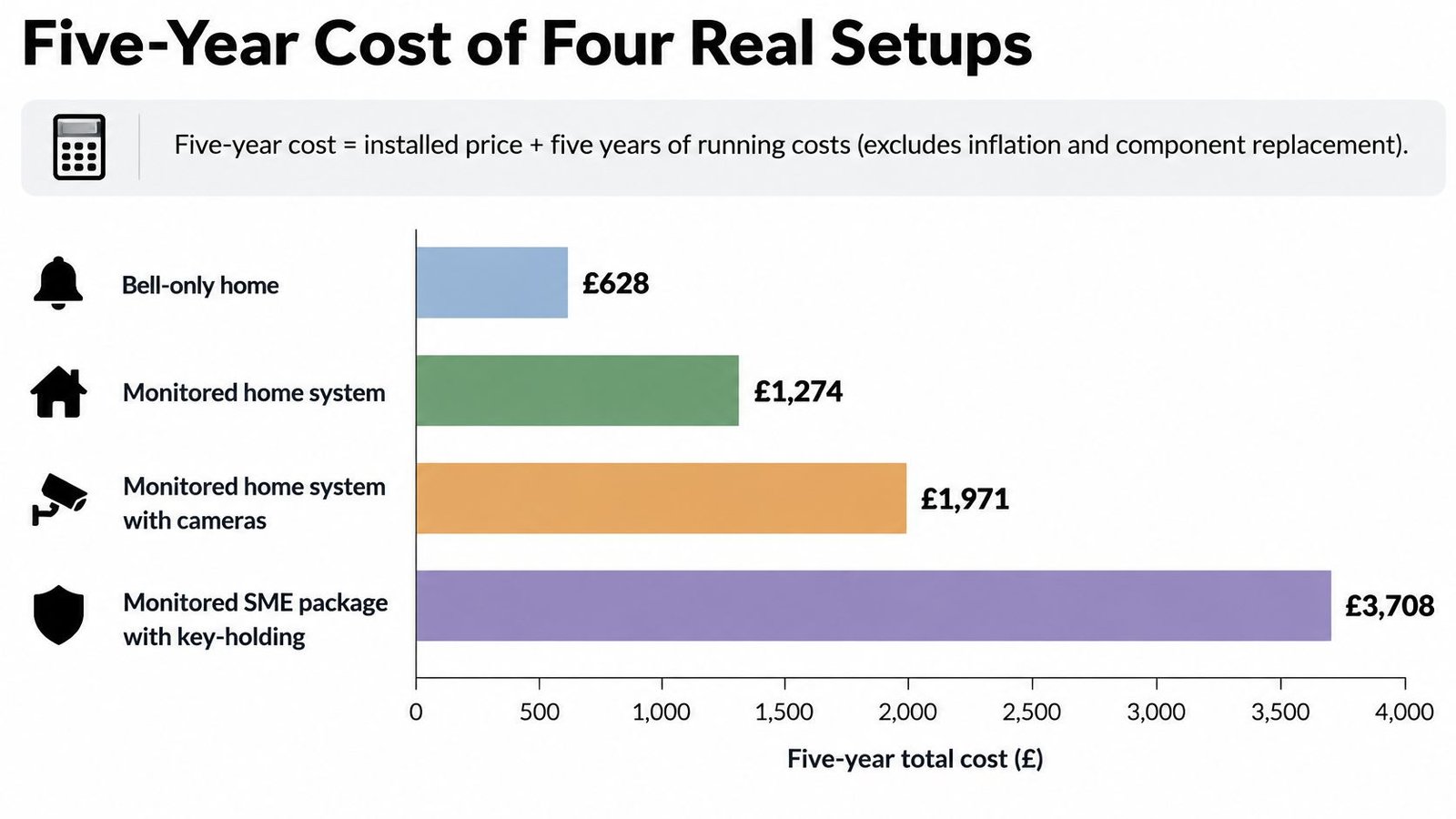
| Setup | Upfront cost | Annual running cost | Five-year total |
|---|---|---|---|
| Bell-only home system, professionally installed | £500 | £60–£100 | £800–£1,000 |
| Monitored home system | £800–£900 | £200–£300 | £1,800–£2,400 |
| Small commercial, Grade 2 monitored | £2,250 | £480–£1,238 | £4,650–£8,440 |
| Medium multi-zone, Grade 2/3 (midpoint) | £5,750 | £760–£1,763 | £9,550–£14,563 |
How the commercial line is built
The small commercial row uses the midpoint of a Grade 2 install, £2,250. Maintenance at 8% of that figure is £180, and at 15% it is about £338. Add ARC monitoring at £300–£900 and the annual band is £480–£1,238. Five years of that is £2,400–£6,190. Add the install and the five-year total is £4,650–£8,440.
The medium row uses the midpoint of £3,500–£8,000, which is £5,750. The same 8–15% maintenance plus the same ARC band produces about £760–£1,763 a year, and £9,550–£14,563 over five years. Repeat the sum with your own quote. Do not borrow these midpoints if your detector schedule is thinner or heavier.
What the gap is buying
The bell-only home stays inside £800–£1,000 over five years if maintenance stays in band and nothing fails outside the visit. The monitored home lands between £1,800 and £2,400 before any SIM or cloud add-on. You are not buying a louder siren. You are buying a staffed intervention path. If nobody will answer, the higher total is poor value. If the house is empty for days, or the unit holds stock you cannot replace quickly, the lower total can be the expensive mistake.
Build the same four columns from the written quotes in front of you, then add a replacement allowance around year seven before you pick a tier.
Matching Spend to Risk and Response
The dearest package is not automatically the right one. Falling burglary figures do not retire the alarm, and they do not justify buying Grade 3 kit for a flat with three doors and a neighbour next door.
Police-recorded burglary in England and Wales fell 12% to 224,518 offences in the year ending December 2025, and the Crime Survey for England and Wales reported a 20% fall in domestic burglary on the previous year, according to the Office for National Statistics. Those police figures mix residential and non-residential burglary, and recorded crime can miss incidents that were never reported. Read them as a reason to judge your own exposure, not as a reason to skip protection.
Spend is easier to defend when one of these is true.
- Isolated property: A bell may not reach anyone who will come out.
- Long vacant periods: Holiday homes, locked shops, and units empty at weekends need a path that does not rely on you being awake.
- Valuable contents or stock: The loss is not just the broken lock. It is the kit, the stock, and the days you cannot trade.
- Weak perimeter: Poor lighting, shared alleys, and easy rear access raise the chance a detector is the first warning, not a neighbour.
- Plant and equipment on site: Warehouses and yards lose more from downtime than from the alarm invoice.
What each tier does after it trips
Detection, notification, verification, response, and evidence are separate benefits. A bell-only alarm may deter, and it may wake a neighbour. It does not call anyone. An app alert tells you, if the power, the broadband or mobile path, and your phone all work, and if you can leave what you are doing. A monitored system adds an intervention service, with a contract, a keyholder list, and a yearly fee. It is still not a promise that police will attend.
For South Wales and the South West, check local patterns and the building itself before you lock a grade. A monitored intruder alarm earns its fee when the empty hours are long. It does not earn it when a housemate is always in and will already hear the bell.
The decision question is blunt. Who will act on this alert within minutes, and what would a missed one cost in stock, damage, or lost trading? If you cannot name that person, do not pay for a signal nobody receives.
Budgeting Steps for Homes and SMEs
Work in this order. Each step has a reason, and a mistake that inflates intruder alarm cost without improving the outcome.
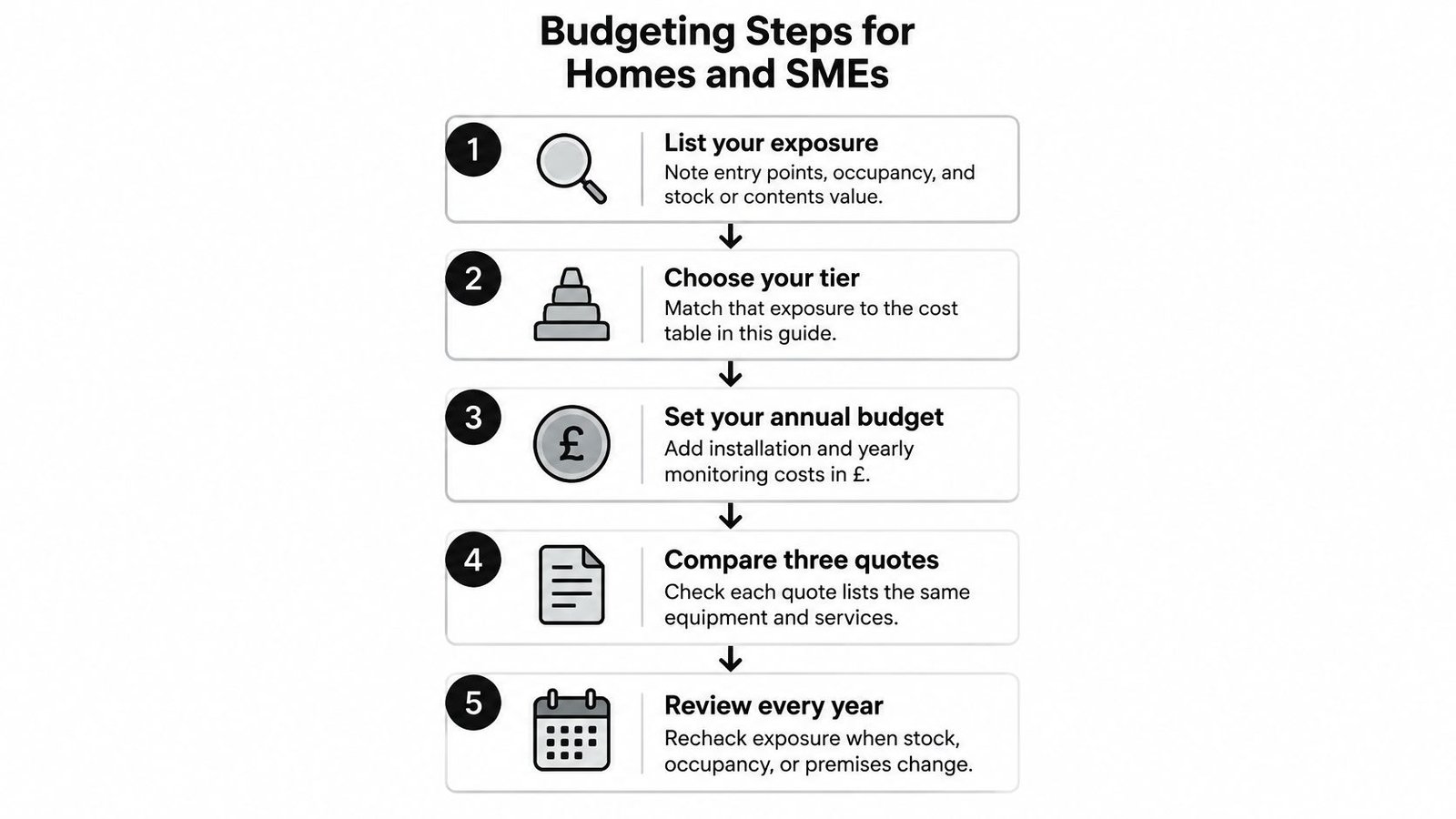
List the exposure. Write down entry points, who is in the building and when, pets, tenants, and the value of contents or stock. You cannot match a tier to a risk you have not named. The common mistake is starting from a brochure package.
Choose the tier that matches that list. Use the installed bands in this guide, then answer who acts. Buying the headline tier without a named responder is how people pay for monitoring they will never use.
Set a five-year budget. Add installation and running costs, including signalling. Comparing one-off prices only makes the monitored option look unfairly dear, or the bell-only option look complete when it is not.
Take at least three written quotes on the same specification. Same contacts, same PIRs, same grade, same paths. Comparing a bell-only price with a monitored price is not a saving. It is a different service.
Read the schedule, not the total. Check detector count and type, tamper protection, grade, signalling path, ARC service level and response times, battery and maintenance inclusions, warranty length, and call-out charges. A low headline with no detector schedule is not a quote you can hold anyone to.
Compare five-year totals, then the renewal. Add a replacement allowance around year seven and read the auto-renewal rate. Ignoring the renewal is how year three costs more than year one for the same visits.
Confirm the insurer before you sign. Ask whether the policy needs a grade, monitoring, or confirmed alarms, and whether police response depends on certified installation, confirmed activations, and a Unique Reference Number. Signing first, then discovering the insurer wanted dual-path, means paying twice.
Official outcomes show why the response plan belongs in the budget. In the year ending March 2026, 72.4% of residential burglary offences in England and Wales were closed because no suspect had been identified, and the figure for non-residential burglary was 70.6%, according to crime outcomes statistics for England and Wales. Those figures do not score alarm brands. They do show that detection is not the same as a named suspect, evidence, or recovery.
For a warehouse, a landlord, or a multi-tenant block, add downtime, stock loss, and whether the alarm should sit beside CCTV, access control, or the fire system. A cheaper alarm is poor value if nobody can act on it. A higher recurring cost can be the rational one where verification and continuity matter. False activations, keyholder gaps, pets, and tenants belong on the same page as the price, because they decide whether the system is usable on a Tuesday night.
Book a Survey Before You Commit to a Tier
Match the tier to the building, then stop shopping on the headline.
A bell-only or app-alert system fits a low-exposure home where an owner or neighbour can respond. A monitored home system fits a property that sits empty for long stretches, or one that is too isolated for a bell to matter. A graded business system fits premises where an insurer sets the grade or the stock and plant would hurt the business if they went overnight.
The only price worth comparing is the one a surveyor has walked. Detector count, loft access, zone splits, and the signalling options are not visible from a web form.
Wisenet Security Ltd, a local, fully insured specialist for South Wales and the South West, including Cardiff, Bristol, Newport, and Swansea, offers free consultations, installs to BS EN 50131 with bell-only or monitored options, and uses DBS-checked engineers with SafeContractor accreditation. Bring your exposure list and your five-year table, and ask for a written quote that shows every recurring line, not a single installed total.
If you want that survey booked rather than another generic price range, Wisenet Security Ltd designs and maintains intruder alarms for homes and commercial sites across South Wales and the South West, with bell-only and monitored options set out against your actual risk. Take your entry-point list and your five-year figures to a free consultation, and ask for a written quote that separates installation from every yearly fee before you commit to a tier.