Commercial Intruder Alarm Installation: A Practical Guide
A warehouse manager in South Wales finds a damaged roller door on Monday morning. The alarm sounded overnight, but nobody can say which zone triggered it, whether the signal reached a monitoring centre, or who was meant to respond. The immediate worry is missing stock. The next is whether the business can reopen safely and what the incident means for insurance.
That uncertainty often starts before the first detector goes in. A useful commercial intruder alarm installation begins with decisions about what needs protecting, how an alarm should be verified, and who will act when it activates. A lower headline burglary figure can't answer those questions for an individual site.
Table of Contents
- Why Commercial Premises Still Need a Planned Alarm Install
- What Commercial Intruder Alarm Installation Really Involves
- BS EN 50131 Grades, Signalling and Confirmed Alarms
- Choosing Between Bell-Only, Self-Monitored and ARC Monitoring
- Site-Specific Planning for Different Business Types
- Commissioning, Handover and What Comes After Installation
- Ongoing Maintenance and False Alarm Reduction
- Common Questions About Commercial Alarm Installation
Why Commercial Premises Still Need a Planned Alarm Install
A shop with a damaged shutter and a warehouse with a forced loading door face different operational problems. Both can lose trading time while staff assess damage, arrange repairs and secure the premises. The impact may extend beyond missing stock: broken glazing or an unusable entrance can delay reopening.
The Commercial Victimisation Survey for the year ending March 2021 recorded that burglary, including attempted burglary, accounted for 8% of crimes measured against businesses in England and Wales, while theft from customers accounted for 14%. The figures show that business crime includes more than forced entry. An attempted break-in can still leave a site exposed or disrupt operations. The UK government's commercial victimisation survey reporting provides the survey details.
The British Chambers of Commerce reports that 42% of UK businesses experienced crime in the previous year, including theft, burglary, cybercrime and fraud. The report also says only a portion of victimised businesses report incidents to police, so recorded offences cannot describe every business's exposure. Use headline figures as context, then assess the actual premises and the consequences of an incident. The British Chambers of Commerce business-crime report sets out its findings.
Start with the business, not the alarm catalogue
Before seeking a quote, decide what would cause the greatest disruption: missing stock, a damaged shutter, unauthorised workshop access, or being unable to open. Give the installer a clear picture of entry points, outbuildings, staff routines, lone working and who can respond to an alert. These details help shape a system around the site rather than a generic equipment list.
Where valuable goods are stored in a defined area, physical protection can complement detection. A business could assess whether security cages from Material Handling USA suit its stock and workflow. An alarm can signal an incident, but it does not physically prevent access to goods.
Recorded burglary figures also need context. The 2021 survey recorded a sharp decline in police-recorded business and community burglary during a period affected by COVID-19 restrictions and reduced commercial activity. The later business survey still treated burglary and attempted burglary as a distinct category. A change in recorded offences does not establish the risk at a particular site or justify reducing protection without a site assessment.
What Commercial Intruder Alarm Installation Really Involves
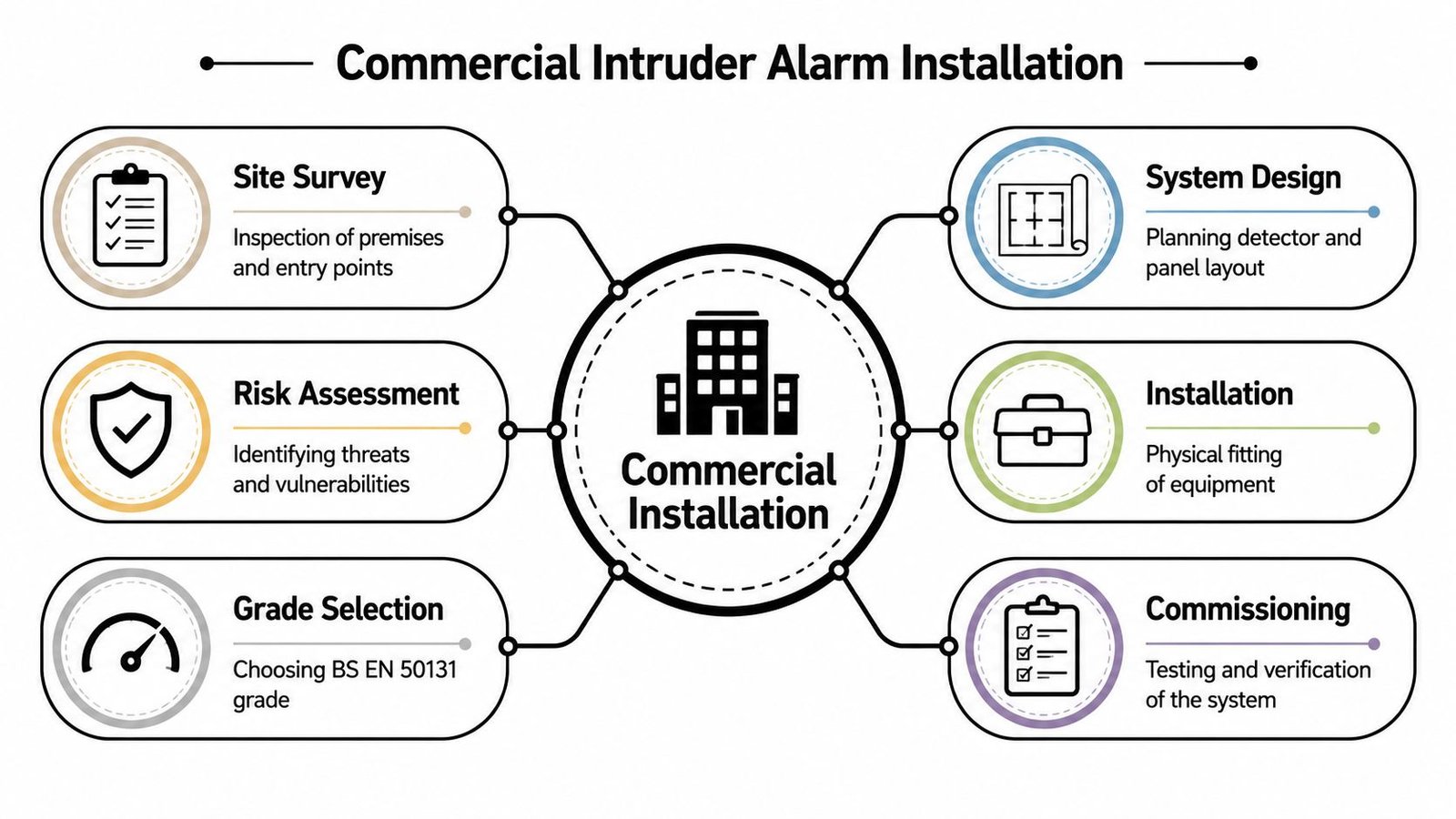
A commercial alarm is a designed and documented system, not a collection of sensors connected to a keypad. The installer needs to understand how the premises is used, what an intruder could reach, how staff enter and leave, and what should happen when a detector activates. Those inputs determine the system's grade, coverage, signalling and response arrangements.
The UK framework reflects a shift from prescriptive national standards to risk-based European standards. BS 4737, a 21-part series first published in 1971, covered elements including detectors, signalling equipment, installation, maintenance and servicing. During the late 1980s, the British Standards Institution and CENELEC began developing the EN 5013X family; the first relevant EN 50131 documents appeared in the late 1990s. BS EN 50131-1 introduced design based on the anticipated capability of an intruder, rather than relying only on a fixed prescriptive approach. The transition was implemented through PD 6662:2004, and new UK installations were expected to follow the European-standard framework from 1 October 2005. The history is summarised by Professional Security.
The job is a chain of decisions
A proper survey leads to a risk assessment, then a grade and a design. The installer selects detection based on the route an intruder might take, places equipment to suit the building, plans the control panel and signalling path, and defines how the system distinguishes an alarm condition. Commissioning then checks that the design works in practice.
Think of the alarm as part of the building's wider safety plan. A fire plan considers routes, zones and who responds; an intruder system also needs defined coverage, reliable communications, user instructions and documented checks. The analogy isn't that the two systems do the same job. It's that both fail if the design ignores how people use the building.
BS EN 50131 is a technical foundation, not a marketing badge. Ask the installer to explain the proposed grade, detection logic, signalling method and commissioning evidence in terms of your premises. The overview of EN 50131 can help you understand the standard's role, but the system still needs a site-specific design.
BS EN 50131 Grades, Signalling and Confirmed Alarms
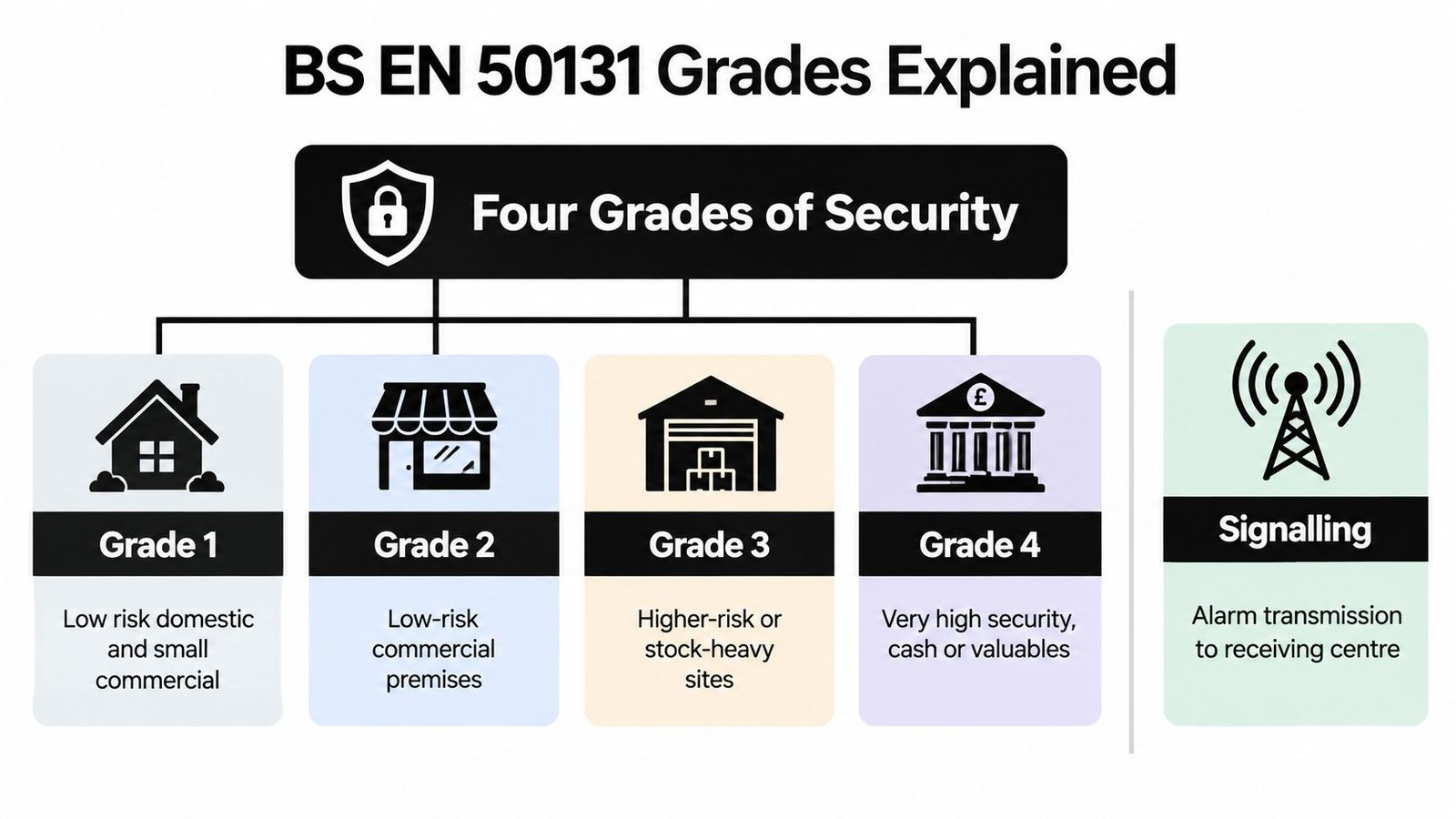
A grade describes the expected security level of a system in relation to risk, including the anticipated intruder's knowledge and equipment. It isn't a label for how many sensors appear on a quote. Higher-risk sites may need stronger tamper protection, more deliberate detection coverage and greater resilience in the power and signalling arrangements.
Match the grade to the exposure
Grade 2 is often considered for lower-risk commercial premises. Grade 3 may be appropriate where there's higher risk or valuable stock, while Grade 4 is intended for very high-security targets. Those descriptions are a starting point for discussion, not a substitute for the insurer's requirements or an installer's assessment of the actual site.
A Grade 2 and Grade 3 proposal might list similar-looking devices, yet differ in the protection built into equipment, its resistance to interference, and the system's design assumptions. Ask the installer to identify the standard and grade being quoted against, then explain how the proposed coverage and resilience meet the site's risk. The BS EN 50131 grades and design considerations video provides a visual introduction.
Signalling also matters. If a monitored alarm is expected to support police response, the path from premises to alarm-receiving centre, the centre's handling process and the event's confirmation logic must form a compliant chain. A system that detects an event but can't reliably communicate it, or that generates unconfirmed activations, won't deliver the intended response.
Confirmation is an operating rule, not a product feature
For premises in England and Wales, BS EN 50131 sets system requirements, while PD 6662:2017 and BS 8243:2021 guide the UK application and design, installation and configuration of systems that generate confirmed alarm conditions. Confirmation may use a sequence of detections or other approved verification methods. The point is to establish a credible alarm condition before the event is passed through the police-response process.
Before approving a proposal, ask how entry and exit are configured, what event qualifies as confirmed, how the ARC receives and handles signals, and who will manage police registration. The installer should explain the complete arrangement, not just name a panel or signalling device.
Choosing Between Bell-Only, Self-Monitored and ARC Monitoring
The right monitoring tier depends on who can respond, how quickly they can reach the site and whether police response is part of the requirement. A bell-only alarm alerts people nearby. A self-monitored system sends notifications to nominated users. An ARC-monitored system routes signals to an alarm-receiving centre, with procedures for handling events and contacting keyholders.
| Tier | Signal path | Response model | Police URN eligible | Insurance impact |
|---|---|---|---|---|
| Bell-only | Local sounder | Nearby staff, neighbours or a keyholder may investigate | No, not on its own | Depends on the insurer and site |
| Self-monitored | App alert to nominated users | A manager or keyholder decides what to do | No, not on its own | Confirm acceptance with the insurer |
| ARC-monitored | Signalling to an alarm-receiving centre | ARC follows agreed procedures and contacts keyholders | Yes, if the required conditions are met | May support specified policy requirements |
Choose by response capability
Bell-only can suit a lower-risk unit where there's a realistic chance that a responsible person will hear the sound and act. It doesn't create a dependable response because the siren is loud. If a premises is isolated or neighbours can't identify who should attend, the sounder may deter without resolving the incident.
Phone alerts give a manager more information than a local sounder alone, but they depend on someone noticing the notification, being available and knowing what to do. They shouldn't be treated as a route to police response where that response is required.
ARC monitoring carries an ongoing cost and a service relationship, but it provides a defined receiving and escalation process. A police Unique Reference Number (URN) is required for police response, and the system must connect to an approved ARC through an approved installer. The monitored intruder alarm system options can help frame a conversation about those arrangements.
Practical rule: Ask your insurer which alarm and response arrangements it requires before you choose a monitoring tier.
Site-Specific Planning for Different Business Types
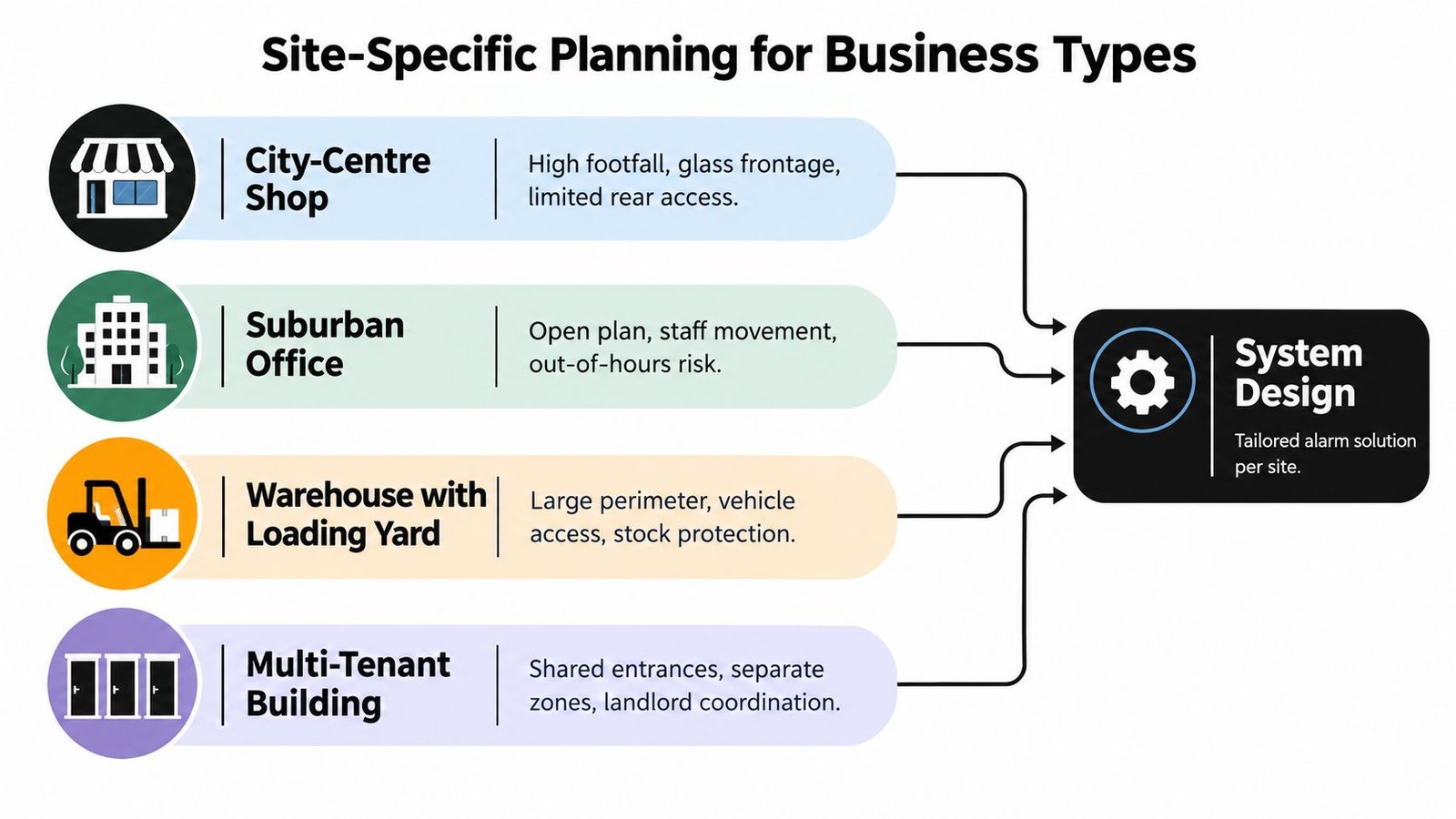
A shop with a glazed frontage needs a different alarm design from a warehouse with roller doors or an office with shared corridors. As the survey figures earlier in this guide show, business crime extends beyond break-ins, so the design should follow the premises' use rather than a generic equipment package. On a site survey, the installer should map likely entry routes, working patterns, stock areas and access responsibilities before recommending equipment.
Four premises, four design conversations
City-centre shop. Glazing, shutters, rear delivery doors and stock near public areas shape the detection plan. Door or shutter contacts can cover likely entry points, while internal detectors should cover routes through the shop. Staff also need entry and exit settings they can use consistently. Smoke detection belongs to the fire system's design, not as a substitute for intruder detection.
Suburban office. Staff movement during working hours can complicate setting and unsetting. The survey should establish out-of-hours access, shared corridors, sensitive rooms and lone-working arrangements. Panic buttons may suit workplaces where staff need a way to summon help, but they address a different risk from intrusion detection.
Warehouse with a loading yard. Large open areas, roller doors, stock zones and external approaches make coverage more demanding. The installer may propose door contacts, detection in selected internal zones and perimeter protection, provided it can be configured to avoid nuisance alarms during normal operations. Vehicles, loading schedules and staff routes all affect detector placement and alarm settings.
Multi-tenant building. Shared entrances and separate occupiers require clear boundaries. The system may need partitioned areas, agreed control of shared access and a documented process for tenants, landlords and contractors. Managers of temporary or modular workplaces can review these security options for mobile offices when assessing the access and security needs of those buildings.
The site manager's brief matters. Give the installer opening hours, stock details, access arrangements, outbuildings and keyholder responsibilities. Those details make it possible to challenge a design that overlooks a delivery entrance, leaves shared areas unclear or places detectors where routine work will trigger them. The right questions concern coverage, staff use and how each area will be managed, not just how many devices the quote includes.
Commissioning, Handover and What Comes After Installation
Installation isn't complete when the panel powers up. Commissioning should verify that detectors respond as intended, the system sets and unsets correctly, and alarm signals reach the ARC where monitoring is specified. Any confirmation sequence and response arrangement should be tested against the agreed design.

Make the handover testable
Ask for records that let a new facilities manager understand and operate the system. A useful handover typically includes:
- As-fitted information: Drawings or schedules showing equipment locations and alarm zones.
- User guidance: Clear instructions for setting, unsetting, managing authorised users and responding to faults.
- Commissioning evidence: A record of detector tests and signal checks, including ARC connection where applicable.
- Police-response arrangements: Confirmation of who is responsible for the URN application and the registration process.
- Maintenance plan: The agreed service arrangements and contact route for faults or changes.
The business should know who can attend, how keyholders are contacted and what happens when a signal is received. Don't sign off a monitored system if the ARC connection, user training or agreed documentation is still outstanding.
Wisenet Security Ltd can be one option for businesses seeking a local survey, installation, user training and system documentation. Its engineers are DBS-checked, and the company's work includes integrating alarms with CCTV or access control where that suits the site. The useful question for any provider is whether the promised scope, handover and ongoing responsibilities are written down.
Ongoing Maintenance and False Alarm Reduction
A commercial alarm needs routine attention after commissioning. Dust, moved stock, building work, changing layouts and staff habits can all affect detection. A detector that was correctly positioned during installation may become obstructed by a new shelf or storage area, while an unnoticed battery or power fault can compromise reliability.
Keep the design aligned with the building
Maintenance should follow the system specification and the provider's recommendations. A service visit can check detector operation, sounders, power supplies, batteries, signalling and the condition of equipment. Ask for service records that document faults found, actions taken and any changes that affect coverage.
False alarms deserve active management. Poorly set entry and exit routines, unsuitable detector placement or changing site conditions can generate avoidable activations. On a police-linked system, repeated nuisance alarms can affect the credibility of the site's signals and the response arrangements, so the cause should be investigated rather than resetting the panel.
A maintenance agreement is useful when it names who responds to faults, how service visits are recorded and what happens if the premises changes. For example, adding a partition, changing a tenant or moving stock can alter detection paths. Tell the provider before the alteration becomes a blind spot.
Use the intruder alarm maintenance checklist to prepare for a service discussion. The aim is not just to keep equipment operational. It's to preserve a clear link between the original risk assessment, the system's present layout and the people who rely on it.
Common Questions About Commercial Alarm Installation
How long does installation take?
It depends on the building, the number of areas to cover, cabling access and whether the system needs ARC monitoring or integration with other equipment. Ask for a site-specific programme and what access or business downtime the work requires.
What should the system cost?
There's no reliable price without a survey and agreed scope. Compare proposals by grade, coverage, signalling, confirmation, commissioning and maintenance, not by equipment list alone.
Can an existing alarm be upgraded to monitored status?
Sometimes. The installer needs to check the panel, signalling capability, system condition and whether the design meets the relevant requirements. A new signalling path alone may not make an older system suitable.
Do falling burglary figures mean I can reduce protection?
No. Recorded trends don't establish the risk to your particular premises, and reporting is incomplete. Review the site, stock, access, occupancy and insurer requirements before changing protection.
Before commissioning, confirm the proposed grade, ARC and response arrangements, URN responsibility, handover documents and maintenance plan. Ask the installer to explain each item in plain language.
Wisenet Security Ltd provides commercial alarm surveys, custom system design, installation, monitoring options, user training and ongoing maintenance across South Wales and the South West. If you're planning a new system or reviewing an existing one, visit Wisenet Security Ltd to discuss a site-specific assessment.