Professional CCTV Installation: A Practical 2026 Guide
You've had a camera fitted above the front door, the app works, and the installer says the system is ready. Then a neighbour complains that the lens sees into their garden, a delivery dispute needs usable footage, or the recorder has overwritten the relevant night before anyone checks it. At that point, the question isn't whether the camera powers on. It's whether the installation can be justified, operated correctly, and trusted as evidence.
Professional CCTV installation is about defensibility. A sound system gives you a clear reason for every camera, controls what each lens captures, protects recorded images, and leaves a documented trail from survey to handover. That matters to homeowners, landlords, facilities managers and business owners across England and Wales, especially where cameras overlook shared entrances, public paths, staff areas or neighbouring properties.
The wrong choice usually falls into one of three camps: cut the price and accept weak evidence later, pay fairly for a system that can withstand scrutiny, or overspend on resolution while neglecting positioning, retention and governance. The sections below give you the practical tests needed to choose properly.
Table of Contents
- What Professional CCTV Installation Involves
- The Step-by-Step Installation Process From Survey to Handover
- Why Camera Position and Height Matter More Than Resolution
- UK Standards and Compliance Every Installer Must Follow
- Typical Costs and What Your Budget Buys
- Integrating CCTV With Alarms, Access Control and Fire Systems
- Maintenance, Servicing and Common Troubleshooting Issues
- Choosing a Trusted Installer and Frequently Asked Questions
What Professional CCTV Installation Involves
A defensible CCTV installation begins with a written security requirement, not a catalogue of cameras. The installer should identify the incidents you need to detect, the areas requiring observation, and the evidence each camera must produce. A gate camera needs a different lens and angle from one covering a yard. A camera intended to identify a face needs a different design from one intended only to show movement.
The completed system should include:
- A risk-led design: Each camera has a stated operational purpose, with blind spots and privacy risks recorded. This documentation helps answer neighbour complaints and questions from the ICO.
- Standards-aligned equipment: Selection should reflect the minimum system and installation requirements associated with BS EN 62676 guidance, rather than the resolution printed on a box.
- Compliant operation: Signage, access controls, retention settings and privacy masking must match the site's use. A business may also need data protection registration and supporting documentation under the applicable UK framework.
- Sound infrastructure: Cables must be routed, protected, labelled and terminated correctly. Poor cable work causes intermittent faults that are difficult to diagnose and can compromise recorded evidence.
- Verified recording: The installer must confirm that cameras record at the intended quality, the recorder retains footage for the required operational period, and playback works under realistic conditions.
- A documented handover: You should receive operating instructions, user credentials through a secure process, equipment details, drawings or a camera schedule, and maintenance advice.
The deliverable is usable footage under the lighting, weather, network and privacy conditions of your property. It must also be explainable after an incident, including why the camera was installed, who could access the footage, and how the relevant recording was preserved.
CCTV has developed from limited use in Britain during the 1970s to widespread public-space deployment in the 1980s. Installers now work in a mature market where multi-camera systems, public-facing views and compliance duties are routine. The Police Foundation's historical review provides that context.
Ask every bidder to show how the proposal connects camera purpose with positioning, lens selection, storage and governance. If the quotation lists only camera models and labour, you are buying hardware, not a security system that can withstand neighbour complaints, ICO scrutiny or evidential review.
The Step-by-Step Installation Process From Survey to Handover
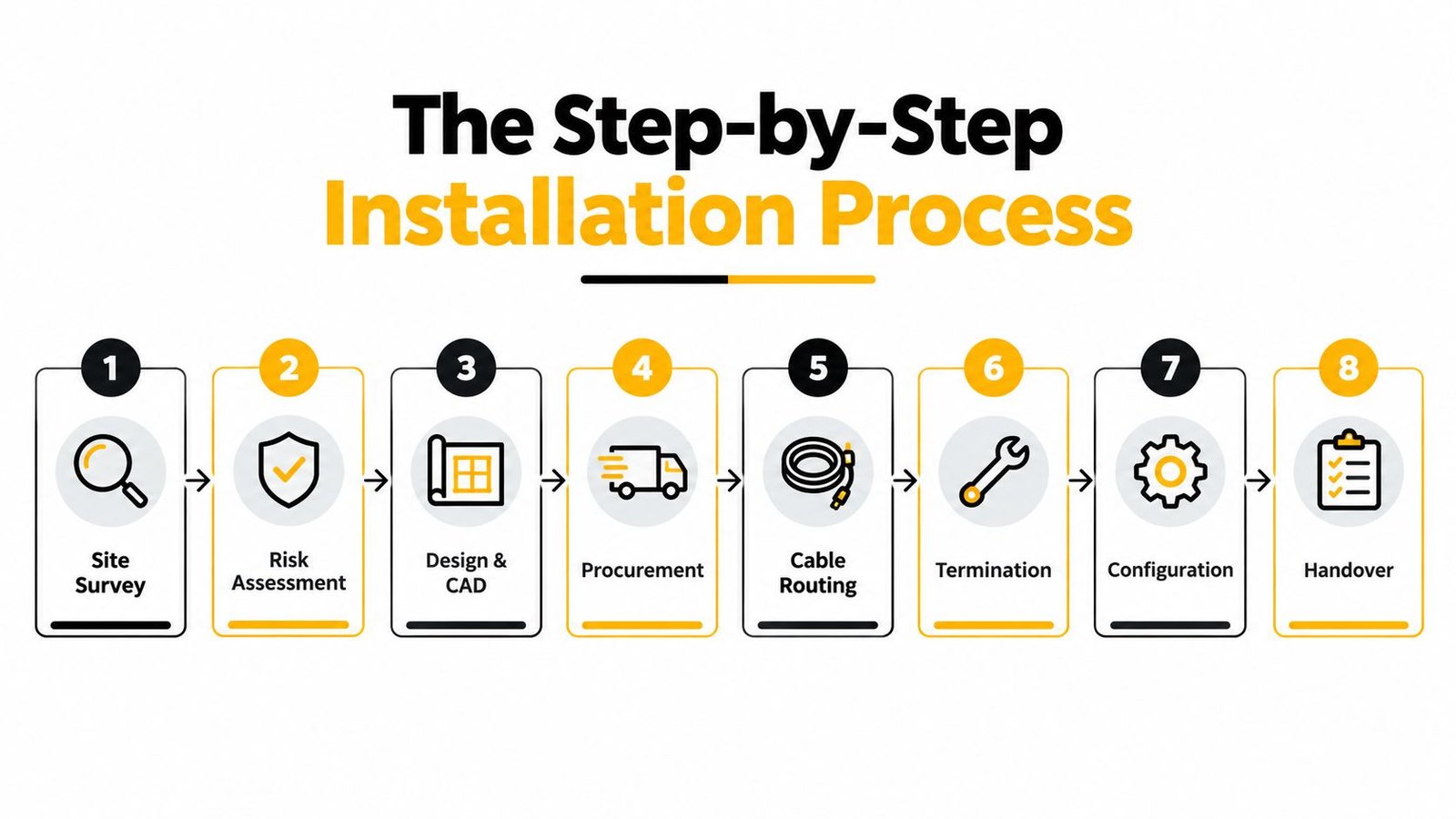
A competent installation has visible outputs at every stage. If the contractor can't explain what gets produced and checked, the method is probably being improvised.
Survey and risk assessment
The installer should inspect entrances, boundaries, lighting, mounting surfaces, cable routes, network locations and areas that could create privacy complaints. The output is a site survey and risk assessment, not a verbal promise. Ask which incidents the design is intended to address and which areas will remain outside view.
Design and camera schedule
The design should identify each camera, its purpose, field of view, mounting position, lens, lighting conditions and recording requirement. A camera schedule or drawing lets you challenge unnecessary coverage and identify missing choke points before work starts.
Quote and scope approval
The quotation should separate equipment, containment, cabling, access equipment, configuration, training and exclusions. Confirm who provides power, network infrastructure, signage, privacy masking and remedial building work. A vague “standard installation” clause gives the contractor room to reduce scope later.
Procurement and pre-install preparation
Before arriving, the installer should confirm equipment compatibility, recorder capacity, brackets, weather protection, cable lengths and software requirements. Matching the kit in advance prevents substitutions that alter the design.
First-fix cabling and containment
Cables should follow agreed routes, with suitable protection where exposed to impact, weather or tampering. Ask whether cable tests and labels form part of the handover pack. A neat cable run is useful, but a tested run is what protects reliability.
Mounting and termination
The engineer mounts cameras at the designed height and angle, seals external penetrations, terminates connections correctly and secures the recorder. The physical installation should preserve access for future servicing without making the equipment easy to interfere with.
Configuration and commissioning
Commissioning should cover recording quality, focus, exposure, time synchronisation, motion zones, privacy masks, user permissions, storage behaviour and remote access. The installer should test playback from each camera and confirm that alerts don't overwhelm the people expected to respond to them.
Handover and training
The final pack should include as-built drawings, camera names, equipment details, test results, maintenance recommendations and user guidance. The installer should train authorised users on live viewing, playback, export, access control and incident handling, then transfer credentials securely rather than leaving default accounts active.
The government-linked specification used by some UK authorities points to BS EN 62676-1-1 for minimum system requirements, BS EN 62676-4 for selection, planning, installation, commissioning, maintenance and testing, and BS8418 for detector-activated remotely monitored CCTV. Those references are useful pressure tests for a quote because they shift the conversation from “does it turn on?” to “does it perform the intended job?”
The final handover should prove that the system was commissioned against its operational purpose. Don't accept a test that only confirms power and connectivity.
Why Camera Position and Height Matter More Than Resolution
A badly positioned high-resolution camera still produces bad evidence. A lens aimed from a soffit at a steep downward angle may show the top of a person's head, while a wide-angle lens at a gateway can make a face too small to identify. More pixels don't correct the geometry.
The UK performance specification states that installation height is generally 2.5 m to 5 m, while stressing that the correct choice depends on target form, required detail, building structure and the camera and lens combination. The CCTV performance specification supports the practical conclusion: raise a camera for tamper resistance or coverage only when the lens, angle and resolution still deliver the required detail.
Mounting height changes the evidence. A gateway camera needs a controlled view of faces and vehicle plates, not an expansive view of the road. Backlight can turn a person into a silhouette. Infrared reflection from nearby walls, foliage or a pale soffit can wash out night footage. Motion blur can erase the detail that a specification sheet appears to promise.
| Scene | Pixel/m target | Typical mount height | Lens choice |
|---|---|---|---|
| General overview | Set by the operational requirement | High enough to resist interference without losing context | Wider lens where identification isn't required |
| Entrance observation | Identification detail | Moderate height with a controlled face angle | Varifocal or narrower lens aimed at the approach |
| Vehicle gate | Plate or driver evidence | Height matched to the vehicle path | Lens selected for distance and plate position |
| Boundary detection | Recognition of movement and direction | Positioned to cover the boundary without excessive neighbouring capture | Lens chosen to avoid unnecessary wide-area viewing |
These targets must be set during design, not guessed after installation. The practical guide to CCTV camera placement is useful for checking whether proposed views make sense before brackets are drilled.
A camera should be judged by the evidence it produces at the point of interest, not by the largest resolution number on its packaging.
UK Standards and Compliance Every Installer Must Follow
Compliance is a design constraint, not paperwork added after the cameras are installed. The UK government's surveillance-camera guidance points installers towards BS EN 62676-1-1 for minimum requirements, BS EN 62676-4 for planning, installation, commissioning and maintenance, and BS8418 for detector-activated remotely monitored systems. The relevant choice is always operational: what must the camera show, who needs access, and how long does the footage remain justified?
The Surveillance Camera Code of Practice sets out 12 guiding principles for surveillance-camera systems operating in public places in England and Wales. They cover legitimate purpose, transparency, accountability, proportionate collection, restricted access and deletion once the stated purpose has been met.
Translate principles into installation decisions
A compliant design should document why each camera is needed and limit capture to that purpose. The ICO advises organisations to explain why CCTV is required, minimise privacy impact, check camera angles and install signs before use. If a lens captures a neighbour's window, a tenant's private area or more of a public path than necessary, the installer should adjust the physical view or apply a privacy mask.
Domestic systems aren't automatically exempt from privacy concerns. If a home camera captures beyond the property boundary, the household may need to consider data protection obligations and the rights of people recorded. The ICO's CCTV guidance for organisations is a useful starting point, especially for signage, purpose, access and retention.
| Standard / regulation | Scope | Practical installation requirement |
|---|---|---|
| BS EN 62676-1-1 | Minimum CCTV system requirements | Select and configure equipment for the intended evidential task |
| BS EN 62676-4 | Planning, installation, commissioning and maintenance | Document the design, test performance and maintain the system |
| BS8418 | Detector-activated remotely monitored CCTV | Use suitable equipment and monitoring arrangements for the specified application |
| Surveillance Camera Code | Public-place systems in England and Wales | Establish purpose, transparency, accountability, proportionality and access rules |
| UK GDPR and the Data Protection Act 2018 | Personal data captured by cameras | Control access, justify collection, manage retention and respond to rights appropriately |
At handover, request the camera schedule, privacy assessment, signage position, access policy, retention setting, user list and commissioning record. Where the processing creates a higher privacy risk, ask whether a Data Protection Impact Assessment is required and who owns it. A professional installer won't treat compliance as a slogan. They'll show you where each control exists.
Typical Costs and What Your Budget Buys
A low quote can conceal an incomplete system. A two-camera house with accessible cable routes is a different job from a warehouse requiring difficult containment, several network cabinets and controlled access. The budget covers hardware, engineering time, cabling, infrastructure, configuration and future support. Compare the work included, not just the number at the bottom of the quote.
The practical tiers are:
- Small domestic system: Usually covers priority views such as an entrance, driveway or rear access. Spend on reliable night performance, the correct lens, secure recording and a clear handover.
- SME or retail installation: Adds more involved cable routes, user permissions, signage, storage planning and remote access. Alarm or access-control integration may be appropriate where staff need a coordinated response.
- Commercial or multi-site deployment: Requires consistent design standards, network planning, centralised management, documented commissioning and a service arrangement that can handle faults across locations.
Use the CCTV installation cost guide to compare quotes, but treat any headline figure as a starting point. Ask exactly what the price includes, what it excludes and what assumptions the installer has made about access, cabling and network capacity.
Spend where evidence improves
A better low-light sensor can matter more than a higher stated resolution. Weather-rated housings, stable mounts, suitable infrared performance, protected cabling, reliable storage and correctly configured network equipment improve practical performance. Labour that resolves glare, cable access and privacy masking often delivers more value than adding another camera to a weak design.
Overspending starts when buyers chase megapixels without checking the lens, lighting or target distance. A wide view may cover more ground while leaving faces too small to identify. A narrow lens may provide useful detail at a gate but miss the approach. Set the evidential task first, then choose equipment that can perform it and withstand scrutiny from neighbours, the ICO or a court.
Require a line-by-line quote covering equipment, labour, cabling, containment, access equipment, configuration, signage, training, warranty terms and ongoing maintenance. Keep the scope, camera views and acceptance tests with the handover records. That makes a cheap quote easier to challenge and a sound quote easier to defend.
Integrating CCTV With Alarms, Access Control and Fire Systems
Standalone CCTV is often the right answer for a home or small premises with a simple monitoring requirement. It records activity and lets an authorised user review footage. Integration becomes more valuable when the site has several systems producing events that people must interpret quickly.
An intruder alarm can trigger a camera call-up or event marker, taking the operator directly to the relevant view instead of forcing them to search through hours of footage. That's particularly useful for warehouses, retail premises and sites that remain empty overnight. The alarm identifies a possible event, while video helps establish what happened and whether a response is justified.
Access control creates another useful evidence layer. A door event, card record or keypad transaction can be compared with the corresponding camera view. The result is a more coherent incident package than either a video clip or an access log alone. It can also help property managers investigate disputed entry at shared doors without giving every tenant unrestricted access to footage.
Fire integration has a different purpose. A fire panel signal can call up cameras near an affected zone, helping authorised staff understand conditions and supporting a coordinated response. CCTV does not replace fire detection, evacuation procedures or the fire risk assessment, but it can provide additional visual information where the platform and site procedures support it.
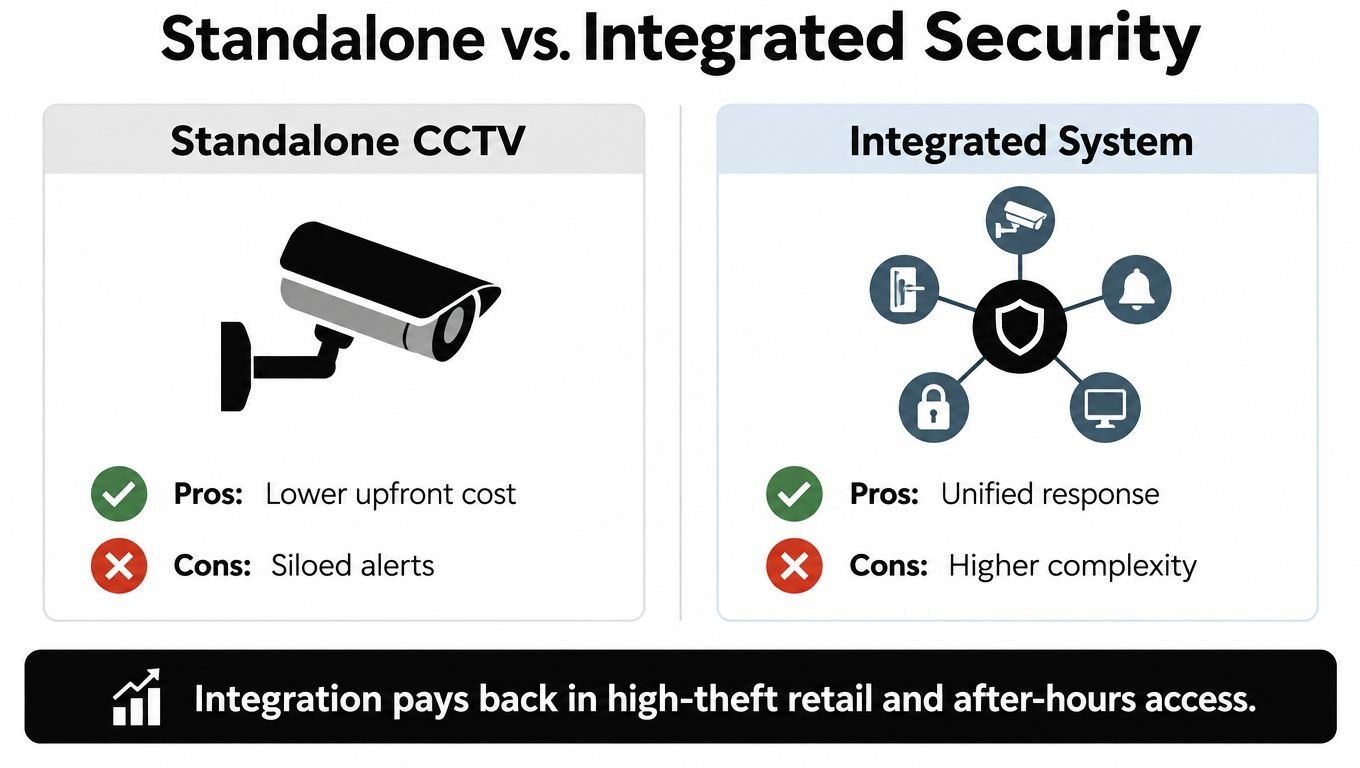
Integration introduces engineering trade-offs. Hardwired signalling can be preferable where predictable event delivery and local operation matter. Cloud APIs may be convenient, but they introduce dependency on internet access, subscriptions, vendor support and changing software interfaces. Proprietary platforms can also limit future upgrades if cameras, recorders, alarm panels and readers don't share compatible protocols.
Before approving integration, demand a compatibility matrix and a failure plan. Ask what happens if the internet fails, the recorder is offline, the alarm panel is replaced or a manufacturer changes its API. Integration pays when it shortens response and improves evidence. It doesn't pay when it creates a fragile collection of features nobody operates.
Maintenance, Servicing and Common Troubleshooting Issues
A CCTV system deteriorates through small failures. A lens gathers dirt, a mount shifts, an infrared illuminator weakens, storage health changes and time drift makes event correlation harder. Planned servicing catches those problems before an incident exposes them.
Consider a representative retail park installation in Bristol over a five-year service relationship. The engineer's remote checks might flag focus drift, infrared performance, recorder storage health and time synchronisation. A physical visit can then verify the image at the actual scene, inspect housing seals, clean lenses, check the available PoE budget and apply approved firmware updates.
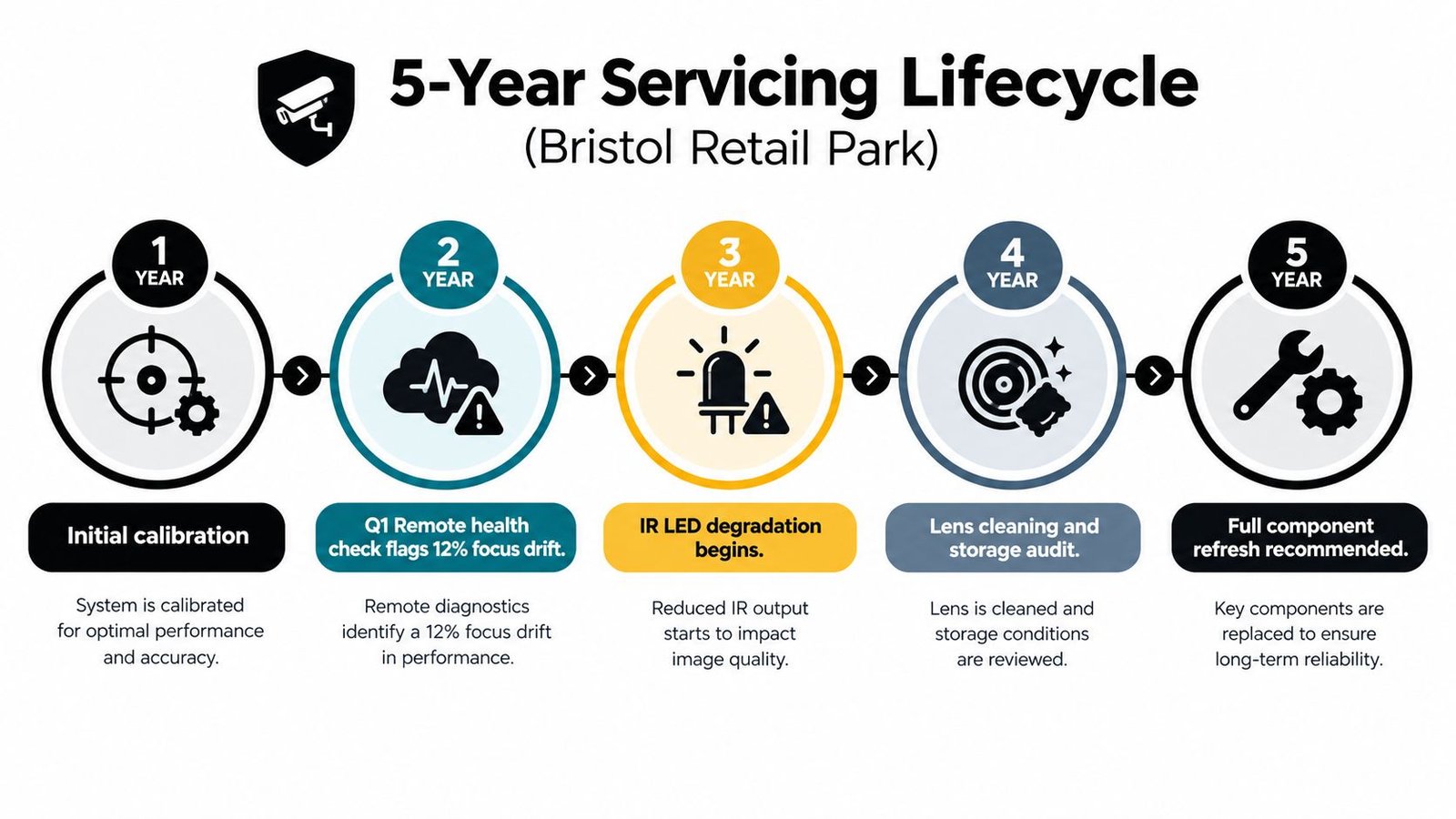
The most useful annual test is an image audit, not a tick-box inspection. Review typical footage from each camera and ask whether it still supports the intended task. A camera meant to identify a face should be checked at the relevant entrance. A camera intended to observe number plates needs testing under the lighting and traffic conditions where plates appear.
Faults owners commonly discover too late
- Night-time washout: Streetlights, vehicle headlights or reflective surfaces can flatten the image. Repositioning, exposure changes, shielding or a different camera may solve it.
- Motion overload: Foliage, rain, insects and passing traffic can trigger excessive alerts. Refine detection zones and sensitivity rather than disabling alerts altogether.
- Early overwrite: A recorder can appear healthy while deleting footage before anyone reviews it. Check storage settings against the required retention period and test playback regularly.
- Network instability: A camera may drop offline because of a damaged cable, overloaded PoE switch or poor termination. Review event logs and test the physical link.
- Time drift: Incorrect time settings make footage harder to correlate with alarm and access events. Use a controlled time source and verify it during service visits.
A reactive callout fixes a visible failure. A service contract creates a routine for checking failures that users haven't noticed. The CCTV system maintenance service should be judged by its inspection scope, response terms, reporting and ability to preserve evidential performance, not merely by the promise to clean cameras.
Schedule service around risk and operating conditions. Outdoor cameras near trees, roads or coastal air need closer attention than protected indoor units. Budget systems often outgrow informal support when faults, firmware and storage become more complex. At that point, use an integrator who can test the full system rather than a handyman who replaces whichever component looks suspicious.
Choosing a Trusted Installer and Frequently Asked Questions
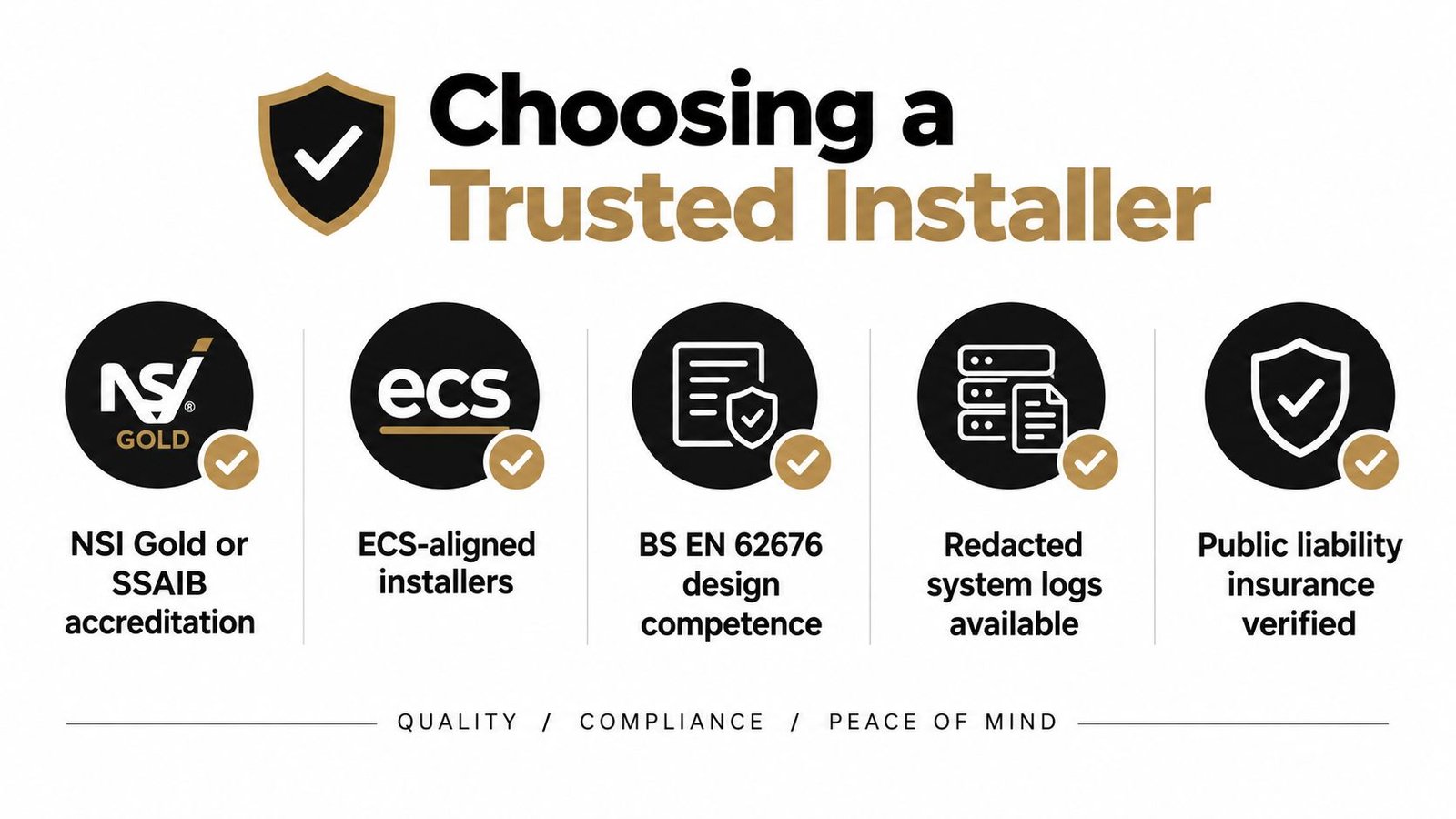
Sales polish proves very little. A reliable installer shows the design, explains the trade-offs and agrees how performance will be checked. Look for relevant accreditation such as NSI Gold or SSAIB, installers with appropriate ECS alignment, demonstrable competence in BS EN 62676-based design, suitable insurance and references from comparable properties.
Ask questions that expose whether the bidder has engineered the system:
- What detail must each camera provide, and how will you verify it?
- What are the expected lighting conditions and lens choices?
- What recording quality and frame rate apply at full resolution?
- How is retention calculated from bitrate and storage capacity?
- Where will signage go, and what areas will privacy masking cover?
- Who controls access to footage and administrator accounts?
- What records will I receive at handover?
- What happens when a camera, switch or recorder fails?
Frequently asked questions
Does a domestic CCTV system need signage?
If cameras capture beyond the private domestic area, signage and data protection considerations become important. The ICO advises organisations to explain the purpose, minimise intrusion, check angles and sign before use. The precise obligations depend on what the system captures and how it's operated.
Can police response be added to standard commercial CCTV or ANPR?
CCTV alone doesn't create a police response service. Response depends on the alarm or monitoring arrangement, the service provider, the site's procedures and the relevant authority requirements. ANPR also needs a clearly defined purpose, suitable governance and compatible processing arrangements.
What should I expect to pay for a four-camera home system or an eight-camera commercial installation?
There isn't a defensible universal figure. Labour access, cable routes, equipment, storage, mounting surfaces, network work, configuration and compliance documentation all change the scope. Compare itemised proposals rather than accepting a camera-count price.
Can existing cabling be reused?
Sometimes. The installer should test cable continuity, performance, termination quality, route condition and compatibility with the proposed equipment. Reuse is sensible only when the cable can support the intended system reliably and remains serviceable.
You still own three decisions: the risks to cover, the retention period you can justify and the integrator relationship you're prepared to maintain. Wisenet Security Ltd provides site surveys, CCTV design and installation, configuration, user training and ongoing maintenance for homes and businesses across South Wales and the South West.
Choose an installer who will document the design, test evidential performance and address privacy before drilling. For a practical consultation built around your property's risks, coverage, retention and integration needs, visit Wisenet Security Ltd.