Monitored Intruder Alarm Systems in South Wales
At 2 a.m., a bell-only alarm is screaming from a house three streets away. The neighbours hear it, turn over, and wait for someone else to deal with it. The intruder leaves with a laptop bag, and the owner discovers the broken door and empty rooms at sunrise.
That's the weakness of relying on noise alone. A monitored intruder alarm system sends the activation to an Alarm Receiving Centre, or ARC, where trained operators assess the signal and follow an agreed response procedure. For South Wales homes and SMEs, the important question isn't which badge is printed on the control panel. It's whether the system has been designed, installed, verified, and maintained well enough to preserve the response you're paying for.
Table of Contents
- What a Monitored Intruder Alarm System Actually Does
- How the Signal Reaches an Alarm Receiving Centre
- Monitored Versus Bell-Only and Self-Monitored Alarms
- UK Standards That Shape a Compliant Installation
- Police Response, URN Levels, and False Alarm Policy
- Choosing the Right Setup for Homes and Businesses
- Typical Costs and Ongoing Maintenance in South Wales
- Why a Local South Wales Specialist Makes a Difference
What a Monitored Intruder Alarm System Actually Does
A monitored system has three working parts: detection devices, a control panel, and a communication route to an ARC. Door contacts, movement detectors, shock sensors, panic buttons, and other devices identify an event. The control panel checks the activation against the system's programming, then sends the relevant signal away from the property.
That final step changes the outcome. A bell-only alarm asks neighbours or passers-by to decide whether something is wrong. A self-monitored app asks the property owner to notice a notification, have a working phone, understand the situation, and act quickly. A professionally monitored system puts the first decision in the hands of an ARC operator who can follow site instructions, contact nominated keyholders, and escalate a verified incident where the signalling and police-response requirements support it.
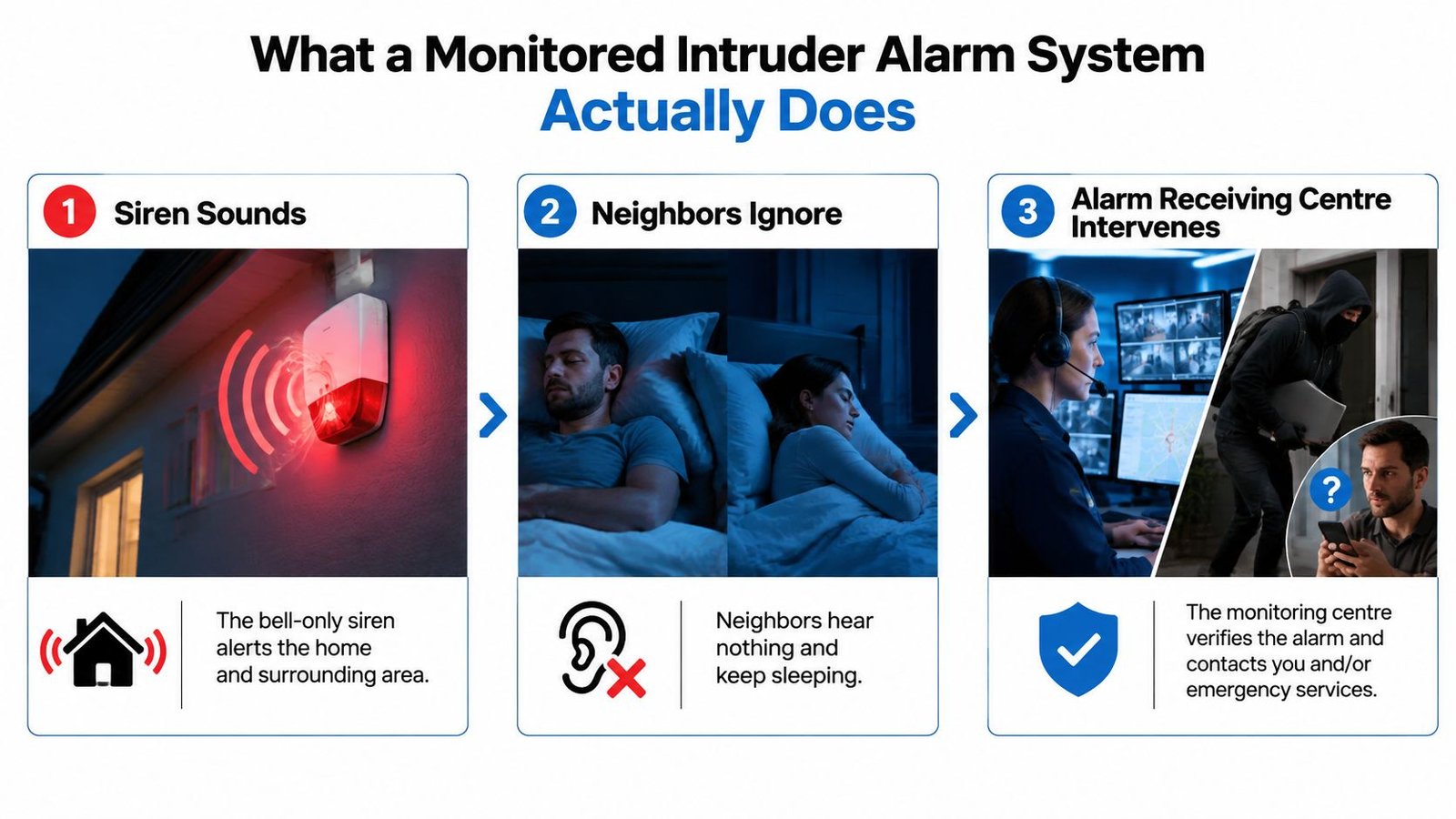
What happens after an activation
The ARC doesn't hear a siren through the phone line. It receives structured information, such as which detector activated, whether another device confirmed the event, and whether the system has a communication fault. The operator then works through the site's response instructions.
That can involve:
- Checking the activation: The operator reviews the signal history and any available confirmation information.
- Contacting keyholders: The nominated people are called using the agreed order and passcode procedure.
- Escalating appropriately: Where the activation is confirmed and the system meets the relevant police-response route, the ARC contacts the police or follows the applicable site procedure.
- Recording the event: The operator documents the activation, contacts, actions, and outcome for later review.
A monitored alarm doesn't guarantee that every activation produces police attendance. It creates a professional response chain. The quality of that chain depends on correct detector selection, sensible programming, reliable signalling, accurate keyholder details, and disciplined maintenance.
Installer's rule: A monitored alarm is only as dependable as the weakest part of its response path.
That's why I look at the property before discussing brands. In a Cardiff terrace, the priorities may be front-door protection, rear access, and a detector that won't be triggered by normal household movement. In a rural Carmarthenshire property, outbuildings, longer communication routes, and slower physical access may matter more. The equipment has to suit the building and the way people use it.
How the Signal Reaches an Alarm Receiving Centre
The signal path should be clear to you before you approve the installation. A proper design accounts for what happens during a burglary, a false activation, a broadband failure, and a power cut.
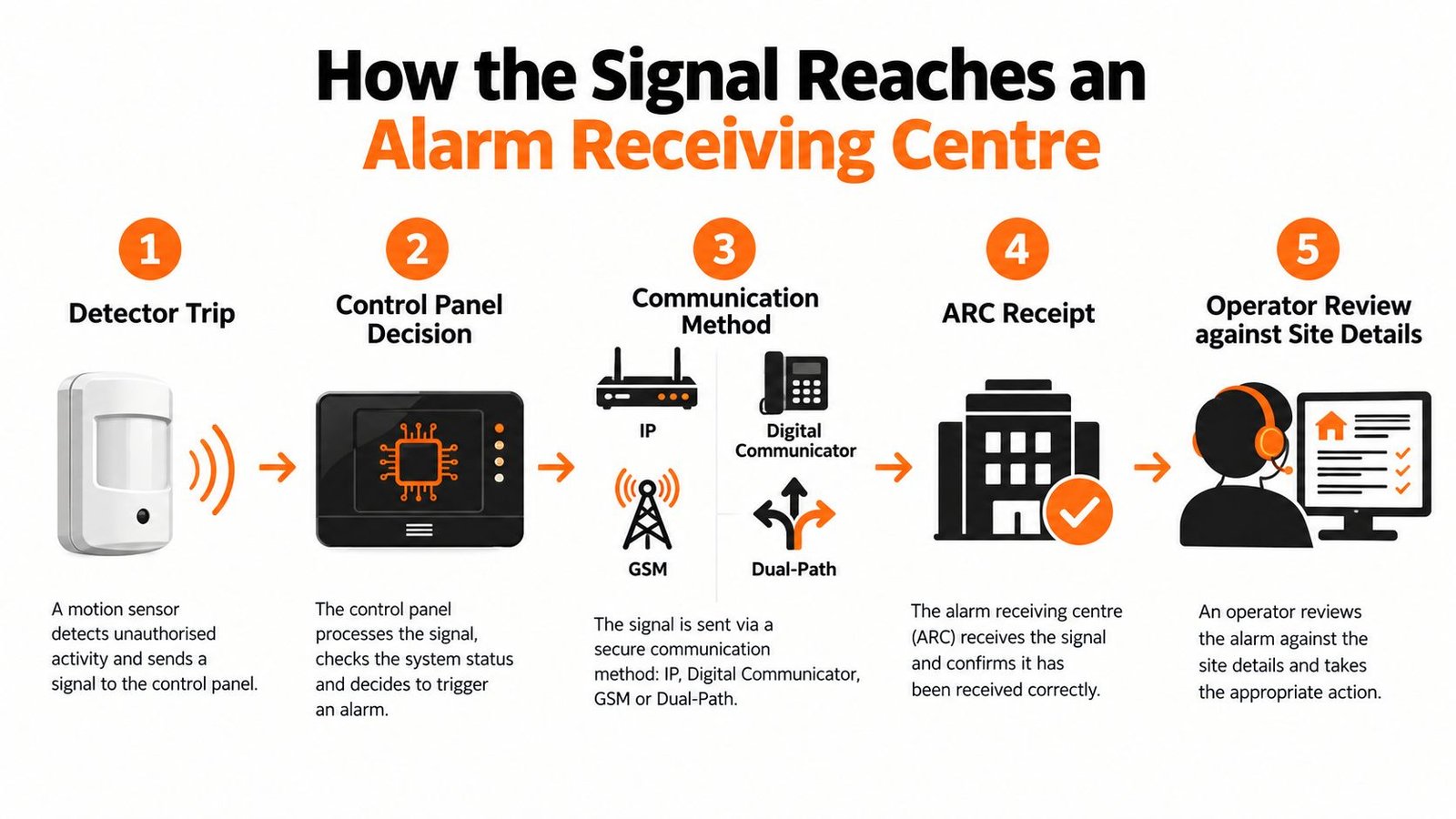
The alarm journey
A detector trips. A door contact opens, a movement detector sees activity, or a shock sensor identifies an impact. The device reports to the control panel.
The control panel makes a decision. It checks the zone, arming state, entry delay, confirmation rules, tamper condition, and any programmed verification sequence. A badly configured panel can create nuisance activations or fail to provide useful confirmation.
The communicator sends the message. Systems may use IP, a digital communicator, GSM, or a dual-path arrangement. A single route can be interrupted by a cut cable, a failed router, a mobile network problem, or a local power issue. For sites relying on a dependable ARC connection, I favour a properly engineered dual-path solution rather than treating one communication route as sufficient.
The ARC receives the event. The monitoring centre identifies the site and receives the event type. It can also receive communications-failure signals, test messages, and other system conditions, depending on the installation.
The operator checks the site procedure. The operator reviews the activation against the agreed response plan, confirmation information, keyholder records, and any available visual evidence. The operator then contacts the relevant people or escalates according to the service arrangement.
For smaller premises, GSM alarm signalling options may be useful where fixed broadband is unreliable or unavailable. That doesn't make mobile signalling automatically suitable. The installer still needs to check coverage, antenna placement, battery capacity, supervision, and how the system reports a failed path.
The details that prevent avoidable failures
Ask whether the communicator uses supervised paths, whether dual SIMs can roam between suitable networks, and what the system does if one route drops. Ask how long the panel can operate during a power failure and whether the backup battery is tested during maintenance. Don't accept “it has app notifications” as an answer to a resilience question. An app alert is useful, but it isn't the same as an ARC receiving and managing a confirmed alarm.
An ARC operator also needs accurate information. Incorrect keyholder numbers, an outdated passcode, unclear access instructions, or a changed business layout can turn a technically sound alarm into a poor response. Put those details in the handover pack and update them whenever staff, tenants, locks, or opening hours change.
The UK's modern ARC framework was shaped by BS EN 50518, with its first two parts published in 2010 and the procedures part following in 2011. The standard replaced BS 5979:2007 for the relevant ARC functions and established a clearer framework for how alarm-receiving facilities are located, built, and operated. The history of the UK intruder-alarm industry gives useful context for that change.
Monitored Versus Bell-Only and Self-Monitored Alarms
The three options can all detect an opening door or movement. They differ in who takes responsibility after the system activates.
A bell-only alarm is the simplest and cheapest route. It creates noise and may deter an opportunist, but it leaves verification to other people. It can make sense for a small flat, a low-risk outbuilding, or a property where budget is the overriding concern. It's a weak choice where the owner needs a dependable response while away.
A self-monitored alarm sends an alert to your phone, usually through an app. That's convenient for arming, disarming, checking status, and dealing with a known false activation. The limitation is obvious: if you're driving, asleep, abroad, in a poor-signal area, or unable to answer, the system is waiting for you.
Professional monitoring adds an ARC and a defined response process. It costs more and demands better installation discipline, but it removes the owner from the first-response bottleneck. It also supports a documented handling process, which matters when police response depends on verified activations and an active URN.
Comparing alarm system types
| Feature | Bell-Only | Self-Monitored (App) | Professionally Monitored |
|---|---|---|---|
| First response | Neighbours or passers-by hear the siren | Owner receives an app alert | ARC operator receives and assesses the signal |
| Owner unavailable | No alternative decision-maker | Response may wait until the owner sees the alert | Keyholders and escalation procedures can continue |
| Communication dependence | Local siren and power | Internet, mobile service, and the owner's phone | Signalling path, ARC connection, and agreed response procedure |
| False activation | May continue until someone attends | Owner decides whether it's genuine | ARC follows verification and contact procedures |
| Police escalation | Not normally available through the bell alone | Depends on the system, monitoring, and compliance route | Can support police escalation where the required standards and URN conditions are met |
| Evidence trail | Limited event information | App history may show activity | ARC records the activation and response actions |
| Best fit | Tight budgets and lower-risk locations | Owners who can respond consistently | Homes and businesses needing managed cover while people are away |
The historical burden of false alarms explains why verification matters. A UK study reported a false-alarm rate exceeding 90%, more than one million false calls annually, over 500,000 police man-hours consumed each year, and more than £13 million in wasted police resources. Those figures are discussed in the study of intruder alarms as crime-prevention measures.
The practical conclusion is straightforward. Don't pay for monitoring and then install the wrong detector in the wrong place. A conservatory PIR that reacts to temperature changes, a movement detector facing a heater, or a loose door contact can create the false activations that damage your response status.
UK Standards That Shape a Compliant Installation
Security standards matter because they turn “alarm fitted” into something more specific. They address the equipment, the system design, the signalling route, and the installation process. They don't replace good judgement on site.
BS EN 50131 is the core equipment and system standard for intruder alarms. It deals with matters such as detector performance, tamper protection, and environmental conditions, and it supports security grading from Grade 1 through Grade 4. A higher grade isn't automatically right for every property. The grade should match the threat, the building, the contents, and any insurer or police-response requirement.
PD 6662:2017 provides the UK application framework that brings the relevant European security standards into a practical compliant package. Think of it as the UK route for specifying and documenting a system, rather than a model number printed on a detector.
BS 8243:2021 deals with the way intruder alarms are configured and managed for remote signalling to an ARC. It covers the logic used to confirm an activation and supports procedures for different alarm types, including personal attack signals. For a customer, the important point is that compliance includes the interaction between detector, control panel, communicator, ARC, and response procedure.
What those standards mean at handover
Ask the installer to explain:
- The selected grade: Why it suits the property and any insurance requirement.
- The commissioning checks: Whether every zone, tamper circuit, communicator, battery, and user function has been tested.
- The documentation: Whether you'll receive system details, operating instructions, certificates, zone descriptions, and maintenance information.
- The maintenance arrangement: Who checks the system and how faults are reported and resolved.
- The accreditation route: Whether the installing company is independently assessed and audited by a recognised body.
For help understanding the role of the Security Systems and Alarms Inspection Board, use the organisation's name as a starting point, then ask the contractor exactly what accreditation applies to the installation and the monitoring service.
Standards won't correct a detector aimed at a window, a cable run damaged during later building work, or a keyholder list nobody updates. Commissioning, handover, and maintenance are where the written requirements become a working system.
Police Response, URN Levels, and False Alarm Policy
A police response isn't activated because a siren sounds. The property, alarm system, monitoring route, verification method, and response record all have to fit the applicable policy.
For new remotely monitored systems intended to obtain police response since June 2019, the relevant pathway includes PD 6662:2017 and BS 8243:2021. The signal goes to a 24/7 monitoring centre, which then contacts police, keyholders, or a keyholding service after the activation has been verified. NSI's guidance on workplace intruder alarms explains that compliance depends on the complete signalling and confirmation chain, not just the detector hardware.
How the URN system affects attendance
A Unique Reference Number, or URN, links an eligible alarm system and site to the police-response process. The exact response available depends on the level assigned and the confirmation route.
| URN Level | Trigger Required | Police Response | Typical Site |
|---|---|---|---|
| Level 1 | Compliant activation with the required keyholder or ARC confirmation | Immediate response under the applicable policy | Homes and businesses with an eligible confirmed alarm |
| Level 2 | Appropriate ARC confirmation using the required signalling arrangement | Immediate response under the applicable policy | Higher-risk premises using stronger confirmation and signalling |
| Level 3 | No qualifying confirmation, unless visual evidence supports escalation | Keyholder response, with police attendance dependent on accepted evidence | Sites without active qualifying police attendance |
Treat the table as an operating summary, not a substitute for written confirmation from your installer and local force. Police procedures can be amended, and the ARC must know which route applies to your site.
False activations can remove the benefit
Under the NPCC policy, a system with a URN can initially receive Level 1 response. After three false calls within a rolling 12-month period, police response is withdrawn and the system is downgraded to Level 3, meaning keyholder response only. The policy is set out in the NPCC Security Systems Policy.
That's why installation quality is a police-response issue, not merely a comfort issue. One badly positioned detector can repeatedly trigger during normal activity. Poor user training can create entry-delay alarms. A weak battery or neglected tamper fault can undermine confidence in the system.
Practical advice: Before accepting a monitored installation, ask how the engineer will reduce false activations, how confirmation works, and what maintenance evidence will be kept.
Choosing the Right Setup for Homes and Businesses
Start with how the property operates, not with a shopping list of devices. A South Wales home with pets, a conservatory, and a rear lane needs a different design from a Newport retail unit with staff access, stock areas, and a delivery door.
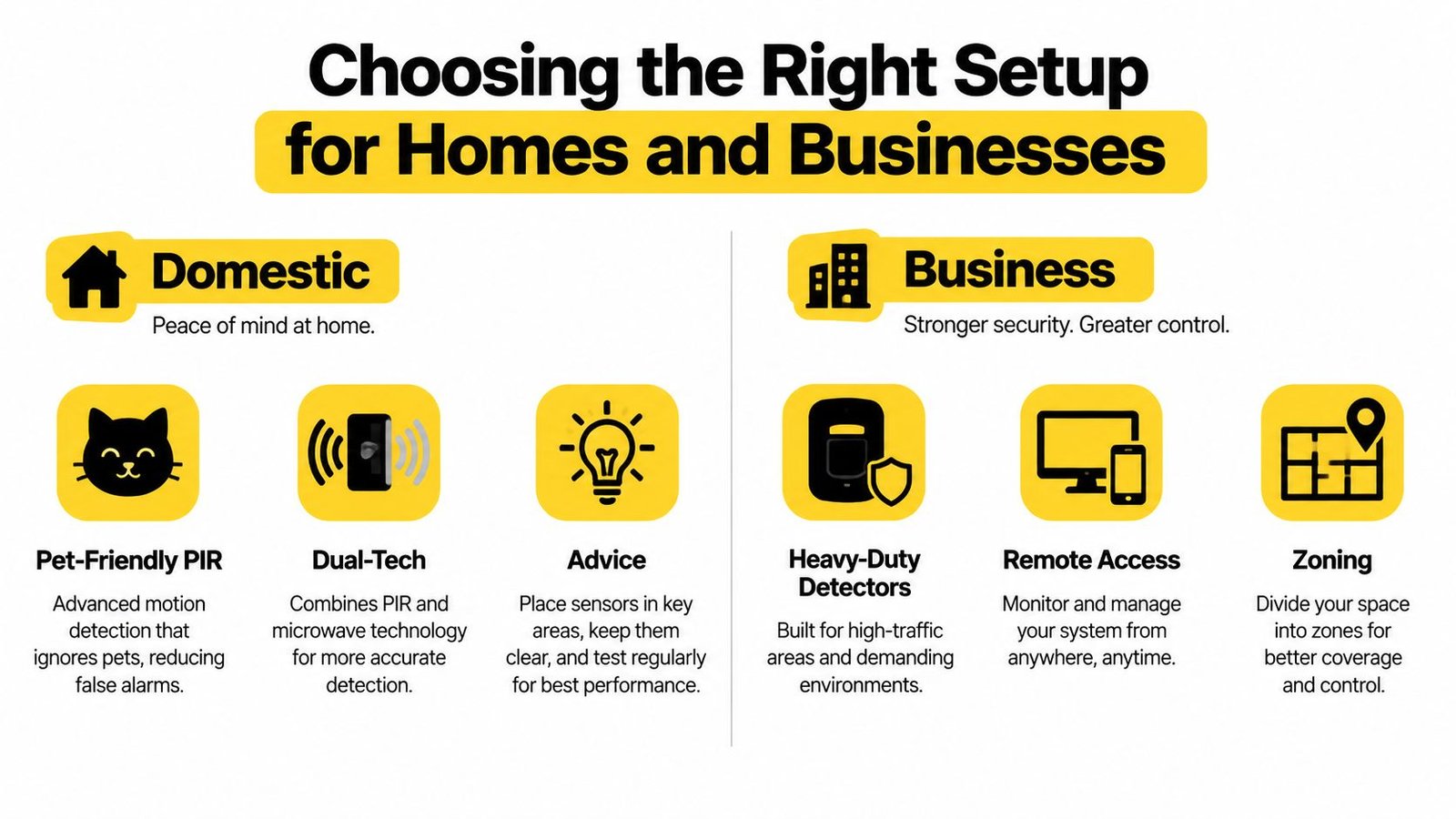
Domestic installations
For most homes, I'd prioritise reliable perimeter protection and sensible internal detection:
- Pet-tolerant PIRs: Use detectors designed for the animals living in the property, and position them so pets can't climb onto furniture and defeat the intended detection pattern.
- Dual-technology detection: Conservatories and rooms with changing temperatures may benefit from detectors that combine technologies rather than relying on one movement-reading method.
- Shock sensors: Glazed doors and vulnerable windows may need early warning before an intruder reaches the protected interior.
- Panic buttons: A discreet button near a bed or another agreed location can provide a direct alarm function when someone can't reach the keypad.
- Useful everyday controls: App access, mobile alerts, chime zones, and clear user instructions should be treated as practical features, not decoration.
Grade selection still matters. Grade 2 is often considered for ordinary homes and small offices, while higher-risk stockrooms, vacant premises, jewellers, and other high-value sites may need a more demanding design. The installer should justify the grade rather than upselling it without examining the building.
Commercial premises
Businesses need zoning. A shop may need the sales floor and stockroom armed after closing while allowing authorised access to a staff office. A warehouse may need separate areas, controlled staff entrances, and a response plan that distinguishes an out-of-hours loading-door activation from a scheduled delivery.
CCTV integration is the most useful upgrade where police attendance depends on visual confirmation. Cameras should cover the approaches and critical internal areas, produce usable night images, and be configured so the ARC can receive relevant visual information under the agreed service. Access control can protect staff doors, while fire and building-management integration can reduce conflicting signals and duplicated site visits.
For businesses that manage vehicle keys or fleet access alongside premises security, a separate specialist may be useful. Automotive locksmith services can address vehicle entry and key-control issues that an intruder alarm installer shouldn't be expected to solve as part of the alarm design.
Don't add every available feature. Add the features that improve detection, confirmation, access control, or response at your property.
Typical Costs and Ongoing Maintenance in South Wales
A monitored alarm quote should separate equipment, installation, ARC monitoring, and maintenance. If those elements are bundled into one attractive monthly figure, ask what happens when the contract ends, when a communicator fails, or when the police require remedial work after false activations.
The indicative South Wales ranges below reflect the supplied planning figures, not a fixed tariff. Actual costs depend on the building, wiring, detector count, security grade, signalling resilience, CCTV integration, and the work needed to commission the system properly.
| Property Type | Install Cost | Monthly Monitoring | Annual Maintenance |
|---|---|---|---|
| Domestic home | £500 to £800 | £15 to £35 | £80 to £200 |
| Small retail or office unit | £1,200 to £2,500 | Varies by design | Higher than domestic |
| Larger commercial or integrated site | More than £5,000 where multiple panels and CCTV are required | Varies by design | Higher commercial rate |
The domestic figures cover equipment and professional fitting, while the monitoring range depends partly on whether the system uses a single or dual communication path. Commercial prices rise quickly when a site needs partitions, multiple access points, additional panels, visual verification, access control, or connections to existing fire and building systems.
Where the money goes
Cable routes cost more when walls, ceilings, outbuildings, or listed features complicate access. Wireless equipment can reduce disruption, but it still needs correct radio planning, battery management, and a proper signal test. Pet-friendly detectors, dual-technology devices, shock sensors, and dual-path communicators all add cost because they solve specific site problems.
Maintenance isn't a luxury add-on. The engineer checks batteries, tamper circuits, detectors, signalling, event history, and user procedures. A planned maintenance arrangement also gives you a route for correcting faults before they become repeated false alarms or a response-status problem. Alarm system maintenance support should be assessed as part of the system price from the beginning.
The cheapest quote often excludes commissioning evidence, proper handover, or the remedial work needed to meet an insurer's requirements. Compare the scope, not just the headline figure.
Why a Local South Wales Specialist Makes a Difference
A national provider can supply capable equipment. A DIY package can produce useful alerts. Neither option removes the need for someone who understands the building, the local response process, and the consequences of repeated faults.
South Wales sites vary sharply. A rural property in Carmarthenshire may have detached barns, long approaches, and limited immediate assistance. A Cardiff or Newport retail unit may have shared access, delivery traffic, neighbouring businesses, and a high volume of legitimate movement. A Swansea home may need a design that protects a rear extension without making family life impossible.
A local specialist can survey those conditions properly and return when the system needs attention. That matters for communications faults, detector changes, tenant alterations, and false-alarm investigations. A remote helpdesk can log a ticket, but it can't inspect a detector that's now facing a radiator or a door that no longer closes against its contact.
What to check before you appoint an installer
- Accreditation: Confirm the company's current approval and ask what parts of the service it covers.
- Engineer checks: Ask whether engineers are DBS-checked, insured, trained, and directly employed or subcontracted.
- Integration capability: Check whether one team can connect the alarm with existing CCTV, access control, fire systems, intercoms, and gates.
- Response arrangements: Get fault reporting, emergency attendance, and maintenance terms in writing.
- Handover quality: Require zone plans, user training, certificates, ARC details, keyholder instructions, and battery information.
The installer should also explain how false-alarm reviews are handled. If an activation threatens the site's police-response status, you need a contractor who can identify the cause, correct the engineering problem, and provide a clear record of the remedial work.
Local knowledge doesn't mean guessing about crime. It means designing around the actual property, access routes, weather exposure, occupancy, network conditions, and response arrangements found on South Wales sites. The hardware brand is secondary to the survey, installation, commissioning, and aftercare.
Wisenet Security Ltd designs, installs, and maintains monitored intruder alarm systems for South Wales homes, shops, offices, warehouses, and integrated commercial sites, including ARC signalling, smartphone alerts, CCTV, access control, and maintenance. If you want a system engineered around your property and police-response requirements rather than a generic equipment package, visit Wisenet Security Ltd to arrange a consultation.