Fire Alarm Manual Call Point: A Complete UK Guide 2026
A small red box can create a very large problem when it's misunderstood. In the UK, unwanted manual call point activations make up approximately 12.7% of all false fire alarms, which is around 37,000 incidents each year, with an estimated cost to the UK economy of £127 million annually according to Apollo Fire's summary of false manual call point alarms.
For a business owner or property manager, that figure changes the way you should think about the device on the wall. A fire alarm manual call point isn't just a red box installed to satisfy a drawing or tick off a regulation. It's a life-safety control that depends on people using it correctly, finding it quickly, and understanding what happens after it's activated.
Many readers know the device by older names such as “break glass unit” or “fire alarm point”. Those terms are still common on sites and in maintenance conversations. But the bigger issue isn't terminology. It's the fact that many people assume the call point does more than it really does, while others don't realise how strict the siting, height, testing, and record-keeping rules are.
If you're responsible for premises, you need the practical version, not the vague version. You need to know what a manual call point does, what it does not do, where it must go, how it fits into your wider alarm system, and what your legal duties look like in day-to-day building management.
Table of Contents
- Introduction The Critical Red Box on Your Wall
- What a Manual Call Point Does And What It Does Not
- Choosing the Right Call Point Break Glass vs Resettable
- How Call Points Connect Conventional vs Addressable Systems
- Compliant Installation Siting and Spacing Rules in the UK
- Testing and Maintenance Your Legal Obligations
- Your Next Step to Fire Safety Compliance in South Wales
Introduction The Critical Red Box on Your Wall
If your building has a fire alarm system, the manual call point is one of the few parts that relies entirely on human action. Smoke detectors and heat detectors respond automatically. A manual call point only works when someone sees danger, reaches the unit, and activates it without hesitation.
That's why this device deserves more attention than it usually gets. Too often, people treat it as basic hardware. In practice, it sits at the point where building design, occupant behaviour, emergency procedure, and legal compliance all meet.
A well-planned fire alarm manual call point layout helps people raise the alarm fast on an escape route. A poor layout creates delay. A badly maintained unit can fail when it's needed. A misunderstood one can trigger panic, confusion, or a dangerous assumption that help is already on the way.
Practical rule: Treat every call point as both a safety device and a management responsibility.
For owners and managers, the important questions are straightforward. Can occupants find a call point quickly? Are the units mounted correctly and kept visible? Are you choosing the right style of unit for your building? Are weekly tests happening, and is someone recording them properly?
Those are not minor details. They're the difference between a system that works on paper and one that works in a real evacuation.
What a Manual Call Point Does And What It Does Not
A manual call point is best understood as a manual trigger for your building's fire alarm system. Someone discovers a fire or signs of fire, they operate the call point, and that signal goes to the fire alarm control equipment. The system then raises the building alarm so occupants can begin evacuation.
How the device works in simple terms
On older and traditional units, the action may involve breaking or pressing through a frangible element. On resettable models, the front element is usually designed to be operated without replacing glass afterward. Either way, the purpose is the same. A person initiates the alarm manually.
In plain language, it's the building's “raise the alarm now” switch.
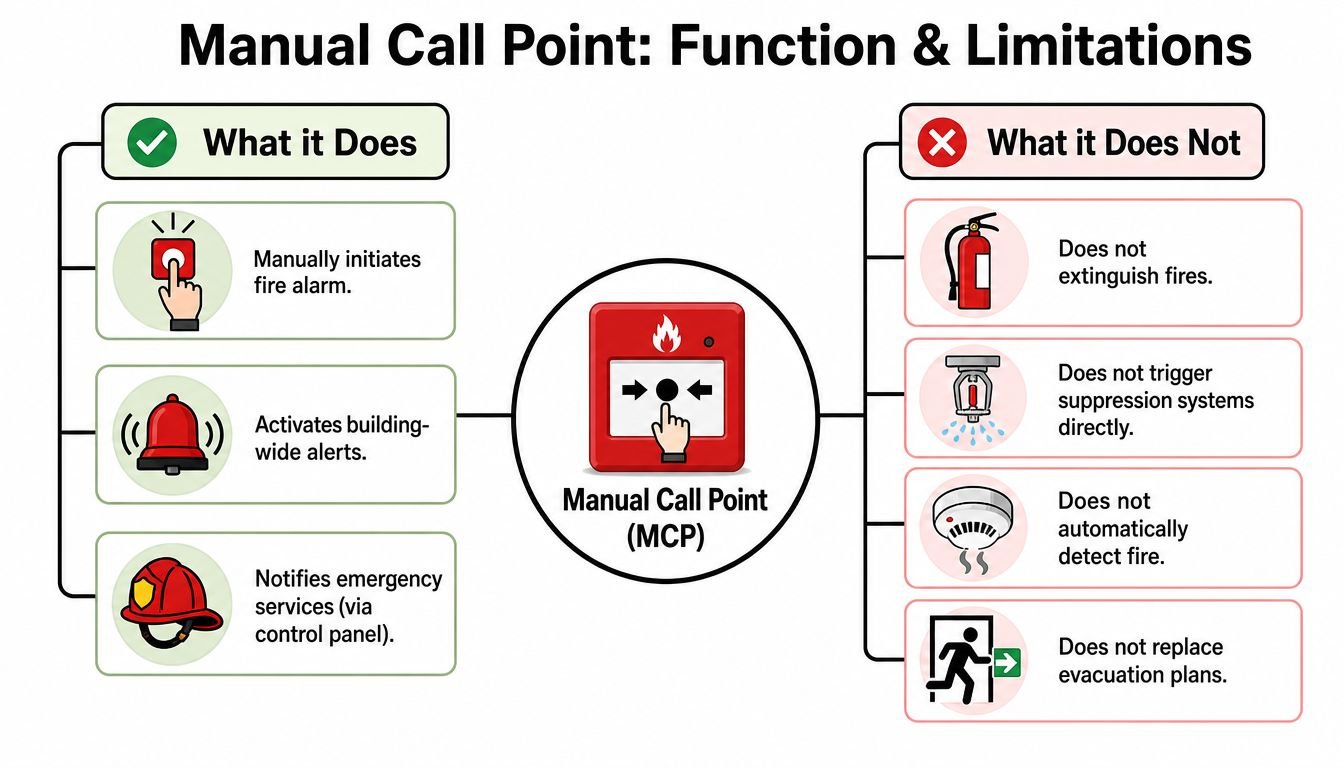
Once activated, the system typically sounds internal sounders and may also operate visual indicators such as beacons, depending on the design of the fire alarm system. The exact sequence depends on the control panel, programming, and connected life-safety devices within the building.
That point matters because people often give the call point too much credit. It isn't a fire detector. It doesn't put water on a fire. It doesn't replace staff training, evacuation drills, or a clear fire action notice.
The misconception that causes dangerous delay
The most common and most dangerous misunderstanding is this. Many people assume that pressing a manual call point automatically contacts the fire brigade.
That assumption is often wrong. Fire Response explains that in 99% of UK buildings, manual call points only activate internal alarms and do not automatically summon the fire brigade. After activation, human responsibility under the building's Fire Action Plan still matters. Someone must call 999 if that's the procedure for the premises.
If staff think “the system has already called for help”, valuable time can be lost.
Practical training holds greater importance than labels on the wall. Staff should know who calls 999, when they do it, and what information they must give. If your building has out-of-hours arrangements, monitored connections, or a specific evacuation protocol, that should be written into your fire action plan and reinforced during drills.
A useful way to explain it to occupants is to separate three actions:
- Raise the alarm: Operate the manual call point.
- Warn people: The system sounds throughout the building.
- Call emergency services: A responsible person follows the site procedure and calls 999 when required.
That sequence removes the guesswork. It also prevents the kind of hesitation that happens when people assume the technology is doing jobs it was never designed to do.
Choosing the Right Call Point Break Glass vs Resettable
Not every manual call point is equally suited to every building. The two most common choices are break glass units and resettable units. Both can perform the same safety function, but they behave differently after activation and that changes the maintenance burden.
Why the choice matters in practice
A traditional break glass call point uses a frangible element. Once it's operated, someone usually needs to replace that element before the unit is returned to service. Many people like this style because it's familiar and clearly signals that the device has been used.
A resettable call point uses a reusable operating element. After activation, a competent person can reset it with the correct key or tool, depending on the model. That makes routine reinstatement simpler and reduces the need to keep replacement glass elements on hand.
Neither type is automatically “best”. The better option depends on the building.
In a school, leisure site, busy reception, or public corridor, resettable units often make practical sense because they reduce disruption after accidental or malicious activations. In a quieter industrial area or plant room with controlled access, a conventional break glass unit may still be perfectly acceptable if it aligns with the system design and maintenance regime.
Choose for the environment, not just the catalogue.
Other practical factors also matter:
- Traffic level: Busy circulation routes increase the risk of accidental knocks or opportunistic misuse.
- Maintenance preference: Some facilities teams prefer resettable units because they're easier to reinstate after a test or unwanted operation.
- User familiarity: Some occupiers still strongly associate “break glass” with emergency action, which can influence training and behaviour.
- Spare parts handling: Break glass styles require a process for replacements and prompt reinstatement.
Comparison of Manual Call Point Types
| Feature | Break Glass Call Point | Resettable Call Point |
|---|---|---|
| Operating method | Usually activated by breaking or pressing a frangible element | Usually activated by pressing a reusable plastic element |
| After use | Commonly needs a replacement element | Usually reset with the proper key or tool |
| Familiarity | Very familiar to many occupants and staff | Familiar to engineers and increasingly common in modern installations |
| Ongoing upkeep | More consumables to manage after use or testing | Simpler reinstatement in many settings |
| Best fit | Lower traffic or controlled environments | Public areas, schools, offices, and sites where unwanted activations are a concern |
There's no universal answer. The sensible approach is to match the device to the building's use, the people moving through it, and the way your maintenance team manages resets and replacements.
How Call Points Connect Conventional vs Addressable Systems
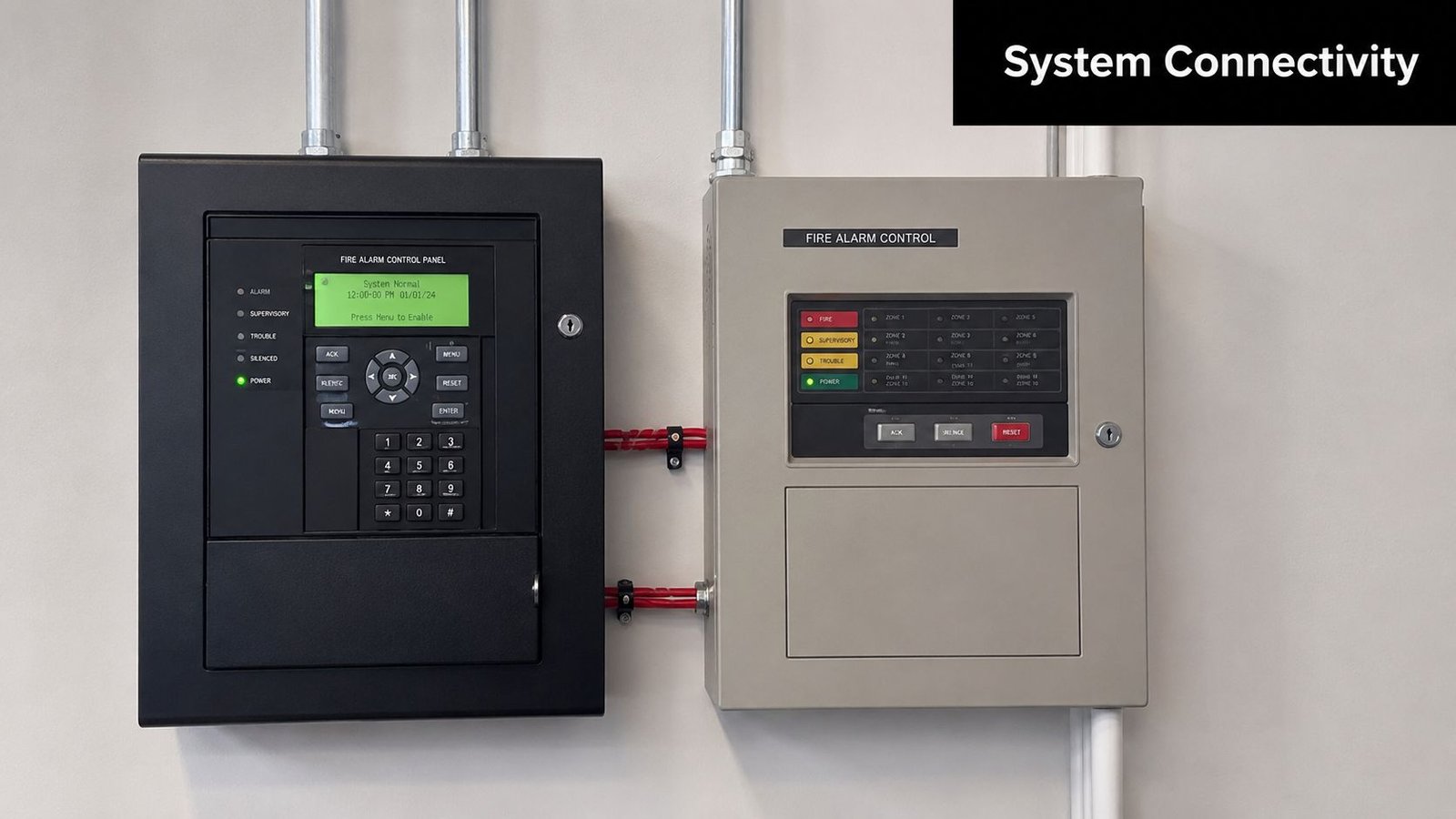
A manual call point doesn't work in isolation. It sits inside a wider fire alarm system, and the type of system affects what the control panel can tell you when the call point is used.
Zone based systems and device specific systems
In a conventional system, devices are grouped into zones. If a call point activates, the panel tells you which zone has gone into alarm. That may be enough for a small building. Staff can quickly identify the general area and investigate or evacuate according to procedure.
In an addressable system, each device has its own identity on the loop. If a call point operates, the panel can indicate the exact device location, such as the one by a particular final exit or stair core. That gives staff and attending responders much more precise information.
A simple analogy helps. A conventional system is like being told, “something happened on the first floor.” An addressable system is like being told, “the manual call point by the first-floor rear exit was activated.”
For a broader explanation of how these system types are typically used in different buildings, this guide to UK fire alarm systems gives useful background.
The choice affects more than alarm text on a panel. It changes how quickly a team can verify an event, isolate a fault, and direct people to the right location. If you're reviewing system design, it's also worth understanding the practical strengths of addressable fire alarm systems in larger or more complex premises.
What this means for response and maintenance
Conventional systems can be suitable where the building is smaller, simpler, and easier to search. They're often easier for non-technical users to understand because the panel shows zones rather than a long device list.
Addressable systems offer clearer fault finding and more precise alarm identification. That becomes valuable where the site has multiple storeys, several exits, compartmentation, or a need to know exactly which device was triggered.
This short video gives a helpful visual overview of fire alarm panels and system layout.
For managers, the practical question isn't which option sounds more advanced. It's which one gives your building a clear, usable response when someone activates a manual call point under stress.
Compliant Installation Siting and Spacing Rules in the UK
A manual call point only helps if a person can get to it fast, recognise it instantly, and operate it without hesitation. Good siting is what turns a red box on the wall into a working part of your evacuation plan.
The rules that matter most on site
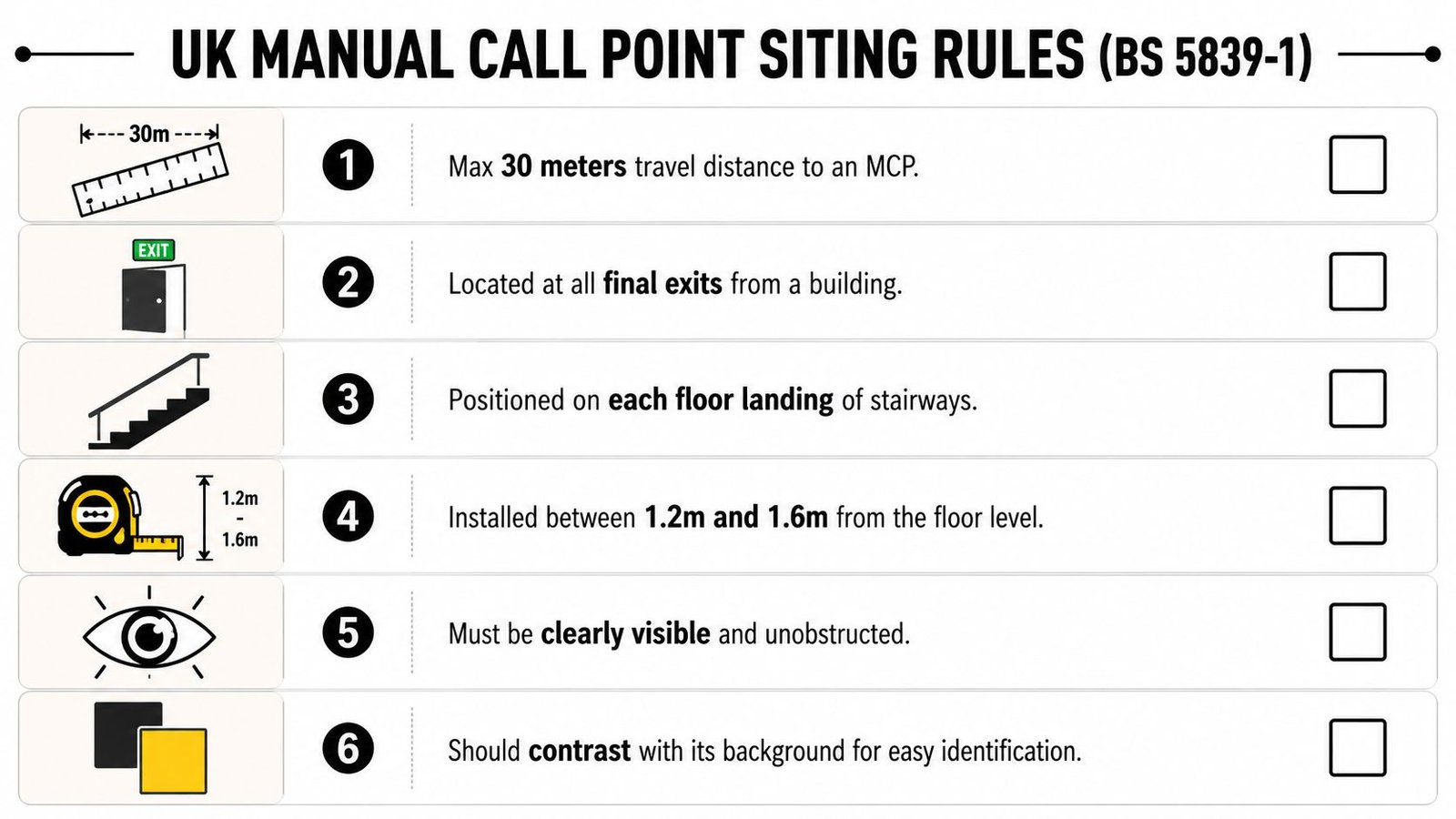
In the UK, the baseline expectation is straightforward. A person should not have to travel more than 45 metres along the actual escape route to reach a manual call point, and the unit should usually be mounted at 1.4 metres above finished floor level, with a tolerance of +200mm and -300mm, as summarised in the British Fire Consortium's guidance on manual call points.
“Actual escape route” is the part that often causes confusion. It does not mean measuring a neat straight line across a plan. It means the route a person really walks, around partitions, through corridors, and toward an exit. A tape measure across open office space can give a false sense of compliance.
In some buildings, that travel distance needs to be shorter. The Fire Industry Association guide to BS 5839-1 explains that reduced distances may apply where there is a higher risk profile or where occupants may need earlier warning and easier access to a call point.
The mounting height has a practical reason too. Around 1.4 metres usually places the device where it is easy to see, easy to reach, and less likely to be blocked by furniture, stock, or wall finishes.
Common siting failures that cause real problems
The failures are usually ordinary building management issues, not dramatic design mistakes. A call point ends up behind a door leaf. A vending machine or display stand narrows the approach. A refurbishment changes the corridor layout, but nobody checks whether the walking distance still complies.
Visibility matters as much as spacing. A unit can technically sit at the correct height and still be poor in practice if it blends into a strong wall colour, sits in shadow, or is tucked away from the route people naturally follow during an evacuation.
A useful site check is simple:
- Can a person see the call point while moving toward an exit?
- Can they reach it directly without stepping around storage, furniture, or displays?
- Does the walking route still comply after any fit-out or partition changes?
- Is the device protected from accidental knocks where false alarms are a known issue?
That last point deserves attention. Many owners assume pressing a manual call point automatically summons the fire brigade. In many premises, it does not. It usually starts the building alarm and then relies on your system configuration, your alarm receiving arrangements, and your staff response. Poor siting can therefore create two different failures. People may struggle to raise the alarm quickly in a real fire, or a badly positioned unit may be activated accidentally, disrupting the site and creating unnecessary callouts or investigation costs.
Protective covers can help in areas where accidental operation is a known problem, but they are not a substitute for sensible placement. The aim is clear access for genuine use, with fewer unwanted activations.
If you're reviewing fire alarm positions as part of a refurbishment, access review, or layout change, broader guidance on UK building code compliance can help frame the wider duty. For building owners planning a new system or redesign, this guide to commercial fire alarm systems installation is a useful starting point for the overall layout.
Testing and Maintenance Your Legal Obligations
A compliant installation is only the starting point. After that, the legal duty becomes operational. The system has to be tested, faults have to be dealt with, and records have to show what was done.
What your weekly routine should achieve
In commercial properties, fire alarm systems including manual call points must be tested weekly, using a rotating selection of call points, according to the Fire Industry Association guidance PDF on user responsibilities and testing. The purpose of rotation is straightforward. Over time, you confirm that different call points across the premises are functioning, rather than repeatedly testing the same easy-to-reach unit.
That weekly test should be organised, not random. The responsible person or nominated staff member should know which call point is being tested, confirm that alarm sounders operate as expected, and make sure the panel resets correctly afterwards.
The same FIA guidance also states that the system should receive an annual inspection by a professional maintenance company. That professional servicing checks the wider system condition and helps identify issues that a simple user test won't catch.
A useful discipline is to think in layers:
- Weekly user testing confirms the system can still be activated.
- Fault reporting deals with any damaged or unreliable call point immediately.
- Professional maintenance checks the system more thoroughly and keeps it in serviceable condition.
If your team needs a plain-English refresher on scheduling and frequency, this page on how often fire alarms should be tested is a practical reference.
The logbook is part of compliance not paperwork
The fire alarm logbook is not optional administration. The FIA guidance states that the fire alarm logbook is a mandatory legal requirement, and it should record the date, time, and result of each test, along with faults and the action taken.
That matters for three reasons.
- Evidence of compliance: If there's scrutiny after an incident or inspection, the logbook shows whether the routine was followed.
- System history: Repeated faults on one call point or one area can indicate damage, misuse, or an underlying installation issue.
- Management continuity: When duties pass between managers, caretakers, or contractors, the logbook keeps the system history clear.
A missed entry can hide a missed test. A poor record can hide a recurring fault.
One more point catches many occupiers out. A manual call point usually activates the internal alarm system only. It does not, by itself, automatically call 999 or trigger sprinkler systems. If your staff still assume otherwise, your maintenance regime should be paired with training and a fire action plan that removes that ambiguity.
Your Next Step to Fire Safety Compliance in South Wales
A manual call point can be the first part of your fire response that a person touches, and that makes it easy to get wrong in ways that only become obvious during an alarm or an inspection. The red box on the wall is simple in appearance, but proper compliance depends on several details working together. It must be in the right place, operate correctly, be tested and recorded, and be understood by the people expected to use it.
One misunderstanding causes more risk than many owners realise. Staff, tenants, and visitors often assume pressing a manual call point automatically summons the fire brigade. In most buildings, it does not. It starts the fire alarm system within the premises, and your fire action plan still needs to state who calls 999, when they do it, and what happens next.
That gap matters in both directions. In a real fire, delay can happen because someone assumes help is already on the way. In a false alarm, poor procedures can lead to an unnecessary brigade attendance, disruption to the site, and avoidable cost.
For owners and managers, that means compliance is a practical management issue, not just an installation task. A well-sited call point with weak staff training still leaves a hole in the response. Good records with poor system design do the same. Ensuring these details are correct is a core part of a professional fire safety strategy.
If you manage property in South Wales or the South West, review three things together. Check where your call points are located. Check whether testing and logbook records are up to date. Check whether your staff can explain what happens after activation, including who contacts the emergency services. Those are often the first places where practical compliance gaps appear.
If you need help reviewing, installing, or maintaining a compliant fire alarm system, Wisenet Security Ltd can support sites across South Wales and the South West with professional advice, system design, installation, and ongoing maintenance.