Security Systems and Alarms Inspection Board Guide (2026)
You've probably landed here because someone has told you your alarm must be certified, approved, or installed by an accredited company. That usually happens at exactly the wrong moment. You're renewing insurance, fitting out a new unit, taking on a rental property, or trying to get police response on a monitored system. The wording sounds official, but it often isn't explained in plain English.
Selecting a security system often comes down to two main questions: "Will my insurer accept this system?" and "Will it work properly when I need it?" Those are exactly the right questions to ask.
The security systems and alarms inspection board matters because it sits in the space between the installer's promise and independent proof. If you're a business owner, landlord, facilities manager, or homeowner, that proof affects far more than a certificate on a wall. It can affect insurer conditions, police response arrangements, maintenance obligations, and whether your system stays compliant after day one.
Table of Contents
- Your Insurance Demands a Certified Alarm What Now
- What Is the SSAIB and Why Does It Really Matter
- Understanding UK Security Standards and Accreditations
- The SSAIB Inspection Process from Start to Finish
- Common Inspection Fail Points and How to Avoid Them
- Proactive Maintenance Your Key to Continuous Compliance
- How Wisenet Security Guarantees Your Peace of Mind
Your Insurance Demands a Certified Alarm What Now
If your insurer has written “approved alarm”, “certified alarm installer”, or similar wording into your policy, don't guess what they mean. Ask them for the exact requirement in writing. You want to know whether they need a monitored system, whether police response is part of the condition, and whether ongoing maintenance is expected as part of compliance.
That last point catches people out. A lot of owners focus on the installation quote and miss the service obligation that comes after it. If the policy depends on a compliant system, the paperwork, servicing, and monitoring arrangements matter just as much as the control panel and detectors.
A practical way to think about it is this:
- Read the policy wording carefully. Look for terms such as approved, certified, monitored, maintained, or police response.
- Ask what evidence the insurer expects. That may include a certificate, maintenance records, or confirmation that the installer operates under a recognised certification scheme.
- Check whether the requirement applies continuously. Some buyers assume the system only has to be right on installation day. Insurance conditions often depend on the system remaining in that condition.
Practical rule: If your insurer is using compliance language, treat the alarm as an ongoing risk-control requirement, not a one-off product purchase.
The Security Systems and Alarms Inspection Board becomes relevant for this exact reason. In plain language, it gives insurers, monitoring providers, and end users an independent route to verify that a security company has been assessed against recognised requirements rather than claiming to follow them.
That matters most when something goes wrong. A break-in, an alarm dispute, or a rejected claim is a bad time to discover your installer's “approved” wording was marketing language rather than formal certification. Getting the requirement clear at the start is cheaper, calmer, and much easier to fix.
What Is the SSAIB and Why Does It Really Matter
The Security Systems and Alarms Inspection Board, usually shortened to SSAIB, is a UK certification body for security and related systems. BAFE states that SSAIB is both “UKAS Accredited” and “BAFE Licensed” within the scope of its schemes, which places it inside a recognised UK conformity-assessment framework rather than a casual trade approval scheme (BAFE summary of SSAIB status).
That sounds formal, so let's translate it. SSAIB does more than hand out badges. It assesses whether organisations meet the standards and procedures required for the work they carry out. For a client, that means the certification has weight beyond sales literature.

If you want a straightforward explanation of the term itself, this guide on SSAIB alarm meaning is useful alongside the wider practical points covered here.
Why insurers and police care
Most buyers think certification is about quality alone. Quality matters, but the practical consequence is usually insurance acceptance and the ability to support police response arrangements where applicable.
SSAIB says its schemes comply with police policies across England, Wales, Scotland, Northern Ireland and the Republic of Ireland, and it also notes that insurers often place specific demands on security and fire system providers. That's the point many articles miss. The issue isn't whether the badge looks reassuring. The issue is whether your installer can support the compliance pathway your policy or monitoring setup relies on.
If your system needs to support insurer conditions or a police response route, the installer's certification status stops being a nice-to-have and becomes part of the operating requirement.
What SSAIB covers in practice
Another common misunderstanding is that SSAIB is only about burglar alarms. It isn't. Its scope has expanded with the industry. SSAIB describes itself as a certification body for organisations providing security systems and services, fire detection and alarm systems, telecare systems and more, and it lists services including intruder alarms, CCTV, key holding, and door supervision for commercial premises, offices, retailers, and industrial sites (SSAIB official scope and services).
That breadth matters because modern sites rarely use one standalone system. A warehouse might have intruder detection, CCTV, access control, monitored signalling, and a fire interface. A managing agent may need documentation across several systems for one property portfolio. SSAIB sits across that joined-up reality.
It's also widely described as one of the UK's two major electronic security inspectorates. In practical terms, that means buyers, insurers, and specifiers recognise it as part of the mainstream UK security framework, not a niche label.
Understanding UK Security Standards and Accreditations
A lot of confusion comes from mixing up certification bodies with technical standards. They are connected, but they're not the same thing.
A certification body, such as SSAIB, assesses organisations. Technical standards set out how systems should be designed, installed, commissioned, and maintained. If you only know one acronym, it's easy to miss that distinction and ask the wrong questions when comparing installers.
Certification bodies and technical standards are not the same thing
In UK security, buyers will often come across SSAIB and NSI. Both are prominent in accreditation. The important point for a client is not to turn this into a badge competition. Ask instead, “What standards does this company work to, and how is that verified?”
For intruder alarms, one standard you'll hear frequently is BS EN 50131. That standard affects areas such as system grading, detector choice, tamper protection, signalling expectations, and how the system is documented and handed over. If you want a simple explainer before speaking to an installer, this page on what EN 50131 means is a good starting point.
SSAIB's scope reflects the fact that the market now expects joined-up compliance. It covers not just intruder alarms but also fire detection and alarm systems, CCTV, access control, key holding, and more, which is why certification can extend across integrated projects rather than one isolated product line.
A useful buyer habit is to separate your questions into two groups:
- About the company: Are they independently assessed for the type of system they are proposing?
- About the system: Which standards will the design, installation, and maintenance follow?
- About the paperwork: What will you receive for handover, service history, and future audits?
- About the lifecycle: Who maintains it, how often, and what happens if faults are left unresolved?
Why this matters for landlords and mixed-use properties
Landlords and property managers often have the messiest compliance picture. They may be juggling residential areas, common parts, plant rooms, shutters, gates, CCTV, access control, and vacant units. In that environment, security compliance overlaps with broader building obligations. A practical companion resource is this landlord compliance and safety guide, which helps frame security within the wider responsibilities of managing property safely.
The primary value in understanding standards is that it improves conversations on site. Instead of asking for “a better alarm”, you can ask whether detector placement matches room risk, whether cabling and tamper protection are appropriate, whether the signalling path suits the insurance condition, and whether the documentation will stand up later.
That changes the whole purchasing process. You move from buying a box of equipment to buying a compliant, supportable system.
The SSAIB Inspection Process from Start to Finish
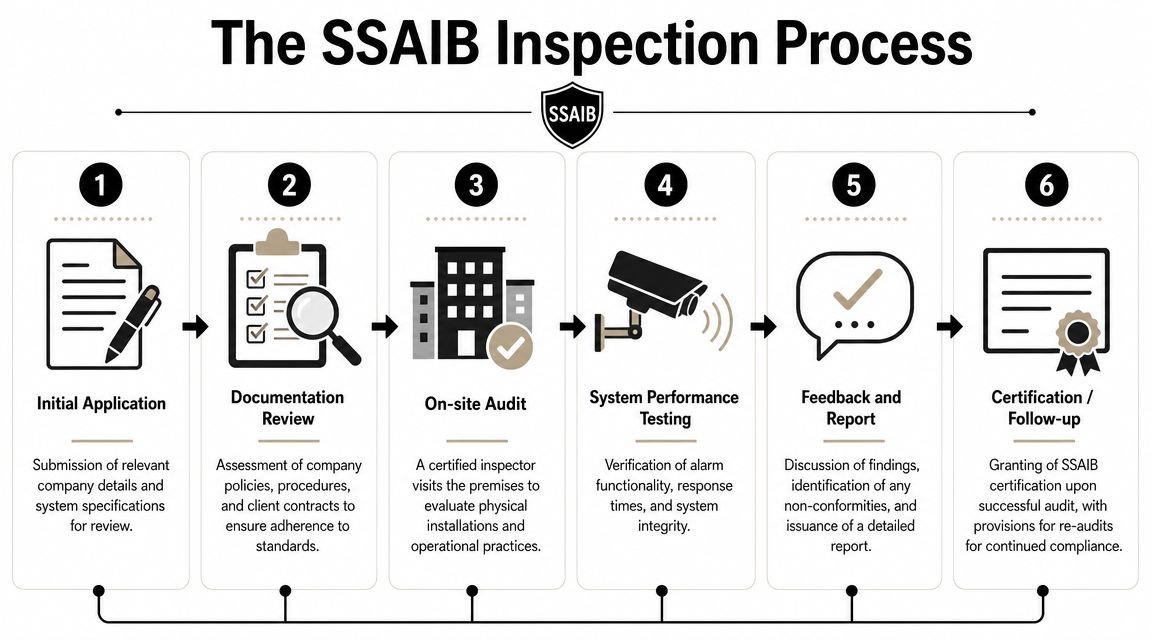
Most clients imagine an inspection as someone arriving with a clipboard and looking for faults. In reality, the process is much broader. It checks whether the company's systems, technical work, records, and site practices all line up.
For UK projects, SSAIB accreditation is used as evidence that a provider can deliver high-integrity systems to recognised standards. Clearway's examples include areas such as Vacant Property Alarm Systems and Visual Surveillance Systems, which shows that the oversight extends well beyond a simple bell-only alarm and into higher-risk monitored applications where reliability matters (Clearway on SSAIB accreditation and VSS use cases).
What gets reviewed before site testing
Before anyone starts opening panels or walking a perimeter, there is usually a paperwork and process element. An assessor may review company procedures, sample job files, certificates, maintenance records, and the way customer contracts and handover information are handled.
For a new installation, the design logic matters. Why was that detector chosen? Why is the keypad positioned there? Why is that signalling path suitable for the risk? A well-installed system starts with a sensible design, not just tidy hardware.
What an inspector looks for on site
On site, the inspection moves from theory to physical reality. The assessor will want to see whether the installation matches the design and whether the system works properly under test.
Typical areas of attention include:
- Detector siting: A PIR aimed at a heat source or a poorly chosen camera angle can reduce reliability.
- Cabling and containment: Loose, vulnerable, or badly terminated cabling creates fault risk and tamper risk.
- Tamper protection: Covers, junctions, housings, and critical devices must respond correctly if interfered with.
- Signalling and communications: If the system is monitored, the signalling path has to be configured and tested properly.
- User operation: The system should be understandable to the end user, not just the engineer who programmed it.
A compliant system isn't just one that can trigger an alarm. It has to do so for the right reasons, communicate correctly, and be maintainable over time.
What happens after the visit
After testing, findings are recorded and any non-conformities are dealt with through corrective action. That might involve technical changes on site, improved documentation, or adjustments to process.
From a client perspective, the key takeaway is reassurance. Inspection isn't there to make life difficult for the end user. It exists to reduce the chance of hidden weaknesses. A system that looks fine on the wall can still be poorly documented, badly configured, or impossible to support later. The inspection process is designed to catch that before it becomes your insurance dispute or false confidence problem.
Common Inspection Fail Points and How to Avoid Them
Most failed inspections don't come from exotic technical problems. They come from ordinary oversights that affect reliability, traceability, or both. In many cases, the equipment itself is fine. The issue is where it has been placed, how it has been programmed, or whether the records behind it are complete.
Where systems usually come unstuck
One common issue is poor detector placement. A detector may technically be installed, but not installed sensibly. A motion detector facing a radiator, direct sunlight, or a draughty entrance can become unstable. A door contact that doesn't align cleanly may work on the day but become intermittent later.
Another frequent problem is weak documentation. If the logbook, zone list, user instructions, maintenance history, or commissioning records are missing or unclear, the system becomes harder to verify and maintain. That affects inspections because compliance is not only about what is fitted. It's also about whether the system can be understood, serviced, and evidenced.
You also see trouble with battery health, signalling tests, and tamper circuits. These are easy for non-specialists to overlook because the system may still appear to arm and unset normally. But an alarm that works only under ideal conditions is exactly the kind of system that causes disputes after an incident.
The dangerous systems aren't always the obviously broken ones. The risk often sits in the small details that only show up during a fault, a power cut, or an attempted intrusion.
Checklist to Avoid Common Inspection Failures
| Failure Point | Why It's a Problem | Prevention Tip |
|---|---|---|
| Detector positioned badly | It may create false alarms or miss genuine movement | Review each detector against the room layout, heat sources, glazing, draughts, and likely approach routes |
| Untidy or unprotected cabling | Cabling is easier to damage, interfere with, or fault-find badly later | Use secure routing, proper terminations, and suitable containment from the outset |
| Incomplete tamper protection | The system may not report interference correctly | Test lids, housings, junctions, and key field devices during commissioning, not just at handover |
| Weak standby battery or poor power arrangement | The system may not hold up properly during mains failure | Replace ageing batteries promptly and verify backup performance during service visits |
| Signalling path not fully tested | A monitored alarm may trigger locally but fail to communicate correctly | Carry out end-to-end transmission tests and record the result clearly |
| Missing paperwork | The owner, insurer, or future engineer can't verify what was installed or maintained | Keep handover packs, zone charts, user instructions, service records, and certificates together |
| Programming errors | Timers, entry routes, part sets, and outputs may not match the site's real use | Test real operating scenarios with the client before signing the system off |
| Sensors unsuited to the environment | Dust, pets, external doors, and site use can undermine reliability | Choose devices to match actual conditions, not just the cheapest compatible option |
A good installer reduces these risks before the inspection ever happens. That's why pre-commissioning checks matter so much. They're where most avoidable failures should be caught.
Proactive Maintenance Your Key to Continuous Compliance
The biggest misunderstanding in this whole area is simple. People think certification ends at handover.
It doesn't. Ongoing servicing sits right in the middle of compliance, insurer expectations, and system reliability.
Maintenance guidance aimed at end users often notes that compliant security systems may require annual or twice-yearly inspections, with checks covering items such as detectors, sounders, communication paths, anti-masking, tamper circuits, and ARC test signals. The practical point is that servicing is central to keeping the system compliant and insurance-friendly after installation (plain-English overview of security system maintenance contracts).
What a proper maintenance visit should include
A proper service visit is more than pressing a few devices and writing “tested” in a log. The engineer should be checking whether the system still matches the site and still performs as intended.
That usually includes things like:
- Detection devices: Are sensors clean, secure, responsive, and still suitable for the current room use?
- Warning devices: Do internal and external sounders operate correctly?
- Communications: Does the signalling path still report correctly to the ARC if monitoring is in place?
- Power resilience: Are standby batteries healthy and charger outputs normal?
- Records: Has the logbook been updated with faults, changes, and test results?
If you're comparing service providers, this guide to alarm system maintenance gives a practical summary of what ongoing support should look like.
For a visual walk-through of inspection and servicing expectations, this short video is a helpful reference.
Why missed servicing becomes an insurance problem
The consequences manifest tangibly in actual practice. If the system drifts out of service, develops unresolved faults, or loses its maintenance trail, the issue isn't only technical. It can become contractual.
Insurers and monitored response arrangements rely on the idea that the system is not just installed but kept in proper order. A site with neglected servicing may still feel protected because the keypad lights up and the app still opens. That's not the same as knowing the signalling path, tamper functions, standby power, and detector performance are still sound.
Client advice: Budget for maintenance at the same time you budget for installation. If you treat servicing as optional, you're weakening the very proof your insurer may want to see later.
For landlords, retailers, and warehouse operators, maintenance also helps catch changes in site use. A stockroom becomes an office. A vacant unit becomes temporarily occupied. Shelving blocks a detector. A new shutter affects entry timings. Compliance often slips because the building changed and nobody updated the system to match.
How Wisenet Security Guarantees Your Peace of Mind
Choosing an installer is really about choosing who carries the compliance burden with you. If they understand police response requirements, insurer expectations, system design, documentation, and aftercare, the whole process becomes much less stressful.
SSAIB states that its schemes comply with police policies across the UK, and for homeowners and businesses the practical issue is whether the installer can support police response and insurer conditions where required. Weak compliance creates a real operational risk, which is why certified installation matters in the first place (SSAIB explanation of police policy and insurer relevance).

What good compliance support looks like day to day
For clients in South Wales and the South West, one practical option is Wisenet Security Ltd, which designs, installs, and maintains systems including CCTV, intruder alarms, access control, fire alarms, intercoms, and gate automation. The useful point from a compliance perspective is not marketing language. It's that the company's service model includes DBS-checked engineers, documented installations, and ongoing maintenance support, which are the kinds of day-to-day disciplines that help systems remain supportable after handover.
That matters because peace of mind doesn't come from the logo on the outside sounder. It comes from knowing several things are being handled properly:
- System design matches the risk. A shop, warehouse, house, and managed block don't need the same layout or same level of signalling.
- Equipment choice is sensible. Brands such as Hikvision, Pyronix, Paxton, and Fike are only as good as the way they're applied.
- Handover records are complete. If a future claim, inspection, or engineer visit happens, your file needs to make sense.
- Maintenance is planned. Compliance weakens quickly when servicing is vague or reactive.
If you take one point away from this guide, make it this. The security systems and alarms inspection board matters because it turns security from a sales promise into an independently assessed process. For buyers, that process has practical consequences. It can affect whether your insurance requirement is met, whether a monitored pathway is supportable, and whether the system still stands up months or years after installation.
If you want help reviewing an existing system, understanding an insurer's wording, or planning a compliant installation, contact Wisenet Security Ltd. A good security company should be able to explain the standards in plain English, set out the maintenance commitment clearly, and show you how the system will remain insurable and supportable after the install is finished.