SSAIB Alarm Meaning: Insurance, Police, & UK Installers
You're probably here because you've had a burglar alarm quote in front of you, seen “SSAIB approved”, and wondered whether it's meaningful or just another industry badge. That's a sensible question. Purchasing alarm systems isn't a frequent activity, and the paperwork can feel full of initials, standards, and promises that all sound the same.
In practice, ssaib alarm meaning comes down to one simple idea. It tells you whether the company installing and maintaining your alarm has been independently checked against recognised standards, and whether your system is likely to satisfy the people who matter later, especially your insurer and, where relevant, the police. If you're protecting a home in Cardiff, a shop in Bristol, or a warehouse in Newport, that difference matters long after the installation day.
Table of Contents
- What Does SSAIB Mean on a Burglar Alarm Quote
- What Is the SSAIB and What Does It Do
- Why Your Alarm Needs to Be SSAIB Approved
- SSAIB vs NSI What Is the Difference
- Choosing Your SSAIB Certified Security Installer
- Your SSAIB Questions Answered
What Does SSAIB Mean on a Burglar Alarm Quote
If SSAIB appears on your quote, it means the installer is saying their business is certified by the Security Systems and Alarms Inspection Board. For you as the buyer, that's not just a label. It's a quality mark that says the company has been assessed against recognised security standards and ongoing inspection requirements.
The easiest analogy is a hallmark on jewellery. Two rings can look similar in a photo, but the hallmark tells you one has been independently verified. Alarm systems are similar. A quote can mention door contacts, motion sensors, smartphone alerts, and monitoring, but the certification tells you whether the installer's work has been checked to a recognised level.
For most homeowners and businesses, the practical meaning of ssaib alarm meaning shows up in three places:
- Installation quality: The company should be working to recognised standards rather than making up its own version of “best practice”.
- Insurance acceptance: Many insurers want evidence that a system was installed by an approved provider.
- Police eligibility: For monitored alarms, certification can affect whether the setup meets the conditions expected for police response.
Practical rule: If two quotes look similar, treat the one from a certified installer as the one with verifiable paperwork behind it.
This matters even more in South Wales and the South West, where many clients are balancing real-world concerns rather than abstract standards. A family in Swansea may want proof for home insurance. A retail unit in Bristol may need a monitored alarm that aligns with insurer expectations. A small industrial site in Cardiff may need confidence that the system won't become a headache at claim time.
What catches people out is that an alarm can be loud, modern, and full of app features, yet still fall short where it counts. Certification helps separate a professionally installed security system from a box of parts that merely looks convincing.
What Is the SSAIB and What Does It Do
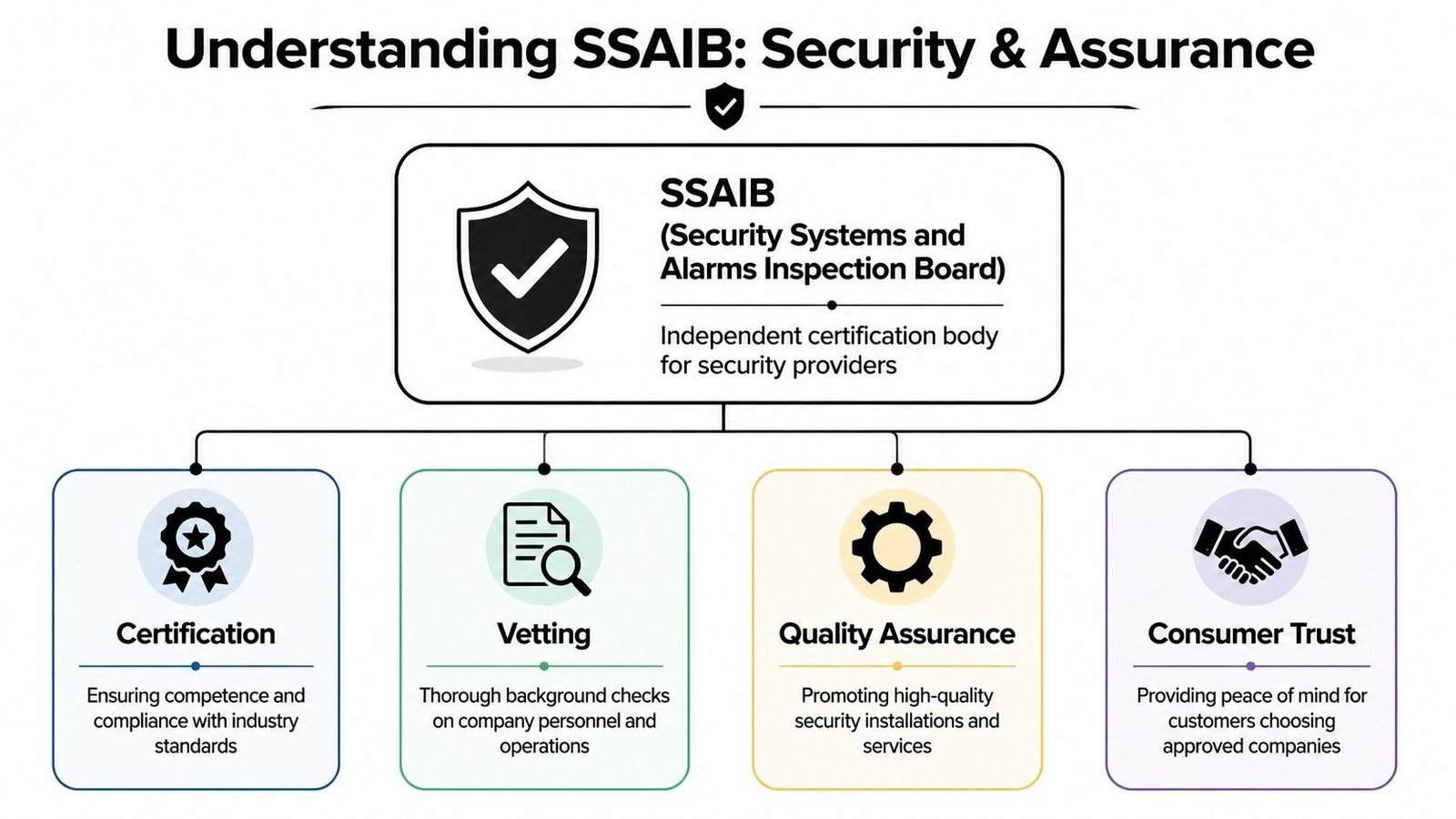
SSAIB stands for Security Systems and Alarms Inspection Board. It is a UK certification body that checks security providers, including companies working in electronic security, fire detection, and monitoring services. According to Clearway's overview of SSAIB accreditation, SSAIB is the leading UK certification body and oversees approximately 1,800 registered companies.
A simple way to think about it
If you've ever checked whether a gas engineer is properly registered, you already understand the basic principle. The installer does the actual work, but an independent body checks whether that company is competent, organised, and operating to recognised rules.
That's also why people sometimes confuse a certification body with a trade group. They're not the same thing. If you want a plain-English explanation of that distinction, this guide on what is trade association is useful. A trade association represents members. A certification body inspects and assesses them.
SSAIB's role is to give customers confidence that the firm isn't merely claiming to be professional. It has to prove it.
What certification involves in real life
Certification is not just a badge on a van. The process involves checking installations, paperwork, and company procedures, followed by periodic inspections to maintain standards. That matters because alarm reliability is rarely about one single component. It usually comes down to the whole chain: design, installation, documentation, handover, and maintenance.
A proper monitored alarm setup also relies on the response path after an activation. If you want to understand that side of the system, this guide to what a monitored alarm system is helps connect the installer's certification with what happens once the alarm signal leaves your property.
Later in the buying process, many people realise they're not really buying a keypad and a few sensors. They're buying a process. That process includes site assessment, equipment selection, installation standards, testing, records, and follow-up support.
Here's a short video that gives additional background on security certification and alarm standards:
A good installer doesn't just fit hardware. They leave you with a system that can stand up to scrutiny after an incident.
For homeowners, that means fewer nasty surprises when you need proof for an insurer. For businesses, it means your alarm arrangement is more likely to line up with lease terms, risk assessments, and monitoring requirements.
Why Your Alarm Needs to Be SSAIB Approved
A break-in is stressful enough on its own. The last thing any homeowner or business owner in South Wales or the South West wants is to find out afterwards that their alarm was fitted in a way an insurer questions, or that a monitored setup does not meet the conditions needed for the response they expected.
Insurance is often the first place approval makes a real difference
An SSAIB approved alarm is not just about having a bell box on the wall. It shows that the system has been designed and installed under recognised rules, with the paperwork and inspection trail to back it up. Insurers pay attention to that because, from their point of view, a security system only helps reduce risk if it has been specified and fitted properly.
That can affect price.
Insurers may offer discounts on premiums for alarm systems that meet recognised standards and are installed by approved companies, as noted by industry experts across the UK security and insurance sectors. The exact saving depends on the property, the insurer, and the level of risk, so it is better to treat certification as something that may help your premium and can also protect your position if you need to claim.
That second point is the one people often miss. If your policy refers to an approved or professionally installed alarm, the certificate and maintenance record matter in the same way a service history matters on a company vehicle. They help show that the system was not just present, but suitable and properly looked after.
For a homeowner in Cardiff, Swansea, or Newport, that can mean fewer arguments after a burglary. For a business owner in Bristol or Bath, it can mean meeting insurer requirements from the start instead of correcting the system later at extra cost.
Police response depends on the full monitored setup
Police attendance is another area where assumptions cause problems. A siren making noise outside your building does not, by itself, mean police will respond. For monitored systems, response depends on the alarm being set up to the right standard, connected through the right signalling path, and managed through the right channels.
The benchmark commonly referred to here is PD 6662:2017. In practical terms, that standard helps make sure the parts of the system work together properly, from detectors and control equipment to signalling and verification. If higher risk premises are involved, the specification may also call for a higher alarm grade and dual-path signalling.
Dual-path signalling works like having two delivery routes for an urgent message. If one route fails, the signal still has another way to reach the Alarm Receiving Centre. That matters for empty commercial units, warehouses, and higher risk homes where a single communication path could leave you exposed.
If police response is part of your plan, ask one direct question. Does the whole monitored system meet the standards and signalling requirements needed for the level of response you want?
That is why SSAIB approval matters in everyday terms. It reduces the chance of buying something that looks professional on the surface but falls short where it counts. The app may work. The keypad may look modern. The external sounder may be loud. None of that guarantees the system will satisfy insurer expectations or the criteria tied to monitored response.
A certified installer starts with the risk, then matches the system to it. For a detached home in South Wales, that may mean making sure the alarm specification aligns with insurer expectations for the property and contents value. For a retail unit in the South West, it may mean choosing signalling and monitoring arrangements that keep the response chain intact outside trading hours.
The practical benefit is simple. You are more likely to get an alarm system that stands up under pressure, on paper as well as on the wall.
SSAIB vs NSI What Is the Difference
This is one of the most common points of confusion. People see SSAIB on one quote and NSI on another and assume one must be the “real” standard. In practice, that's the wrong way to look at it.
According to VOG Alarms' summary of the two bodies, SSAIB and NSI are the two primary UKAS-accredited inspection bodies recognised by police and insurers, and SSAIB has around 1,800 organisations on its register. For most buyers, the key point is that both are credible routes.
If you want to understand one of the technical standards these installers work to, this explanation of EN 50131 alarm grading is a useful companion.
SSAIB vs NSI at a Glance
| Feature | SSAIB (Security Systems and Alarms Inspection Board) | NSI (National Security Inspectorate) |
|---|---|---|
| Core role | Certification body for security and fire providers | Certification body for security and fire providers |
| Recognition | Recognised by police and insurers | Recognised by police and insurers |
| UKAS-accredited | Yes | Yes |
| Market presence | Largest number of registered providers | Strong national presence |
| What it means for a customer | Independent assessment of installer competence and compliance | Independent assessment of installer competence and compliance |
| Notable distinction | Broad register of approved companies | Known for tiered schemes such as Gold and Silver |
For most homes and standard business premises, the better question isn't “SSAIB or NSI?” It's “Can this company prove its certification and explain the system properly?”
So don't get stuck on badge rivalry. If a provider is certified by either body, that's the main thing. Your decision should then move to system design, maintenance support, monitoring options, and whether the installer understands your property.
Choosing Your SSAIB Certified Security Installer
A good alarm quote should leave you clearer, not more confused. If two companies visit your shop in Cardiff or your home in Bristol and both promise “high-quality security”, the difference often shows up in the details they can prove. Certification is one of those details. It works like an MOT record for a car. Anyone can say the vehicle runs well, but independent inspection tells you whether it meets the standard.
Start by checking whether the company is listed with SSAIB. That sounds basic, but it saves a lot of trouble. A firm that is certified should be easy to verify, and a serious installer will not be offended when you ask.
Once that is confirmed, move from the badge to the design. Ask what standard the system is being installed to, what grade has been specified for your property, and whether the quote includes the level of signalling and maintenance your insurer or monitoring arrangement may expect. As noted earlier, these standards affect more than tidy paperwork. They can influence whether a system is accepted for insurance purposes and whether it can support the response arrangements you want.
If you are comparing local firms, this guide on choosing a security company in Cardiff is a useful way to assess how a provider handles survey work, recommendations, and aftercare.
Questions worth asking before you sign
Price matters, but it should not be your first filter. A cheaper alarm that is poorly specified can cost more later through upgrade work, insurer objections, false activations, or weak coverage in the areas that matter most.
Ask these questions and listen to how clearly they are answered:
- Will I receive a certificate of conformity after installation? You should know exactly what paperwork you will get.
- Why is this alarm grade suitable for my property? The answer should relate to your risk, not just repeat product names.
- How will the system be monitored, if monitored at all? A shop with stock, a rural home, and a small office may need different signalling arrangements.
- What maintenance is included? Alarms need servicing, fault checks, battery replacement, and a clear call-out process.
- How does this design reduce false alarms? That question matters because reliability affects day-to-day confidence and, for some monitored systems, response expectations.
A capable installer explains this in plain English. You should not need to translate jargon or guess what has been left out.
What a well-chosen installer does differently
The best firms do more than fit equipment. They survey the property properly, identify entry points, ask how the building is used, and explain trade-offs. A pet-tolerant detector, for example, can be the right choice for a family home in Newport, but only if it is positioned correctly and matched to the room. A warehouse unit in Swansea may need a very different approach, with attention paid to out-of-hours access, stock areas, and communication paths if signals need to reach a monitoring centre.
That practical thinking is where certification starts to pay off. You are not just buying sensors and a bell box. You are buying system design, documentation, testing, and ongoing support that stand up when you need the alarm to work.
Red flags that should make you pause
Some warning signs come up again and again:
- Loose wording about approval. “Built to SSAIB standards” is not the same as certification by an SSAIB-approved company.
- A quote heavy on gadgets but light on compliance. App control is useful, but it should not crowd out the basics.
- No clear discussion of maintenance or monitoring. That often means costs or limitations appear later.
- Pressure to sign on the spot. Careful security design usually involves a proper survey and a clear written recommendation.
- Vague answers about paperwork. If the company cannot explain what certificate or documentation you will receive, treat that as a warning.
A reliable installer should be able to explain why each part of the system is there and what problem it solves. That is the essential test. For homeowners and businesses across South Wales and the South West, a well-chosen certified installer gives you a better chance of insurer acceptance, fewer unpleasant surprises, and a system that performs properly when it matters.
Your SSAIB Questions Answered
Can a DIY alarm be SSAIB approved
Not as one might commonly understand it. SSAIB certification applies to the approved company and the professionally installed system, not to a box bought online and self-fitted over the weekend.
That's why a DIY setup can still be useful as a basic deterrent but may not satisfy the same insurance or monitoring expectations as a professionally installed system. If your priority is recognised compliance, DIY and certified installation are not equivalent.
Does SSAIB matter for smart alarms and app control
Yes, and arguably more now than before. Modern systems use IP connections, mobile apps, cloud services, and networked devices. That creates convenience, but it also creates new points of weakness.
According to SSAIB's guidance on alarm systems, SSAIB now mandates enhanced security audits for IP-based smart alarms under revised PD 6662 standards, aimed at addressing vulnerabilities in app-controlled systems that non-certified DIY solutions may overlook.
That matters if you're choosing between a professional smart alarm and a consumer gadget. Both may send phone alerts. Only one may have been installed within a certification framework that treats cyber risk as part of the security job.
Do I need maintenance after installation
Yes. An alarm isn't a fit-and-forget product. Batteries age, sensors drift, signalling faults happen, and site use changes. A warehouse door that was rarely used last year may become a daily access point. A family may remodel a room and change the detector's field of view.
Maintenance keeps the system aligned with the way the property works. It also helps preserve the value of the original installation, because the system remains checked, documented, and supportable rather than slowly becoming unreliable.
If you're weighing up alarm quotes in South Wales or the South West, the safest approach is to treat SSAIB certification as one of the first filters, not an optional extra. It helps protect your insurance position, supports proper monitored response arrangements, and gives you a clearer standard for judging who should be trusted with your home or business security. Wisenet Security Ltd provides customized security systems across Cardiff, Bristol, Newport, Swansea, and surrounding areas, including intruder alarms, CCTV, access control, and monitored solutions, with experienced engineers who can advise on compliant system design for your property.