Integrated Security Solutions: Protect Your UK Business
You’re probably already dealing with some version of this. The alarm sends alerts through one app. The CCTV sits in another. The gate or front door entry runs on its own schedule. If something happens out of hours, you’re jumping between screens, trying to work out whether it’s a genuine issue, a staff mistake, or a false alarm.
That fragmented setup is common across South Wales homes, shops, offices, warehouses, and multi-tenant buildings. It also creates delays at the exact moment you need clarity. Integrated security solutions fix that by making your cameras, alarms, access control, intercoms, fire systems, and automation work as one joined-up system instead of a pile of separate products.
This isn’t a niche approach anymore. The global integrated security solutions market is projected to reach $69.15 billion by 2034, growing at a 14.1% CAGR from 2024, according to market analysis on integrated security solutions. The reason is simple. Connected systems are easier to manage and far more useful when something goes wrong.
Table of Contents
- Beyond Silos A New Era for Security
- What Is An Integrated Security System
- How Security Components Work Together in Practice
- Tailored Benefits for Different Needs
- Meeting UK Compliance and Standards
- Your Selection and Installation Checklist
- Secure Your Future with Wisenet Security
Beyond Silos A New Era for Security
Most poor security setups don’t fail because the devices are broken. They fail because the devices don’t talk to each other.
A camera may record a delivery yard perfectly well, but if it doesn’t trigger a response when an alarm activates, it’s only giving you evidence after the fact. A keypad may control the front door, but if it doesn’t work with user permissions, time schedules, and audit trails, you still end up relying on guesswork. This is the core problem with siloed systems. You own the parts, but you don’t get a coordinated response.
What siloed security looks like on site
In practice, the warning signs are easy to spot:
- Multiple apps: staff use one app for cameras, another for intruder alerts, and another for entry.
- No cause-and-effect rules: a break-in alarm doesn’t automatically bring the right camera view on screen.
- Manual checks: someone has to verify incidents by logging into several systems.
- Poor visibility: managers can’t see the whole site status from one dashboard.
- Difficult expansion: adding a gate, outbuilding, or second premises creates another standalone system.
For homeowners, that means inconvenience and patchy coverage. For businesses, it means slower decisions, more avoidable callouts, and a higher chance that a genuine incident is missed in the noise.
What changed
Modern integrated security solutions combine CCTV, intruder detection, access control, intercoms, fire systems, and automation under a single operating logic. The best systems don’t just collect inputs. They trigger planned actions.
Practical rule: If your system needs a person to manually connect the dots during an incident, it isn’t really integrated.
This matters most when you’ve got more than one risk to manage at once. A retail unit may need after-hours alarm verification, staff access logging, and GDPR-aware video handling. A warehouse may need perimeter detection, gate control, loading bay coverage, and out-of-hours monitoring. A block of flats may need communal door entry, parcel access, and camera coverage in shared areas.
The value isn’t in owning more equipment. The value is in having the right systems respond together, in the right order, without delay.
What Is An Integrated Security System
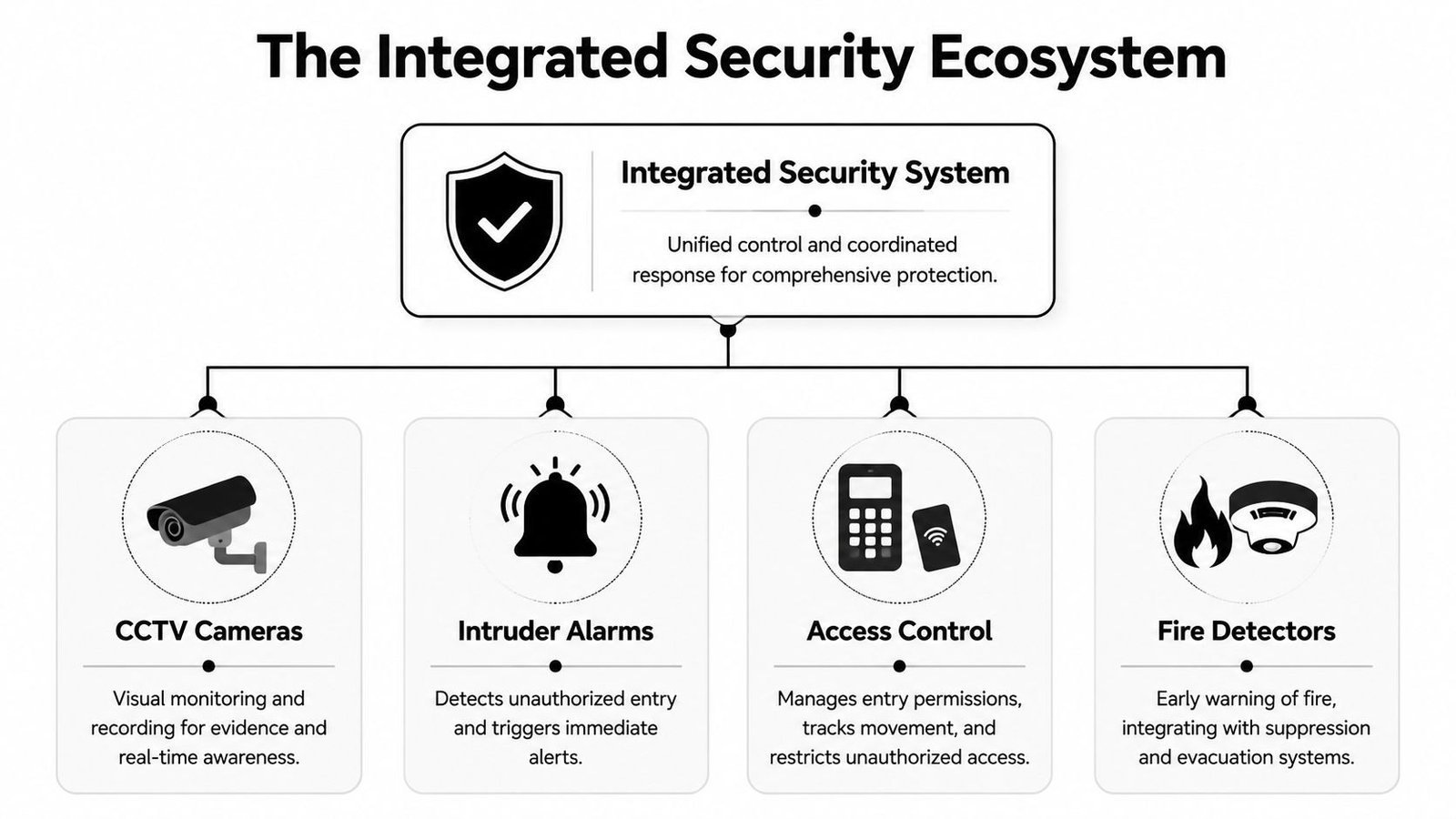
An integrated security system links several security functions into one coordinated setup. Instead of each device working alone, they share information through a central platform and follow programmed rules.
The simplest way to think about it is this. Separate security devices are like trades working on the same building without a site manager. They may all be competent, but progress is messy. An integrated system adds the site manager.
One system instead of separate islands
In a typical UK installation, the connected parts often include:
- CCTV cameras: fixed and PTZ cameras for live viewing, recording, and event verification.
- Intruder alarms: door contacts, PIRs, shock sensors, and control panels built to the right grade.
- Access control: card readers, fobs, keypads, intercoms, biometrics, and door release hardware.
- Fire detection: conventional or addressable fire alarms, often linked to doors, notifications, and evacuation workflows.
- Gate automation and intercoms: common on yards, car parks, and larger homes.
- Mobile access: secure app-based control for alerts, live video, and user management.
The central platform may be a VMS, an access control head-end, or a broader management layer that ties several systems together. On larger sites, that can include PSIM-style logic. On smaller sites, it may be a tightly integrated combination of recorder, alarm app, and access controller.
What the central platform actually does
The platform’s job is straightforward. It receives events, applies rules, and presents them in a way a person can act on quickly.
That can include:
- Correlating events so a forced door alarm brings up the nearest camera automatically.
- Running actions such as locking selected doors, turning on lighting, or sending alerts.
- Logging activity across doors, users, alarms, and video for audit and review.
- Simplifying control so managers aren’t switching between disconnected systems.
For businesses where access history matters, user permissions matter even more. If you’re reviewing user groups, audit trails, and door permissions, this guide on how to manage access for compliance is a useful companion to the physical side of system design.
A good integrated setup doesn’t remove human control. It removes wasted human delay.
That’s why integrated security solutions suit both practical homeowners and busy operators. You can still decide who gets in, which areas stay open, and how alerts are escalated. The difference is that the system supports those decisions instead of slowing them down.
How Security Components Work Together in Practice
Integration sounds abstract until you see what happens during a live incident. On site, the difference is immediate.
A warehouse incident at 2 am
Take a South Wales warehouse with shutter doors, staff access doors, external lighting, a monitored intruder alarm, and PTZ coverage over the yard.
At 2 am, a door contact on a rear access point detects an unauthorised opening attempt. In a siloed setup, the alarm panel may send a signal, but someone still has to open a separate CCTV app, find the right camera, and work out whether there’s a person on site. That costs time.
In an integrated setup, the event chain is already programmed:
- The alarm event triggers immediately and the system marks the exact door or zone in alarm.
- The nearest camera view is pulled up automatically for local review or remote monitoring.
- PTZ coverage moves to the breach area so the operator sees the approach, not just the aftermath.
- Lighting activates in the affected area if that output is part of the design.
- Other controlled doors can be secured to limit movement through the building.
- The owner or keyholder receives one meaningful alert instead of a stream of disconnected notifications.
Integration earns its keep through its capabilities. You’re not just collecting alarms. You’re verifying them quickly and responding with context.
Why speed matters more than extra hardware
For most clients, the biggest gain isn’t adding another detector. It’s shortening the time between event and informed action.
In UK commercial sites, integrated systems using PSIM have shown a clear response advantage. Evidence from 2024 NSI audits found mean time to acknowledge dropped from 45 seconds to 27 seconds with integrated technology, according to UK commercial site findings on integrated response times.
That’s the sort of improvement operators notice because it changes what happens next. A monitoring station can verify a real intruder sooner. A keyholder gets a usable clip instead of a vague alarm message. Staff can review a door event alongside video without hunting through timestamps.
If you want a practical primer on the physical side of door hardware, controllers, and deployment basics, this access control system installation guide is worth reading alongside your security design discussions.
A short example helps. If a staff member forgets to secure a side entrance after a late shift, a connected system can flag the door status, show live video, and let an authorised manager deal with it before it becomes a break-in opportunity. With separate systems, that kind of simple issue often gets missed until the morning.
A quick visual overview of this kind of joined-up response is below.
The strongest integrated systems are boring on quiet days and decisive on bad ones.
That’s what works in practice. Clear event logic. Good camera positioning. Door hardware that suits the traffic. User permissions that match reality. And one operating view that lets someone make the right call fast.
Tailored Benefits for Different Needs
Integrated security systems work best when they reflect how a property is used. A family home in Swansea, a trade counter in Newport, a warehouse on an estate outside Cardiff, and a managed block in Bristol all have different risks, different routines, and different tolerances for false alarms or admin overhead.
That is the point. Good integration is site-specific.
Homeowners and small premises
For homeowners, the best setup is usually the one people will use every day without fuss. If arming the alarm, answering the gate, checking a side path camera, and letting in a delivery all sit across separate apps and logins, corners get cut.
A sensible domestic system might combine intruder detection, video door entry, perimeter cameras, gate or garage control, and app alerts. That gives the occupier one clear view of what is happening outside and one practical way to respond. Night setting can cover downstairs while leaving the landing free. A side gate can be checked before bed. A parcel delivery can be verified without opening the door blind.
For small shops, salons, workshops, and similar premises, the same principle applies. Owners want proof, not just notifications.
SMEs and office environments
Smaller businesses often build their security in stages. A camera kit goes in after a break-in nearby. A door entry panel gets added when staff numbers grow. The intruder alarm is upgraded later to satisfy an insurer. The result is common across South Wales. Three systems, three installers, and no single record of what happened when something goes wrong.
Joined systems reduce that friction in daily use and during incidents.
| User Type | Siloed System Problem | Integrated Solution Benefit |
|---|---|---|
| Homeowner | Separate apps for alarm, cameras, and gate | One routine for viewing, arming, and entry control |
| Small business owner | No shared view of alarms, doors, and video | Faster verification and simpler staff management |
| Warehouse manager | Weak link between gate access and CCTV evidence | Joined-up event trail across vehicles, doors, and loading bays |
| Property manager | Multiple systems across communal spaces and tenants | Central oversight of entry, intercoms, and shared-area monitoring |
For offices, I usually advise clients to focus on user roles first. Decide who needs access, when they need it, and what should be recorded. Then link doors, alarms, and cameras around those rules. Businesses reviewing detection accuracy and video review time should also read this guide on how AI CCTV systems can improve security.
Warehouses and logistics sites
Warehouses show the value of integration very quickly because the weak points are obvious. Gates, loading bays, roller shutters, pedestrian doors, and temporary access for drivers or contractors all need to line up. If they do not, the site ends up with footage but no usable timeline, or access records but no visual confirmation.
That causes real operational problems. A delivery arrives out of hours. The gate opens. A shutter is left unsecured. Someone reviews three systems the next morning and still cannot establish who entered, which vehicle was involved, or whether the event was authorised.
A better setup links gate control, ANPR where it suits the site, intercom calls, access permissions, and the relevant camera views. For warehouse owners in South Wales and the South West, that matters as much for day-to-day accountability as it does for theft prevention. Busy estates around Newport, Avonmouth, and Bridgend often have high vehicle movement, shared yards, and agency staff. Systems need to reflect that reality.
Common failure points on these sites include:
- Gate activity with no linked video reference
- Delivery doors covered by CCTV but not tied to access events
- Contractor or temporary staff credentials left active too long
- Alarm activations sent out with no context for keyholders or monitoring staff
The fix is not more hardware on its own. It is cleaner event logic and a clearer chain from perimeter to response.
Property managers and multi-tenant buildings
Property managers have a different problem. They need control across shared areas without being on site all day. That usually means communal entrances, resident or tenant permissions, delivery handling, bin stores, plant rooms, side gates, and car parks all sitting under one managed setup.
In practice, the trouble starts when these areas are fitted at different times by different contractors. The front entrance works one way. Secondary doors work another. CCTV is separate again. Then a resident reports repeated door propping or fob misuse, and nobody can check the event trail quickly.
A joined system gives managing agents and block managers a cleaner way to run the building. Permissions can be changed without replacing keys. Intercom events can be checked against video. Shared areas can be monitored consistently across sites. For HMOs, apartment blocks, and mixed-use properties, that also helps keep the setup aligned with occupancy changes and access control expectations under UK standards such as BS EN 50131 where intruder elements are involved.
If your site also includes fire doors, release mechanisms, or linked life-safety systems, it is worth understanding the process behind critical fire alarm compliance for businesses. That work needs to sit properly alongside access and security design, especially in managed buildings.
The practical benefit is straightforward. Fewer blind spots, less admin, and quicker decisions when something needs attention.
Meeting UK Compliance and Standards
A lot of systems fail a practical test here. They arm, record, and send alerts, but the paperwork is weak, the user permissions are messy, or the interfaces were never set up in a way that stands up to an insurer, managing agent, or investigating officer. On a warehouse, block, or small business site in South Wales, that usually comes to light after an incident, not during the sales process.
Compliance starts at survey stage.
Compliance starts with design
The common mistake is fitting the hardware first and trying to sort the standards afterwards. That approach causes problems fast. A camera may cover more than it should. An access door may release in a way that clashes with the fire strategy. An intruder alarm may be specified at the wrong grade for the risk or insurance requirement.
The practical checks are usually straightforward:
- Intruder alarm grading and configuration: especially where insurers expect a system to align with the site risk and signalling method.
- Fire alarm integration: where door release, evacuation cause and effect, and monitored signalling need to work properly together.
- CCTV data handling: who can view footage, how long it is kept, and whether the recording purpose is justified.
- Access control records: whether user permissions, entry events, and admin changes are recorded clearly enough to defend later.
The standards that matter in practice
For intruder alarms, BS EN 50131 is one of the main reference points. It affects grading, detector choice, tamper protection, notification paths, and how the system is set up for the risk level on site. For a warehouse with stock, an office with shared access, or a larger home with outbuildings, that has direct design implications. It is not just a certificate issue.
For fire systems, BS 5839 shapes design, installation, and maintenance. If the security system needs to interact with maglocks, automatic door release, or evacuation procedures, that interface has to be agreed properly before install. Businesses reviewing the fire side in more depth may find this guide to critical fire alarm compliance for businesses helpful.
For CCTV, UK GDPR and the Data Protection Act matter in day-to-day use. This catches out businesses that keep footage too long, give too many staff admin access, or point cameras into public areas without a clear reason. If you need the practical side set out clearly, this guide on CCTV and GDPR in the UK for businesses is a sensible place to start.
The trade-off is real. The cheapest quote often strips out commissioning time, documentation, staff handover, and proper testing between systems. That saves money at install stage, but it tends to create call-backs, false alarms, unclear audit trails, and arguments over responsibility later.
Well-designed compliance work usually improves the security outcome as well. Clear user roles reduce shared credentials. Correct grading reduces weak points. Better event logs make investigations faster. On managed properties and mixed-use sites, that clarity matters just as much as the hardware.
Your Selection and Installation Checklist
Choosing integrated security solutions is easier when you stop thinking in terms of boxes and start thinking in terms of workflow. What has to happen on your site, who needs control, and what evidence would you want after an incident?
The procurement mistakes are predictable. Clients buy on headline price, compare unlike-for-like quotes, or assume any installer who can fit cameras can also integrate access, alarms, fire interfaces, and remote management properly.
Start with risk not kit
Write down the main problems first. Keep it plain.
- Entry control issues: lost keys, ex-staff access, shared doors, unmanaged side entrances.
- Verification problems: alarms with no quick visual check, poor camera angles, unclear notifications.
- Out-of-hours risks: empty offices, lone worker areas, yard access, remote properties.
- Compliance concerns: footage handling, audit trails, insurance requirements, fire interfaces.
If a proposed system doesn’t solve those practical issues, it’s the wrong design even if the hardware is good.
Choose an installer who can integrate properly
Ask better questions than “what cameras do you use?”
Look for:
- Relevant accreditation such as NSI or SSAIB where appropriate.
- Sector experience in homes, retail, offices, industrial sites, or multi-tenant buildings similar to yours.
- Clear product logic using reliable manufacturers such as Hikvision, Paxton, Pyronix, and Fike where they fit the brief.
- Interoperability planning so future additions don’t force a complete rip-out.
- A real survey done on site, not a quick guess from photos.
It also helps to understand what a competent deployment should involve. This overview of what is involved in the installation process of an access control system is a good benchmark for the level of planning and handover you should expect.
Selection rule: If the quote lists hardware but doesn’t describe system behaviour, the design probably isn’t finished.
A proper proposal should explain cause-and-effect. For example, what happens if a rear door is forced after hours? What happens if a fire alarm activates? What happens when a tenant moves out, or a staff member leaves?
Check the handover before you sign off
Many installations go wrong at the end, not the start. Hardware is on the wall, but nobody has been shown how to use it properly.
Before sign-off, confirm that you’ll receive:
- User training for managers and day-to-day operators
- Admin credentials and role structure with named users, not one shared login
- Event testing across alarms, doors, recording, notifications, and any fire interfaces
- Documentation covering devices, locations, permissions, and maintenance expectations
- A support plan for faults, updates, remote help, and future changes
Good integrated systems aren’t difficult to live with. Bad ones are. The difference usually comes down to design quality, commissioning, and handover discipline rather than the badge on the box.
Secure Your Future with Wisenet Security
A break-in at a warehouse in Cardiff rarely starts as a dramatic event. More often, it is a side door left unsecured, a missed alarm notification, or CCTV that records the problem but does nothing to help in the moment. A joined-up security system reduces those gaps. It links detection, access, recording, and response so the building reacts properly when something happens.
That matters just as much at home as it does on a commercial site.
For homeowners, it means clearer control over who comes and goes, fewer apps to manage, and better visibility when the property is empty. For businesses, it usually means faster checks on alarms, better records for incidents, and fewer wasted callouts caused by disconnected systems. For landlords, warehouse operators, and property managers, it creates a clearer line from event to action to evidence.
The result is practical, not flashy. Staff know what to do. Managers can review incidents quickly. Keyholders are not left guessing whether an alert is real or another false activation.
Good integration starts with the site itself. In South Wales and the South West, I’d expect any serious proposal to account for local building types, yard access, weather exposure, tenancy turnover, and the way the premises run day to day. It should also reflect UK requirements, including the relevant parts of BS EN 50131 for intruder alarms, rather than copying a generic package from a US brochure.
That is where a local installer earns their fee. A city-centre office in Swansea, a multi-tenant block in Newport, and a detached home in the Vale all need different system behaviour, different user permissions, and different maintenance priorities.
If you are replacing older equipment, combining CCTV with alarms and access control, or trying to bring fire interfaces and gates into one usable setup, get advice from a firm that can design around the actual risks on your site, not just sell boxes.
For specific advice on integrated security solutions across South Wales and the South West, speak with Wisenet Security Ltd. They design, install, and maintain CCTV, intruder alarms, access control, fire alarms, intercoms, and gate automation for homes, businesses, warehouses, and multi-tenant properties, with free consultations and a practical, compliance-aware approach.