
CCTV Installation Cost: Your 2026 UK Price Guide
A professionally installed 4-camera CCTV system in the UK typically starts around £1,200 to £2,500, and for small to medium-sized business systems in South Wales and the South West, 4 to 16 cameras commonly land between £2,500 and £8,000 installed. That's a very different picture from the cheap DIY kits and US-based averages you'll find online, and it's usually the first point that confuses people trying to budget properly.
Most readers looking up cctv installation cost are in the same position. You want a straight answer, but every website gives you a different one. One says a basic system is cheap, another quotes commercial figures with no context, and half the results are written for the US market, where the standards, tax treatment, labour model, and legal setup aren't the same as they are in Cardiff, Bristol, Newport, or Swansea.
The cost of CCTV in the UK comes down to what you're asking the system to do, how difficult the site is, and whether the job is being installed to a proper professional standard. A camera on a box is cheap. A system that records reliably, covers the right areas, works at night, stores footage correctly, and doesn't create legal headaches is where the budget changes.
Table of Contents
- Why Online CCTV Cost Estimates Are Misleading
- Decoding Your Quote The Core Cost Components
- Key Factors That Drive Your Final Installation Cost
- Sample CCTV Installation Costs in South Wales and the South West
- Beyond the Upfront Price The Total Cost of Ownership
- UK Legal Compliance You Cannot Ignore
- Your Checklist for an Accurate Professional Quote
Why Online CCTV Cost Estimates Are Misleading
If you've searched cctv installation cost and felt like the numbers were all over the place, you're not imagining it. A lot of online guides mix DIY kits, US labour rates, and vague “average system” prices into one article, then present it as if it applies everywhere.
One of the most repeated examples is a US average of $1,297 for a system, but that figure doesn't account for UK-specific cost drivers such as 20% VAT, BS EN 50131 compliance standards for insurance purposes, and GDPR data handling requirements according to HomeAdvisor's security camera installation cost guide. That's why a US article can be technically true for its own market and still be useless for a buyer in South Wales.
UK pricing has different moving parts
In practice, UK jobs are shaped by a different set of expectations. Clients often need compliant installation, secure data handling, sensible retention settings, and paperwork that stands up if there's ever an incident, insurer query, or neighbour complaint.
For local homes and businesses, the quote also reflects ordinary site realities:
- VAT applies: UK pricing has to account for tax in a way many US guides don't show clearly.
- Standards matter: If a system is part of a wider alarm or insurance-led setup, compliance work affects design time and installation method.
- Regional labour is local: A job in Cardiff, Bristol, Newport, or Swansea isn't priced the same way as a generic online average.
- Property type changes the job: Solid walls, awkward cable routes, listed features, external runs, and outbuildings all change labour and materials.
Practical rule: If a guide doesn't mention UK standards, VAT, or GDPR, treat its price as background noise, not a budget.
Cheap online prices usually describe a different product
The other problem is that many “budget” figures describe a completely different level of system. They often assume battery cameras, short retention, basic app setup, and no real cable infrastructure. That may be enough for some homes, but it's not the same as a professionally mounted system with stable recording, proper night coverage, and secure configuration.
That gap is where most quote shock comes from. People compare a consumer kit price to a full installation price, even though they aren't buying the same thing.
Decoding Your Quote The Core Cost Components
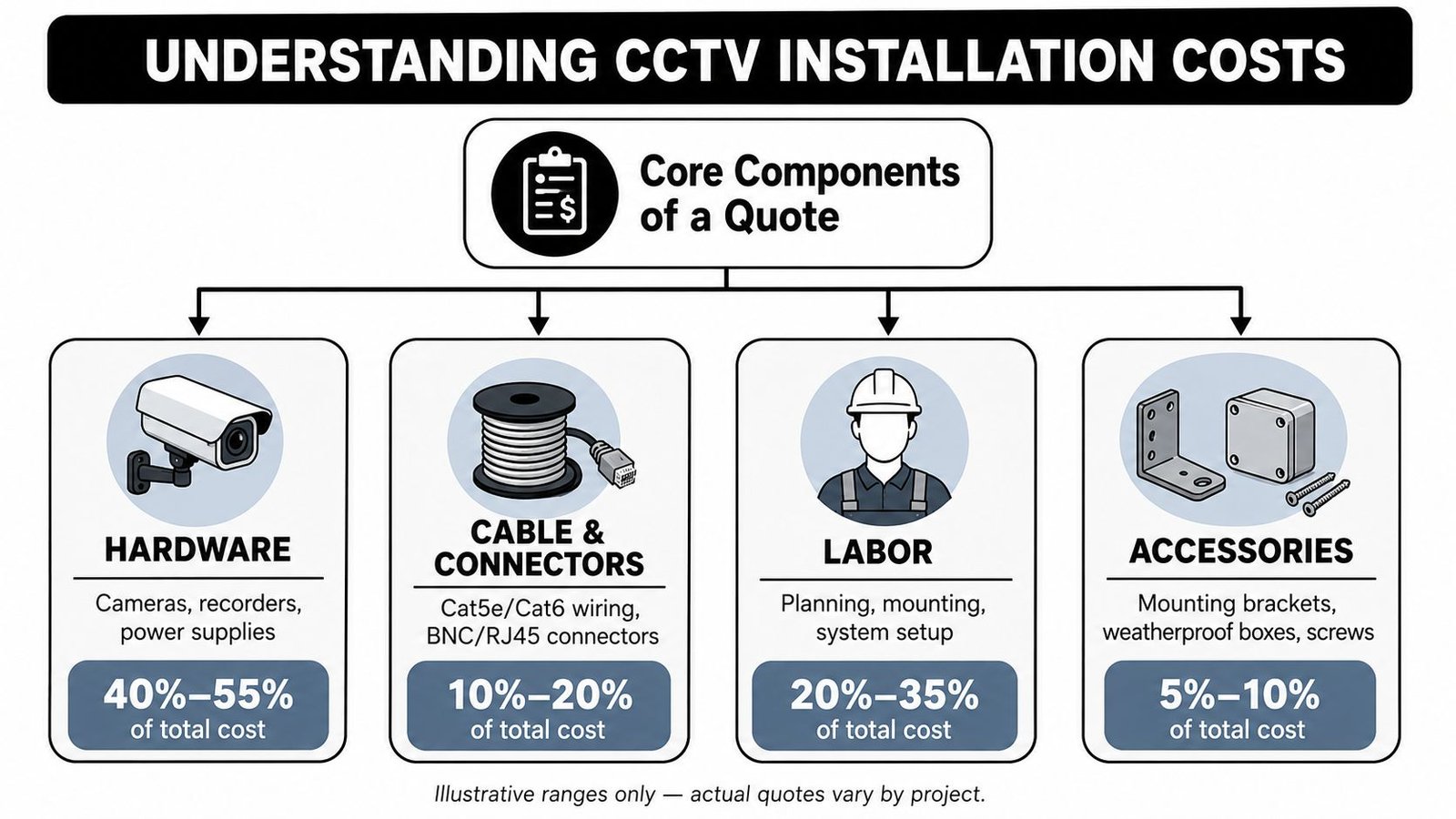
A CCTV quote in South Wales usually makes more sense once it is split into parts. The total is not just “camera cost plus fitting”. It is equipment, labour, access gear, testing, setup time, and the small materials that determine whether the system stays reliable through Welsh weather and day-to-day use.
The hardware line covers more than cameras
Clients often scan a quote for the camera model and jump straight to that figure. The bigger cost picture usually sits in the supporting parts. A usable system needs a recorder or NVR, hard drives sized for the retention period, power or PoE switching, junction boxes, brackets, weather protection, fixings, and often better cable than the cheapest option.
The practical trade-off is simple. Better cameras usually need stronger support around them. Higher resolution and better low-light performance can mean more storage, more bandwidth, and more careful positioning if the goal is footage that effectively helps after an incident.
For a general benchmark on how installers split equipment and labour, Checkatrade's CCTV installation cost guide gives a useful UK-facing reference point, even though any real quote still depends on the site and specification.
If you want a useful comparison point outside the UK, looking at how other markets bundle equipment and labour can help you understand quoting logic. This example of CCTV packages with installation in the Philippines is useful for seeing how installers group cameras, storage, and setup into packaged options, even though local standards, VAT treatment, and compliance expectations differ from the UK.
A straightforward way to read the hardware side of a quote is this:
| Component | What it does | Why it affects cost |
|---|---|---|
| Cameras | Capture footage and define coverage | Better image quality, low-light performance, and analytics increase unit cost |
| Recorder | Manages recording and playback | More channels, better processing, and remote access features raise the price |
| Hard drives | Store footage for the required retention period | Longer retention needs more capacity and surveillance-rated drives |
| Cabling and fixings | Connect and protect the system | Long runs, outdoor-grade materials, and tidy containment add time and materials |
A short explainer helps if you want to see physical installation issues in action:
Labour includes survey work, setup, and responsibility
Labour is usually the part people underestimate.
A proper install involves more than mounting cameras and pulling cable. Time goes into checking sight lines, avoiding glare, choosing realistic mounting heights, routing cable cleanly, sealing external entries, configuring recording quality, setting remote access securely, and testing whether exported footage is usable.
On many South Wales and South West jobs, labour also reflects the parts of the work that never show up in a product photo. Loft runs, thick stone walls, awkward external routes, access towers, listed building constraints, and safe isolation around existing electrics all add time. So does the admin tied to a professional handover, especially where GDPR, signage, user permissions, or evidential footage handling need to be thought through properly.
Good installation work gives you footage you can retrieve quickly, a system that stays online, and fewer faults after the engineer leaves.
That is what clients are paying for. The hours on site matter, but so does the judgement behind the design, setup, and final testing.
Key Factors That Drive Your Final Installation Cost
Two properties can both ask for four cameras and end up with very different quotes.
A detached new-build on an estate outside Cardiff is usually quicker and cleaner to wire than a stone-fronted terrace in Swansea, a shop on a busy high street in Newport, or a mixed-use unit in Bristol with awkward access and shared areas. That is why online price calculators often miss the mark. They count cameras, but they do not price the actual work on site, the compliance checks, or the setup standards expected on a professional UK installation.
Hardware choice affects more than the camera price
Clients often start by asking for sharper images, better night footage, or wider coverage. Fair enough. Those are sensible goals. The cost changes because the rest of the system has to support them.
A higher-spec IP camera usually needs better cabling, more storage, more careful positioning, and longer setup time. If the brief moves from general monitoring to evidential footage, the job usually shifts from a basic layout to a more deliberate design. Lens choice, lighting conditions, recorder capacity, and network performance all matter more at that point.
A few examples make the trade-offs clearer:
- Fixed dome cameras suit entrances, internal circulation areas, and lower-risk external positions where you want a tidy finish.
- Bullet cameras are often used where visible deterrence matters and longer viewing angles are needed.
- PTZ cameras can reduce camera count on larger yards or car parks, but they increase system complexity and are rarely the cheapest answer.
- Higher-resolution cameras help where you need to identify faces, vehicles, or cash-handling activity, not just see that an incident happened.
Camera placement also affects cost more than many buyers expect. Bad placement wastes money. Good placement can reduce the number of cameras you need and improve the footage you get. This guide on where to put surveillance cameras is a useful starting point if you want to understand why two similar systems can be priced differently.
The building often sets the labour cost
Labour rises when access is poor, cable routes are long, or the finish has to be especially neat.
In South Wales, older housing stock and converted commercial buildings often create the biggest surprises. Thick walls slow drilling. Loft spaces can be tight or blocked with insulation. External runs may need conduit or catenary wire. Some sites need towers, lifts, out-of-hours access, or extra care around tenants and staff. None of that is obvious from a floorplan or a quick phone estimate.
The compliance side adds time too. A proper installer is not only fixing cameras to walls. They are checking power arrangements, securing remote access, documenting the system, labelling where needed, and making sure the finished job is fit for purpose. On business sites, GDPR duties, user permissions, retention settings, and signage can all affect the scope. In the UK, that professional overhead is part of the actual cost, along with VAT, which many US-based guides leave out entirely.
If you want to see what a professionally specified system can include beyond the basic kit, our guide to CCTV and security systems for homes and businesses shows the sort of choices that change a quote in practice.
Storage, retention, and integration raise the system spec
Recording video is the starting point. The final price usually moves when the system has to do more than that.
Longer retention means larger drives or better compression planning. Multiple users viewing remotely means more attention to network stability and permissions. Linking CCTV to access control, intruder alarms, gates, or fire-related cause-and-effect functions increases setup and testing time. On commercial jobs, those integrations also need to be documented properly so the client knows what triggers what, and who can retrieve footage when something goes wrong.
That is why a lower quote is not always better value. If storage is undersized, remote access is left on weak default settings, or the handover is rushed, the system may still record video but fail at the point you need it.
Sample CCTV Installation Costs in South Wales and the South West
Local pricing becomes clearer when you tie it to recognisable property types. That's more useful than abstract averages because individuals seek to understand costs relevant to their own building.
Local examples that reflect real buying decisions
The table below uses the verified regional figures available for South Wales and the South West, along with the known local gap figure for residential starting ranges.
| Property Type | Typical System | Estimated Cost Range |
|---|---|---|
| 3-bedroom home in Cardiff | Professionally installed 4-camera system | £1,200 to £2,500 |
| Small retail shop in Bristol | 4 to 16 camera business system with professional installation | £2,500 to £8,000 |
| SME office or mixed-use unit in Newport or Swansea | 4 to 16 camera business system with compliant installation | £2,500 to £8,000 |
| Large warehouse or logistics site in Swansea or Newport | 20 to 60 camera enterprise installation | £20,000 to £60,000 |
The local benchmark for small to medium-sized businesses in South Wales and South West areas such as Cardiff and Bristol is £2,500 to £8,000 for 4 to 16 cameras including professional installation, while large warehouse installations in logistics hubs like Swansea or Newport can range from £20,000 to £60,000, driven by advanced PTZ cameras, fibre backbone requirements, and fire alarm integration under BS 5839-1, based on the regional data discussed in this commercial CCTV systems overview.
A home quote at the lower end usually suits straightforward coverage. Think front drive, rear garden, side access, and main entry points. Once the property needs more difficult cable routes, stronger night coverage, detached buildings, or cleaner hidden installation, the figure tends to move up.
A Bristol city-centre shop sits differently. There may be stock areas, customer-facing zones, rear delivery access, and restricted times for installation. The system itself may still be modest, but labour and setup complexity often rise because the environment is busier and less forgiving.
Most sensible buyers don't need the biggest system. They need the right coverage in the right places, with footage they can actually use.
For a warehouse or industrial unit, the budget rises for reasons that are easy to justify once you've seen the site. Height, distance, lighting variation, data transmission, and integration all become serious engineering questions rather than simple fitting work.
Beyond the Upfront Price The Total Cost of Ownership
The purchase price is only part of the financial picture. If you want a realistic view of cctv installation cost, you need to look at what the system costs to keep reliable over time.
What keeps costing after installation day
The two biggest ongoing items are usually maintenance and monitoring. The verified UK budgeting figures are clear on this point. A professional maintenance contract can be 8% to 15% of system cost annually, which works out at £400 to £750 per year on a £5,000 system, and professional monitoring can add £240 to £600+ per year, as explained in this guide to what CCTV maintenance involves.
That isn't wasted spend. Maintenance covers the boring but important work that keeps systems dependable. Cameras get dirty. Firmware needs updating. Time settings drift. Recorders fail unnoticed. Connectors loosen. Remote apps stop behaving after router changes. The system may still look fine on the wall while missing the exact footage you thought it had.
Here's what ongoing cost often includes:
- Maintenance visits: Cleaning, testing, recorder checks, and software or firmware housekeeping
- Monitoring services: If the system is professionally monitored rather than viewed by staff or the owner
- Storage subscriptions: Relevant when cloud options are part of the setup
- Future additions: Extra cameras, changed layouts, or altered business risk
Why cheap quotes can cost more later
A low upfront quote can look attractive because it strips out anything not needed on day one. That often means weaker storage planning, no maintenance allowance, little thought given to future expansion, and no support once the installer leaves.
A cheap install can become an expensive nuisance if the recorder is undersized, the app is unreliable, or nobody owns the aftercare.
Buyers make better decisions by thinking in terms of service life, not just installation day. A system that's easier to maintain, easier to expand, and less likely to fail at a critical moment often represents better value, even if the quote isn't the lowest on the page.
For businesses especially, TCO is the more honest way to compare options. It forces you to ask what support exists after handover, how faults are handled, and whether the quote is built for stable use rather than just a quick sale.
UK Legal Compliance You Cannot Ignore
A CCTV system doesn't only need to record properly. It also needs to be used responsibly. This is the part many DIY-focused guides skip, and it's one reason a professional installation often costs more than a simple consumer setup.
Where owners get caught out
In the UK, CCTV use can trigger responsibilities under data protection law, especially when cameras capture areas beyond your private boundary or record staff, visitors, customers, or members of the public. The legal issue isn't “Can I own a camera?” It's whether the system is positioned, configured, and managed properly.
Common trouble spots include:
- Cameras aimed too wide: Neighbouring gardens, public pavements, or shared access can create complaints fast.
- No clear purpose: If you can't explain why a camera is there, it's harder to justify the coverage.
- Poor access control: Too many people can view or export footage.
- Weak retention discipline: Footage gets kept without a clear policy or deleted inconsistently.
- No signage: People aren't informed that recording is taking place.
If you want a practical business-focused explanation, this guide on CCTV and GDPR in the UK covers the ownership side clearly.
Why professional setup matters legally
A decent installer helps by narrowing the camera view to the necessary area, setting secure user access, sizing storage sensibly, and discussing how footage is reviewed and retained. That doesn't remove the owner's responsibilities, but it reduces the chance of starting with a badly configured system.
The legal side also affects cost indirectly. If a job needs more careful positioning, privacy-aware setup, or a more considered storage design, it takes more time. That time is part of a proper quote, not an unnecessary extra.
Your Checklist for an Accurate Professional Quote
If you want a useful quote rather than a vague estimate, give the installer the right information from the start. That saves time on both sides and makes the pricing much more realistic.
What to prepare before you ask for prices
You don't need technical language. You do need clarity on your priorities.
Start with these points:
- What are you trying to achieve: Deterrence, evidence, staff safety, delivery monitoring, car park oversight, or general peace of mind
- Which areas matter most: Front door, driveway, rear access, stock room, warehouse aisles, loading bay, reception, shared corridors
- What happens at night: If the main risk is out of hours, say so early
- How your building is laid out: Detached garage, outbuilding, multiple floors, shuttered frontage, yard, or awkward access routes
- Who needs access to footage: Just you, a manager, several users, or a monitoring provider
For connected systems, privacy planning matters as well. If your setup will include mobile access, cloud elements, or linked devices, it's worth understanding broader data issues around connected hardware. This article on managing global IoT SIM card privacy is a helpful reminder that remote convenience always needs proper data discipline behind it.
Questions worth asking the installer
Good questions usually reveal more than chasing the lowest number.
Ask things like:
- What camera positions are you recommending, and why?
- How will cabling be routed and protected?
- What footage quality should I realistically expect at night?
- How is footage stored and who can access it?
- What support happens after installation if something stops recording properly?
A serious installer should be able to answer those without hiding behind jargon. If they can't explain the design clearly, that's usually a warning sign.
The best quotes feel boring in the right way. They're clear, itemised, and honest about what's included, what isn't, and what site conditions could change the price.
If you want a straightforward, locally informed quote for your property in South Wales or the South West, Wisenet Security Ltd can assess the site, explain the trade-offs clearly, and price the job based on what you need rather than a generic package.