Alarm System Maintenance: UK Home & Business Guide
Your alarm usually gets attention only when it's making a noise you didn't ask for. A keypad starts beeping at bedtime. A shop alarm throws a fault on a wet Monday morning. A warehouse system looks fine for months, then loses communication when you need it. That's how alarm system maintenance tends to enter the conversation in Cardiff, Newport, Bristol and across the wider South Wales and South West patch. Too late.
The problem isn't usually dramatic failure. It's drift. Batteries weaken, sensor covers get dusty, door contacts move out of line, app settings change, communicators lose proper confirmation, and nobody notices because the panel still lights up. A reliable alarm is rarely the one that was fitted and forgotten. It's the one that gets checked properly, logged properly, and serviced before faults turn into outages.
Table of Contents
- Why Bother With Alarm Maintenance? The Real Risks of 'Set and Forget'
- Your Essential Monthly DIY Alarm System Checks
- The Professional Servicing Schedule and Its Value
- Troubleshooting Common Alarm Faults Yourself
- UK Compliance, Insurance, and Warranty Explained
- When to Call a Wisenet Engineer in South Wales and the South West
Why Bother With Alarm Maintenance? The Real Risks of 'Set and Forget'
A lot of people treat an alarm like a boiler they hope will just carry on. It was installed, it armed fine, the app worked, job done. Then one night the external siren sounds for no clear reason, or the panel throws a fault that nobody in the house understands.
That “set and forget” approach is exactly what causes trouble. Research indicates that 20 percent of businesses only check their fire alarm systems once a year, which is not enough to ensure reliable performance, and when sensors or communication modules stop working properly, alarms may fail to activate during a break-in or fire, creating dangerous blind spots, as noted in this maintenance guidance for businesses. The same mindset shows up in homes as well, even if the paperwork is lighter.

In practice, neglected systems tend to fail in ordinary ways. A back door contact gets knocked slightly out of alignment. A PIR in a porch gets coated with dust and insects. A backup battery weakens while the mains is still on, so the panel looks healthy until there's a power cut. None of that is exotic. It's day-to-day wear.
The real cost isn't just a fault light
False alarms waste time and train people to ignore the system. Undetected faults are worse. If you own a home, that means false confidence. If you run a business, it can mean disrupted opening hours, staff inconvenience, and questions from insurers if the system hasn't been maintained properly.
Practical rule: If you can't say when the system was last tested, logged and serviced, you don't know whether it's reliable.
Maintenance also sits alongside wider property safety habits. If you're reviewing smoke alarms, escape routes and household risks at the same time, Survey Merchant's guide to home safety is a sensible companion read because it deals with the bigger picture around prevention inside the property.
For many people, the better question isn't “Do I need maintenance?” It's whether the alarm is worth relying on at all if nobody is checking it. If you're still deciding how much value a system adds in the first place, this look at whether an intruder alarm is worth having helps frame that decision properly.
What works and what doesn't
What works is boring and consistent. Monthly user checks. A written record. Proper servicing. Battery changes on schedule, not only when the panel starts complaining.
What doesn't work is hoping silence means health. A quiet system can still be a faulty one.
Your Essential Monthly DIY Alarm System Checks
Most alarm system maintenance starts with work the owner or site manager can do in a few minutes. You don't need engineer access for basic monthly checks. You do need a routine.
Routine monthly testing of alarm components such as control panels, motion detectors and sensors can reduce false signals and undetected faults by around 60 to 70 percent, and some UK installers report false alarms requiring engineer visits dropped by an average of 65 percent after a structured monthly test programme, according to UK alarm testing guidance. That's why the simple checks matter.
Start with a visual sweep
Walk the property before you touch the keypad. Don't overthink it. You're looking for change.
- Check detector faces: PIRs, door contacts, shock sensors and smoke detectors should be clean, fixed firmly and free from cobwebs, dust build-up or accidental paint.
- Look at doors and windows: If a contact has moved or a frame has swollen, the gap can drift enough to cause intermittent faults.
- Inspect external sounders: Cracked covers, water ingress marks or obvious damage need attention.
- Review the keypad or app: Fault lights, tampers, battery warnings and communication messages should never be ignored just because the system still arms.
A lot of faults in South Wales come from ordinary property conditions. Damp porches, coastal air, condensation in garages, and older timber doors all affect sensor reliability over time.
Use the system's test mode properly
Most modern panels have a test mode, walk test or user test option. If you've got a Pyronix, Hikvision AX PRO or similar system, the naming may vary, but the idea is the same. Put the system into test, then trigger devices one at a time.
Open the protected door. Walk past each PIR. Trigger the bell test if your user level allows it and if it's appropriate at the time of day. If the system is monitored, make sure signals are managed correctly before testing so you don't create an unnecessary response.
Don't just test whether a sensor activates. Check whether the panel identifies the correct zone or device. A response from the wrong zone points to a programming or labelling issue, not just a hardware one.
Confirm the bits people forget
A lot of owners test the siren and stop there. That misses some of the most important failure points.
Power supply status
Look for any mains fail or battery trouble indicators.Communication path If the alarm is monitored or app-connected, confirm the communicator is working and that a test signal is getting where it should.
User devices
Fobs, panic buttons and set/unset tags need checking too. They often get left out of the routine.Event log
If your panel shows a history log, scan it for repeated faults, tampers or missing devices.
If you manage several units, flats or HMOs, the easiest way to keep this organised is to tie the alarm check into other recurring property tasks. For landlords and managers already using room-by-room rental management checklists, it makes sense to build alarm testing into the same monthly inspection rhythm rather than treating it as a separate job that gets missed.
Keep a simple written record
You don't need a fancy system for a home setup. Date, time, who tested it, what was checked, what fault appeared, and whether it was resolved. For businesses, that record should be more disciplined because maintenance logs often matter later.
A short, consistent log beats a perfect one that never gets written.
The Professional Servicing Schedule and Its Value
Monthly user checks are useful, but they don't replace a proper service visit. There's a clear difference between pressing test mode and having an engineer check battery condition under load, inspect signalling paths, clean internal components, review programming, and verify that the system still matches the risk on site.
That's where alarm system maintenance stops being a quick household task and becomes part of long-term reliability. According to fire alarm maintenance research, UK facilities using preventive maintenance programmes see average annual cost reductions of 12 to 18 percent compared with reactive approaches, and predictive strategies can reduce system downtime by up to 60 percent. Those figures line up with what engineers see on the ground. Planned visits cost less grief than emergency call-outs.
What a proper engineer visit covers
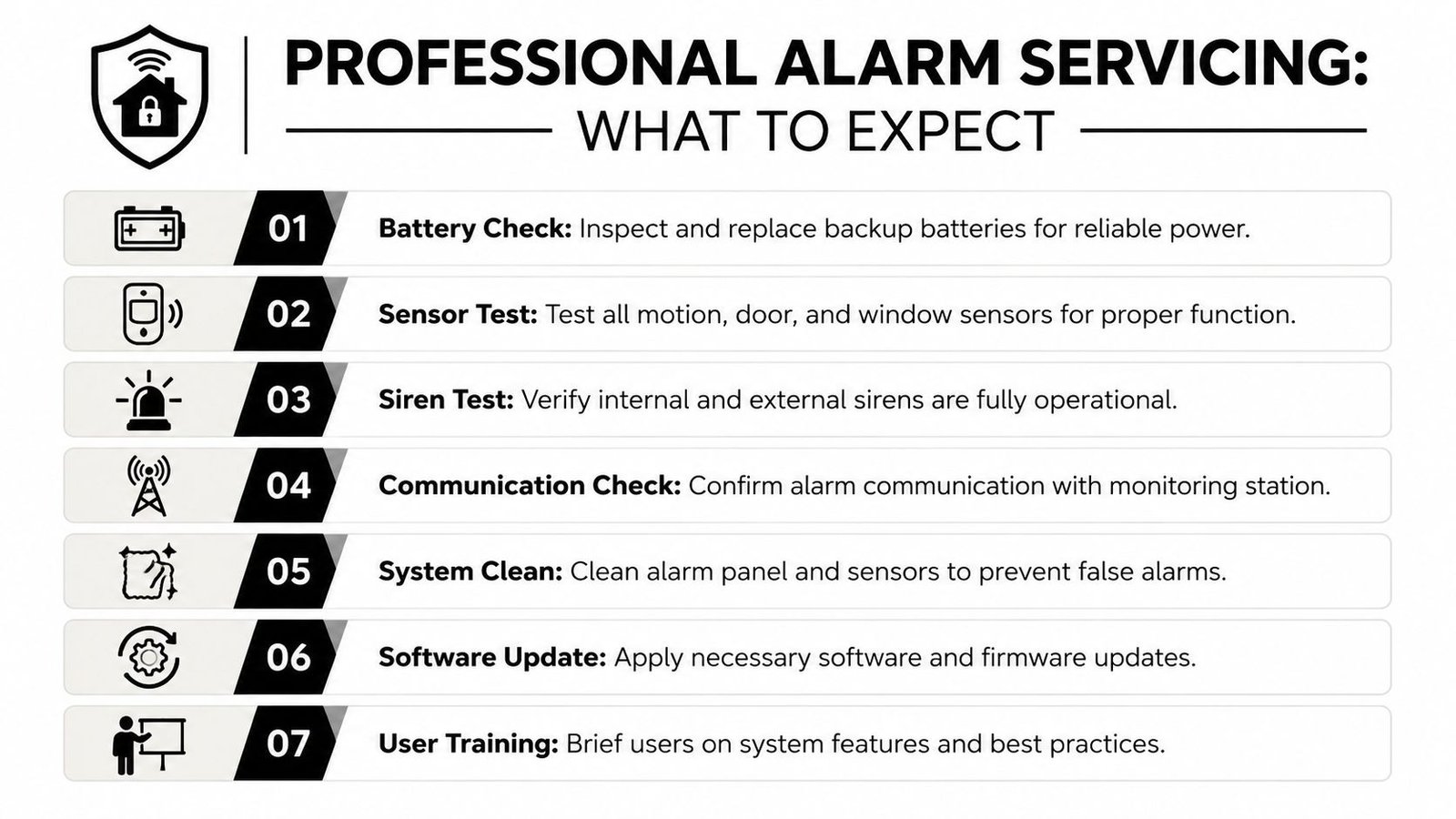
A real service isn't just “does it still make a noise?” It should cover the things users can't verify confidently.
- Battery condition under test: Not just voltage at rest. A weak backup battery can look acceptable until load is applied.
- Detector performance: Engineers check whether devices respond correctly, whether lenses need cleaning, and whether the device location still makes sense after layout changes.
- Signal path verification: If the system reports to an ARC or uses app-based communication, signalling needs checking end to end.
- Firmware and software review: Older panels and wireless peripherals can develop compatibility issues if updates are ignored.
- Physical condition: Loose tampers, worn cable entries, damaged enclosures and signs of moisture matter.
For busy households juggling multiple service tasks, it helps to think of alarm maintenance the same way you'd think about other essential equipment checks. This guide to equipment maintenance for busy families is a useful example of how small, planned servicing jobs prevent bigger failures later.
An alarm that hasn't had its communicator, battery and detector health checked professionally is only partially tested, even if the user runs monthly checks.
Recommended Alarm Maintenance Schedule
Below is a practical schedule used widely as a baseline. The exact frequency can vary with system type, monitoring arrangements, insurance requirements and site risk.
Recommended Alarm Maintenance Schedule
| Task | Frequency | Performed By |
|---|---|---|
| Visual check of keypad, detectors, contacts and sounders | Monthly | User or site manager |
| Walk test or user test of detectors and entry points | Monthly | User or site manager |
| Check app alerts, communicator status and fault log | Monthly | User or site manager |
| Clean accessible external surfaces of keypads and detector covers | Monthly | User or site manager |
| Full service visit including battery testing, signalling checks and detector inspection | At scheduled service interval required for the property | Qualified engineer |
| Firmware review and system configuration check | During professional service | Qualified engineer |
| Maintenance record update and compliance documentation | After each test or service | User and qualified engineer |
A domestic bell-only system may have lighter demands than a monitored commercial installation, but neither should be left indefinitely. For businesses, monitored premises, shared buildings and higher-risk sites, professional servicing isn't optional in any practical sense.
If you need a provider to handle that planned side of the work, Wisenet's maintenance service is one example of a structured option for homes and commercial properties in the region.
Troubleshooting Common Alarm Faults Yourself
Most nuisance faults have a simple starting point. Check the display. The panel is usually telling you more than the noise is.
UK alarm contractors report that battery-related failures account for roughly 40 to 50 percent of preventable system outages when maintenance is neglected, and some systems still appear normal on mains power even when the backup battery is degraded, leaving the premises exposed during a power cut, according to this burglar and intruder alarm maintenance guide. That's why batteries are the first place to look.
If the panel is beeping
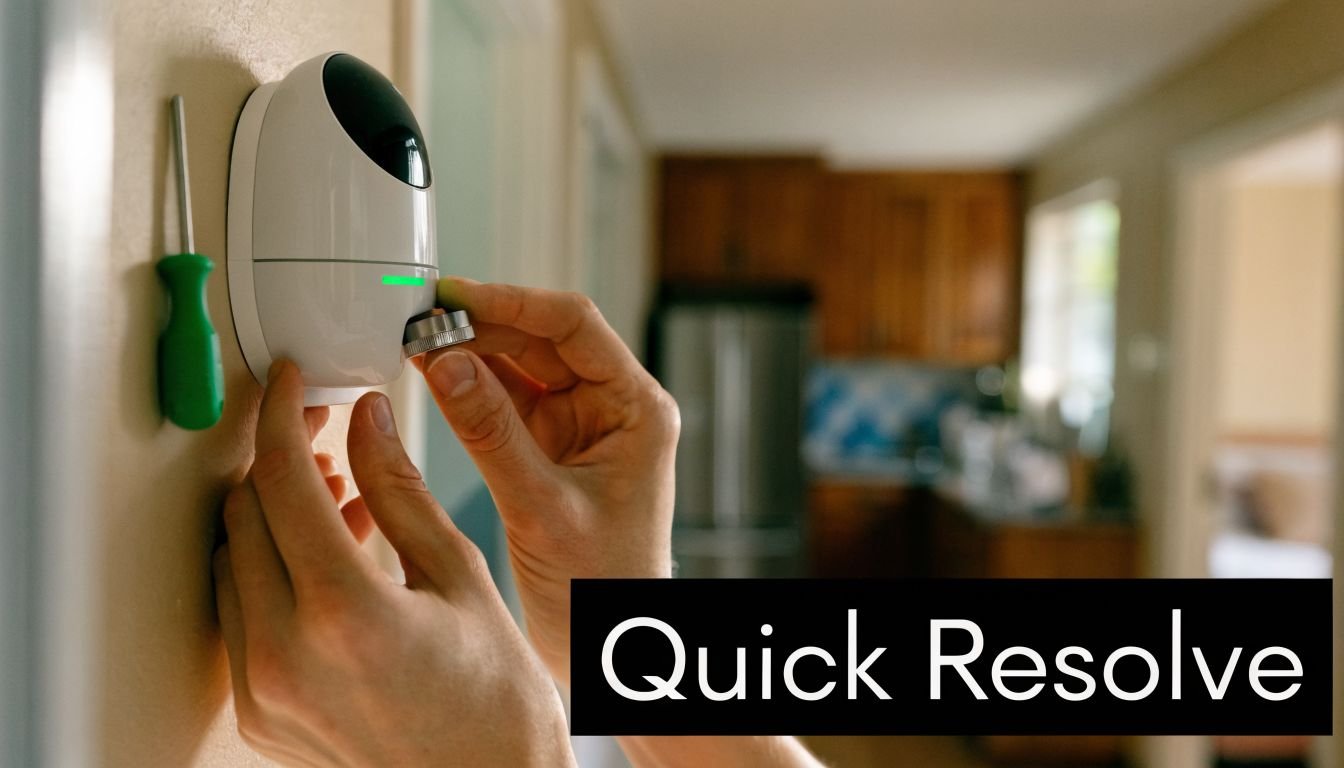
Start with the message on screen or in the app. “Low battery”, “tamper”, “mains fail” and “comms fault” all mean different things and need different responses.
- If it says low battery: Identify whether the warning relates to the main panel battery or a specific wireless sensor. A panel battery fault usually needs a service-safe replacement with the correct type. A wireless device battery may be a user-replaceable coin cell or specialist battery, depending on the model.
- If it says mains fail: Check the fused spur or local power supply first. If the circuit is live and the fault remains, stop there and call an engineer.
- If it says tamper: Look for a detector cover that's loose, a keypad not seated correctly, or a sounder lid that has shifted.
A lot of people silence the tone and leave the cause unresolved. That's the wrong order. Clear the fault first, then silence becomes meaningful.
If a sensor keeps triggering
Intermittent activations usually come from one of four things. Dirt, movement, environment, or failing power.
A PIR near a draughty entrance, a heater, direct sunlight or a loose bracket will behave badly. Door contacts cause trouble when the magnet and reed switch stop lining up cleanly. In shops and offices, stock changes and displays often end up blocking sensors or changing detection patterns without anyone realising.
If one zone keeps appearing in the log, focus on that device and its surroundings before assuming the whole system is unreliable.
Use the panel history if available. Repeated events from the same zone point you towards a device issue, not a site-wide problem.
Here's a simple refresher on practical alarm fault checking:
If the system shows a communication fault
Communication faults are common now that more systems rely on IP, dual-path or mobile signalling. First check the obvious. Is the broadband down? Has the router been replaced? Has anyone altered network equipment, power sockets or mobile signal equipment near the panel?
Then check what the system still does locally. If it arms and detects locally but cannot report remotely, that's a communications problem. If it won't arm, won't unset properly, or shows multiple missing devices, the issue may be broader.
Know when not to force it
Don't open the panel if you're not authorised and confident doing so. Don't keep resetting repeated tampers. Don't swap battery types because they “fit”. And don't ignore a backup battery warning just because the house or business still has mains power.
Small faults are worth checking. Persistent faults need proper diagnosis.
UK Compliance, Insurance, and Warranty Explained
A reliable alarm doesn't just protect the building. It protects your position if something goes wrong afterwards. That's where maintenance records start to matter far more than most owners expect.
In UK practice, alarm maintenance sits inside a wider chain. The system specification, the installation standard, the service history, the monitoring setup, and the insurance wording all interact. If one part is weak, the rest can become awkward very quickly after an incident.
Why maintenance logs matter
When an insurer asks whether an alarm was maintained in line with the policy terms, they usually don't mean “did someone glance at the keypad now and then?” They mean documented checks and servicing. If you're a landlord, retailer, office manager or warehouse operator, a missing maintenance trail can become a problem at exactly the wrong moment.
Good records should show:
- Dates of user checks
- Faults found and action taken
- Engineer service visits
- Battery changes and component replacements
- Any changes to monitored communication paths or user permissions
For domestic owners, this may help with warranty disputes or support calls. For businesses, it often supports insurance compliance and internal safety governance.
A maintenance log is evidence. Without it, you're relying on memory after a stressful event.
Where BS EN 50131 fits in
BS EN 50131 matters because it provides the framework many UK intruder alarm systems are designed and maintained around. For the owner, the practical takeaway is simple. If your system is supposed to meet that standard, it can't be treated casually.
That affects three things in everyday use. First, who is allowed to do what on the system. Second, how batteries, signalling and detector performance are managed. Third, whether the service history supports the claimed grade and configuration.
It also affects insurance conversations. A policy may refer to an alarm requirement, monitored response, or maintained system without spelling out every technical detail in the schedule. If the installed system has drifted away from its maintained condition, the paperwork and the actual setup stop matching.
Warranty and servicing are tied together
Manufacturers and installers don't usually want to own faults caused by neglect, contamination, impact damage, power issues or unauthorised interference. That's normal. If a sensor has never been cleaned, a panel battery has been left beyond its service life, or a communication path has been altered by third-party changes on site, you can expect awkward conversations.
For homes, the lesson is straightforward. Keep the paperwork. Log tests. Book servicing at sensible intervals.
For businesses, add one more discipline. Make one person responsible. Shared responsibility usually means no responsibility, especially in multi-user premises where several people arm and unset the system but nobody owns the maintenance file.
When to Call a Wisenet Engineer in South Wales and the South West
Some faults are worth a basic user check. Others need an engineer straight away. The trick is knowing the line.
Call a professional if the system has repeated communication faults, unexplained tampers, detector issues that keep returning after basic cleaning and retesting, or any panel battery problem inside the main enclosure. The same applies after a break-in, attempted entry, flood, electrical fault, decorating work near sensors, or a broadband and signalling change that affects reporting.

The point where DIY stops being sensible
If your alarm is older, has never had a proper service, or has grown in a piecemeal way over time, a full inspection is usually better than another round of guesswork. That's especially true in mixed-use buildings, retail units, warehouses and properties with app control, monitoring, access control links or multiple users.
There's also a regional reality to this. Properties across Cardiff, Newport, Swansea, Bristol and nearby areas often deal with a mix of coastal air, damp outbuildings, older housing stock, business-unit alterations, and telecoms changes. Those conditions don't always cause immediate failure, but they do create the kind of slow deterioration that only shows up when the alarm is tested properly.
If you need local support, Wisenet's service area across South Wales and the South West covers the region many owners need help in. The useful part of working with a local engineer is practical familiarity with the kind of properties and system mixes common in this area, not just generic alarm knowledge.
Use the simple rule. If the fault is clear, isolated and user-level, start there. If the fault affects power, signalling, compliance, repeated activations, or confidence in the system as a whole, book the engineer.
If your alarm hasn't been checked properly for a while, or you're dealing with repeat faults, battery issues, signalling problems or overdue servicing, Wisenet Security Ltd can arrange practical alarm system maintenance for homes and businesses across South Wales and the South West.